
Power
How to Build a Small DIY Solar Power Source: A Beginner's Guide to Off-Grid Energy Experiments

By Ephraim Rusk · · 10 min read
This article contains an affiliate link. If you buy through it, we may earn a commission at no extra cost to you.
Quick answer
A small DIY solar power source typically combines one or more photovoltaic panels, a charge controller, a battery bank, and an inverter — a basic setup can be assembled for a few hundred dollars and is enough to power lights, small appliances, or charge devices during an outage. Experimental form-factor concepts like 3D solar spheres exist but are not yet proven at consumer scale.
Building a small DIY solar power source is one of the most practical first steps toward off-grid energy independence — and it does not require a $20,000 rooftop installation to get started. A properly sized small system can keep your lights on, charge your devices, and run a refrigerator or sump pump through a grid outage, all from equipment you can order online and assemble in a weekend.
The gap between 'I want energy independence' and 'I have it' is almost always money and information, not physics. Standard photovoltaic technology is mature, well-documented, and scalable from a single 100-watt panel on up. What most beginners get wrong is sizing — they either overbuild and overspend, or undersize and wonder why their battery dies at 2 a.m.
This guide covers what a real small DIY solar setup requires, what the actual limitations are, and where experimental DIY concepts sit on the spectrum from proven to speculative — so you can make an informed decision before you spend a dollar.
What a Small DIY Solar Power Source Actually Consists Of
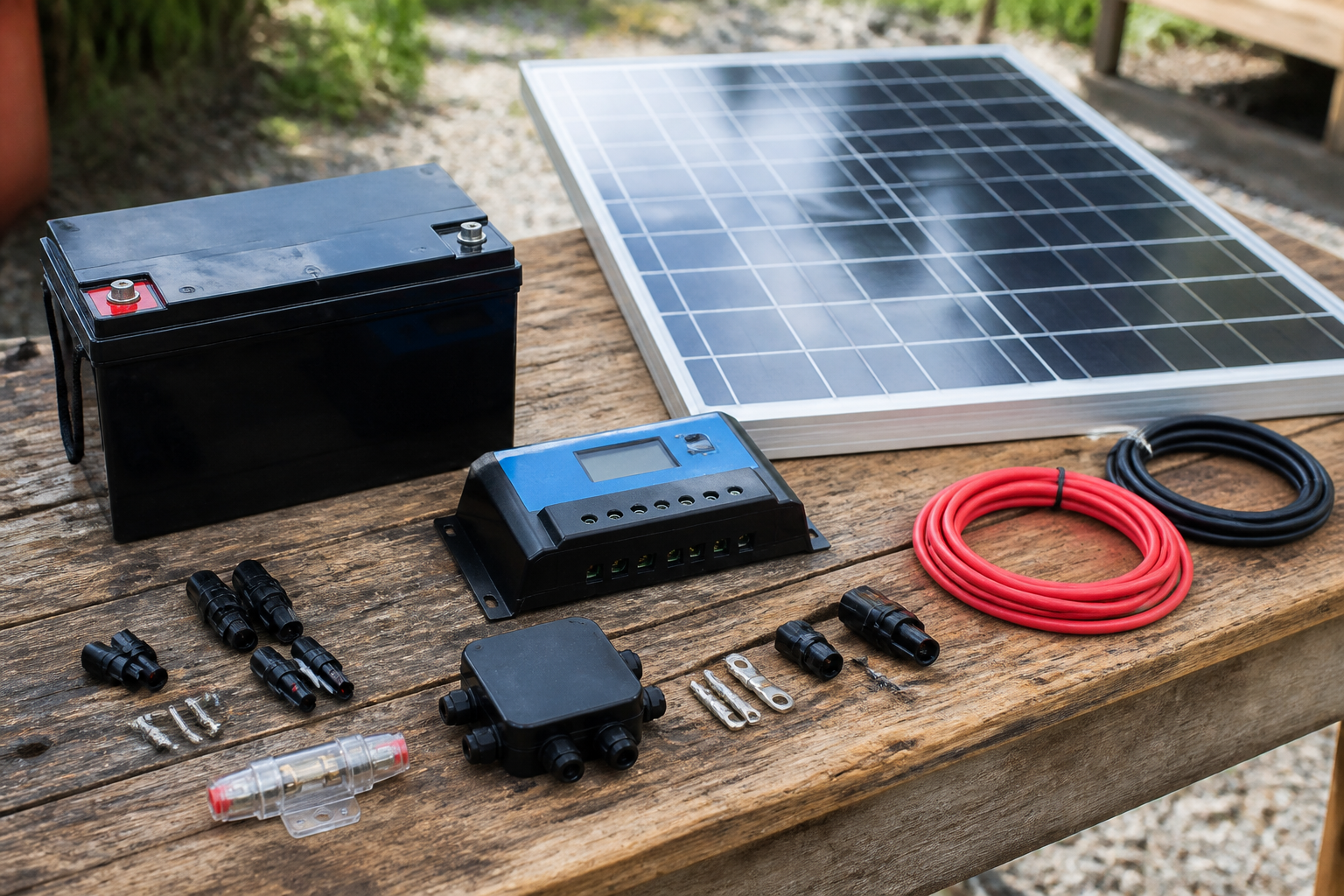
A functional small solar power system has four core components: a photovoltaic (PV) panel to capture sunlight, a charge controller to regulate current into the battery, a battery bank to store that energy, and an inverter to convert DC battery power into AC power your household devices can use.
The photovoltaic panel is the part most people picture — the flat, blue or black glass panel mounted in sunlight. Modern monocrystalline panels convert roughly 18–22% of incoming solar radiation into electricity under ideal conditions, according to the U.S. Department of Energy. A single 200-watt panel in a location averaging five peak sun hours per day will produce roughly 1 kilowatt-hour (kWh) of electricity daily under real-world conditions.
The charge controller sits between the panel and the battery. Its job is to prevent overcharging, which degrades batteries quickly. PWM (Pulse Width Modulation) controllers are cheaper and adequate for small systems; MPPT (Maximum Power Point Tracking) controllers are more efficient and worth the extra cost once you scale above 400 watts of panel capacity.
Battery choice determines how long your system can supply power after the sun goes down or during cloudy days. Lead-acid batteries (AGM or flooded) are the least expensive entry point. Lithium iron phosphate (LiFePO4) batteries cost more upfront but last significantly longer and tolerate deeper discharge cycles — a meaningful factor if you plan to use the system regularly rather than just for emergencies.
The inverter converts stored DC power to the 120V AC power your outlets and most appliances expect. For a small system, a pure sine wave inverter is worth the modest premium over a modified sine wave unit — it runs sensitive electronics, motors, and medical devices without compatibility issues.
How to Size a Small System Before You Buy Anything
Sizing your DIY solar system correctly before purchasing anything saves you from the most common beginner mistake: buying the wrong amount of panel and battery capacity for your actual load.
Start by listing the devices you need to power and their wattages. The label on the back of most appliances states watts directly, or you can calculate it by multiplying volts by amps. Then estimate how many hours per day each device runs. Multiply wattage by hours to get watt-hours (Wh) per day per device, and add them up. That total is your daily load.
As a practical example: a 60W LED equivalent lamp running 5 hours (300 Wh), a phone charger at 10W for 2 hours (20 Wh), and a 12V fan at 20W for 8 hours (160 Wh) gives you a daily load of 480 Wh. Add a 20% buffer for inefficiency losses in the inverter and wiring, and you are targeting roughly 580 Wh of daily generation.
To meet that load with one panel, divide your daily Wh target by your location's average peak sun hours. The National Renewable Energy Laboratory (NREL) publishes free solar resource maps showing peak sun hours by ZIP code — most of the continental U.S. falls between 3.5 and 6 hours. At 4.5 peak sun hours, you would need at least a 130-watt panel (580 ÷ 4.5 ≈ 129W). Round up to the next standard size — 150W or 200W — to account for real-world conditions.
For battery storage, a common rule of thumb is to store 1.5 to 2 days of your daily load to ride out overcast days. At 580 Wh daily, that means 870–1,160 Wh of usable battery capacity. If you use lead-acid batteries, only discharge them to 50% to preserve lifespan — so your installed capacity needs to be double your usable capacity, putting you around 1,740–2,320 Wh of installed lead-acid or roughly 870–1,160 Wh of LiFePO4.
Real Limitations Every DIY Solar Builder Should Understand
A small DIY solar system is genuinely useful, but it has hard limits that advertising rarely mentions — and understanding them upfront keeps frustration low and expectations calibrated.
Intermittency is the fundamental constraint. Solar panels produce power only when sunlight hits them. In the Pacific Northwest or New England in January, you may average fewer than 2.5 peak sun hours per day for weeks at a stretch. That is not a DIY problem — it is physics. Any honest solar setup needs either supplemental generation (a wind turbine, a generator, grid backup) or a battery bank large enough to bridge extended low-production periods.
Roof or ground mounting adds real cost and complexity that many beginner guides gloss over. A portable ground-mounted panel avoids permitting in most jurisdictions, but it also means someone has to angle it correctly every morning and store it safely during storms. Fixed mounting requires structural assessment and, depending on your municipality, a permit — even for small systems. Check your local building department before you commit to a fixed installation.
Grid-tied systems, which feed surplus power back to the utility, require a grid-tie inverter and utility approval in virtually every U.S. jurisdiction. Off-grid island systems — the kind most preppers are actually building — sidestep that approval process entirely but also receive no grid backup. Know which you are building.
Finally, component quality varies enormously at the low end of the market. Cheap panels are often rated under ideal lab conditions (STC) that your garage roof will never replicate. Cheap inverters frequently fail to deliver their rated wattage under load. Buying from reputable manufacturers and reading independent test reviews — not just Amazon star ratings — matters more at the small-system level than at the utility scale, because there is no redundancy to absorb a single component failure.
- Intermittency: no sun means no production — plan for cloudy-day storage or backup
- Permit requirements vary by jurisdiction even for small systems
- Component quality at the low end is inconsistent — vet manufacturers carefully
- Lead-acid batteries require 50% depth-of-discharge discipline to avoid early failure
- Grid-tied systems need utility approval; off-grid systems do not but have no grid backup
Where Experimental DIY Solar Concepts Fit In
Beyond conventional flat-panel setups, there is a category of experimental and alternative solar form-factors that surfaces regularly in prepper and homesteader communities — and it is worth addressing honestly rather than dismissing or overselling.
The most discussed alternative geometry is the 3D or spherical solar concentrator. The concept is straightforward in theory: a spherical or faceted three-dimensional collector can capture sunlight across a wider arc throughout the day, potentially reducing the efficiency losses that come from a fixed-angle flat panel as the sun moves. Research into 3D photovoltaic geometries is real — academic papers have explored the approach, particularly for urban or constrained-space contexts where tracking systems are impractical.
What is not established — and this distinction matters — is whether these geometries deliver meaningfully better real-world output than a properly angled flat panel at the small consumer scale. Industry-standard flat monocrystalline panels paired with a simple seasonal angle adjustment already capture a high fraction of available daily insolation. The practical performance gap between a well-aimed flat panel and an experimental 3D configuration, in a backyard or on a shed roof, has not been validated in peer-reviewed consumer testing.
That said, the DIY exploration space has genuine value for preppers who want to understand energy from first principles rather than just buying a plug-and-play kit. Building something small and experimental — even if its output is modest — teaches you about solar geometry, electrical basics, and system integration in ways that simply purchasing a pre-made solar generator does not. The key is to hold the right expectations: an experimental DIY concept is a learning project and potentially a supplemental micro-source, not a replacement for a sized, proven system.
Our Recommendation: Solar Innovator
The core problem this article addresses is real: most households have no backup power source at all, and the barrier to entry for a conventional solar install — cost, permitting, roof assessment, installer wait times — keeps most people stuck at zero. Even a modest DIY system takes research, component sourcing, and enough electrical confidence to wire a charge controller correctly.
The gap in common DIY approaches is the learning curve. You can find free information about flat-panel solar systems across dozens of websites, but most of it assumes you already know how to size a system, interpret a spec sheet, or safely work with DC wiring. For someone who wants to understand energy generation from scratch before committing hundreds or thousands of dollars to conventional components, that scattered free information is a frustrating place to start.
Solar Innovator is a $39 digital guide that teaches you how to build a small 3D solar-sphere-style device from a DIY standpoint. The publisher categorizes it as an experimental technology concept — the sales page itself notes that the approach is unverified — so approach it as an unconventional DIY learning project rather than a proven power system. If you are the type of person who wants to understand solar energy from first principles, experiment with an alternative form-factor on a low budget, and develop hands-on skills before scaling up to a full conventional system, it represents a low-cost entry point into that exploration. No guarantee information was provided. If that kind of exploratory DIY project interests you, it is worth a look. For the next step, read How to Generate Electricity at Home Without Solar Panels: 5 Real Alternatives Worth Knowing.
Our recommendation
Solar Innovator
Check availability →This article contains an affiliate link. If you buy through it, we may earn a commission at no extra cost to you.
Frequently asked questions
How much does it cost to build a small DIY solar power system?
A basic functional system — one 200-watt panel, a PWM charge controller, a 100Ah AGM battery, and a 400W pure sine wave inverter — can be assembled for roughly $300–$500 in parts, depending on component quality and where you source them. Lithium batteries push that figure higher but last significantly longer.
Do you need a permit to install a small solar system at home?
It depends on your jurisdiction and how the system is installed. Portable, ground-mounted off-grid systems generally do not require a permit in most U.S. localities. Roof-mounted or permanently fixed systems typically do. Grid-tied systems always require utility approval. Check with your local building department before any fixed installation.
Can a small solar setup power a whole house during an outage?
A small DIY system — one to four panels and a modest battery bank — will not power an average American home in full. It can realistically run lights, charge devices, power a small refrigerator, and run a fan or similar loads. Whole-home backup requires a much larger system, typically 5–15 kW of panels and substantial battery storage.
What is a 3D solar sphere and does it produce more power than a flat panel?
A 3D or spherical solar concentrator is an alternative collector geometry designed to capture sunlight across a wider arc throughout the day without mechanical tracking. The concept has been explored in academic research. Whether it delivers meaningfully better real-world output than a properly angled flat panel at small consumer scale has not been established in peer-reviewed consumer testing — it remains an experimental approach.
What is the best battery type for a small off-grid solar system?
Lithium iron phosphate (LiFePO4) batteries are the best choice for most off-grid DIY solar systems if budget allows — they tolerate deeper discharge, last 2,000–4,000 cycles, and require no maintenance. AGM lead-acid batteries are a viable lower-cost alternative but must be kept above 50% state of charge to achieve their rated lifespan.
Related guides
Sources
- U.S. Department of Energy — Homeowner's Guide to Going Solar
- National Renewable Energy Laboratory — PVWatts Calculator (Solar Resource Data)
- U.S. Department of Energy — Solar Energy Technologies Office: Photovoltaics
General preparedness information, not medical or legal advice. Follow instructions from your local emergency authority during an active event.
Field notes by email
Get the next guide before you need it
One email when a new field guide drops — water, food, power, medicine. No spam, no daily noise, unsubscribe in one click.
Comments on this guide
Questions, corrections and field reports from your own setup are welcome.
No comments yet. Be the first to add a field report.