
Power
How to Lower Your Electric Bill with DIY Off-Grid Energy Methods (Without a Full Solar Install)

By Ephraim Rusk · · 10 min read
This article contains an affiliate link. If you buy through it, we may earn a commission at no extra cost to you.
Quick answer
You can meaningfully lower your electric bill through targeted DIY off-grid methods — load reduction, battery-backed micro-systems, and passive energy strategies — without committing to a full solar install. Each step reduces grid dependence incrementally and costs far less than a contractor-installed system.
If you're searching for how to lower your electric bill with DIY off-grid energy methods, you already know the two options most people get handed: pay the utility company whatever they ask, or spend $15,000–$30,000 on a full rooftop solar install. Neither one feels like a real choice for most households trying to build genuine energy resilience on a working budget.
The good news is that those aren't actually your only two options. Between 'do nothing' and 'go full solar,' there's a substantial middle ground — practical, lower-cost DIY approaches that real homesteaders and preppers use to chip away at grid dependence month by month. Some are dead simple. Some require an afternoon of work. A few involve concepts that fall outside the mainstream but are worth understanding before you dismiss them.
This article walks through what actually works, what the realistic savings look like, and where the limits of each approach are — including one digital guide at the end that covers a less conventional energy concept, with the caveats that come with it stated plainly.
Start With Load Reduction: The Fastest Dollar-for-Dollar Return
The cheapest watt is the one you never use — load reduction consistently delivers the fastest return of any DIY energy strategy. Before you spend a dollar on generation equipment, understanding exactly where your power goes gives you a roadmap for cutting the bill with zero hardware investment.
The U.S. Energy Information Administration reports that the average American household uses about 10,500 kWh per year, with heating, cooling, and water heating typically accounting for more than half of that. Appliances and lighting make up most of the rest. That breakdown tells you where the leverage is.
Smart power strips eliminate phantom load — the electricity that devices draw while 'off' or in standby. The Lawrence Berkeley National Laboratory has estimated that standby power accounts for roughly 5–10% of residential electricity use in U.S. homes. Plugging your entertainment center, home office equipment, and kitchen appliances into switched strips and cutting them fully off when not in use costs about $20–$40 and starts saving immediately.
LED lighting upgrades, if you haven't made them yet, remain one of the highest-ROI changes available. A standard LED bulb uses about 75% less energy than an incandescent and lasts 15–25 times longer, according to the U.S. Department of Energy. For a household still running incandescents, a full swap can reduce lighting load by hundreds of kilowatt-hours per year.
Water heater management is frequently overlooked. Setting your electric water heater to 120°F instead of the factory default of 140°F cuts energy use without compromising safety (the CDC recommends 120°F as a Legionella-prevention balance point). Adding a water heater timer so the element only runs during off-peak hours can reduce that load further, particularly in areas with time-of-use utility pricing.
Build a Micro-System: Battery Banks and DC Appliances
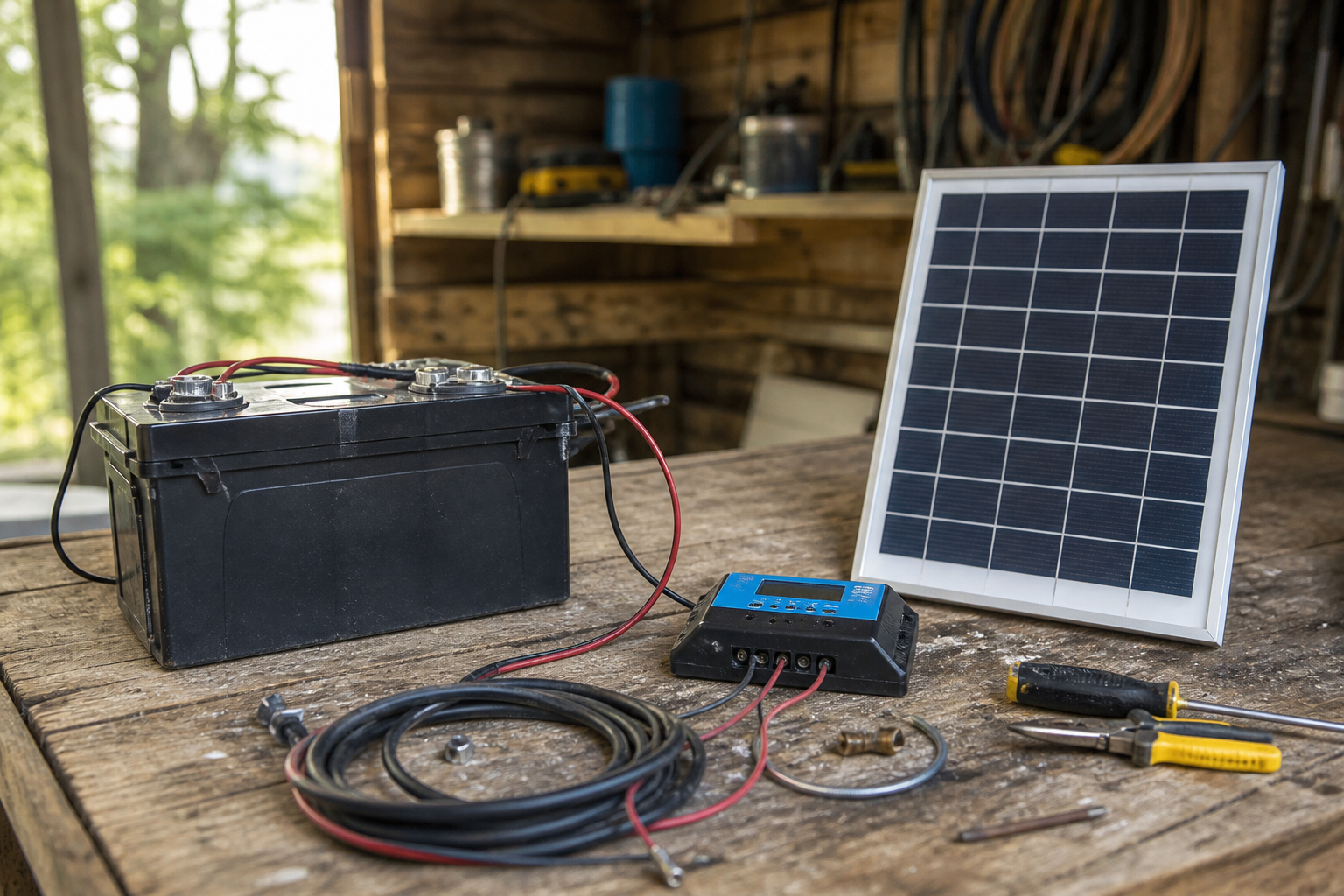
A small, self-contained battery system running select DC appliances can take a meaningful slice of daily consumption entirely off the grid without requiring a licensed electrician or a permit. This is the approach most serious off-grid homesteaders start with before scaling up.
The core of a micro-system is a battery bank — typically lithium iron phosphate (LiFePO4) for its cycle life and safety profile — charged by one or more small solar panels. A 200-watt panel paired with a 100Ah LiFePO4 battery and a basic charge controller runs between $300 and $600 depending on sourcing, and can reliably power LED lighting, phone and device charging, a small fan, and a low-draw radio entirely independent of the grid.
The key discipline here is matching your loads to what the system can actually deliver. A 100Ah battery at 12V holds 1,200 watt-hours of theoretical capacity; with a 50% depth-of-discharge limit (which preserves battery life), you have about 600 watt-hours to work with per charge cycle. That's real, useful power — but it won't run a full-size refrigerator or an electric range. Know your loads before you size your system.
For preppers specifically, the dual-use case is strong: a micro-system that lowers your bill during normal operations becomes your backup power source the moment the grid goes down. That's a preparedness investment that pays monthly dividends rather than sitting idle until disaster strikes.
If you want to go deeper on this approach without the full solar install commitment, the related post linked below on reducing home electricity dependence covers the step-by-step build in more detail.
Passive and Behavioral Strategies That Compound Over Time
Passive energy strategies — changes to how your home manages heat, airflow, and thermal mass — reduce consumption without any ongoing effort once implemented, and they compound with everything else you're doing.
Air sealing is unglamorous but highly effective. The U.S. Department of Energy estimates that air leaks account for 25–40% of heating and cooling energy loss in a typical home. Weatherstripping doors, caulking window frames, and sealing penetrations around pipes and wiring with foam can cost less than $100 in materials and reduce HVAC demand significantly — which matters because your HVAC system is almost certainly your largest single energy load.
Attic insulation is the next tier up. If your attic insulation is below the DOE-recommended R-value for your climate zone (R-38 to R-60 in most of the continental U.S.), adding blown-in insulation is one of the highest-ROI improvements available. This is a DIY-able project for most homeowners willing to rent a blower for a day.
Behavioral patterns — running the dishwasher and laundry after 9 p.m. if you have time-of-use pricing, grilling outside instead of using the oven in summer, line-drying clothes — each sound minor but can collectively move your bill by 10–15% without any hardware. The discipline of treating electricity as a resource to be managed rather than an unlimited utility is itself a preparedness mindset shift worth developing.
Alternative Energy Generation Concepts: What's Out There Beyond Solar and Wind
Beyond conventional solar and small wind setups, there is a broader landscape of alternative energy generation concepts — some well-established at small scale, some experimental, some more controversial — that motivated DIYers investigate when they want to think outside the standard options.
Micro-hydroelectric systems are legitimate and well-documented where moving water is available on a property. Even a modest stream with a few feet of head (vertical drop) can power a small pelton wheel generator continuously — unlike solar, which is intermittent. If you have the water resource, this is worth serious research; the efficiency and consistency advantages over solar are real.
Thermoelectric generators (TEGs) convert a temperature differential directly into electricity using the Seebeck effect. Small TEG modules are commercially available and have genuine niche applications — generating a few watts from a wood stove's heat, for instance, to run low-draw sensors or charge a phone. The power output is modest, but the concept is solid physics and the DIY community has documented many practical builds.
There are also concepts circulating in the DIY energy space that make claims beyond what current established science supports — systems described as producing more output than input, or leveraging magnetic or resonance effects in ways that haven't been independently verified in peer-reviewed literature. I'm not going to pretend these don't exist, because a lot of readers come across them and want to know what to make of them. My honest position: approach any concept that conflicts with established thermodynamic principles with serious skepticism, do your own research, and never invest more than you're genuinely prepared to lose on an unverified approach.
What's worth doing is staying curious and informed about the full range of options — including the ones that sit outside the mainstream — while keeping your critical thinking engaged. The DIY energy community contains some genuinely innovative people and also some who overstate what their systems deliver.
Our Recommendation: Energy Revolution System
Here's the core problem this article has been circling: electricity costs keep rising, full solar installs remain out of reach for most households, and the conventional DIY advice — LED bulbs, smart strips, better insulation — is real and worth doing, but it only goes so far. If you're looking to reduce your bill and your grid dependence more aggressively, you eventually want to explore generation options beyond the standard playbook.
The gap in the free DIY research path is time and coherence. Assembling a working picture of alternative home energy generation concepts from scattered forums, YouTube channels, and blog posts takes dozens of hours, and there's no quality filter — genuinely useful information sits alongside pseudoscience with no easy way to tell them apart unless you already have a technical background.
The Energy Revolution System is a digital guide — currently priced at $39, down from the regular $149 — that presents an alternative home energy generation concept for readers who want to explore options beyond conventional solar and wind. I want to be direct about what it is and isn't: the sales page's own disclaimers state that the system 'was not technically assessed,' and notes that some implementations may be restricted locally. That's important. This is a concept guide, not a certified engineering document, and I'm recommending it as a starting point for motivated DIYers who want a structured introduction to a less conventional approach — not as a proven blueprint with guaranteed results. Treat it as one input in your research, not the final word. It carries a money-back guarantee, which removes the financial risk of trying it. If the concepts don't hold up to your scrutiny or don't apply to your situation, you can get your money back. That's the right way to approach any guide in this space — with open eyes, a willingness to verify claims independently, and no more on the line than you're comfortable losing.
Our recommendation
Energy Revolution System
Check availability →This article contains an affiliate link. If you buy through it, we may earn a commission at no extra cost to you.
Frequently asked questions
What is the fastest way to lower my electric bill without spending a lot of money?
Load reduction is the fastest dollar-for-dollar return: smart power strips to eliminate standby draw, LED lighting swaps, and setting your water heater to 120°F can collectively reduce your bill by 15–20% with under $100 in materials and no professional installation required.
Can I build a DIY off-grid power system without hiring an electrician?
A self-contained DC micro-system — a small solar panel, charge controller, and LiFePO4 battery bank running LED lights and low-draw devices — typically does not require a permit or licensed electrician because it doesn't connect to your home's main wiring. Any system that ties into your home's AC wiring or the grid will have local code and permitting requirements you need to check.
How much can air sealing and insulation actually reduce my electric bill?
The U.S. Department of Energy estimates that air leaks account for 25–40% of heating and cooling energy loss in a typical home. Proper air sealing and bringing attic insulation up to the recommended R-value for your climate zone can reduce your HVAC energy use substantially — HVAC is usually the largest single load in a home, so the savings can be significant even if the percentage sounds modest.
Are alternative home energy generation concepts beyond solar legitimate?
Some are well-established: micro-hydroelectric and thermoelectric generators have solid scientific foundations and documented DIY applications. Others circulating online make claims that conflict with established thermodynamic principles and have not been independently verified. Approach any concept that promises output exceeding input with serious skepticism and verify claims independently before investing time or money.
What is the difference between reducing grid dependence and going fully off-grid?
Reducing grid dependence means lowering how much electricity you draw from the utility — through efficiency, small-scale generation, and behavioral changes — while remaining connected as a backup. Going fully off-grid means disconnecting entirely and meeting 100% of your needs with on-site generation and storage. Most households benefit more from incremental dependence reduction than from attempting a full disconnection, which requires much larger and more expensive systems.
Related guides
Sources
- U.S. EIA — Average U.S. Household Electricity Use
- U.S. DOE — Lighting Choices to Save You Money
- U.S. DOE — Air Sealing Your Home
- CDC — Legionella and Water Heater Temperature
General preparedness information, not medical or legal advice. Follow instructions from your local emergency authority during an active event.
Field notes by email
Get the next guide before you need it
One email when a new field guide drops — water, food, power, medicine. No spam, no daily noise, unsubscribe in one click.
Comments on this guide
Questions, corrections and field reports from your own setup are welcome.
No comments yet. Be the first to add a field report.