
Water
Emergency Water Storage and Purification: The Complete Guide

By Ephraim Rusk · · 10 min read
Quick answer
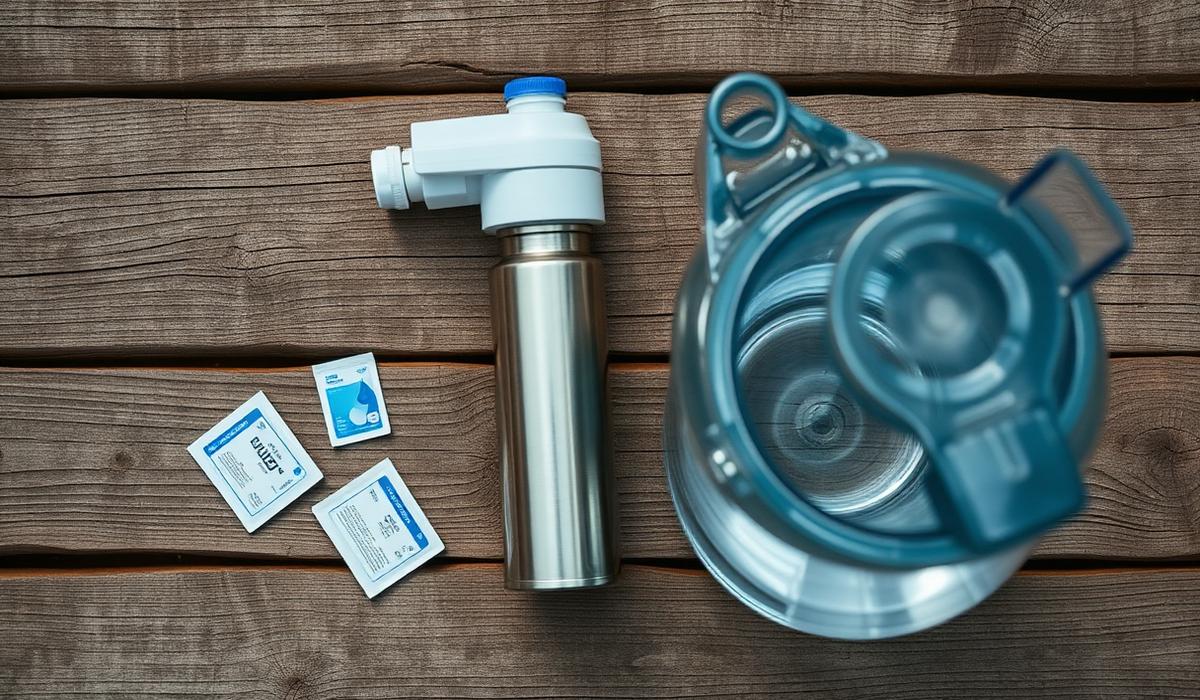
Store at least one gallon of water per person per day — 14 days at home, 3 days in a go-bag — and know all four purification methods (boiling, filtering, chemical treatment, distillation) since each has different limits.
You can survive roughly three weeks without food. Without water, the clock runs out in about three days — faster in heat, faster still if you are working. That is why every serious preparedness agency, from FEMA to the CDC to the World Health Organization, puts water at the top of the list rather than food, ammunition, or gear.
This guide covers the three things that actually matter: how much to store, how to store it so it stays drinkable, and how to make questionable water safe when your stored supply runs out.
How much water should you store?
Ready.gov's standing guidance is one gallon (about 3.8 litres) per person per day, split roughly evenly between drinking and basic sanitation. Store at least a two-week supply at home if space allows, and a three-day supply in anything you might have to carry.
That baseline goes up in real conditions. The CDC notes that children, nursing mothers, and sick people need more, that hot environments can double requirements, and that a medical emergency can demand additional water on top of everything else. Pets count too — roughly one ounce per pound of body weight per day.
- Minimum: 1 gallon / 3.8 L per person per day
- Home target: 14 days (56 gallons for a family of four)
- Go-bag target: 3 days, plus a filter to extend it
- Add 50–100% in hot climates or for physical work
Storing water so it stays safe
Commercially bottled water is the simplest option: leave it sealed, keep it cool and dark, and observe the printed date. Water itself does not spoil, but plastic degrades and containers can leak, so rotate every one to two years.
If you fill your own containers, use food-grade plastic — HDPE marked #2 — that has never held anything but food or drink. Never reuse milk jugs or fruit-juice bottles: residual sugars and proteins are impossible to fully remove and will feed bacteria. Sanitise containers with a solution of one teaspoon of unscented household bleach per quart of water, rinse, then fill from a treated municipal tap.
Label every container with the fill date, store off concrete floors and away from fuels or pesticides (vapours pass through plastic), and rotate self-filled water every six months.
Purification method 1: boiling
Boiling is the most reliable way to kill bacteria, viruses and protozoa such as Giardia and Cryptosporidium. The CDC's instruction is simple: bring water to a rolling boil for one minute — three minutes above 6,500 feet (2,000 m) of elevation.
Boiling does not remove chemical contaminants, heavy metals, or salt, and it concentrates them slightly as water evaporates. Filter cloudy water through a coffee filter or clean cloth and let it settle first, then boil. Let it cool covered, and pour it back and forth between two clean containers to restore taste.
Purification method 2: filtration
A good filter handles bacteria and protozoa and requires no fuel — the reason it belongs in every bag. Look for an absolute pore size of 1 micron or smaller, or a filter tested to NSF/ANSI P231 or the EPA Guide Standard for microbiological purifiers.
The important caveat: most hollow-fibre and ceramic filters do not remove viruses, which are too small to catch mechanically. In North American and European backcountry the practical virus risk is low; after flooding, in dense urban failure, or anywhere sewage may be present, follow filtration with a chemical treatment or a boil.
Filters clog and freeze. Carry a spare element, keep a filter from freezing once it has been wet, and backflush on the schedule the manufacturer specifies.
Purification method 3: chemical treatment
Unscented household bleach (sodium hypochlorite, 5–9%, with no added cleaners) is the standard fallback. The CDC ratio for 6% bleach is 8 drops — about 1/8 teaspoon — per gallon of clear water, or 16 drops per gallon if the water is cloudy after filtering. Stir, then let it stand 30 minutes. A faint chlorine smell means it worked; if there is none, repeat the dose once and wait another 15 minutes.
Commercial tablets (chlorine dioxide, sodium dichloroisocyanurate, iodine) are more precise and travel better. Chlorine dioxide is the strongest of the three because it also handles Cryptosporidium, but it needs up to four hours of contact time for that. Iodine should not be used by pregnant people or anyone with thyroid disease, or continuously for more than a few weeks.
Bleach loses potency: replace household bleach used for water treatment annually, and check tablet expiry dates every spring.
Purification method 4: distillation
Distillation is the only household method that removes salt, most heavy metals and many chemicals along with pathogens. Boil water in a pot with an inverted lid, hang a cup under the lid handle so condensate drips into it, and collect the distillate.
It is slow and fuel-hungry, so treat it as the specialist tool: brackish water, suspected chemical contamination, or a flooded area where industrial runoff is a real possibility.
Finding water when storage runs out
Inside your home there is more water than most people realise: the hot-water heater tank (turn off power or gas and the incoming supply first, then drain from the bottom valve), the reservoir tank of a toilet, melted ice, and canned vegetable liquid.
Outside, rainwater collected from a clean surface is the easiest source, followed by moving freshwater. Avoid water near industry, agriculture with heavy runoff, or standing pools with dead vegetation. Never drink flood water, water with a chemical sheen, or water from a swimming pool that has been sitting untreated for weeks — pool water is chlorinated for contact, not for consumption, and stabilisers make it unsafe to drink for long.
A two-hour plan for this weekend
Preparedness fails on complexity. Do this instead: count your household, multiply by 14 gallons, buy that much bottled water and stack it somewhere cool. Add one filter rated to at least 1 micron, one bottle of plain unscented bleach with an eyedropper taped to it, and one printed copy of the ratios above — because phones die.
Then run it once. Filter a jug of tap water through the filter you bought so you learn how slow it really is. The first time should never be during an emergency. For the next step, read How Much Water Does a Household Actually Need for a 30-Day Emergency?.
Sources
- Ready.gov — Water
- CDC — Making Water Safe in an Emergency
- EPA — Emergency Disinfection of Drinking Water
General preparedness information, not medical or legal advice. Follow instructions from your local emergency authority during an active event.
Field notes by email
Get the next guide before you need it
One email when a new field guide drops — water, food, power, medicine. No spam, no daily noise, unsubscribe in one click.
Comments on this guide
Questions, corrections and field reports from your own setup are welcome.
No comments yet. Be the first to add a field report.