
Water
How Much Water Does a Household Actually Need for a 30-Day Emergency?

By Ephraim Rusk · · 10 min read
This article contains an affiliate link. If you buy through it, we may earn a commission at no extra cost to you.
Quick answer
A realistic 30-day emergency water supply requires roughly 3 to 5 gallons per person per day when you account for drinking, cooking, basic sanitation, and pet needs — far more than the often-cited one-gallon minimum. For a family of four, that means storing or sourcing 360 to 600 gallons over 30 days.
Every major preparedness guide starts with water. FEMA, the Red Cross, and Ready.gov all recommend one gallon per person per day as a baseline figure. That number is survivable. It is not comfortable, and it does not account for cooking, pets, a nursing mother, a diabetic who must wash injection sites, or anyone doing physical work outdoors. Treat it as the floor, not the ceiling.
The more useful question is not 'what is the minimum I can get away with?' but 'how much water does my specific household actually consume in a disrupted situation, and where does that water come from if the tap goes dry for 30 days?' That is a harder question, and it is the one this article is built to answer.
Water emergencies are no longer theoretical. The U.S. Drought Monitor reported that over 45 percent of the contiguous United States experienced moderate to exceptional drought conditions at various points in recent years. Municipal systems have been disrupted by infrastructure failures, contamination events, and utility shutoffs. Thirty days is a realistic planning horizon for a serious regional emergency. Let's do the math honestly.
The Real Per-Person Daily Water Budget
One gallon per day keeps a sedentary adult alive with very little margin. The breakdown is roughly half a gallon for drinking and half a gallon for minimal food prep. Sanitation — handwashing, basic wound care, oral hygiene — gets nothing at that level. That is a crisis ration, not a livable standard.
A functional daily water budget looks more like this: drinking water accounts for 0.5 to 1 gallon depending on body size, temperature, and activity level; cooking and food hydration adds another 0.5 to 1 gallon; basic hygiene including handwashing, teeth brushing, and sponge bathing adds 1 to 2 gallons; and dish cleaning adds roughly 0.5 gallons. That puts a realistic functional minimum at 2.5 to 4.5 gallons per person per day.
Add one medium-sized dog and the per-day number climbs by roughly half a gallon. Two dogs, a cat, and a garden that needs watering in summer heat, and you are looking at 5 to 7 gallons per day for a single adult household. The point is not to scare you — it is to get you planning against a real number, not an overly optimistic one.
The CDC's guidance on emergency water specifically notes that children, nursing mothers, the elderly, and people who are physically active or ill may need significantly more than the one-gallon baseline. Plan for your actual household, not an average.
- Drinking: 0.5 to 1 gallon per person per day
- Cooking and food rehydration: 0.5 to 1 gallon per person per day
- Basic hygiene (sponge bath, brushing, handwashing): 1 to 2 gallons per person per day
- Dish and utensil sanitation: 0.5 gallons per person per day
- Pets: 0.25 to 0.5 gallons per medium dog per day
- Nursing mothers or sick individuals: add 0.5 to 1 gallon per day
Calculating Your 30-Day Number
Multiply your household's realistic daily total by 30. A family of four adults using a conservative 3 gallons per person per day needs 360 gallons. At 4 gallons per person per day — a more comfortable operational level — that same family needs 480 gallons. At 5 gallons, it is 600 gallons.
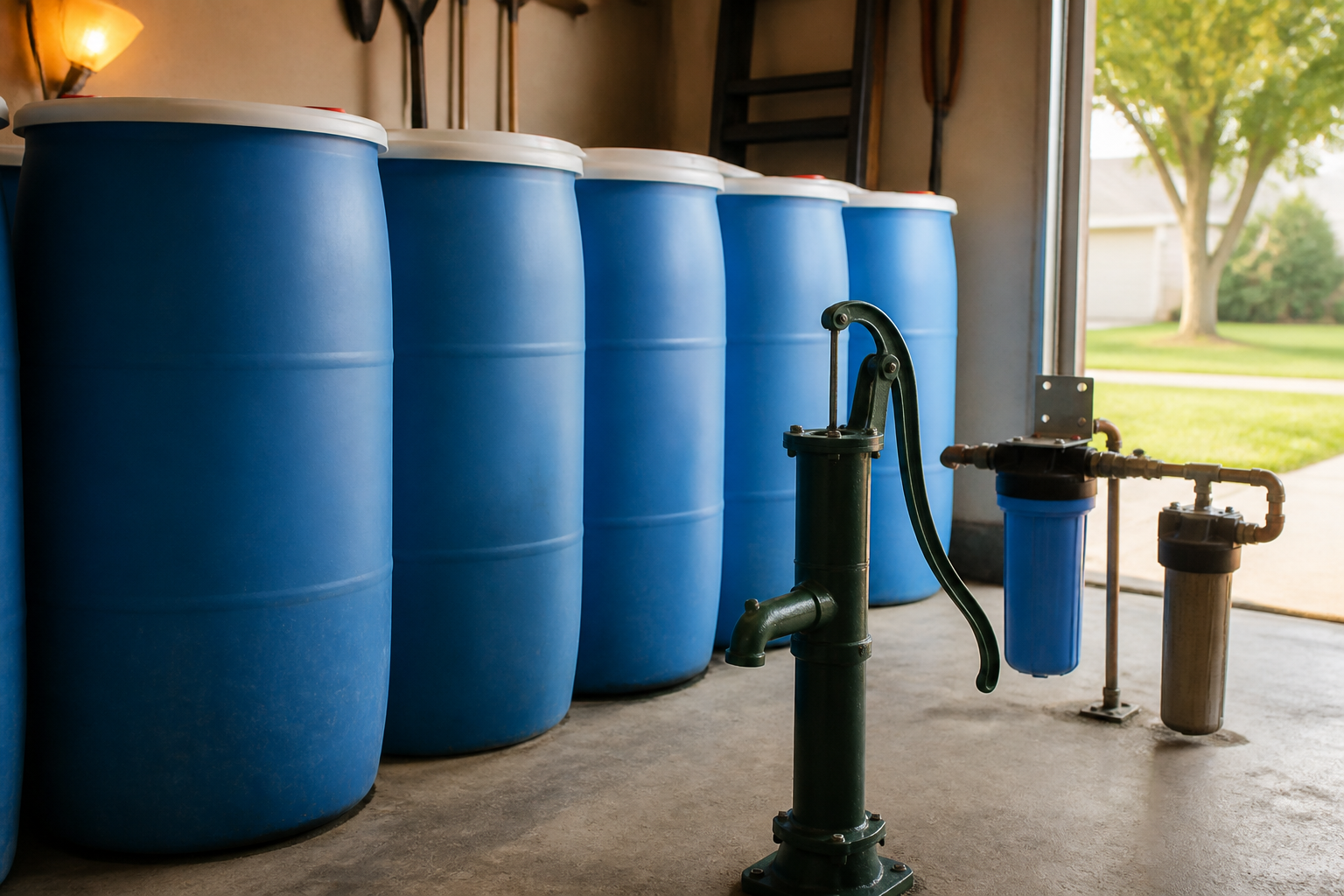
Now think about where 480 gallons of stored water actually lives in your home. Standard 55-gallon drums are a common storage solution; you would need nearly nine of them to hit that number. Each drum full of water weighs approximately 459 pounds, so your floor, garage slab, or basement must be able to support that load. Smaller WaterBOB-style bathtub bladders hold 100 gallons each but require advance notice before a disruption hits.
Storage is only one side of the equation. For a 30-day scenario, most households will need to combine stored water with an ongoing source. That changes the problem from a single purchase decision into a system: storage as a buffer, collection or provisioning as the renewable supply. This is the piece most short-form guides skip entirely.
Before you finalize any number, account for seasonal factors. Summer heat in the Southwest doubles drinking water needs. Winter scenarios in cold climates may require extra water for flushing toilets manually if pipes freeze or pressure drops. Adjust your target seasonally and revisit it annually.
Why Storage Alone Falls Short for 30-Day Scenarios
Pure storage preparedness has a ceiling problem. At some point, the volume of water required for extended emergencies becomes physically and financially impractical for most households. A family of four planning for 30 days at 4 gallons per person per day needs storage equivalent to roughly eight 55-gallon drums — that is significant real estate, significant upfront cost, and a rotation schedule you must actually follow.
Water stored in non-food-grade containers or left unrotated for years degrades in quality. The EPA notes that commercially bottled water carries a manufacturer's recommended consumption date not because water itself expires, but because the container can leach chemicals over time and any introduced contaminants can multiply. Tap water stored in food-grade containers should be rotated every six to twelve months and treated with unscented liquid chlorine bleach at roughly eight drops per gallon if you are refilling from a municipal source.
The sustainable answer for a 30-day or longer planning horizon is to combine a meaningful storage buffer with a collection or provisioning system that replenishes your supply. Think of it like a bank account: storage is the cash on hand, and your collection system is the income that keeps you solvent. Without the income side, even a well-stocked household eventually runs dry.
Natural collection methods — rainwater harvesting, well water, and surface water filtration — all have real regulatory, mechanical, and quality considerations that storage water does not. Rainwater collection regulations vary by state, some prohibiting or limiting it entirely. Well water quality depends heavily on local geology and should be tested annually according to the EPA. Surface water requires multi-stage filtration and chemical treatment before it is safe to drink. Whatever system you use, understand the inputs and their limitations before you depend on them.
Water Quality and Treatment: What You Cannot Skip
Having 500 gallons of contaminated water is worse than having 100 gallons of clean water, because contaminated water can sicken everyone you are trying to protect. Water quality is not optional in a 30-day planning framework.
The EPA and CDC both distinguish between water that is microbiologically safe and water that is free of chemical or heavy metal contamination. Boiling kills biological threats including bacteria, viruses, and protozoa, but it does nothing for lead, nitrates, or volatile organic compounds. Your treatment method must match the threat in your water source.
For stored tap water from a treated municipal system, basic chlorination and proper sealing is generally adequate. For collected rainwater, a sediment pre-filter followed by a carbon filter and UV treatment or chemical disinfection covers most biological risks, though rooftop collection can introduce bird droppings, debris, and roof material leachates. The CDC recommends testing any non-municipal source water before relying on it for drinking.
Keep a basic water testing kit in your preparedness supplies. They are inexpensive and available at most hardware stores. Know your baseline, and know what changed if something tastes or smells off.
- Boiling (1 minute at a rolling boil, 3 minutes above 6,500 feet elevation): kills biological threats only
- Unscented liquid chlorine bleach (6-8.25% sodium hypochlorite): 8 drops per gallon, let stand 30 minutes
- Iodine or chlorine tablets: follow manufacturer dosing, not effective against all protozoa
- Gravity or pump ceramic filters: remove protozoa and bacteria, check micron rating
- UV purifiers: effective against viruses, bacteria, and protozoa, requires clear water first
- Reverse osmosis: removes chemicals and heavy metals, slow and requires pressure
Our Recommendation: Joseph's Well
If you have run the math above and realized your storage plan alone does not close the gap for a 30-day scenario, Joseph's Well is worth a serious look. It is a DIY home water provisioning and collection system designed to produce up to 40 gallons of water per day from sources independent of your municipal connection. At 40 gallons per day, a family of four operating at 4 gallons per person per day has a buffer of 24 gallons each day — enough to maintain reserves or extend your operational window significantly beyond any fixed-storage-only plan.
What makes it relevant for this specific planning problem is the independence angle. During municipal rationing events, drought-driven service interruptions, or infrastructure failures — exactly the scenarios where your stored supply is drawing down fastest — Joseph's Well is still producing. It is positioned as a residential-scale system that you build and control, which means no dependence on delivery logistics, no ongoing cartridge subscription, and no waiting for a contractor during the exact emergency when contractors are unavailable. The DIY design also means you understand how it works, which matters when something needs adjustment under pressure.
If you are serious about 30-day water security for your household and you have been looking for the collection-and-provisioning side of the equation to complement your storage, Joseph's Well is the next step worth taking. Click the button below to learn more about the system and see whether it fits your setup. For the next step, read Emergency Water Storage and Purification: The Complete Guide.
Our recommendation
Joseph's Well
Check availability →This article contains an affiliate link. If you buy through it, we may earn a commission at no extra cost to you.
Frequently asked questions
How much water should I store for a family of 4 for 30 days?
At a realistic planning level of 3 to 4 gallons per person per day, a family of four needs 360 to 480 gallons for 30 days. The one-gallon-per-day FEMA baseline is a survival minimum, not a comfortable or sanitation-safe standard. Factor in pets, any medical needs, and seasonal heat when calculating your actual target.
Can I store enough water at home for a month-long emergency?
It is physically possible but logistically demanding. At 4 gallons per person per day for a family of four, you need roughly 480 gallons — close to nine full 55-gallon drums. That requires significant floor space, structural load capacity, and a rotation schedule. Most households combine stored water with a collection or provisioning system for extended scenarios.
How long can you store tap water for emergencies?
Tap water stored in clean, food-grade containers with proper sealing can be kept safely for 6 to 12 months. After that, it should be rotated or re-treated. Add 8 drops of unscented liquid chlorine bleach (6-8.25% concentration) per gallon before sealing if you are not sure the source water is fully treated. Label containers with the fill date.
Is rainwater safe to drink in an emergency?
Collected rainwater is not safe to drink without treatment. Rooftop collection introduces biological contaminants, debris, bird droppings, and potentially materials from your roofing. Run collected rainwater through a sediment filter, then a carbon filter, and then disinfect with bleach, boiling, or UV treatment before drinking. Have it tested if you plan to rely on it regularly.
What is the most water-efficient way to handle sanitation during a water shortage?
Switch to sponge baths instead of showers, use hand sanitizer between soap-and-water handwashings when hands are not visibly dirty, adopt a wash-rinse-sanitize dishwashing method using two small basins, and use a composting or bucket toilet system if water pressure is unavailable. These changes can reduce sanitation water use from 50 or more gallons per person per day to under 2 gallons.
Sources
- CDC — Emergency Water Storage and Treatment Guidance
- EPA — Emergency Disinfection of Drinking Water
- Ready.gov — Water: Store and Purify
- FEMA — Food and Water in an Emergency (IS-394.A)
General preparedness information, not medical or legal advice. Follow instructions from your local emergency authority during an active event.
Field notes by email
Get the next guide before you need it
One email when a new field guide drops — water, food, power, medicine. No spam, no daily noise, unsubscribe in one click.
Comments on this guide
Questions, corrections and field reports from your own setup are welcome.
No comments yet. Be the first to add a field report.