
Medicine
Herbal Remedies for Cold and Flu Symptoms: What Actually Works at Home

By Ephraim Rusk · · 10 min read
This article contains an affiliate link. If you buy through it, we may earn a commission at no extra cost to you.
Quick answer
Several herbal remedies — including elderberry, echinacea, and ginger — have meaningful clinical evidence supporting their use for reducing the severity or duration of common cold and flu symptoms. None replace medical care for serious illness, but for minor respiratory ailments they are a practical, low-cost complement to conventional treatment.
Herbal remedies for cold and flu symptoms are one of the most searched health topics for good reason: pharmacies run out of stock during outbreaks, not everyone wants to reach for a pill for a minor illness, and most over-the-counter cold medicines treat symptoms without doing much about the underlying cause. If you're building a preparedness-minded household, having a working knowledge of which plant-based remedies have actual evidence behind them is a practical skill — not a detour into folk magic.
This article is not about replacing your doctor. A flu that turns into bacterial pneumonia, a fever over 103°F that won't break, or any sign of serious respiratory distress belongs in a medical setting. What we're talking about here is the large middle ground: the week-long sore throat, the sinus congestion, the body aches and low-grade fever that most healthy adults ride out at home anyway. In that space, the right herbal tools can shorten recovery time, ease discomfort, and reduce your dependence on a supply chain that doesn't always cooperate.
Below, I've broken down the remedies with the strongest scientific backing, explained how to use them correctly, and flagged where the evidence is thin. At the end, I'll point you to a resource that brings 100 of these recipes together in one practical format.
Why Herbal Cold Remedies Deserve a Place in Your Medicine Kit
Most conventional cold and flu treatments are symptomatic — they suppress a cough, thin mucus, or reduce fever, but they don't accelerate viral clearance. Some herbal compounds, by contrast, have demonstrated immunomodulatory or antiviral properties in clinical trials, meaning they may actually interact with the disease process rather than just masking it.
That's a meaningful distinction for preparedness purposes. If a grid-down situation or a local shortage limits your access to a pharmacy, a remedy that does something real is far more valuable than one that just makes you feel marginally better for a few hours.
The key is knowing which remedies fall into which category. The landscape ranges from elderberry — which has multiple randomized controlled trials supporting its use — to Vitamin C megadosing, which has decades of research showing minimal benefit for most people. Using the right tool matters.
Elderberry: The Strongest Evidence of Any Herbal Flu Remedy
Elderberry (Sambucus nigra) is the single most evidence-backed herbal remedy for influenza symptom duration and severity available without a prescription.
A 2016 randomized, double-blind, placebo-controlled trial published in Nutrients found that air travelers who took elderberry extract had significantly shorter cold duration and reduced symptom severity compared to placebo. A 2004 study published in the Journal of International Medical Research found elderberry extract reduced influenza duration by an average of four days compared to placebo in a small but well-controlled trial.
The proposed mechanism involves anthocyanin compounds in elderberries that may inhibit viral attachment to host cells and stimulate cytokine production. The caveat: raw elderberries contain cyanogenic glycosides and must be cooked before consumption. Commercial standardized extracts and properly prepared syrups eliminate this risk. If you're making your own elderberry syrup — which is straightforward — you must heat the berries thoroughly.
Typical dosing in studies: 15 ml of elderberry syrup four times daily for adults during active illness. Elderberry is not a substitute for antiviral medications like oseltamivir in confirmed high-risk influenza cases, but for otherwise healthy adults managing typical flu symptoms at home, it's a defensible first-line herbal option.
Ginger, Honey, and Thyme: The Sore Throat and Cough Tier
For sore throat and cough, ginger, raw honey, and thyme each have evidence supporting specific mechanisms — and all three are typically already in your kitchen.
Ginger contains gingerols and shogaols, compounds shown in laboratory studies to have anti-inflammatory and mild antimicrobial properties. A warm ginger and lemon tea is not just comfort food: it reduces throat inflammation, supports mucus thinning, and the steam provides direct airway relief. Clinical evidence for ginger specifically in cold symptoms is limited mostly to in-vitro and small human studies, so the claim is "supportive" rather than "proven," but the risk is essentially zero and the benefit is plausible.
Raw honey is better-studied than most people realize. A 2021 systematic review and meta-analysis published in BMJ Evidence-Based Medicine found honey was superior to usual care for upper respiratory tract infection symptoms, including cough frequency and severity. This held across multiple studies. Honey also has documented antimicrobial properties attributable to hydrogen peroxide production and low pH. One important hard rule: never give honey to children under 12 months due to the risk of infant botulism.
Thyme (Thymus vulgaris) has a particularly strong evidence base for cough. A German multicenter trial found thyme-ivy syrup equivalent to the expectorant drug ambroxol for acute bronchitis. Thyme contains thymol, a compound with demonstrated bronchospasmolytic and antimicrobial properties. A simple thyme tea — steep a tablespoon of fresh or dried thyme in hot water for ten minutes — is a practical, low-cost intervention for productive cough.
Echinacea and Garlic: Useful, But with Important Caveats
Echinacea and garlic are two of the most popular herbal cold remedies, and both have enough real evidence to be worth understanding — along with important limitations that the marketing often glosses over.
Echinacea research is genuinely mixed. A 2015 Cochrane review of 24 randomized trials found some echinacea preparations may reduce the incidence and duration of the common cold, but results varied significantly by preparation type and dosing. The bottom line: echinacea may offer modest benefit if you start it at the first sign of symptoms, but it isn't a reliable prevention tool taken continuously, and not all echinacea products are equivalent. Echinacea purpurea root preparations have the most consistent positive trial data.
Garlic contains allicin, a sulfur compound with documented antimicrobial properties in laboratory settings. A single small 2001 trial found garlic supplementation reduced cold incidence, but independent replication has been limited and the Cochrane review on garlic concluded evidence was insufficient to draw firm conclusions. Where garlic earns its place in a practical home medicine context is as an antimicrobial food ingredient — particularly relevant for sore throats and sinus congestion — rather than as a proven antiviral supplement.
The honest summary: both are low-risk, low-cost, and plausibly useful. Neither is a reliable standalone treatment. Use them as part of a broader supportive care approach, not as a primary intervention.
How to Build a Home Herbal Cold and Flu Kit
A functional home herbal medicine kit for respiratory illness doesn't require exotic ingredients — it requires knowing which common plants and pantry staples do what, and having them on hand before you need them.
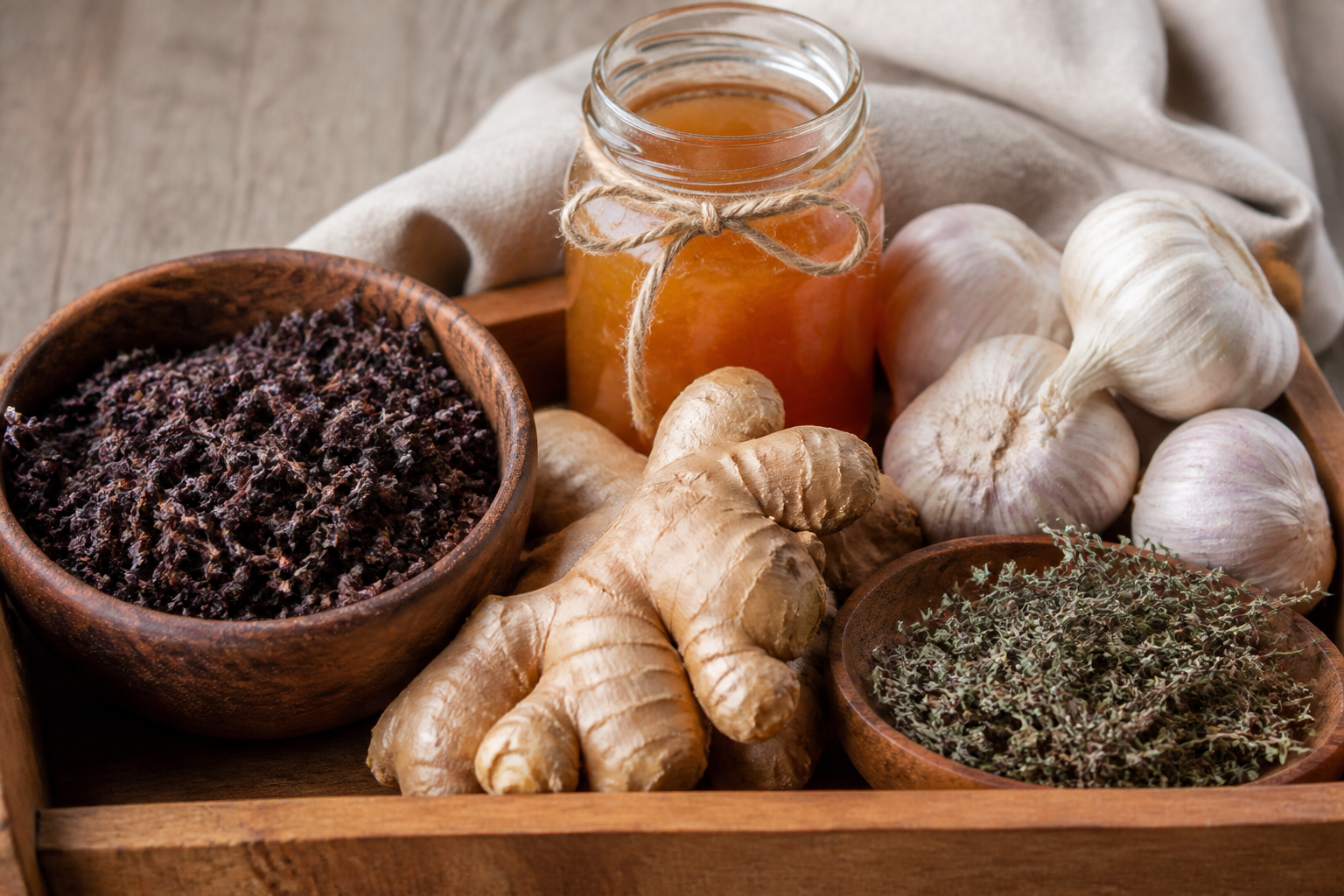
The core inventory for cold and flu management: dried elderberries (for syrup), raw honey, fresh or dried ginger, dried thyme, echinacea purpurea tincture or capsules, and garlic. Most of these store for 12 to 24 months in proper conditions. Elderberry syrup can be made in a 30-minute batch and stored in the refrigerator for up to two to three weeks, or frozen in ice cube trays for longer storage.
Beyond the ingredients, you need the recipes — the specific ratios, preparation methods, and dosing guidelines that make the difference between a remedy that works and one that's too weak to do anything. This is where most people stall: the knowledge gap between having the right plants and actually using them correctly is real, and it's the gap that leaves most herbal medicine kits sitting unused on a shelf.
- Dried elderberries: base for antiviral syrup, stores 12-24 months
- Raw honey: cough and throat relief, indefinite shelf life when stored properly
- Fresh or dried ginger: anti-inflammatory tea, widely available
- Dried thyme: proven for productive cough, easy to grow or store dried
- Echinacea purpurea tincture: early-onset cold support, follow label dosing
- Garlic: antimicrobial food ingredient, best used fresh
Our Recommendation: Herbal Remedies for Everyday Ailments
Knowing which herbs work is half the battle — but a sore throat at 2 a.m. or a flu that hits mid-week isn't the time to be searching the internet for the right elderberry-to-water ratio or how long to steep a thyme infusion.
The gap in the DIY approach is the recipes themselves. You can read about elderberry's clinical evidence, but you still need the correct preparation method to get a therapeutically meaningful result. Sourcing that information across blogs, books, and studies takes hours, and quality varies wildly — some sources give doses that are too low to be effective, others skip safety notes entirely.
Herbal Remedies for Everyday Ailments is a $12 ebook with 100 tested herbal remedy recipes for common ailments — colds, coughs, sore throats, congestion, and more — all using household and garden ingredients. It's designed as a practical complement to conventional medicine for minor issues, not a replacement for serious medical care. At $12 with a 60-day money-back guarantee, it's a low-risk way to fill the recipe knowledge gap in your home medicine kit before you actually need it. For the next step, read How to Treat an Infected Wound Without Antibiotics: A Step-by-Step Home Guide.
Our recommendation
Herbal Remedies for Everyday Ailments
Check availability →This article contains an affiliate link. If you buy through it, we may earn a commission at no extra cost to you.
Frequently asked questions
What is the most effective herbal remedy for flu symptoms?
Elderberry (Sambucus nigra) has the strongest clinical evidence of any herbal remedy for influenza, with multiple randomized controlled trials showing reduced symptom duration and severity. It is best used at the first sign of illness, not as a long-term preventive supplement.
Can herbal remedies actually shorten a cold?
Some can. Elderberry extract has shown an average reduction in cold duration of two to four days in controlled trials. Honey has been found superior to usual care for cough frequency in a 2021 BMJ meta-analysis. Results vary by preparation quality and how early the remedy is started.
Is it safe to make your own elderberry syrup at home?
Yes, with one critical rule: raw elderberries must be fully cooked before consumption. They contain cyanogenic glycosides that cause nausea and vomiting if eaten raw. Simmering the berries for 20-30 minutes eliminates this risk. Commercial standardized extracts are also safe.
Can I give herbal cold remedies to children?
Many herbal remedies are appropriate for older children with adjusted dosing, but honey should never be given to children under 12 months due to the risk of infant botulism. Always consult a pediatrician before giving herbal remedies to young children, especially for fever management.
When should I stop using home remedies and see a doctor for a cold or flu?
Seek medical care if you have a fever above 103°F (39.4°C) that won't break, difficulty breathing or shortness of breath, chest pain, severe or worsening symptoms after 10 days, or if you are in a high-risk group (elderly, immunocompromised, pregnant, or very young children). Home remedies are for mild to moderate illness in otherwise healthy adults.
Related guides
Sources
- NIH National Center for Complementary and Integrative Health: Echinacea
- NIH National Center for Complementary and Integrative Health: Elderberry
- CDC: Flu Symptoms and Complications
- NIH MedlinePlus: Honey for Upper Respiratory Infections
General preparedness information, not medical or legal advice. Follow instructions from your local emergency authority during an active event.
Field notes by email
Get the next guide before you need it
One email when a new field guide drops — water, food, power, medicine. No spam, no daily noise, unsubscribe in one click.
Comments on this guide
Questions, corrections and field reports from your own setup are welcome.
No comments yet. Be the first to add a field report.