
Skills
Home Food Preservation Without Electricity: 6 Methods That Actually Work

By Ephraim Rusk · · 11 min read
This article contains an affiliate link. If you buy through it, we may earn a commission at no extra cost to you.
Quick answer
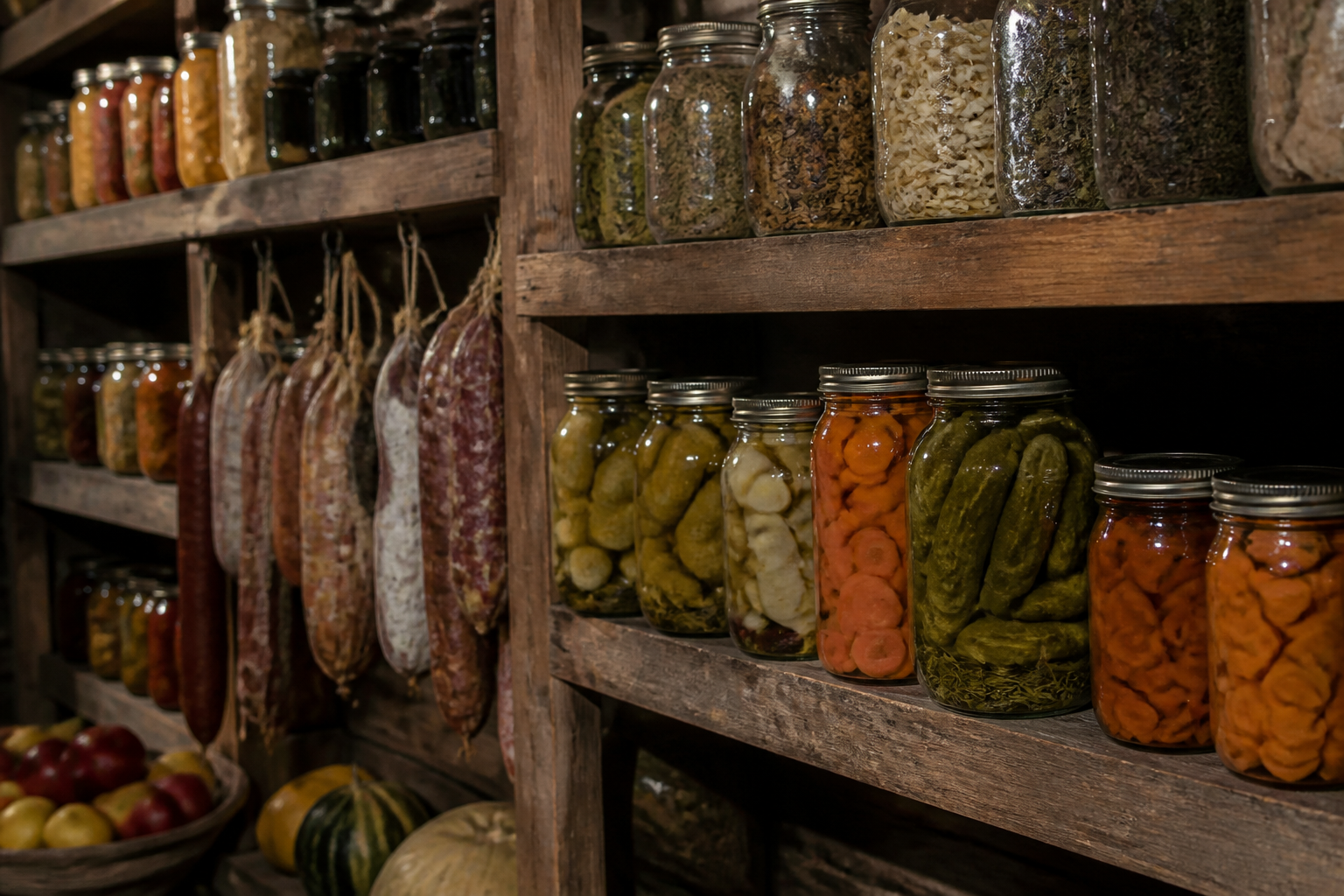
You can preserve food long-term without electricity using six proven methods: salt curing, lacto-fermentation, water-bath canning, dehydrating, fat packing (confit), and root-cellar cold storage. Each eliminates the conditions microbes need to cause spoilage — excess moisture, the wrong pH, or oxygen access — without relying on a freezer or refrigerator.
Home food preservation without electricity is not a fringe skill — it is how every household on earth stored food for most of recorded history, and it is still the most reliable insurance against a grid failure, a supply-chain disruption, or simply a paycheck that does not stretch as far as you need it to. If your only preservation strategy is a chest freezer, a single long outage erases weeks of stored food in 24 to 48 hours.
The six methods covered here are not theoretical. They are the same techniques that kept families fed through hard winters before refrigeration existed, and they are still in active use by homesteaders, small farms, and traditional food cultures worldwide. You do not need specialized equipment to start — salt, mason jars, and a dark cool corner of your home are enough for most of them.
This article walks through each method, explains the science plainly so you understand why it works, and gives you realistic starting points. If you have been putting this off because it seemed complicated, you will find it is much more approachable than it looks.
Why Electricity-Free Preservation Methods Are More Reliable Than a Freezer
A freezer preserves food by holding it below 0°F, which slows microbial activity to near zero — but it does nothing to eliminate the conditions that cause spoilage. The moment power is lost for more than 48 hours, a full chest freezer begins a slow but irreversible countdown. FEMA recommends treating freezer food as unsafe after 48 hours without power if the freezer was not kept packed solid, and that window shrinks in a warm climate or an already partially full unit.
Low-tech preservation methods work differently. Salt curing, fermentation, and dehydration do not just slow spoilage — they actively eliminate the conditions microbes need to survive: free water, the wrong pH, or access to oxygen. A properly sealed jar of fermented vegetables or a salt-cured ham does not start a countdown the moment the lights go out. It simply sits on the shelf and keeps working.
From a preparedness standpoint, that is a meaningful difference. Grid-independent food storage is not about distrust of technology — it is about not having a single point of failure between your family and a stocked pantry. These methods also tend to be cheaper per calorie than buying freeze-dried commercial supplies, and they use real, whole food your household already eats.
Salt Curing and Brining: The Oldest Reliable Method for Meat and Vegetables
Salt preservation works by pulling free water out of food through osmosis and raising the salt concentration to a level where most spoilage bacteria and pathogens cannot survive — typically above 10% salinity by weight of the food.
For meat, dry curing involves packing cuts in a mixture of salt, often sugar, and sometimes curing salts (sodium nitrite or nitrate) to inhibit Clostridium botulinum specifically. The USDA's Complete Guide to Home Canning and Preserving outlines safe ratios and cure times for common cuts. Simpler wet-brining — submerging vegetables or meat in a 3–5% salt solution — is the basis of traditional pickles, corned beef, and salt fish.
The most common beginner mistake is guessing at salt ratios. Use a kitchen scale, not volume measures, for curing mixes. Weight-based measurements account for differences in crystal size between table salt, kosher salt, and sea salt, which vary enough to under-cure or over-salt a batch if you use cups instead of grams.
Cured meats stored in a cool, dry location can remain safe for weeks to months. Traditional salt-cured hams in European and American traditions were stored for 6–12 months at cellar temperatures without refrigeration. That track record is long enough to be meaningful.
Lacto-Fermentation: How Beneficial Bacteria Preserve Food and Improve It
Lacto-fermentation uses naturally occurring Lactobacillus bacteria to convert sugars in vegetables into lactic acid, dropping the pH of the food to a level (typically below 4.6) where pathogenic bacteria including Salmonella and E. coli cannot survive.
The process requires three things: vegetables, salt (to create the right environment for Lactobacillus to outcompete other bacteria), and an anaerobic environment — achieved simply by keeping vegetables submerged below their own brine in a sealed jar. No starter culture is needed for most vegetables; the bacteria are present naturally on the surface of fresh produce.
Sauerkraut, kimchi, traditional dill pickles (not the vinegar-brined supermarket type), and fermented hot sauce are all lacto-ferments. They are among the easiest preservation projects to start because the only equipment needed is a jar, a weight to keep vegetables submerged, and a lid that allows CO2 to escape — a standard mason jar lid left slightly loose works in a pinch.
An important practical point: lacto-fermented vegetables still benefit from cool storage after fermentation is complete. They do not require refrigeration to remain safe, but warmer temperatures accelerate continued fermentation and soften texture over time. A root cellar, unheated basement, or cool pantry (50–65°F) is ideal for long-term storage.
Water-Bath Canning and Dehydrating: Sealing Out Spoilage for the Long Term
Water-bath canning is appropriate for high-acid foods — fruits, jams, most tomato products, and vinegar-pickled vegetables — where the natural or added acid (pH below 4.6) prevents botulism growth. The boiling water bath drives air from the jar and creates a vacuum seal as it cools, eliminating the oxygen that most spoilage organisms need.
Low-acid foods — vegetables, meats, beans, and low-acid tomato products — require pressure canning to reach the 240°F temperature necessary to destroy botulism spores. Water-bath canning is not safe for low-acid foods, and this is not a point to improvise around. The USDA and the National Center for Home Food Preservation publish tested recipes with validated processing times; using untested recipes or shortening processing times introduces real risk.
Dehydrating removes enough free water (reducing water activity below 0.6) to prevent microbial growth without heat-sealing or chemical intervention. Sun drying and air drying are the electricity-free versions — effective in dry climates with consistent temperatures above 85°F and low humidity. Herbs, sliced fruits, and thin-cut vegetables dry reliably by air in the right conditions. Meat jerky requires more controlled temperatures to be safe; the USDA recommends heating dried jerky to 160°F after the drying process, which can be done over a fire or wood stove.
Properly dehydrated and sealed food stored away from light and heat has documented shelf lives of 1–4 years for most produce, and longer for grains and legumes. Both methods together — canning high-acid foods, dehydrating others — cover a wide range of the foods a typical household eats.
Fat Packing and Root Cellaring: Two Underused Methods Worth Adding
Confit — preserving cooked meat or vegetables submerged in rendered fat — is an anaerobic preservation method that has been used in French farm kitchens for centuries. Meat cooked low and slow until tender, then packed into a crock and completely covered with rendered lard, duck fat, or tallow, is sealed from oxygen and held in a cool environment. Duck confit stored properly in a cellar has historically kept for 6 months or longer.
The critical requirement is that the fat fully covers the food with no air pockets, and that storage temperatures stay consistently cool — below 50°F is safer for multi-month storage. This method works best paired with a root cellar or unheated space, and it is particularly well-suited to poultry and pork.
Root cellaring leverages stable underground temperatures and moderate humidity to slow the respiration and decay of root vegetables, winter squash, apples, and similar produce without any processing at all. A well-built root cellar maintains 32–40°F and 85–95% relative humidity — conditions that can keep carrots, potatoes, beets, and cabbage edible for 4–6 months. Even a buried insulated trash can in the right climate approximates those conditions well enough to be useful.
The combination of these two less-talked-about methods with the better-known ones gives a household genuine depth. You are not relying on any single technique or any single food type, which is exactly the kind of redundancy that makes a food storage plan resilient rather than fragile.
Our Recommendation: The Lost Frontier Handbook
The real problem with a single-method food storage plan — whether that is a chest freezer, a bulk bin of rice, or only one preservation technique — is that it has a single point of failure. A grid outage, a bad harvest, or simply running out of one staple can unravel months of preparation in a short time.
The honest limitation of piecing together preservation skills from scattered blog posts and YouTube videos is that the knowledge stays fragmented. You might learn water-bath canning in one place, fermentation in another, and never get a clear picture of how these methods connect to a full household food system — including finding or growing the food in the first place, building a water filtration setup that works without municipal supply, or identifying medicinal plants when a pharmacy is not an option. That gap between individual techniques and an integrated skill set is where most families stall out.
The Lost Frontier Handbook was built specifically for working families who want that integrated foundation without needing to be specialists. It covers food preservation alongside medicinal remedies, off-grid cooking, water filtration, and even guidance on finding free land in the US — the practical cluster of skills that actually add up to self-reliance rather than a collection of disconnected projects. If you are ready to move from scattered notes to a single, organized reference your household can actually use, this is a practical place to start. For the next step, read Survival Kit List: The Complete Checklist for the First 72 Hours.
Our recommendation
The Lost Frontier Handbook
Check availability →This article contains an affiliate link. If you buy through it, we may earn a commission at no extra cost to you.
Frequently asked questions
What is the safest way to preserve meat without a refrigerator?
Salt curing and fat packing (confit) are the two best-established methods for preserving meat without refrigeration. Both require strict attention to ratios and storage temperatures. For curing, follow USDA-validated salt and nitrite ratios by weight. For confit, ensure the meat is fully submerged in fat and stored below 50°F. Canning meat in a pressure canner is also safe and shelf-stable at room temperature when done correctly with validated processing times.
How long does lacto-fermented food last without refrigeration?
Lacto-fermented vegetables kept submerged in their brine in a sealed jar at cellar temperatures (50–65°F) can remain safe and palatable for several months. At room temperature they remain safe but continue to acidify and soften, which affects flavor and texture more than safety. Refrigeration or a cool root cellar significantly extends the window where they taste their best.
Is water-bath canning safe for all foods?
No. Water-bath canning is only safe for high-acid foods with a pH below 4.6 — fruits, jams, jellies, most tomato products, and vinegar-pickled vegetables. Low-acid foods including plain vegetables, meats, and beans require pressure canning to reach temperatures high enough to destroy botulism spores. Using water-bath canning for low-acid foods is a documented cause of home canning-related botulism cases.
Can you dehydrate food without a dehydrator or electricity?
Yes. Sun drying and air drying work well for herbs, sliced fruits, and thin-cut vegetables in dry climates with temperatures consistently above 85°F and low humidity. A drying rack in a sunny, well-ventilated spot is the basic setup. For meat jerky, the USDA recommends heating the dried product to 160°F after drying — achievable on a wood stove or outdoor fire — to ensure pathogen destruction that air drying alone may not guarantee.
What temperature does a root cellar need to be to store vegetables through winter?
The USDA and extension service guidelines recommend 32–40°F with 85–95% relative humidity for most root vegetables and cabbage. Potatoes prefer slightly warmer storage around 38–40°F and should be kept in darkness to prevent greening. Winter squash and onions prefer cooler and drier conditions — around 50–55°F with lower humidity — than most root vegetables.
Related guides
Sources
- USDA Complete Guide to Home Canning — National Center for Home Food Preservation
- USDA Food Safety — Freezer Storage and Power Outages
- USDA — Jerky and Food Safety
- CDC — Botulism and Home Canning
General preparedness information, not medical or legal advice. Follow instructions from your local emergency authority during an active event.
Field notes by email
Get the next guide before you need it
One email when a new field guide drops — water, food, power, medicine. No spam, no daily noise, unsubscribe in one click.
Comments on this guide
Questions, corrections and field reports from your own setup are welcome.
No comments yet. Be the first to add a field report.