
Food
How to Grow Enough Food in a Small Backyard to Meaningfully Cut Your Grocery Bill

By Ephraim Rusk · · 11 min read
This article contains an affiliate link. If you buy through it, we may earn a commission at no extra cost to you.
Quick answer
A well-planned garden as small as 100 to 200 square feet can supply a meaningful portion of a household's vegetables and herbs year-round. Choosing high-yield, calorie-dense crops and staggering plantings across seasons is what makes the difference between a hobby garden and a food-security asset.
Most people picture a survival garden as something sprawling — rows of corn disappearing into the distance, a chest freezer full of green beans, a root cellar the size of a garage. That picture stops a lot of households before they ever put a seed in the ground. The reality is that productive food growing scales down further than most people expect, and the gap between 'hobby garden' and 'serious food production' is mostly a planning problem, not a space problem.
The question worth asking right now is not 'do I have enough land?' It's 'what does my household actually eat, and how much of that can I realistically grow in the space I have?' Those are answerable questions, and the answers are usually more encouraging than people assume. USDA data consistently shows that home-grown produce reduces per-unit food costs dramatically once a garden reaches its stride — not because gardening is free, but because the yield-per-dollar of well-managed intensive beds beats retail pricing by a wide margin.
This article walks through the real numbers, the crop choices that do the most work in limited space, the seasonal planning that keeps production continuous, and a structured system you can apply to a backyard, a side yard, or even a patio. If you have been waiting for the right time to stop treating your food supply as someone else's problem, this is the practical starting point.
The Real Math: What Small-Space Gardening Can Actually Produce
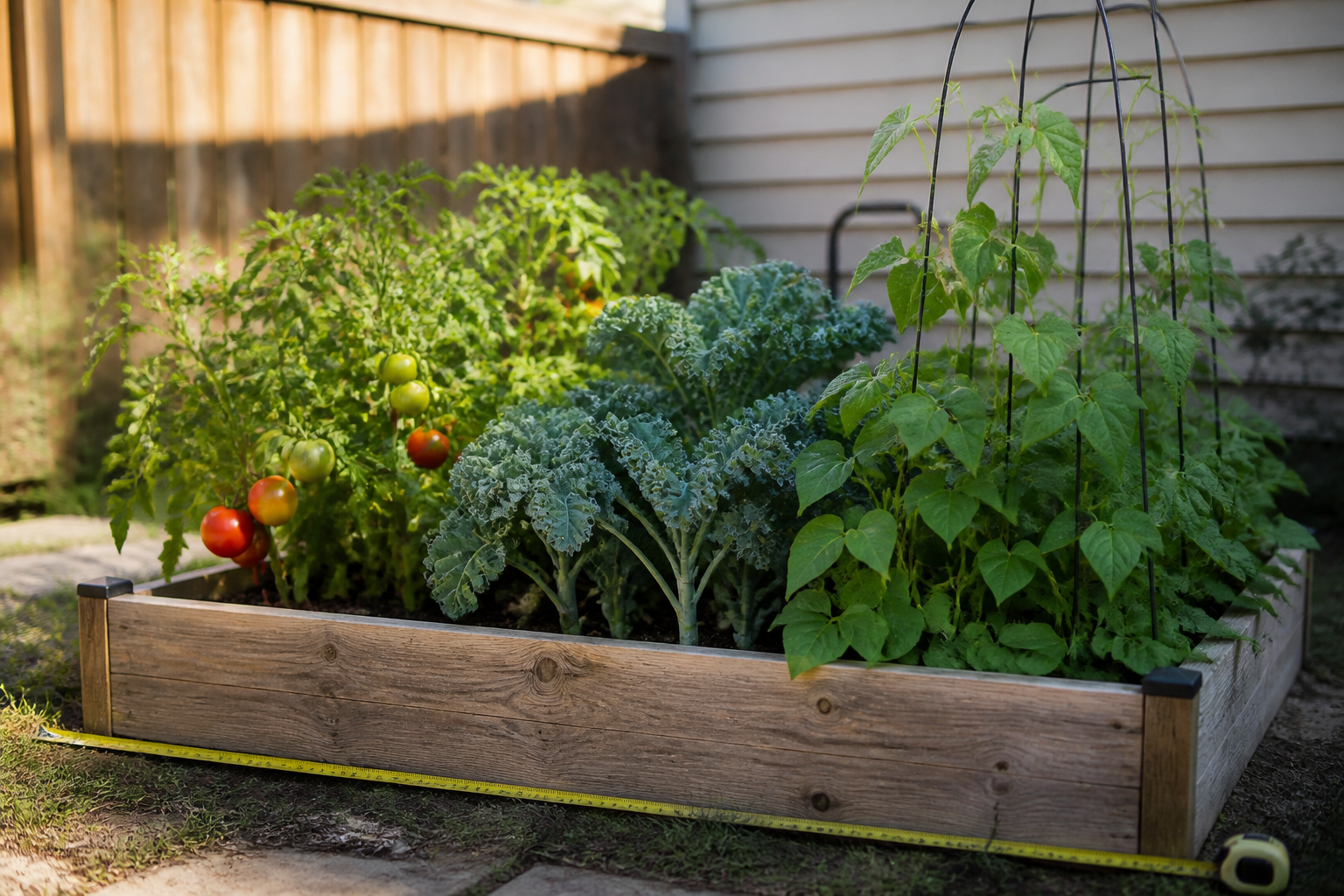
A 4-by-8-foot raised bed — 32 square feet — planted with high-density crops can yield between 30 and 100 pounds of food per growing season depending on your climate, soil quality, and crop selection. Scale that to five or six beds, roughly 160 to 200 square feet, and you are looking at a potential output of 200 to 600 pounds of produce annually. That is not a rounding error in your household food budget.
The University of California Cooperative Extension has documented that well-managed home vegetable gardens return between $500 and $1,200 worth of produce per 100 square feet per year at retail grocery prices. The key phrase is 'well-managed.' Randomly planting whatever seedlings look good at the hardware store in April is not the same as choosing crops intentionally, timing successions, and managing soil fertility across seasons.
For preparedness households specifically, the caloric math matters as much as the dollar math. Leafy greens are nutritious and space-efficient, but they are not calorie-dense. Potatoes, sweet potatoes, dried beans, and winter squash produce meaningful calories per square foot and store without refrigeration. A balanced small garden mixes both categories: greens and herbs for daily nutrition and cost savings, calorie-dense roots and legumes for resilience and storage.
Crop Selection: Which Plants Do the Most Work Per Square Foot
Not all vegetables are equal when you are optimizing for food security in limited space. The metric to work from is yield value per square foot per season — combining nutritional density, caloric output, shelf life, and what that crop would cost you at the grocery store.
Tomatoes are the classic high-return crop for good reason. A single indeterminate tomato plant staked vertically can produce 15 to 30 pounds of fruit in a season, taking up roughly 4 square feet of bed space. At current grocery prices, that one plant represents $20 to $60 of produce. Bush beans, especially dry varieties like Jacob's Cattle or Black Turtle, produce food that stores at room temperature for years. Kale and Swiss chard produce continuously over many months with minimal inputs. Zucchini is almost embarrassingly productive — two plants will feed most households through summer.
Crops to be strategic about in small spaces include corn (high calorie, very space-hungry, better suited to larger plots), watermelon (sprawls aggressively, low calorie-per-square-foot return), and head lettuce in summer (bolts quickly, short harvest window). That doesn't mean you can't grow them — it means you should understand the trade-off and plan accordingly.
For a preparedness-focused small garden, a practical starting crop list includes: determinate or staked tomatoes, bush or pole beans (both fresh and dry varieties), zucchini or summer squash, kale or Swiss chard, sweet potatoes or potatoes (in grow bags if space is very tight), garlic and onions, and at least one winter squash like butternut that stores for months without processing.
- Tomatoes: 15-30 lbs per plant per season, high grocery value
- Dry beans: shelf-stable for years, high protein and calories
- Kale/Swiss chard: continuous harvest, 6+ months of production
- Zucchini: extremely prolific, minimal space for high output
- Sweet potatoes: calorie-dense, stores well, grows in poor soil
- Garlic/onions: culinary staples, long shelf life, low maintenance
- Butternut squash: months of ambient storage, no canning required
Succession Planting and Season Extension: Keeping Production Continuous
The biggest mistake first-time serious gardeners make is treating the garden as a single annual event. They plant in May, harvest in August, and pull everything out in October. A food-security garden is a system that runs as close to twelve months as your climate allows.
Succession planting means staggering plantings of the same crop every two to four weeks so you harvest continuously rather than all at once. A single planting of lettuce gives you two weeks of salads. Four plantings spaced three weeks apart give you ten to twelve weeks of continuous harvest from the same bed space, with no waste from glut. This principle applies to beans, radishes, cilantro, spinach, and many other crops.
Season extension tools — row cover fabric, cold frames, low tunnels, and unheated hoop houses — can add six to ten weeks on each end of your growing season depending on your USDA hardiness zone. In many parts of the continental US, that means growing greens from early March through December. Ready.gov and FEMA both emphasize the importance of multi-season food planning as part of household resilience; a garden that produces nine to eleven months of the year is a materially different asset than one that runs four months.
The practical starting point for season extension is row cover fabric (also called floating row cover or Agribon). A single roll costs $20 to $40, covers multiple beds, and can protect crops down to 24 degrees Fahrenheit depending on weight. It is the highest-return investment in a small-space food garden after good soil.
Soil, Water, and Input Costs: Keeping the System Sustainable
A productive small garden lives or dies on soil quality. This is not a philosophical statement — it is a direct input-output relationship. Plants grown in compacted, depleted, or pH-mismatched soil produce a fraction of what the same varieties will produce in well-amended, biologically active growing medium. The EPA notes that healthy soil structure is the foundation of both crop productivity and water efficiency, which matters when you are trying to minimize ongoing costs.
For raised beds, a standard high-performance mix is one-third compost, one-third coarse perlite or vermiculite, and one-third quality topsoil. This is sometimes called Mel's Mix after garden writer Mel Bartholomew, and it drains well, holds moisture, and supports intensive planting density. The initial investment is real — filling four 4x8 beds with this mix might cost $150 to $300 depending on your sourcing — but the beds can be refreshed each season with a few inches of compost for $20 to $40 total.
Water management in a small intensive garden is straightforward. Drip irrigation or soaker hose systems reduce water use by 30 to 50 percent compared to overhead watering, reduce foliar disease, and can be automated with a $25 timer. In a grid-down scenario, that same drip system can gravity-feed from an elevated rain barrel. Building water redundancy into your garden infrastructure from the start is worth the extra planning time.
Our Recommendation: The 5 Foot Farm
Understanding the principles of high-density food growing is one thing. Having a structured, proven system laid out step by step — one that accounts for planning, crop selection, bed layout, succession timing, and both budget and premium implementation paths — is what actually gets a household from zero to productive. That is exactly what The 5 Foot Farm delivers.
The 5 Foot Farm is an educational home-gardening guide built around a simplified, small-footprint system designed to cut grocery bills by up to 90 percent. It is not a generic gardening book. It is a food-production system built specifically for households that want meaningful output from limited space, with clear guidance for both budget implementations (think reclaimed lumber beds and bulk seed) and premium setups (raised cedar beds, automated irrigation, season extension infrastructure). The two-tier approach is genuinely useful because it meets you where your budget is now, not where you wish it was.
If you have been doing the math in your head while reading this article and thinking 'I could actually do this,' The 5 Foot Farm is the structured next step that removes the guesswork from the planning phase and gets soil under your fingernails faster. Click the button below to learn more and get started. For the next step, read No-Refrigeration Food Preservation: 7 Methods That Actually Work for Long-Term Storage.
Our recommendation
The 5 Foot Farm
Check availability →This article contains an affiliate link. If you buy through it, we may earn a commission at no extra cost to you.
Frequently asked questions
How much space do I actually need to grow a significant portion of my family's food?
Most households can grow a meaningful share of their vegetables and herbs in 150 to 300 square feet of well-managed raised bed space. Calorie self-sufficiency for a family of four requires considerably more — typically 2,000 to 4,000 square feet depending on crop selection — but dramatic grocery bill reductions are achievable at much smaller scales when you focus on high-value, high-yield crops.
What are the highest-yield vegetables for a small survival garden?
For a preparedness-focused small garden, prioritize staked tomatoes, pole or bush beans (especially dry varieties), zucchini, kale, Swiss chard, sweet potatoes, garlic, and winter squash like butternut. These crops combine high yield per square foot, strong nutritional profiles, and in several cases long ambient shelf life without refrigeration or canning.
Can I start a productive food garden with a limited budget?
Yes. A functional 100-square-foot raised bed setup can be built and planted for $100 to $200 using reclaimed lumber, bulk compost, and direct-sown seeds rather than transplants. The ongoing costs drop sharply after the first year once you learn to save seed and compost kitchen and garden waste into your own soil amendment.
How do I keep my garden producing outside of the main summer season?
Row cover fabric, cold frames, and low tunnels extend your growing season by six to ten weeks on each end in most US climates. Focus on cool-season crops — kale, spinach, arugula, mache, carrots, and overwintered garlic — for fall through early spring production. In USDA zones 7 and warmer, year-round outdoor production is realistic with minimal infrastructure.
Is it worth growing food at home compared to just buying extra canned goods for emergency storage?
Both strategies serve different functions and work best together. Stored canned goods provide immediate resilience with no growing time. A productive home garden reduces ongoing grocery costs, provides fresh nutrition that stored food cannot, and builds the skills and infrastructure you need if supply disruptions last longer than your storage covers. The two approaches are complementary, not competing.
Sources
- USDA Economic Research Service — Food Prices and Spending
- EPA — Soil Health and Agricultural Productivity
- Ready.gov — Food and Water in an Emergency
- USDA National Institute of Food and Agriculture — Home Gardening Resources
General preparedness information, not medical or legal advice. Follow instructions from your local emergency authority during an active event.
Field notes by email
Get the next guide before you need it
One email when a new field guide drops — water, food, power, medicine. No spam, no daily noise, unsubscribe in one click.
Comments on this guide
Questions, corrections and field reports from your own setup are welcome.
No comments yet. Be the first to add a field report.