
Food
No-Refrigeration Food Preservation: 7 Methods That Actually Work for Long-Term Storage

By Ephraim Rusk · · 11 min read
This article contains an affiliate link. If you buy through it, we may earn a commission at no extra cost to you.
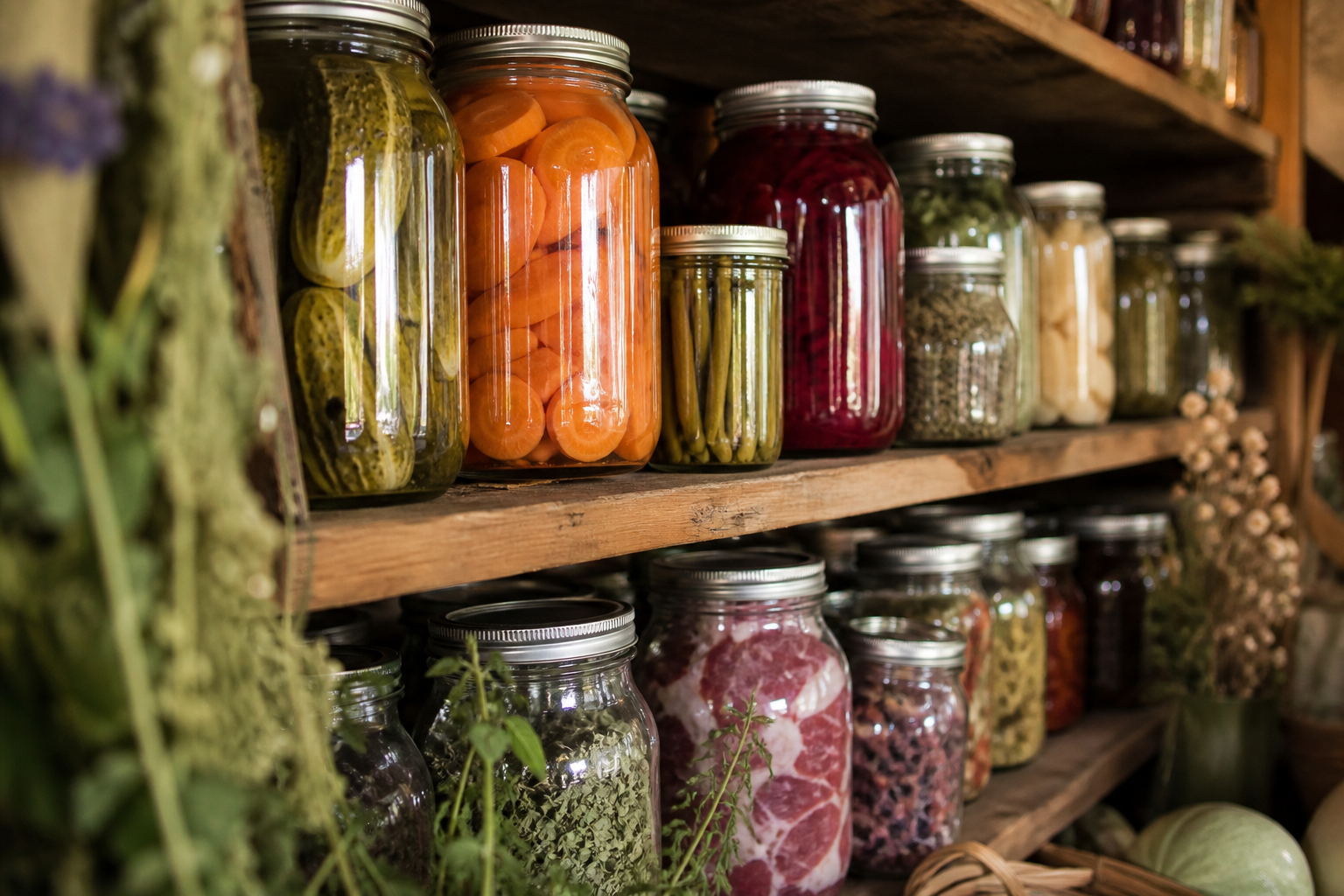
Quick answer
The most reliable no-refrigeration food preservation methods are salt curing, lacto-fermentation, dehydration, fat-packing (confit), root cellaring, pressure canning, and sugar preservation — all proven over centuries and effective for months to years without any electricity.
A power outage that lasts more than four hours starts costing you food. FEMA puts it plainly: a full refrigerator holds safe temperatures for about four hours; a full freezer for 48 hours. After that, you are making judgment calls about what to keep and what to throw away — and those calls get harder the longer the grid stays down.
Most modern households have exactly one food preservation strategy: keep the appliances running. That works fine until it doesn't. A major ice storm, a hurricane, a regional grid failure, or even a prolonged heat wave that triggers rolling blackouts can erase weeks of groceries in a single afternoon. The families who come through those events without panic are the ones who learned — or relearned — how people stored food before electricity was reliable.
This article is not about doomsday stockpiling. It is about practical, well-documented techniques that let a household maintain a meaningful food reserve without depending on refrigeration at any stage — not for storage, and ideally not for preparation either. Some of these methods go back centuries. Some were refined during the rationing years of World War II. All of them work.
Why No-Refrigeration Preservation Is a Core Preparedness Skill
Food spoilage is driven by four things: microbial growth (bacteria, mold, yeast), enzymatic reactions inside the food itself, oxidation, and moisture. Every preservation method targets one or more of these factors. Refrigeration slows microbial growth by lowering temperature. When refrigeration is gone, you need other ways to accomplish the same result — and there are plenty.
The USDA's Complete Guide to Home Canning, which is the federal standard for food safety in home preservation, documents multiple shelf-stable methods that have been studied and validated for safety and longevity. The techniques covered below are not folk remedies. They are methods with understood science behind them and, in most cases, decades of USDA or university extension research validating their safety margins.
The practical payoff is significant. A household that can salt-cure meat, ferment vegetables, dehydrate produce, and water-bath or pressure-can surplus garden yields can maintain a rotating food reserve that costs a fraction of commercial freeze-dried alternatives — and tastes considerably better.
Salt Curing and Brining
Salt is the oldest preservation tool humans have. It works by drawing moisture out of food through osmosis, which raises the water activity to a level where most spoilage bacteria cannot survive. At concentrations above roughly 10 percent by weight, salt creates an environment hostile to the pathogens that cause foodborne illness.
Dry curing involves packing meat or fish directly in salt — sometimes with added nitrates for color retention and extra antimicrobial effect — and allowing it to cure for days to weeks depending on thickness. Wet brining submerges food in a saltwater solution. Both methods have been used for millennia to preserve pork, beef, fish, and poultry without any refrigeration.
The National Center for Home Food Preservation at the University of Georgia, which is the primary research body behind USDA canning and preservation guidelines, maintains detailed tested protocols for curing. Following tested salt ratios is important: under-salting leaves you with food that spoils; over-salting leaves you with food that is unpalatable. Use a tested recipe rather than estimating.
Properly salt-cured products like country ham, salt cod, and corned beef have shelf lives measured in months at room temperature, and much longer under cool cellar conditions. These were staple pantry items in American households well into the twentieth century.
Lacto-Fermentation and Vinegar Pickling
Lacto-fermentation preserves food by encouraging beneficial lactic acid bacteria — already present on raw vegetables — to produce acid as they consume sugars. That drop in pH creates an environment where harmful bacteria cannot establish themselves. No heat, no electricity, and no special equipment beyond a jar and salt.
Sauerkraut, kimchi, traditional dill pickles, and fermented hot sauce all work on this principle. Research published through university extension programs consistently documents lacto-fermented vegetables remaining safe and nutritious for months when kept in a cool location. The lactic acid also preserves vitamins, particularly vitamin C — which is why sauerkraut was historically used to prevent scurvy on long sea voyages.
Vinegar pickling is a faster, more controlled alternative. By submerging food in a solution acidic enough to bring the pH below 4.6 — the threshold below which Clostridium botulinum cannot produce toxin — you create a stable, shelf-stable product. High-acid pickles can be water-bath canned for even longer shelf life. The USDA and the National Center for Home Food Preservation publish tested pickling recipes that specify the minimum vinegar acidity (5 percent) needed for safety.
Both methods are genuinely beginner-accessible. A first batch of sauerkraut requires a head of cabbage, non-iodized salt, a mason jar, and about fifteen minutes of hands-on time. The return — quarts of shelf-stable, probiotic-rich vegetables — is disproportionate to the effort.
Dehydration and Fat-Packing
Dehydration removes enough moisture from food to prevent microbial growth without killing the food's nutritional content as aggressively as high-heat processing does. The USDA recommends drying food to a water activity below 0.60 for shelf stability. In practice, properly dried jerky, fruit leather, dried beans, dehydrated vegetables, and hardtack-style breads store for months to years in airtight containers without refrigeration.
You do not need an electric dehydrator. Sun drying and low-temperature oven drying are effective methods documented extensively in USDA and university extension literature. A simple wire rack in a warm, dry, well-ventilated space can dehydrate sliced fruits and vegetables in one to four days depending on climate. In genuinely arid environments, this costs nothing beyond the food itself.
Fat-packing — known in French cooking tradition as confit — is a less commonly taught but highly effective method. Meat is slow-cooked in its own fat or a neutral fat like lard until fully rendered, then submerged and sealed under the solidified fat in a crock or jar. The fat creates an anaerobic, low-moisture environment hostile to spoilage. Duck confit stored this way was a standard pantry staple in pre-refrigeration France, lasting months without any cooling.
Rendered animal fats themselves — lard, tallow, schmaltz — store for extended periods at room temperature when properly rendered and sealed, and were primary cooking fats in American households before the mid-twentieth century shift to refrigerated vegetable oils.
Pressure Canning and Root Cellaring
Pressure canning is the standard method for shelf-stable storage of low-acid foods — meats, beans, corn, carrots, squash, and other vegetables with a pH above 4.6. A pressure canner achieves temperatures of 240 degrees Fahrenheit (116 Celsius), high enough to destroy Clostridium botulinum spores. Water-bath canning achieves only 212 degrees and is safe only for high-acid foods. Using the wrong method for a given food is how people get hurt; using the right method, following tested USDA processing times, produces food that is documented to remain safe and nutritionally adequate for two or more years on a cool, dark shelf.
The USDA's Complete Guide to Home Canning, available as a free PDF from the National Institute of Food and Agriculture, is the definitive reference. It provides tested processing times for hundreds of specific foods in both pint and quart jars. Following tested times is not optional — processing times are set based on the slowest-heating point inside the jar for a specific food density and acidity, and shortcutting them can leave botulinum spores viable.
Root cellaring is the oldest of all food storage methods and requires essentially nothing beyond a suitable space. A root cellar — or an improvised version using an insulated corner of a basement, a buried barrel, or a hillside pit — maintains temperatures between 32 and 40 degrees Fahrenheit and moderate humidity, conditions that dramatically slow the metabolic processes that cause produce to deteriorate. Properly cellared potatoes, carrots, beets, turnips, winter squash, apples, and cabbages routinely last four to six months without any processing. University extension programs in cold-climate states publish detailed guidance on building and managing root cellars.
Together, pressure canning and root cellaring form the backbone of a no-grid food system. Canning handles the protein and processed staples; the root cellar handles fresh produce through winter. These two methods alone kept rural American families fed for generations before rural electrification reached most of the country in the 1930s and 1940s.
Our Recommendation: The Lost Superfoods
The methods in this article give you a solid framework, but learning to actually execute them — especially the less common techniques like fat-packing, salt-curing specific cuts, or making traditional hardtack and pemmican — requires detailed, recipe-level guidance that a single article cannot fully provide. That is the gap The Lost Superfoods fills. It is a $37 digital guide that documents 126 specific no-refrigeration food preservation methods and recipes drawn from wartime rationing, the Great Depression, and pre-industrial homestead practice — the kind of institutional knowledge that largely disappeared when refrigeration became universal.
What sets this guide apart from generic prepper food lists is the practical density of its content. It walks through how families on the home front during World War II maintained adequate nutrition with limited refrigeration access, how Depression-era households stretched small food budgets into year-round storage, and how to realistically build a 295-plus pound food reserve on roughly five dollars a week using these methods. The techniques are not exotic — they are the same principles of salt, acid, heat, fat, and desiccation covered in this article, applied to specific foods with specific instructions you can follow in your own kitchen.
If you are serious about building a food reserve that does not depend on grid power at any stage — not for preservation, not for storage, and not for preparation — The Lost Superfoods is a legitimate, affordable starting point. The price of entry is low, the information is actionable, and the skill set it teaches is genuinely durable. Check it out and decide if it belongs in your preparedness library. For the next step, read How to Grow Enough Food in a Small Backyard to Meaningfully Cut Your Grocery Bill.
Our recommendation
The Lost Superfoods
Check availability →This article contains an affiliate link. If you buy through it, we may earn a commission at no extra cost to you.
Frequently asked questions
How long can food be preserved without refrigeration?
It depends heavily on the method. Properly pressure-canned foods are documented to remain safe for two or more years. Salt-cured meats like country ham can last six to twelve months at room temperature. Dehydrated foods in airtight containers routinely last one to two years. Lacto-fermented vegetables stored in a cool location typically last three to six months. Root-cellared produce lasts four to six months depending on the vegetable and storage conditions.
Is it safe to preserve meat without refrigeration?
Yes, when you use tested, validated methods. Salt curing, pressure canning, and fat-packing (confit) are all well-documented methods for shelf-stable meat preservation. The key is following tested recipes with correct salt concentrations or processing times — these variables are set specifically to control pathogens like Clostridium botulinum. The USDA and the National Center for Home Food Preservation publish free tested protocols for all of these methods.
What foods can be preserved without electricity or refrigeration?
A wide range: most vegetables via lacto-fermentation, pickling, dehydration, or canning; most meats via salt curing, pressure canning, or fat-packing; fruits via dehydration, sugar preservation (jams, jellies), or water-bath canning; grains and legumes by simple dry storage in airtight containers. Root vegetables, winter squash, and apples store well in a root cellar without any processing. The range of foods that cannot be preserved without refrigeration is actually quite narrow.
Can I learn no-refrigeration food preservation as a beginner?
Yes. Lacto-fermentation — making sauerkraut or simple fermented pickles — is genuinely beginner-accessible and requires no special equipment beyond a mason jar. Dehydration is similarly low-barrier. Pressure canning has a steeper learning curve and requires careful attention to tested processing times, but university extension programs and the USDA publish detailed free guidance. Starting with fermentation and dehydration and working toward canning is a practical learning progression.
What is the cheapest way to build a long-term food supply without refrigeration?
Combining dry storage of bulk staples (beans, rice, rolled oats, wheat berries) with home preservation of garden produce or sale-priced surplus is the lowest-cost approach. Dry staples in airtight containers cost very little per calorie and store for years. Adding lacto-fermented vegetables, home-dehydrated produce, and canned meats and legumes builds nutritional diversity. Many households find they can maintain a meaningful multi-month food reserve for well under ten dollars a week once they have the basic equipment and skills in place.
Sources
- USDA Complete Guide to Home Canning — National Institute of Food and Agriculture
- National Center for Home Food Preservation — Curing and Smoking
- FEMA / Ready.gov — Food and Water in an Emergency
- USDA Food Safety and Inspection Service — Refrigeration and Food Safety
General preparedness information, not medical or legal advice. Follow instructions from your local emergency authority during an active event.
Field notes by email
Get the next guide before you need it
One email when a new field guide drops — water, food, power, medicine. No spam, no daily noise, unsubscribe in one click.
Comments on this guide
Questions, corrections and field reports from your own setup are welcome.
No comments yet. Be the first to add a field report.