
Security
How to Secure Your Home During a Power Outage (When Your Alarm System Goes Dead)

By Ephraim Rusk · · 10 min read
This article contains an affiliate link. If you buy through it, we may earn a commission at no extra cost to you.
Quick answer
Most residential alarm systems lose full function within 4-24 hours of a grid outage when their backup batteries drain. To keep your home secure without power, layer passive physical barriers — door jammers, perimeter tripwires, battery-operated motion sensors, and manual door alarms — that operate entirely independent of the grid.
Home security during a power outage is one of the most overlooked gaps in residential preparedness. Your deadbolt still works. Your reinforced strike plate still holds. But the networked alarm system, the Wi-Fi camera, the smart doorbell, and the floodlight on the garage corner — most of that goes dark with the grid, and faster than people realize.
Here's the uncomfortable part: break-ins and opportunistic theft historically rise during extended blackouts. The reasons are straightforward — darkness, reduced police patrol capacity, and the visible signal that a neighborhood is operating in a degraded state. FEMA and law enforcement agencies have documented this pattern after major outages tied to hurricanes, ice storms, and infrastructure events. The threat isn't hypothetical.
This article walks through exactly how to close the security gap when the power is out — what fails, what still works, what you can add before an emergency, and how to think about layered protection when you can't count on a monitored system or a fast police response.
Why Most Alarm Systems Fail Within Hours of a Grid Outage
The majority of residential alarm systems — including professionally monitored ones — rely on a small sealed lead-acid or lithium backup battery. Under normal standby conditions, these batteries are rated to last anywhere from 4 to 24 hours. Under active use, with sensors firing and the siren drawing current, that window shrinks considerably.
Beyond the backup battery, the monitoring chain itself has dependencies. Cellular communicators in alarm panels need the panel powered to transmit. Your router and modem go down with the grid, cutting any IP-based alarm path. If your monitoring company's own infrastructure is stressed by a regional outage, response times lengthen. The system is designed for a brief, localized outage — not a multi-day regional blackout.
Smart cameras and video doorbells are typically the first to go: no power, no recording, no deterrence. Floodlights on standard circuits are next. What you're left with after several hours is whatever works mechanically or runs on its own dedicated batteries — and for most households, that's very little.
Understanding this failure cascade matters because it tells you exactly where to invest before an emergency. The goal isn't to replicate your alarm system; it's to cover the gaps it leaves when the grid drops.
The Two Things Burglars Count On During a Blackout
Opportunistic break-ins during power outages typically exploit darkness and the assumption of delayed response — and both are predictable, which means both are addressable.
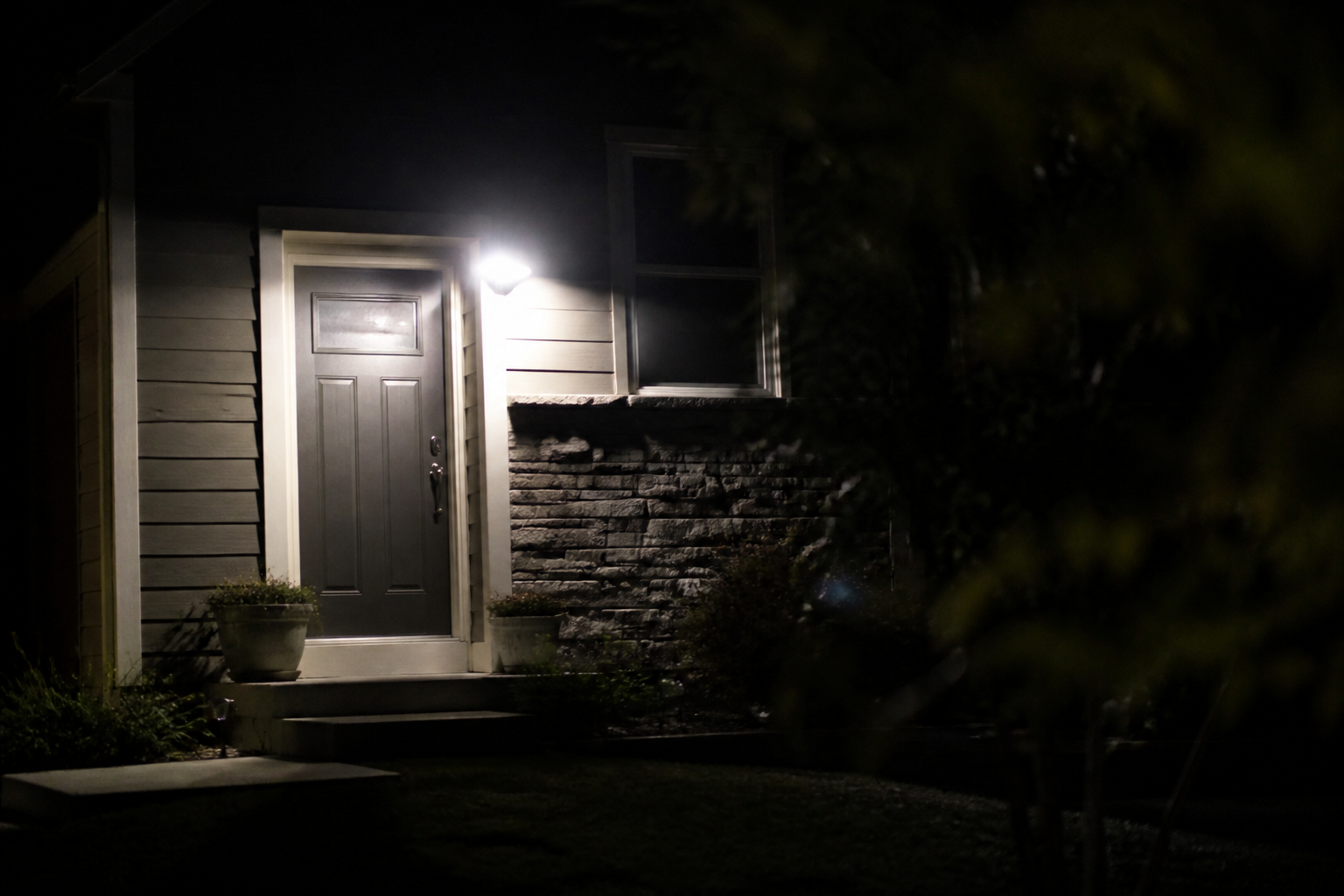
Darkness removes the social deterrence that ambient light provides. A neighborhood that normally has porch lights, interior lighting, and active street lamps becomes significantly easier to move through undetected. Motion-activated lighting powered by its own battery source — not the grid — directly counters this. Even a single bright light triggered at an unexpected moment disrupts the confidence of someone who assumed the environment was dark and static.
Delayed response is the second factor. During large-scale outages, law enforcement resources are often stretched across a wider set of priorities: traffic control at dead signals, medical emergencies, downed lines. The realistic window between an incident and a response extends. This doesn't mean you're on your own in any dramatic sense, but it does mean that deterrence and early detection carry more weight than usual. An alarm that wakes you up and your neighbors matters more when a monitoring center's response time has doubled.
Both of these factors point toward the same design principle: make your property a harder, noisier, more visible target than the next one. Opportunistic burglars, by definition, are looking for low-effort entries. Layers that require them to work, make noise, or risk exposure are often enough.
Physical Layers That Work Without Any Power at All
Passive physical security requires no electricity and no monitoring — it's the foundation every other layer sits on, and it's the one that never fails in a blackout.
Door frames are the first priority. The majority of forced entries are through doors, and the weakest point is almost always the strike plate — the small metal plate the latch or deadbolt seats into. Standard strike plates are held by half-inch screws into soft door casing. Replacing them with a heavy-gauge steel strike plate secured with 3-inch screws into the structural framing is a one-time fix that dramatically increases kick-in resistance. The Door Security Council and security researchers consistently identify this as the highest-return physical upgrade a homeowner can make.
Door jammers — also called security bars or floor braces — add a second line of resistance that is entirely mechanical. A properly seated door jammer transfers force from a kick directly into the floor, and no amount of striking the door itself will move it. This works during a blackout, during a power outage, during any scenario. It requires no batteries and no connectivity.
Window security film is another passive layer worth mentioning. It doesn't prevent glass from breaking, but it holds shards together, which slows entry significantly and turns a quick smash-and-enter into a prolonged, noisy effort. Combined with window pins or key locks, it raises the time and noise cost of a window entry considerably.
Perimeter awareness is the last passive layer. Gravel paths, locked gates, and cleared sightlines around the property reduce the concealment available to someone approaching your home. These are slow, unsexy improvements — but they compound with every other layer you add.
- Replace standard strike plates with heavy-gauge steel versions secured with 3-inch screws
- Use a door jammer or security bar on primary entry points
- Apply security film to ground-floor windows
- Add window pins or secondary locks to sliding doors and windows
- Clear brush and obstructions that provide concealment near entry points
- Use gravel or bark over soft ground near windows to make quiet approach harder
Battery-Powered Detection: Tripwires, Motion Sensors, and Standalone Alarms
Battery-operated detection systems are your early-warning layer during an outage — they don't require the grid, they don't rely on your router, and they operate independently of whatever your main alarm system is doing.
Perimeter tripwires are among the most underused tools in residential security. In their simplest form, these are thin-gauge cords or monofilament strung at ankle height across likely approach paths — attached to a battery-powered alarm unit. They don't stop anyone, but they provide early warning before an intruder reaches a door or window, which is exactly what you need when you can't count on a monitored system to call someone for you. In a grid-down scenario, a few seconds of warning is a significant advantage.
Standalone door and window alarms run on watch batteries or AA cells and operate entirely independently of any network. A door that gets opened triggers a 100-110 dB alarm. They're not sophisticated, but they are reliable, and reliability is the correct metric when the grid is down. Many can be purchased for a few dollars each and placed on secondary entry points — basement windows, garage doors, interior doors between a garage and the living space.
Battery-powered motion sensors with floodlight capability address the darkness problem directly. Unlike a camera, a motion-activated floodlight doesn't require recording, storage, or connectivity to do its job. A sudden bright light in a dark yard is loud in its own way — it signals that something noticed movement, which is often sufficient deterrence on its own.
The key principle across all of these is independence. Every detection layer that runs on its own batteries is one that survives the grid failure intact. Layer three or four of these — perimeter tripwires, door contact alarms, a motion floodlight — and you've rebuilt a functional early-warning system that operates entirely off-grid.
Our Recommendation: Anti-Looter Kit
The core problem this article addresses is real and specific: when the grid goes down, the typical home's security infrastructure partially or fully fails, and that failure coincides with the exact conditions — darkness, reduced police presence, visible community stress — that raise break-in risk.
The gap in a purely DIY approach is integration and completeness. Buying a strike plate here, a door alarm there, stringing your own tripwire in the dark takes time, trial and error, and some baseline knowledge. Most households don't have all the components sourced before an emergency, and improvising them during one is harder than it sounds. What you actually need is a cohesive set of components — motion sensors, perimeter tripwires, door alarms, a battery-powered floodlight, and a door jammer — that can be deployed quickly and work together without any grid connection.
The Anti-Looter Kit is built around exactly that problem. Marketed as intelligence-agency-inspired residential protection, it bundles the specific components that close the grid-down security gap: motion sensors, perimeter tripwires, door alarms, a floodlight, and a door jammer — all designed to function during power outages when police response may be delayed or unavailable. If you've been meaning to close this gap in your preparedness setup, this kit is a practical starting point worth looking at. For the next step, read Palm Stick Self-Defense for Beginners: How to Defend Yourself Against a Stronger Attacker in Close Quarters.
Our recommendation
Anti-Looter Kit
Check availability →This article contains an affiliate link. If you buy through it, we may earn a commission at no extra cost to you.
Frequently asked questions
How long does a home alarm system battery last during a power outage?
Most residential alarm panel backup batteries last between 4 and 24 hours on standby, and significantly less under active use. After that window, the panel loses function entirely unless it's connected to a generator or other independent power source.
Do break-ins actually increase during power outages?
Yes, documented increases in opportunistic theft and property crime have been observed during extended blackouts. Reduced lighting, stretched law enforcement resources, and visible community disruption all contribute. FEMA and local law enforcement after major outage events have noted this pattern.
What is the most effective physical security upgrade for a door?
Replacing the standard strike plate with a heavy-gauge steel strike plate secured by 3-inch screws into the structural framing is consistently identified by security researchers as the highest-return single door upgrade. Adding a floor-braced door jammer provides a second, entirely mechanical layer of resistance.
Can I use a tripwire alarm around my house during an emergency?
Yes. Battery-powered perimeter tripwire alarms are a legitimate early-warning tool for residential use. They run on standard batteries with no grid connection required, and they alert you to someone approaching before they reach a door or window — useful when you can't rely on a monitored alarm system.
What home security measures work without electricity?
Mechanical and battery-powered measures work without grid power: reinforced strike plates, door jammers, door and window contact alarms on watch or AA batteries, battery-powered motion floodlights, and perimeter tripwire alarms. These layers function independently of the grid and remain operational through extended outages.
Sources
- FEMA: Power Outages — Ready.gov
- FEMA: Community Preparedness and Crime During Disasters
- NIST: Residential Door and Frame Security Research
General preparedness information, not medical or legal advice. Follow instructions from your local emergency authority during an active event.
Field notes by email
Get the next guide before you need it
One email when a new field guide drops — water, food, power, medicine. No spam, no daily noise, unsubscribe in one click.
Comments on this guide
Questions, corrections and field reports from your own setup are welcome.
No comments yet. Be the first to add a field report.