
Security
Palm Stick Self-Defense for Beginners: How to Defend Yourself Against a Stronger Attacker in Close Quarters

By Ephraim Rusk · · 10 min read
This article contains an affiliate link. If you buy through it, we may earn a commission at no extra cost to you.
Quick answer
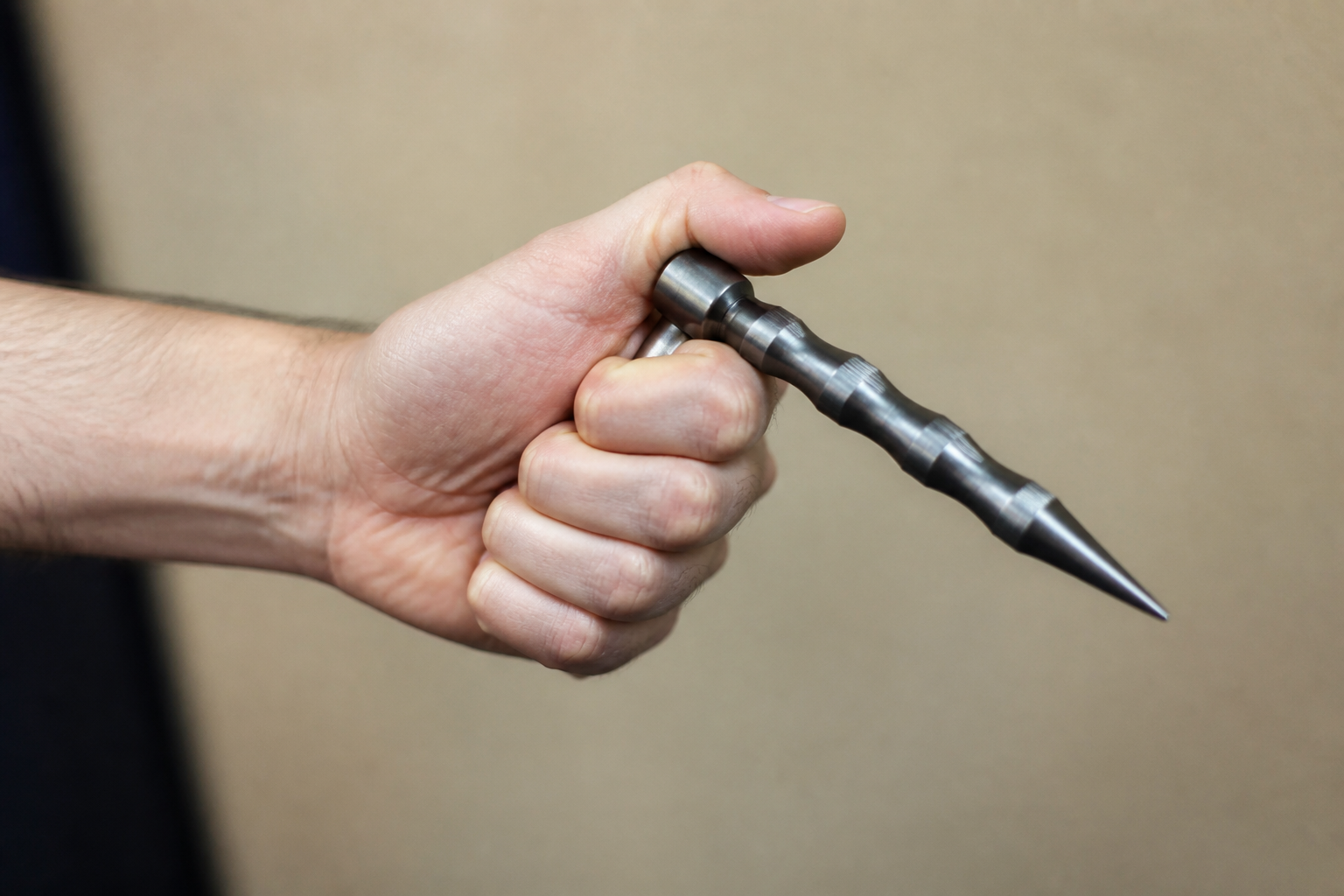
A palm stick (kubotan or tactical pen) gives a smaller or weaker person meaningful mechanical advantage in close-quarters confrontations by concentrating force into pressure points and joint locks. Effective use requires learning a small set of specific techniques — not just owning the tool.
Palm stick self-defense for beginners starts with a simple mechanical reality: a short, rigid rod held in your fist multiplies the force of a strike and lets you target nerve clusters and joints that a bare fist simply can't reach effectively. That is why law enforcement trainers have taught kubotan and palm-stick technique for decades — the physics work regardless of your size or strength relative to your attacker.
The problem is that most people who carry a kubotan, tactical pen, or similar tool have never practiced a single technique with it. They bought the tool, dropped it in a bag, and assumed proximity to the object equals capability. It does not. A palm stick used without trained mechanics is barely more useful than a bare hand — and at close quarters against someone bigger, that gap matters.
This article covers what palm stick technique actually involves, who it is genuinely suited for, what you need to practice before a real situation, and the honest limitations of the tool. If you are a prepper or homesteader who has considered adding a palm stick to your everyday carry or home-defense kit, read this before you assume the hardware alone is enough.
What a Palm Stick Actually Is (And What It Is Not)
A palm stick is any short, blunt rod — roughly 5 to 6 inches long — designed to be gripped in the fist with one or both ends protruding. The kubotan, developed by Soke Takayuki Kubota in the 1970s for law enforcement, is the original commercial version. Tactical pens and purpose-built striking tools serve the same mechanical function. The tool is not a weapon in the legal sense in most U.S. jurisdictions, which is part of why it travels well — but you should check your own state and local laws before carrying any of these.
What the tool provides is force concentration. When you strike with a bare fist, the load spreads across several square inches of knuckle. When the same strike is backed by a palm stick protruding from the bottom of your fist, that energy transfers through a surface roughly the diameter of a pencil eraser. The same muscular effort produces a dramatically different result at a nerve cluster, a joint, or a bone. That is the entire mechanical case for the tool.
What a palm stick is not: a magic equalizer, a ranged deterrent, or a substitute for awareness and avoidance. It is a close-quarters tool — effective at zero to about two feet — and it requires the attacker to already be inside your space. Anyone who markets it as a universal self-defense solution is overselling it. Used correctly, in the scenario it is actually designed for, it is genuinely useful. That scenario is specific: you cannot escape, the attacker is physically larger or stronger, and contact is unavoidable.
Core Techniques Every Beginner Needs to Understand
Palm stick defense is built around four technical families: pressure-point activation, joint manipulation, reinforced strikes, and weapon retention. Beginners need at least a working understanding of all four before any of them become reliable under stress.
Pressure-point activation targets specific nerve clusters — the radial nerve on the forearm, the brachial plexus tie-in at the shoulder, the common peroneal nerve at the outer knee — where the palm stick's concentrated tip produces pain compliance that a bare-hand grab cannot reliably replicate. The key word is 'reliably.' Pain compliance fails on people who are intoxicated, in adrenaline flood, or simply have high pain tolerance. This is why pressure-point technique is one layer, not the whole system.
Joint manipulation with a palm stick uses the tool as a lever against wrist and elbow joints, forcing a wrist lock or arm bar with significantly less physical strength required than bare-hand technique. This is where the tool offers its clearest advantage to a smaller defender: leverage is physics, not athleticism. You are not overpowering the attacker; you are redirecting force through a joint that has a fixed range of motion.
Reinforced strikes mean using the palm stick to back a hammer-fist or edge-of-hand blow, concentrating the impact and reducing the risk of hand injury to the defender. For homesteaders and preppers thinking about a grid-down scenario where medical care is distant, not breaking your own hand during a defensive situation is a real consideration.
Weapon retention is the technique most beginners skip entirely, and it is critical. In a real struggle at close quarters, someone will attempt to grab or strip the tool. Retention grips and transitional movements are part of any complete palm-stick curriculum — and their absence from most casual YouTube tutorials is a significant gap.
- Pressure-point activation: nerve-cluster targeting for pain compliance
- Joint manipulation: wrist locks and arm bars using the stick as a lever
- Reinforced strikes: hammer-fist and edge-of-hand backed by the tool
- Weapon retention: keeping control of the stick when the attacker grabs for it
Honest Limitations and Legal Considerations
Palm stick technique has real limitations that any responsible instructor will tell you upfront. The tool works at contact range — if the attacker is not already inside arm's reach, you have no advantage from it. The moment a confrontation involves a firearm at any significant distance, the calculus changes entirely and the right answer is almost always escape and cover, not close-quarters technique.
Pain compliance, which makes up a substantial portion of palm-stick application, is unreliable against attackers under the influence of stimulants. The CDC's data on methamphetamine and fentanyl prevalence in the U.S. is relevant context here: a meaningful percentage of violent offenders in real-world incidents are not going to respond normally to pain signals. Technique built entirely around compliance assumes a sober attacker. Joint mechanics are more reliable than pain compliance for this reason — a locked joint fails regardless of the attacker's pain threshold.
On the legal side, even tools that are legal to carry can create liability questions when used. Use-of-force law varies significantly by state. The general standard — that defensive force must be proportionate to the threat — applies. Carrying any defensive tool without understanding your jurisdiction's self-defense statutes is a gap in your preparedness, not just your technique. RAND Corporation's research on self-defense law and the Department of Justice's Office for Victims of Crime both offer publicly accessible overviews of these frameworks.
Finally, stress inoculation matters. Techniques that work smoothly in a slow-speed practice session often degrade under real adrenaline. Any training approach worth your time should include scenario-based practice at increasing speed, not only static drilling of individual moves.
How to Start Training Without a Dojo or Expensive Gear
You do not need a martial arts school to begin building palm-stick competence, but you do need structured, sequenced instruction — not a random playlist of clips. The difference matters because bad movement patterns drilled at speed become very hard to unlearn, and several common beginner errors (thumb-in-fist grip, leading with the elbow before the hips, no follow-through on pressure-point application) actively reduce effectiveness and can injure your own hand.
A basic practice setup at home requires the palm stick itself (a kubotan runs $10 to $20, a quality tactical pen $25 to $60), a partner willing to serve as a slow-resistance training dummy at least occasionally, and a wall-mounted or hanging striking surface for solo strike development. Solo drilling against a target builds motor patterns for strikes; partner drilling at low speed is how you actually develop feel for joint manipulation and retention.
For solo practitioners, video-based instruction with clear mechanical breakdown — showing the grip, the body position, the angle of entry, and the common failure points — is the most accessible starting point. The critical quality filter is whether the instruction explains why each element works mechanically, not just what to do. If a video tells you to press 'here' without explaining what nerve or joint structure you are targeting, you will not be able to adapt when the situation is imperfect, which real situations always are.
Realistic training frequency for a beginner building foundational competence: three to four focused sessions per week, each 20 to 30 minutes, over roughly six to eight weeks. Consistency over intensity. After that baseline, maintenance training of two sessions per week sustains the patterns.
Our Recommendation: Hammer Concept Palm Stick Defense
Here is the core problem this article keeps coming back to: carrying a palm stick without trained technique provides almost no real defensive advantage in the close-quarters scenario the tool is actually designed for — and close quarters against a stronger or potentially armed attacker is exactly the situation preppers and homesteaders need to be prepared for.
The gap in the free-and-DIY approach is sequencing and depth. The YouTube clips exist, but they are scattered, inconsistent in quality, often skip weapon retention entirely, and rarely explain the mechanical why behind each technique — which means you cannot adapt when reality does not match the drill. Assembling a coherent curriculum from free sources takes more hours than most people invest, and you end up with gaps you do not even know are there.
Hammer Concept Palm Stick Defense is a structured video course — 26 lessons across more than three hours of instruction — built specifically for beginners who need to be effective in close-quarters scenarios against a stronger or potentially armed attacker and cannot simply rely on escape. It covers the full range of palm-stick application: strikes, pressure points, joint manipulation, and weapon retention, sequenced for someone starting from zero. The course is priced at €97 and comes with a 60-day money-back guarantee, which removes the financial risk of finding out whether the instruction quality holds up. If you have been carrying a kubotan or tactical pen and have not yet put serious structured training behind it, this is a straightforward way to close that gap. For the next step, read How to Secure Your Home During a Power Outage (When Your Alarm System Goes Dead).
Our recommendation
Hammer Concept Palm Stick Defense
Check availability →This article contains an affiliate link. If you buy through it, we may earn a commission at no extra cost to you.
Frequently asked questions
Is a palm stick legal to carry every day?
In most U.S. states, kubotans and tactical pens are legal to carry without a permit. However, some jurisdictions classify them as prohibited weapons or restrict them in specific locations (courthouses, schools, airports). You should verify your own state and local statutes before carrying any palm-stick device.
Can palm stick technique actually work against a bigger attacker?
Yes, within a specific range. Joint manipulation using the stick as a lever relies on physics, not strength — a locked joint fails regardless of body size. Pressure-point technique is less reliable because pain compliance depends partly on the attacker's state. Training both families of technique together improves your odds significantly over bare-hand defense.
How long does it take to learn basic palm stick self-defense?
A focused beginner can build functional foundational technique in six to eight weeks at three to four short sessions per week. 'Functional' means reliable under moderate stress, not competition-level. Deeper skill — scenario adaptation, weapon retention under resisting pressure — takes several months of consistent practice.
What is the difference between a kubotan, a tactical pen, and a palm stick?
They serve the same mechanical function and use the same techniques. A kubotan is a dedicated blunt-tipped rod, usually with a key ring. A tactical pen is a writing instrument built to the same approximate dimensions with a hardened tip. 'Palm stick' is the general category term covering both, plus improvised equivalents like a heavy marker or small flashlight.
Does palm stick self-defense work if the attacker has a weapon?
Palm-stick training does include scenarios where the attacker is armed, typically covering weapon deflection and disarm entries at close range. These are more advanced techniques and require significant repetition to build reliable reflexes. The first priority against an armed attacker at any distance is always escape if a viable option exists — palm-stick technique for armed scenarios is a last-resort skill, not a primary strategy.
Related guides
Sources
- CDC — Violence Prevention: Understanding Situational Risk Factors
- DOJ Office for Victims of Crime — Self-Defense and the Law
- NIH — Human Musculoskeletal Joint Mechanics and Force Transmission
General preparedness information, not medical or legal advice. Follow instructions from your local emergency authority during an active event.
Field notes by email
Get the next guide before you need it
One email when a new field guide drops — water, food, power, medicine. No spam, no daily noise, unsubscribe in one click.
Comments on this guide
Questions, corrections and field reports from your own setup are welcome.
No comments yet. Be the first to add a field report.