
Food
Long-Term Food Storage: Building a 90-Day Pantry That Works

By Ephraim Rusk · · 12 min read
Quick answer
Build a 90-day pantry from calorie math (~180,000 kcal per person), storing cheap dense staples like rice, beans and oil in mylar bags with oxygen absorbers, and rotating it so it stays edible for decades instead of quietly expiring.
Modern grocery supply runs on roughly three days of shelf inventory. A storm warning, a fuel disruption or a payment-system outage empties shelves long before the underlying problem is solved. A stocked pantry is not a doomsday statement — it is the same logic as a spare tyre.
This guide builds a 90-day pantry from calories up, using the storage science published by the USDA and Utah State University's extension research rather than marketing claims from bucket vendors.
Start with calories, not recipes
An average adult needs about 2,000 kcal per day; active adults and teenagers need more. Ninety days is therefore roughly 180,000 kcal per person — a number that immediately reframes what you buy. A pallet of freeze-dried entrées looks impressive and often carries fewer calories than one sack of rice.
Build the base from cheap, dense staples, then layer flavour and nutrition on top.
- Grains: rice, oats, pasta, wheat berries, cornmeal — ~1,600 kcal/lb
- Legumes: dried beans, lentils, split peas — protein and fibre
- Fats: cooking oil, ghee, peanut butter — highest calorie density, shortest shelf life
- Sugars: honey, white sugar — morale, preservation, and energy
- Protein: canned fish and meat, powdered milk, TVP
- Micronutrients: multivitamins, dried fruit, canned vegetables
Realistic shelf life
Properly packaged low-moisture staples last far longer than package dates suggest. Utah State University Extension's long-term storage research reports that wheat, white rice, dry beans, rolled oats, pasta and powdered milk stored in sealed containers with oxygen absorbers in cool conditions remain acceptable for 20 to 30 years.
Everything else is shorter. Brown rice and whole-grain flours contain oil and go rancid in six to twelve months at room temperature. Cooking oil lasts one to two years. Canned goods are typically good for two to five years and often much longer if the can is undamaged and stored cool — swelling, rust through the seam, or a broken seal means discard without tasting.
Temperature dominates all of it. Storage life roughly halves for every 10 °C (18 °F) increase. A 21 °C basement outperforms a 32 °C garage by years.
Packaging: mylar, oxygen absorbers and buckets
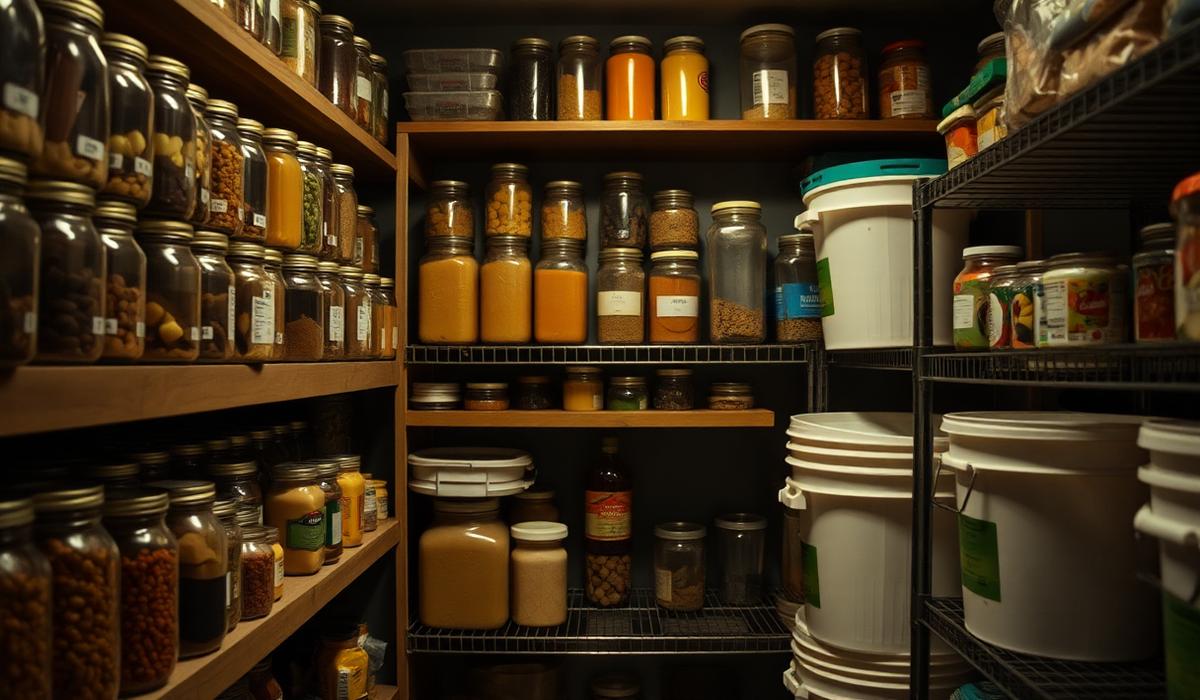
For dry staples the standard method is a 5-gallon food-grade bucket lined with a 5-mil mylar bag, filled, dosed with 2,000 cc of oxygen absorbers, and heat-sealed with a household iron across a straight edge.
Two rules decide whether this works. First, the food must be dry — under about 10% moisture — because sealing damp food in a low-oxygen environment creates the exact conditions botulism spores prefer. Second, oxygen absorbers begin working the moment air hits them: open one bag of absorbers at a time and store the rest in a sealed jar.
Do not vacuum-seal or oxygen-absorb anything with meaningful moisture or oil content: brown rice, nuts, jerky and granola belong in the freezer or in short rotation instead.
Rotation beats accumulation
The most common failure is a wall of buckets nobody ever opens, quietly aging past usefulness while the family eats takeout. A pantry only works if it moves.
Run two tiers. Tier one is a deep version of your normal kitchen — the tinned tomatoes, pasta, coffee and oil you already use — stored first-in-first-out and replenished on every shop. Tier two is the sealed long-term base you open once a year to inspect and cook from deliberately.
Date every container on the day you pack it. Keep a single sheet of paper (not only a spreadsheet) listing what is stored and where.
Cooking without a grid
Dry beans need one to two hours of boiling. If your power plan is a torch and hope, half your pantry is theoretical. Pair storage with fuel: a propane camp stove with spare canisters, a rocket stove that burns twigs, or a thermal cooker that finishes a boiled pot with no further fuel.
Keep at least a week of food that needs no cooking at all — canned fish, peanut butter, crackers, dried fruit, UHT milk — for the first chaotic days when you are dealing with everything else.
Store water for cooking on top of drinking water. Rehydrating beans and rice can add half a gallon per person per day.
Food safety during a power outage
USDA guidance is precise and worth memorising: a closed refrigerator holds safe temperatures for about 4 hours, a full freezer for about 48 hours, and a half-full freezer for about 24 hours. Keep the doors shut.
Discard perishable food that has been above 4 °C (40 °F) for more than two hours. Never taste food to test it, and never rely on smell — the pathogens that matter are odourless. Frozen food with ice crystals still present can be refrozen safely, though texture suffers.
The 90-day build, one month at a time
Month one: buy 30 days of the staples above for each person, plus a manual can opener and a multivitamin bottle. Month two: package the dry base into mylar and buckets, and add cooking fuel. Month three: fill gaps — spices, salt, coffee, comfort food, pet food, and anything medical or dietary your household actually needs.
Then cook a full week of meals from storage alone. The gaps you discover during that week are the real shopping list. For the next step, read How to Grow Enough Food in a Small Backyard to Meaningfully Cut Your Grocery Bill.
Sources
- USDA FSIS — Food Safety During Power Outage
- Utah State University Extension — Food Storage
- Ready.gov — Food
General preparedness information, not medical or legal advice. Follow instructions from your local emergency authority during an active event.
Field notes by email
Get the next guide before you need it
One email when a new field guide drops — water, food, power, medicine. No spam, no daily noise, unsubscribe in one click.
Comments on this guide
Questions, corrections and field reports from your own setup are welcome.
No comments yet. Be the first to add a field report.