
Medicine
Treating Wounds Without a Doctor: Home Remedies That Actually Work (and What to Avoid)

By Ephraim Rusk · · 11 min read
This article contains an affiliate link. If you buy through it, we may earn a commission at no extra cost to you.
Quick answer
To treat a wound without a doctor, irrigate it thoroughly with clean water or saline, control bleeding with direct pressure, and keep it covered and moist. Several plant and household remedies — including honey, plantain leaf, and dilute povidone-iodine — have real evidence supporting their use when professional care is unavailable.
Treating wounds without a doctor is a skill every household should have before it needs it. Whether you are three hours from the nearest ER, dealing with a grid-down scenario, or simply trying to handle a deep cut responsibly at 2 a.m., the gap between doing it right and doing it wrong is significant — and the consequences of getting it wrong can move from a minor laceration to a life-threatening infection within 48 hours.
Most people know roughly what to do for a scraped knee. Fewer people know how to correctly irrigate a puncture wound, how to recognize the early signs of cellulitis, which common household substances actively damage healing tissue and should never touch a wound, or which plant-based remedies have credible evidence behind them versus pure folk tradition. That distinction matters enormously when you cannot call for backup.
This article covers the full sequence: immediate wound management, evidence-grounded home remedies for cleaning and promoting healing, what to stock before you need it, and the hard lines that tell you a wound has exceeded home-care capacity. Nothing here is a substitute for professional medical care when that care is accessible. But when it is not, a prepared household with sound knowledge does meaningfully better than one that is winging it.
The First 10 Minutes: Stop Bleeding and Irrigate Properly
Controlling bleeding and flushing the wound thoroughly are the two most important things you can do in the first ten minutes — both are simple, and both are frequently done wrong.
For bleeding control, apply firm, direct pressure using the cleanest material available. Do not lift the dressing to check; doing so disrupts clot formation. Maintain steady pressure for a full ten minutes by the clock before assessing. Elevating the wound site above heart level reduces arterial pressure and slows bleeding. Tourniquets are for life-threatening extremity hemorrhage only — apply two to three inches above the wound, note the time, and do not remove in the field.
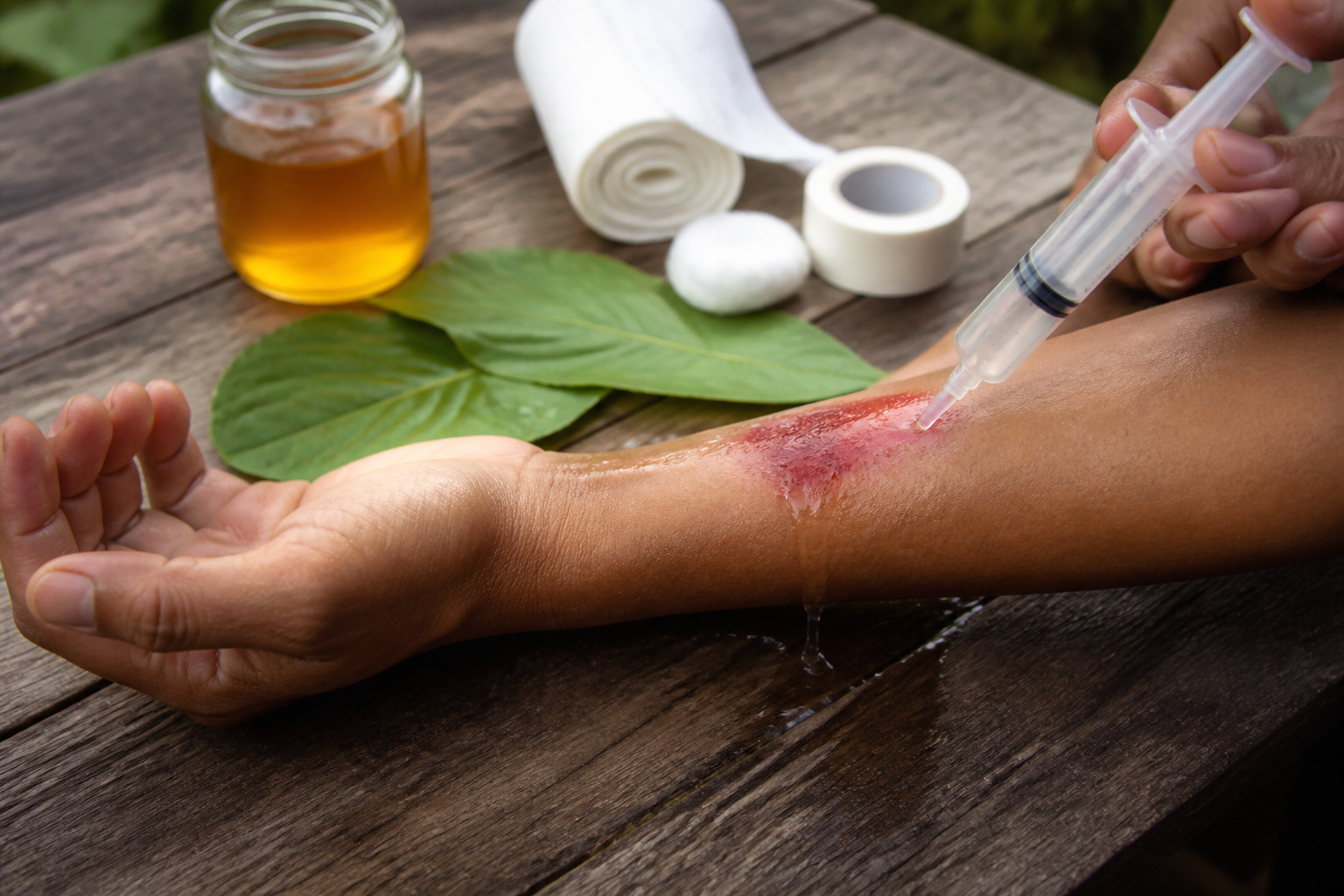
Irrigation is where most home wound care falls short. A wound that is not adequately flushed retains bacteria and debris, setting up conditions for infection regardless of what you apply afterward. The research-supported method is high-pressure irrigation: fill a large syringe or squeeze bottle with clean water or normal saline and flush forcefully and repeatedly until the wound looks visually clean. The American College of Emergency Physicians supports using potable tap water for wound irrigation — it performs comparably to sterile saline in studies of clean lacerations. Volume matters more than sterility here: use at least 50 to 100 milliliters per centimeter of wound length.
Puncture wounds deserve special attention. Because the opening is narrow, surface flushing is insufficient. You need to direct the irrigation stream into the puncture channel itself, as these wounds carry a higher risk of anaerobic infection and tetanus. If the wound was caused by a rusty object, animal bite, or foreign material and you cannot confirm tetanus vaccination is current within the last five to ten years, this is a hard line for seeking professional care when it becomes possible.
What Not to Put on a Wound (Common Mistakes That Delay Healing)
Several substances most people reach for instinctively are actually harmful to wound healing and should be avoided in all but specific circumstances.
Hydrogen peroxide is the most common offender. It does kill surface bacteria — but it also destroys the fibroblasts and newly forming granulation tissue that are doing the actual work of healing your wound. Research published in wound care literature consistently shows that hydrogen peroxide delays closure and increases scarring. Reserve it at most for the very first clean of a heavily contaminated wound, and never use it for ongoing wound care.
Full-strength iodine solution carries a similar problem. Povidone-iodine (Betadine) at the standard 10 percent concentration is cytotoxic to healing tissue. If you use it, dilute it to a 0.5 to 1 percent solution — visually, this means diluting until it looks like weak tea — and use it only for initial decontamination, not daily wound care.
Rubbing alcohol is appropriate for sterilizing your tools and the surrounding skin, not for inside the wound itself. It causes cellular damage and significant pain without adding meaningful benefit over proper irrigation.
Closing a wound that is not clean is also a critical mistake. Deep punctures, animal bites, and any wound you suspect is contaminated should not be closed — they need to drain. Sealing bacteria inside a wound cavity is how you end up with an abscess or, in worst cases, a spreading necrotizing infection.
Finally, keeping a wound too dry is counterproductive. The old approach of 'let it air out and scab over' has been largely replaced in wound care research by moist wound healing — covering the wound with a clean, slightly moistened dressing or an appropriate barrier promotes faster epithelialization and reduces scarring.
Evidence-Grounded Home Remedies for Wound Care
Several plant-based and household remedies have genuine supporting evidence for wound care — not folklore, but documented mechanisms or clinical studies worth knowing about.
Raw honey, particularly Manuka honey, is the most well-supported natural wound remedy in the clinical literature. Honey creates an osmotic environment hostile to bacteria, generates low levels of hydrogen peroxide through enzymatic activity, maintains wound moisture, and has a pH that promotes healing. The National Institutes of Health database includes multiple peer-reviewed studies supporting honey's use on infected and chronic wounds. Standard supermarket honey provides some benefit; medical-grade Manuka honey (UMF 10+ or higher) provides more. Apply a thin layer directly to the wound bed and cover with a clean dressing.
Plantain leaf (Plantago major or Plantago lanceolata — the common lawn weed, not the banana) has been used in wound care across many cultures and has some laboratory evidence supporting anti-inflammatory and antimicrobial activity. A clean, freshly bruised leaf pressed against a minor wound or used as a poultice is a reasonable field measure. The evidence is less robust than for honey, but the risk profile is low and the plant is widely available.
Aloe vera gel applied from a fresh leaf has demonstrated wound-healing properties in several clinical studies, particularly for burns and abrasions. It reduces inflammation, maintains moisture, and has some antimicrobial activity. Avoid commercial aloe products with added alcohol or fragrance — use the raw gel directly from the leaf.
Garlic (allicin, the active compound) has documented antimicrobial properties in laboratory settings. However, applying raw garlic directly to a wound can cause chemical burns and skin damage. This is a case where the traditional use outpaces its safety profile for topical wound care — it is better as a supplemental antimicrobial support taken internally.
Calendula (pot marigold) preparations — tinctures or infused oils — have modest evidence for anti-inflammatory and antimicrobial activity in wound healing, with a very low risk of adverse effects. Calendula is a reasonable addition to a home preparedness kit and is straightforward to prepare from dried flowers.
- Medical-grade honey (Manuka UMF 10+): apply directly to wound bed, cover with dressing
- Plantain leaf poultice: clean, bruise fresh leaves, apply to minor wounds as a field measure
- Aloe vera gel: raw from fresh leaf for burns and abrasions, not commercial products with additives
- Dilute povidone-iodine (0.5-1%): initial decontamination only, not ongoing care
- Calendula tincture or oil: anti-inflammatory support for slow-healing or minor infected wounds
Recognizing Infection: The Warning Signs That Change Everything
A wound that becomes infected requires a different response — the signs are specific and the timeline for escalation is short.
Some redness and warmth immediately around a wound in the first 24 to 48 hours is a normal inflammatory response. The signs that indicate infection rather than normal inflammation include: redness that is spreading beyond the wound margins, increasing rather than decreasing pain after the first day, wound edges that are warm to touch and swollen, cloudy or purulent (pus-containing) discharge, red streaking extending away from the wound toward the trunk or a lymph node, fever above 101°F (38.3°C), and increasing malaise or confusion.
Red streaking moving up a limb — sometimes called 'blood poisoning' in folk terminology — indicates that a bacterial infection is tracking along the lymphatic system and is a genuine emergency. This requires antibiotics and, if possible, immediate professional care.
Cellulitis — a spreading bacterial infection of the skin and underlying tissue — can progress rapidly and is not reliably treatable with home remedies alone. Systemic antibiotics are the standard treatment. If you have antibiotic supplies in your preparedness kit, the common approach for skin infections is a course of first-generation cephalosporins or amoxicillin-clavulanate — but antibiotic selection and dosing decisions are outside the scope of general guidance and are exactly the kind of decision that benefits from a physician-authored reference when professional consultation is unavailable.
The hard rule: if a wound shows signs of spreading infection, systemic symptoms, or red streaking, home remedies are no longer the primary intervention. Your job becomes managing the situation while getting the patient to professional care as quickly as possible.
Our Recommendation: The Doctor's Book of Survival Home Remedies
The core problem this article documents is a real one: the gap between general first-aid knowledge and the specific, decision-level guidance you need when a wound — or any of a dozen other medical emergencies — progresses beyond the basics and professional care is not immediately available.
The honest limitation of articles like this one is scope. A wound that becomes infected, a burn that covers a significant surface area, a puncture with suspected foreign body, a bite wound with infection risk — each of these creates a branch point that requires more granular, physician-level guidance than a blog post can responsibly provide. General internet searches in that moment return conflicting information, unverified claims, and no clear hierarchy for decision-making. That friction — knowing something is wrong, not knowing exactly what to do about it — is what makes the difference between a managed situation and a preventable crisis.
The Doctor's Book of Survival Home Remedies addresses that gap directly. Written by Dr. John Herzog, a board-certified surgeon, the 400-page guide covers roughly 20 common medical emergencies — including wound care, infection, and conditions across multiple body systems — using plant, herb, and household-item remedies framed as science-based rather than folk tradition. At $37, it is a one-time cost for a physical reference that is available when the internet is not. If wound management, infection recognition, and evidence-grounded home treatment for emergencies are gaps in your preparedness library, this is the specific resource worth adding. You can find it through the link below. For the next step, read Natural Remedies for Upset Stomach Without Medicine: What Actually Works.
Our recommendation
The Doctor's Book of Survival Home Remedies
Check availability →This article contains an affiliate link. If you buy through it, we may earn a commission at no extra cost to you.
Frequently asked questions
Can you use tap water to clean a wound instead of sterile saline?
Yes. Research supports clean potable tap water as an effective wound irrigation fluid — it performs comparably to sterile saline for clean lacerations in studies. The key factor is volume and pressure, not sterility. Use at least 50 to 100 milliliters per centimeter of wound length, delivered forcefully with a syringe or squeeze bottle.
How do I know if a wound is infected or just inflamed?
Normal inflammation peaks in the first 24 to 48 hours and then decreases. Signs of infection include spreading redness beyond wound edges, increasing rather than decreasing pain after day one, cloudy or pus-containing discharge, red streaking moving away from the wound, and fever above 101°F. If streaking is present, seek professional care urgently.
Is honey actually effective for wound healing?
Medical-grade honey, particularly Manuka honey rated UMF 10 or higher, has genuine clinical evidence behind it. It creates a hostile osmotic environment for bacteria, maintains wound moisture, and has a documented antimicrobial mechanism. Standard supermarket honey provides some benefit. It is one of the best-supported natural wound remedies available.
Why should you not use hydrogen peroxide on a wound?
Hydrogen peroxide kills surface bacteria but also destroys fibroblasts and new granulation tissue — the cells actively closing your wound. Clinical wound care research shows it delays healing and increases scarring. At most, use it once for an extremely contaminated wound during initial cleaning, then switch to saline or clean water for ongoing care.
When does a wound stop being safe to treat at home?
A wound exceeds home-care capacity when it shows signs of spreading infection (expanding redness, red streaking, fever), when it involves deep structures like tendons, bones, or joints, when caused by an animal bite or a contaminated object with uncertain tetanus coverage, or when bleeding cannot be controlled within 15 minutes of direct pressure.
Related guides
Sources
- NIH: Wound Irrigation and Infection Prevention
- NIH: Honey as a Topical Antibacterial Agent for Treatment of Infected Wounds
- CDC: Wound Care and Infection Prevention Guidance
- FEMA: Emergency First Aid — Ready.gov
General preparedness information, not medical or legal advice. Follow instructions from your local emergency authority during an active event.
Field notes by email
Get the next guide before you need it
One email when a new field guide drops — water, food, power, medicine. No spam, no daily noise, unsubscribe in one click.
Comments on this guide
Questions, corrections and field reports from your own setup are welcome.
No comments yet. Be the first to add a field report.