
Medicine
Herbal Remedies for Cold and Flu at Home: What Actually Works (and What Doesn't)

By Ephraim Rusk · · 10 min read
This article contains an affiliate link. If you buy through it, we may earn a commission at no extra cost to you.
Quick answer
Several herbal remedies — including elderberry extract, echinacea, ginger, and honey — have meaningful clinical or traditional evidence supporting symptom relief or modest duration reduction for cold and flu. None replace medical care for serious illness, but they are legitimate, low-cost options for managing mild symptoms when conventional medications are unavailable or unwanted.
Herbal remedies for cold and flu at home are not wishful thinking — some of them have enough clinical support to earn a place in a serious preparedness medicine kit. If you have ever been stuck with a head cold at a remote cabin, or watched your local pharmacy sell out of decongestants during a flu surge, you already understand why having a plant-based fallback matters.
The problem is that the herbal remedy space is drowning in folklore and marketing noise. Some remedies genuinely reduce symptom duration or severity. Others are essentially expensive placebos. Knowing which is which is the difference between practical preparedness and wasted pantry space — and wasted money when you actually need relief.
This article cuts through the noise. It covers the specific herbs with the best evidence, how to prepare them correctly, which common remedies you can skip, and when home treatment needs to stop and professional care needs to start.
What the Research Actually Says About Herbal Cold and Flu Remedies
The evidence for herbal cold and flu remedies ranges from solid to nonexistent, and it matters which category your remedy falls into. The strongest candidates are elderberry, echinacea, and honey — each backed by randomized controlled trials or systematic reviews, not just anecdote.
Elderberry (Sambucus nigra) is probably the most well-supported. A 2016 randomized, placebo-controlled trial published in Nutrients found that air travelers taking elderberry extract had significantly shorter and less severe colds than those taking a placebo. A 2017 meta-analysis in Complementary Medicine Research examined 14 studies and concluded that elderberry substantially reduces upper respiratory symptoms. The proposed mechanism — blocking viral surface proteins and modulating cytokine activity — is biologically plausible, though researchers continue to refine the details.
Echinacea has a messier evidence base. Some trials show a modest reduction in cold duration and a small preventive effect when taken at first symptom onset; others show no effect. The variation likely comes down to species (Echinacea purpurea has the strongest data), plant part used, and preparation method. A 2015 Cochrane review found some evidence of benefit but called the effect 'not fully convincing.' In practical terms: it is worth having if you grow or source the right species, but do not rely on it as your only tool.
Raw honey is straightforward. The WHO and multiple clinical trials have recognized it as an effective cough suppressant, particularly for children over 12 months. A 2021 BMJ Evidence-Based Medicine systematic review found honey more effective than usual care for upper respiratory symptoms, including cough frequency and severity. It is cheap, shelf-stable, and almost certainly already in your kitchen.
How to Prepare Elderberry, Echinacea, and Ginger at Home
Getting the preparation right is what separates a working remedy from a warm drink that does nothing. Each herb requires a specific method to extract the active compounds.
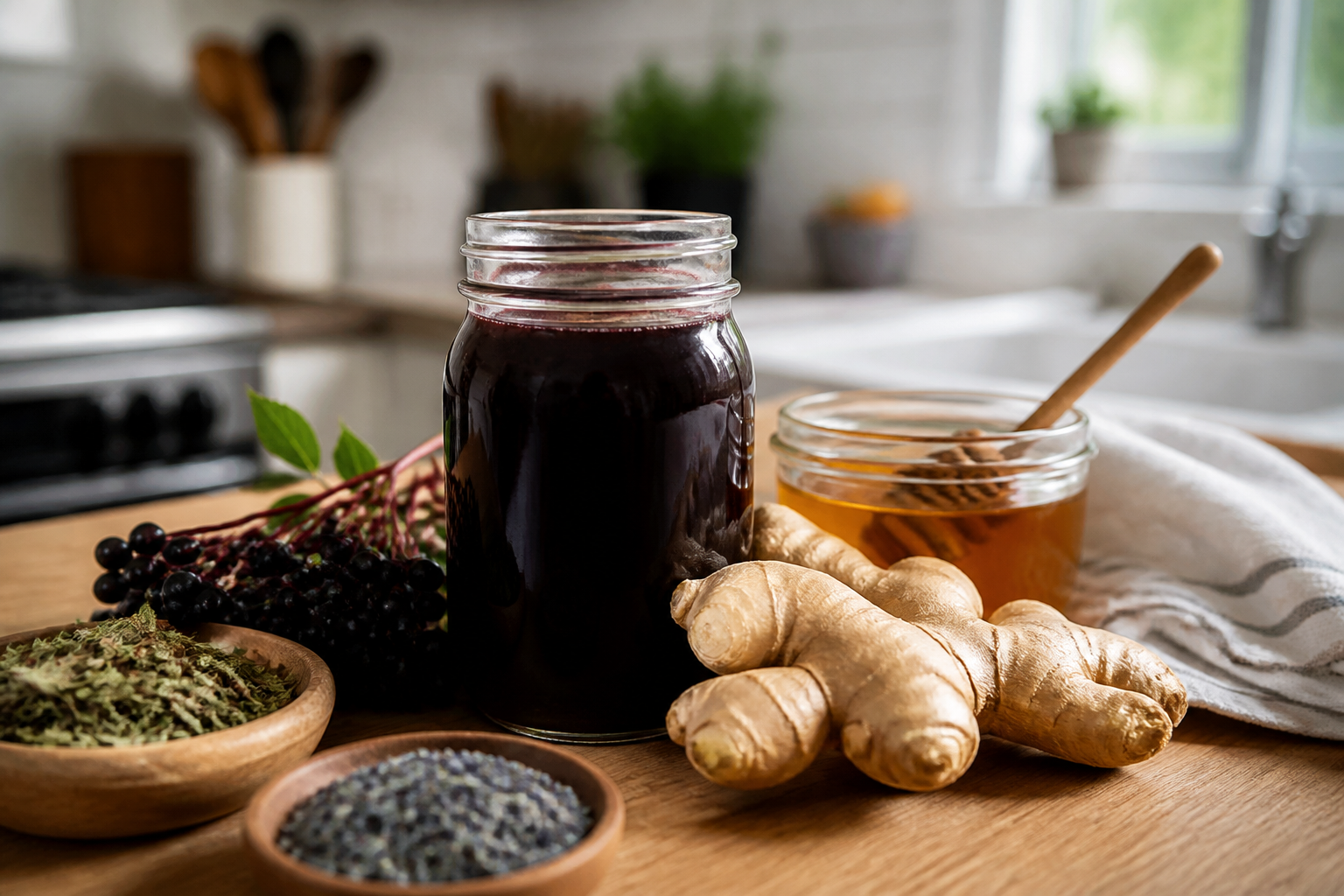
Elderberry syrup is the most practical home preparation. Combine one cup of dried elderberries with three cups of water, one cinnamon stick, five whole cloves, and one tablespoon of fresh ginger in a saucepan. Simmer uncovered for 45 minutes until the liquid reduces by roughly half. Cool, mash and strain the berries, then stir in one cup of raw honey once the liquid is below 104 degrees Fahrenheit (hot liquid degrades honey's antimicrobial compounds). Store in the refrigerator for up to two months. Important: never eat raw elderberries — the cyanogenic glycosides in uncooked berries and leaves can cause nausea and vomiting. The cooking process neutralizes them.
Echinacea tincture is the most efficient form because it has a long shelf life and concentrates the active alkylamides and polysaccharides. If you grow Echinacea purpurea, harvest roots in the fall of the plant's second year. Chop finely, fill a glass jar, cover completely with 80-proof vodka, seal, and store in a dark place for four to six weeks, shaking daily. Strain and bottle. Standard adult dosing in trials was 300 to 400 mg of dry extract equivalent, typically 2-3 times daily at symptom onset — work out the equivalent for your tincture concentration.
Ginger tea is the simplest and most versatile preparation. Slice one to two inches of fresh ginger root thin and steep in boiling water for 10 to 15 minutes, covered (keeping the lid on retains volatile compounds). Add lemon for vitamin C and honey for cough suppression. Ginger's gingerols have demonstrated anti-inflammatory and antiviral properties in laboratory studies, and it reliably helps with the nausea that often accompanies flu. It is not a cure, but it is genuinely useful comfort care.
Remedies You Can Safely Skip (and Why They Don't Hold Up)
Some of the most popular 'natural' cold remedies have little or no evidence behind them, and a few have real risks attached.
High-dose vitamin C is probably the most persistent myth. Linus Pauling's original 1970 claims launched a massive research program, and decades of trials have found that routine supplementation does not prevent colds in the general population. It may modestly shorten duration when taken at the very start of symptoms — a 2013 Cochrane review put the reduction at around 8 percent in adults — but you would need to start within the first 24 hours and the effect size is small. Eating foods high in vitamin C (bell peppers, citrus, kiwi) is worthwhile for general immune support; megadosing supplements for active cold treatment is not a strong play.
Zinc lozenges are more complicated. Some trials show a reduction in cold duration of a day or so when lozenges are started within 24 hours of symptom onset. The problem is tolerability: zinc acetate and zinc gluconate lozenges frequently cause nausea and a persistent metallic taste, and long-term high-dose zinc supplementation can impair copper absorption. If you use them, stick to the recommended short-term dosing on the label and do not use zinc nasal sprays — the FDA warned in 2009 that intranasal zinc products caused permanent loss of smell in some users.
Colloidal silver has no credible clinical evidence for treating cold or flu and carries real risks, including argyria (permanent skin discoloration) and interference with antibiotic absorption. Skip it entirely.
Oscillococcinum, the homeopathic flu remedy, contains no active ingredients at standard dilutions. A Cochrane review found no good evidence it treats or prevents flu. It is not dangerous, but at several dollars a dose it is not worth carrying in a preparedness kit.
When Home Treatment Needs to Stop
Knowing when to stop treating at home is as important as knowing which herbs to use — maybe more important.
Cold and flu symptoms that warrant immediate medical attention include difficulty breathing or shortness of breath, persistent chest pain or pressure, confusion or altered mental status, inability to keep fluids down for more than 24 hours, severe or worsening headache with stiff neck (possible meningitis), fever above 103 degrees Fahrenheit that does not respond to treatment, and any flu-like symptoms that improve then return with worsening fever and cough. That last pattern can signal secondary bacterial pneumonia.
In children under 5 and adults over 65, the thresholds are lower — dehydration and respiratory complications develop faster in those groups. Fast breathing, blue-tinged lips, or extreme lethargy in a child are 911 situations, not home treatment situations.
Herbal remedies are a complement to your preparedness medicine plan, not a replacement for knowing your evacuation routes and the location of your nearest urgent care. Build both skills simultaneously.
- Difficulty breathing or shortness of breath
- Chest pain or pressure
- Confusion or altered mental status
- Inability to keep fluids down for 24 or more hours
- Fever above 103 degrees Fahrenheit unresponsive to treatment
- Flu symptoms that improve then worsen with renewed fever and cough
- In children: fast breathing, blue lips, or extreme lethargy
Our Recommendation: Herbal Remedies for Everyday Ailments
A respiratory illness during a grid-down situation, a remote camping trip, or a simple pharmacy shortage puts you in a position where you either have a treatment plan or you are improvising at the worst possible moment. That gap — not knowing which preparation works, which dose, which plant part — is where people waste time and feel helpless.
The DIY approach to building this knowledge is real but scattered. Good information is spread across academic papers, foraging guides, and ethnobotany texts that most people do not have the time or background to synthesize. Free online sources range from well-researched to dangerously wrong, and sorting them takes longer than most people spend on any single preparedness topic.
Herbal Remedies for Everyday Ailments is a $12 ebook containing 100 herbal remedy recipes specifically for common ailments — the kind of minor but disruptive illnesses like cold, flu, digestive complaints, and skin irritations that make up the vast majority of medical incidents in any household. The recipes are built around household and garden ingredients, not specialty supplements. At $12 with a 60-day money-back guarantee, it is a low-stakes way to fill a real gap in your preparedness library before you actually need it. Pick up a copy and read the cold and flu section before this season starts. For the next step, read How to Treat a Wound Infection at Home When You Can't Get Antibiotics.
Our recommendation
Herbal Remedies for Everyday Ailments
Check availability →This article contains an affiliate link. If you buy through it, we may earn a commission at no extra cost to you.
Frequently asked questions
Does elderberry actually help with the flu?
Clinical evidence suggests elderberry extract can modestly reduce the duration and severity of flu and cold symptoms. A 2017 meta-analysis found it substantially reduced upper respiratory symptoms. It is not a cure and does not replace antiviral medications for serious flu, but it has more supporting evidence than most herbal cold remedies.
Is it safe to make elderberry syrup at home?
Yes, if you cook the berries fully. Raw elderberries contain cyanogenic glycosides that can cause nausea and vomiting. Simmering the berries for at least 45 minutes neutralizes these compounds. Never eat raw elderberries or use elderberry leaves or bark in preparations.
What herbal remedy works fastest for a sore throat?
Raw honey is your fastest option with the best evidence. It coats the throat, has demonstrated antimicrobial properties, and multiple clinical trials show it reduces cough severity and frequency better than placebo. Gargling with warm salt water also has solid evidence for temporary sore throat relief and costs essentially nothing.
Can you take echinacea every day to prevent colds?
The evidence for long-term daily echinacea as prevention is weak and inconsistent. Most trials that showed any benefit used short-term dosing at the first sign of illness. Long-term daily use has not been well-studied for safety, and there are theoretical concerns about immune system effects with continuous use. Short-term use at symptom onset is the better-supported approach.
What common herbs can I grow at home for cold and flu remedies?
Echinacea purpurea, elderberry (Sambucus nigra), ginger (in containers in most climates), lemon balm, and thyme are all practical garden choices. Thyme in particular has demonstrated antispasmodic and mild antimicrobial properties that support its traditional use for coughs. Elderberry grows vigorously in most temperate zones and a single mature shrub produces enough berries for a full season of syrup.
Related guides
Sources
- NIH National Center for Complementary and Integrative Health — Echinacea
- NIH National Center for Complementary and Integrative Health — Elderberry
- CDC — Flu: What to Do If You Get Sick
- NIH — Honey for Acute Cough in Children (PubMed review)
General preparedness information, not medical or legal advice. Follow instructions from your local emergency authority during an active event.
Field notes by email
Get the next guide before you need it
One email when a new field guide drops — water, food, power, medicine. No spam, no daily noise, unsubscribe in one click.
Comments on this guide
Questions, corrections and field reports from your own setup are welcome.
No comments yet. Be the first to add a field report.