
Power
DIY Off-Grid Power Systems for Beginners: What You Actually Need Before You Build

By Ephraim Rusk · · 10 min read
This article contains an affiliate link. If you buy through it, we may earn a commission at no extra cost to you.
Quick answer
A functional DIY off-grid power system requires four core components: a generation source (solar, wind, or other), a charge controller, a battery bank, and an inverter. Most beginners can build a modest system capable of running critical loads for $500–$2,000 in parts, but success depends on correctly sizing each component before buying anything.
DIY off-grid power system planning is the stage where most beginners spend the least time — and lose the most money. You can buy decent solar panels, a capable inverter, and a solid battery bank, and still end up with a system that underperforms or fails during the first extended outage if those components are not matched to each other and sized to your actual load.
This article is not about selling you on energy independence as a lifestyle. It is about giving you the honest technical foundation you need to make smart decisions before you buy a single component. We will cover what a real off-grid system looks like, what it costs to do it right versus cutting corners, and where the knowledge gaps are most likely to trip up a first-time builder.
If you have already started researching and feel like you are drowning in conflicting advice — expensive installer quotes, YouTube channels that gloss over the math, forums where everyone disagrees — that is a normal place to be. The goal here is to cut through that noise with information you can actually act on.
The Four Core Components Every Off-Grid Power System Needs
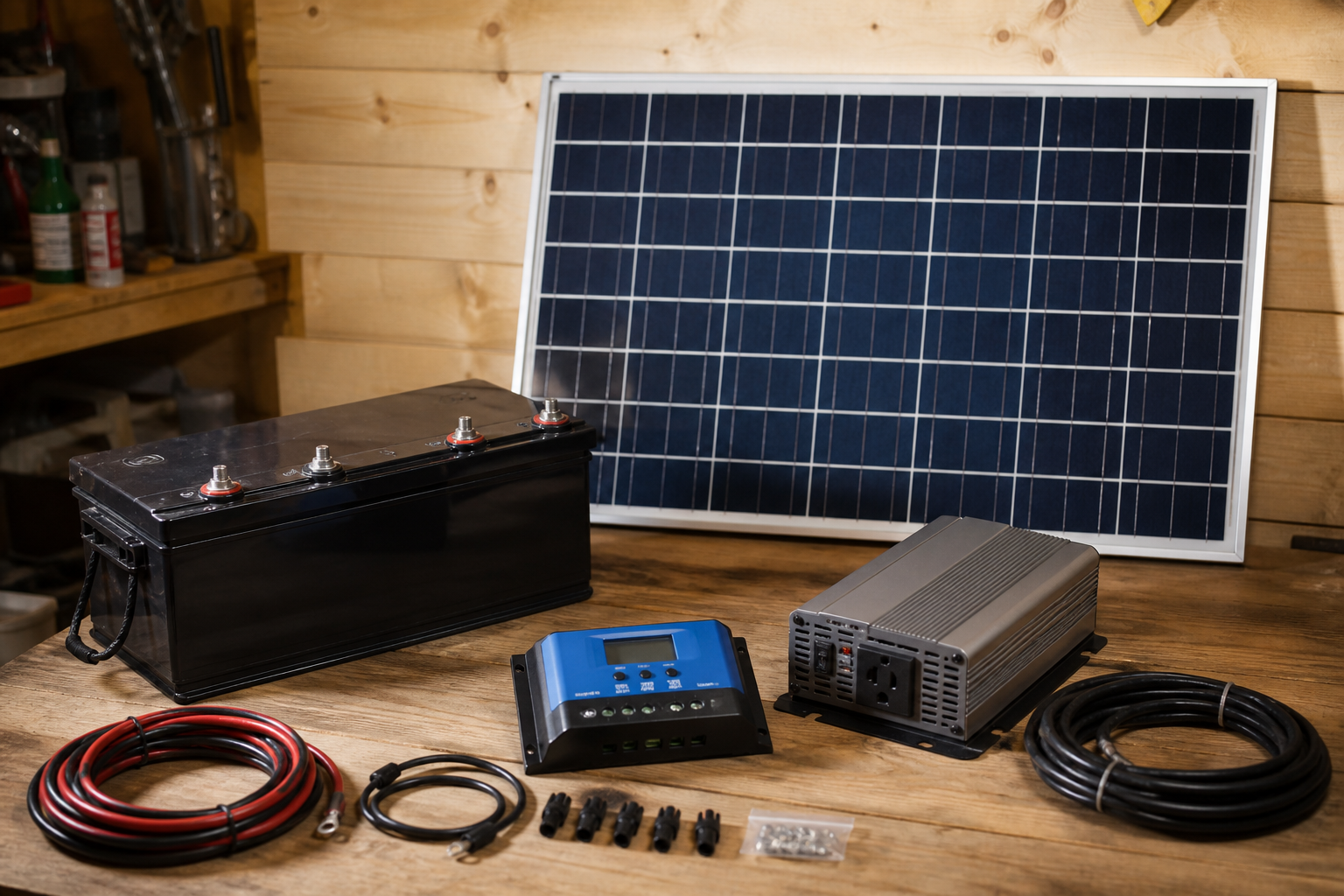
Every off-grid power system — regardless of the energy source — relies on the same four functional components: generation, regulation, storage, and conversion. Understanding what each one does and how they interact is the non-negotiable foundation of any build.
Generation is your energy source. For most residential DIY systems, this means solar photovoltaic panels. Wind turbines are an option in the right geography, and there are other alternative generation concepts circulating in the DIY community — we will touch on those later. Your generation capacity needs to match your average daily energy consumption plus a buffer for cloudy days or low-wind periods.
Regulation means a charge controller. This device sits between your panels and your battery bank and prevents overcharging, which degrades batteries quickly. MPPT (Maximum Power Point Tracking) controllers are more efficient than older PWM (Pulse Width Modulation) models and are generally worth the additional cost for systems larger than about 200 watts.
Storage is your battery bank. Lead-acid batteries (flooded or AGM) are the lowest upfront cost but require more maintenance and have a shorter usable lifespan than lithium iron phosphate (LiFePO4) options. Lithium batteries cost roughly two to three times more per kilowatt-hour of capacity but typically last three to five times as many charge cycles. Over a ten-year horizon, the math often favors lithium.
Conversion is your inverter. Most household appliances run on 120V AC power, but batteries store DC power. A pure sine wave inverter converts stored DC to clean AC. Modified sine wave inverters are cheaper but can damage sensitive electronics and cause motors to run hot — not worth the savings for a system meant to power real household loads.
How to Size a DIY Off-Grid System (Without Getting It Wrong)
Correct system sizing is the step beginners most often skip, and it is the single biggest predictor of whether your build actually works. You cannot size a system by guessing — you need real numbers from your specific household.
Start with a load audit. List every device you want to power, its wattage, and how many hours per day you expect to run it. Multiply watts by hours to get watt-hours per device per day. Sum those figures for your total daily load in watt-hours. FEMA and the Department of Energy both recommend this step before any energy investment, whether on-grid or off.
From your daily load, work backward. Your battery bank needs to store enough to cover your daily load plus your backup days — typically two to three days of autonomy for a resilience-focused system. Your generation source needs to produce enough to refill that bank during your average peak sun hours (or wind hours) per day, which varies significantly by location and season. The National Renewable Energy Laboratory (NREL) provides free regional solar resource data at pvwatts.nrel.gov that you should use before finalizing your panel count.
A common beginner mistake is undersizing the battery bank to save money upfront. Running a lead-acid battery below 50% state of charge regularly cuts its lifespan dramatically. Running a lithium battery below 20% does the same. If your bank is too small for your real load, you will replace it far sooner than the manufacturer's cycle rating suggests.
Wire gauge and fusing are the other place beginners get hurt. Undersized wire creates resistance, wastes energy as heat, and is a fire risk. The American Wire Gauge (AWG) system specifies minimum wire sizes for given current loads and run lengths — these are not suggestions. Your local code may also require permits for systems above a certain output, so check with your jurisdiction before you build.
- Step 1: Complete a full household load audit in watt-hours per day
- Step 2: Determine your required days of battery autonomy (typically 2-3)
- Step 3: Look up your location's average peak sun hours using NREL's PVWatts tool
- Step 4: Size your battery bank (daily load x autonomy days, divided by usable depth of discharge)
- Step 5: Size your solar array (daily load divided by peak sun hours, plus a 20-25% system loss buffer)
- Step 6: Select a charge controller sized for your panel array's current output
- Step 7: Select a pure sine wave inverter sized for your peak simultaneous AC load
Realistic Costs: What a Beginner DIY Off-Grid System Actually Runs
A realistic beginner off-grid system — one capable of powering critical loads like lighting, a refrigerator, phone charging, and a small well pump — costs between $500 and $2,500 in components, depending on capacity and battery chemistry.
A minimal but functional entry-level system (roughly 400W of solar, a 40A MPPT charge controller, 200Ah of lithium battery storage, and a 1,000W pure sine wave inverter) can be assembled for approximately $800–$1,200 if you source components carefully. That system will not run a central air conditioner or an electric dryer, but it will keep your lights on, your refrigerator cold, and your communications charged through a multi-day grid outage.
Scaling up to a more capable system — one that could carry a significant portion of your normal household load — pushes costs into the $3,000–$8,000 range for components alone, before any installation labor. Professional off-grid system installation routinely runs $15,000–$40,000 for a whole-home setup, which is why the DIY route attracts serious interest.
The honest caveat: DIY savings are real, but only if you do the work correctly. A miswired system can destroy components, void warranties, or create safety hazards. Budget for quality fusing, proper wire, and at minimum a consultation with a licensed electrician to review your wiring plan before you energize the system.
Alternative Generation Concepts: What the DIY Community Is Exploring
Solar and wind are not the only generation concepts circulating in the DIY preparedness community, though they are the most widely validated at residential scale. It is worth being honest about what else is out there and what the state of evidence actually looks like.
There is a category of DIY energy guides that present alternative or unconventional generation concepts — approaches that go beyond standard solar or wind. These range from magnetic generator concepts to various forms of energy-harvesting designs. Some of these ideas draw on real physics principles; others make claims that mainstream electrical engineering does not support at the efficiencies described.
The practical reality is that most of these alternative concepts have not been independently assessed or peer-reviewed at the scale their proponents describe. That does not automatically make them worthless as starting points for a curious builder — but it does mean you should approach them as exploratory resources rather than proven blueprints, and you should not invest heavily in hardware based solely on an unverified guide.
If you are drawn to alternative generation concepts, the most responsible path is to research the underlying physics independently, start with small-scale prototypes before committing significant resources, and treat any guide in this space as a source of ideas to investigate — not a guarantee of results. We will address one such resource in the recommendation section below, with that framing intact.
Our Recommendation: The Ultimate Energizer Guide
The core problem this article addresses is real: most beginner off-grid builders lack the foundational knowledge to plan and execute a system correctly before spending money, and the gap between a functional DIY system and an expensive pile of mismatched components comes down almost entirely to pre-build education.
The standard paths to filling that knowledge gap all have friction. Professional consultations are expensive. Installer quotes come with obvious sales bias. YouTube tutorials vary wildly in quality and rarely cover system sizing math in a rigorous way. Online forums produce contradictory advice. For someone who wants to explore unconventional or alternative generation concepts specifically — rather than a standard solar build — vetted, organized resources are even harder to find.
The Ultimate Energizer Guide is a $49 digital resource that presents an alternative home energy generation concept for the DIY-minded builder. It is important to be straightforward about what this is: the guide's own sales page states that it was not technically assessed, which means the underlying concept should be treated as an unverified DIY idea to explore and prototype rather than a proven, guaranteed method. If you are curious about alternative generation concepts, want a low-cost starting point for your own investigation, and are comfortable treating it as exploratory material rather than a finished engineering blueprint, it may be worth your time. The guide comes with a 60-day money-back guarantee, which limits your financial risk if it does not meet your needs. For the next step, read How to Reduce Your Electric Bill with DIY Home Energy Generation (What's Actually Worth Your Time).
Our recommendation
The Ultimate Energizer Guide
Check availability →This article contains an affiliate link. If you buy through it, we may earn a commission at no extra cost to you.
Frequently asked questions
How much does it cost to build a basic DIY off-grid power system?
A functional beginner system capable of running critical loads — lights, a refrigerator, phone charging — typically costs $800–$1,200 in components when sourced carefully. More capable systems that can carry a larger portion of household load run $3,000–$8,000 in parts before any labor costs.
Can a DIY off-grid power system run an entire house?
Yes, but it requires significant capacity and careful load management. Most whole-home off-grid systems use 4–12kW of solar generation and 10–30kWh of battery storage. At that scale, costs in the $15,000–$40,000 range are common for professionally installed systems. DIY builders can reduce that cost substantially but must accurately size every component to their specific load.
What is the best battery type for a DIY off-grid system?
Lithium iron phosphate (LiFePO4) batteries are generally the best long-term value for a serious off-grid build. They have a longer usable cycle life than lead-acid options, a greater usable depth of discharge, and require less maintenance — at roughly two to three times the upfront cost per usable kilowatt-hour.
Do I need a permit to build a DIY off-grid power system?
Permit requirements vary by jurisdiction, but many localities require electrical permits for permanent installations above certain output thresholds. Check with your local building department before you build. Operating without a required permit can affect homeowner's insurance and create liability issues in the event of a fire or electrical incident.
Are DIY alternative energy generation guides reliable?
It depends on the specific guide and the generation concept it covers. Standard solar and wind system guides are generally grounded in well-tested principles. Guides presenting unconventional or alternative generation concepts vary widely, and many have not been independently verified or peer-reviewed. Treat them as exploratory starting points rather than proven engineering blueprints, and prototype at small scale before committing significant resources.
Related guides
Sources
- U.S. Department of Energy — Homeowner's Guide to Going Solar
- NREL PVWatts Calculator — Regional Solar Resource Data
- Ready.gov — Power Outages
- U.S. Department of Energy — Batteries for Renewable Energy Storage
General preparedness information, not medical or legal advice. Follow instructions from your local emergency authority during an active event.
Field notes by email
Get the next guide before you need it
One email when a new field guide drops — water, food, power, medicine. No spam, no daily noise, unsubscribe in one click.
Comments on this guide
Questions, corrections and field reports from your own setup are welcome.
No comments yet. Be the first to add a field report.