
Power
How to Reduce Your Electric Bill with DIY Home Energy Generation (What's Actually Worth Your Time)

By Ephraim Rusk · · 10 min read
This article contains an affiliate link. If you buy through it, we may earn a commission at no extra cost to you.
Quick answer
DIY home energy generation — solar, micro-wind, or alternative concept builds — can meaningfully reduce your electric bill and extend your resilience during outages, but each approach has real cost, skill, and local-code requirements you need to evaluate before committing to hardware.
Reducing your electric bill through DIY home energy generation is one of the most searched topics in the preparedness and homesteading space right now — and for good reason. Residential electricity rates in the U.S. rose roughly 25 percent between 2020 and 2024 according to the U.S. Energy Information Administration, and grid reliability in many regions has gotten worse, not better. If you are paying $180 to $300 a month for power and watching that number climb, the idea of generating your own electricity stops being a hobby project and starts being a serious financial decision.
The challenge is that the internet gives you two flavors of advice on this topic: polished solar installers quoting you $25,000 systems, and YouTube rabbit holes full of dramatic claims about 'free energy' that skip over the physics and the permit office. Neither extreme is useful. What most prepper households actually need is a clear-eyed look at what DIY energy generation realistically involves, what it costs, what it saves, and where the legitimate alternative concepts fit into the picture.
This article walks through the core approaches, the real trade-offs, and what you should have in place before you spend a dollar on hardware or a digital guide.
Why Your Electric Bill Keeps Rising (And Why That's a Preparedness Problem)
Rising electricity costs are not just a budgeting inconvenience — they are a preparedness vulnerability. A household that depends entirely on grid power for refrigeration, heating, water pumping, and communication has exactly one point of failure. When that bill becomes unaffordable, or when the grid goes down, every critical system stops at once.
According to the U.S. Energy Information Administration, the average U.S. residential electricity price hit 16.2 cents per kilowatt-hour in 2023, up from 12.7 cents in 2020. In states like California, Connecticut, and Massachusetts, residential rates are already above 25 cents per kWh. A household using 1,000 kWh per month in those states is paying over $250 before taxes and fees — and those rates are projected to keep climbing as aging grid infrastructure requires expensive upgrades.
The preparedness angle here is simple: energy independence reduces your exposure to both cost spikes and supply interruptions. Even a partial offset — generating 30 to 50 percent of your household's electricity needs — meaningfully cuts your bill and keeps critical loads running when the grid goes down. That is the practical goal most DIY energy projects should be aiming for, not total grid disconnection on day one.
The Three Realistic DIY Home Energy Generation Approaches
Most homes can realistically pursue one of three DIY power generation paths: small-scale solar, micro-wind, or alternative low-power generation concepts. Each has a different cost floor, skill requirement, and return timeline.
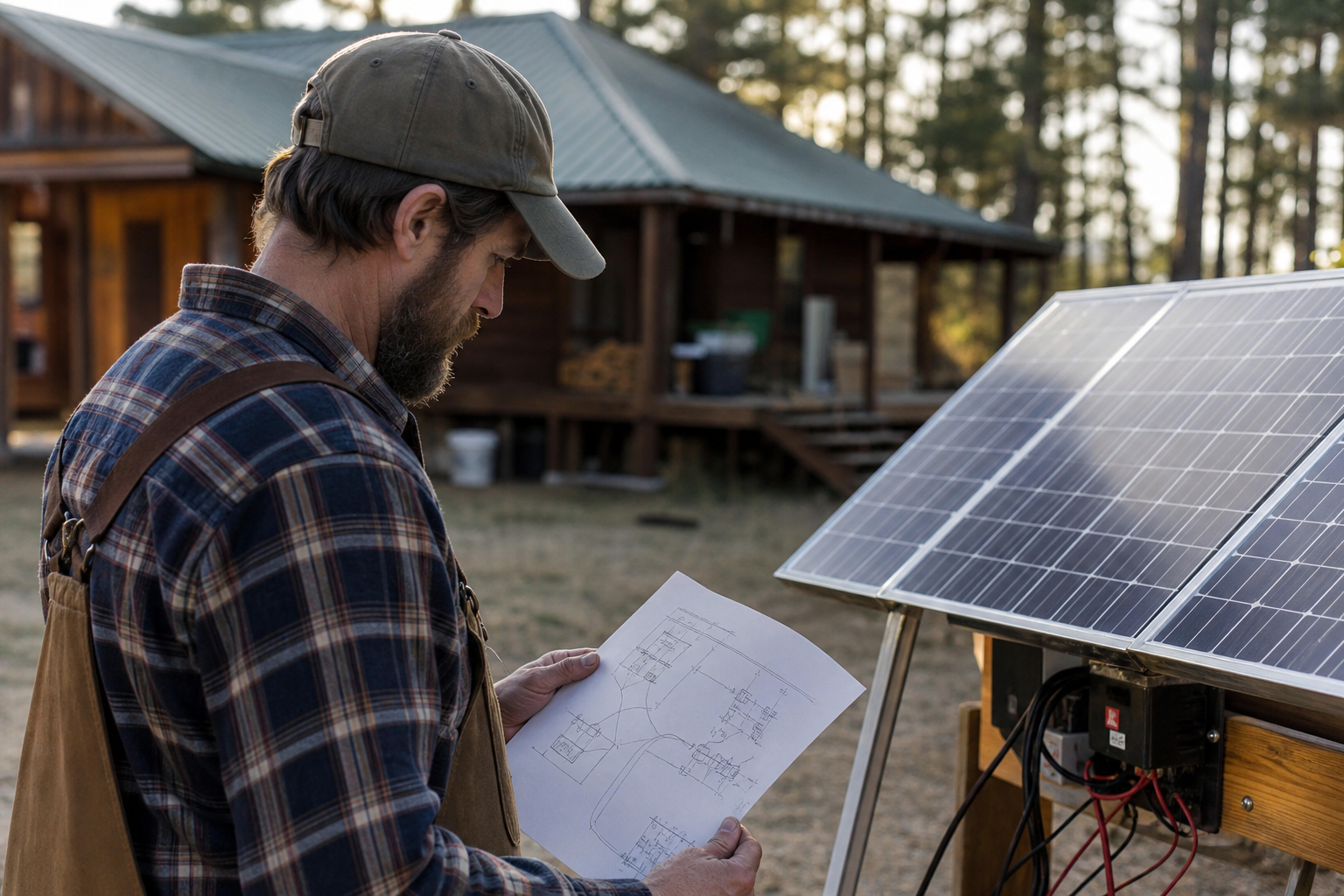
Small-scale solar is the most proven and widely available option. A DIY grid-tied solar array using purchased panels, a quality inverter, and a battery bank can be installed by a handy homeowner in most states — though permits are required in nearly all jurisdictions. A 2 kW system (roughly 6 to 8 panels) can offset 200 to 300 kWh per month depending on your location, which at average U.S. rates is $32 to $48 in monthly savings. Hardware costs for a basic 2 kW setup run $1,500 to $3,000 for the panels alone, before inverter, mounting, wiring, and battery storage. Payback timelines on DIY solar, when done correctly, are typically 6 to 10 years.
Micro-wind generation is viable for rural or semi-rural properties with consistent wind resources — generally sites averaging above 10 mph annually. Small residential turbines rated at 400 to 1,000 watts are available in the $500 to $2,000 range, but they require open land, proper tower height (typically 30 feet above any obstacle within 300 feet), and local zoning clearance. Wind complements solar well because it generates overnight and on cloudy days when solar output drops.
Alternative and experimental low-power generation concepts occupy a third category — DIY builds and concepts drawn from unconventional energy ideas. These range from thermoelectric generators (which convert heat differential into electricity, a real and documented phenomenon) to more speculative electromagnetic or resonance-based concepts whose practical output has not been independently verified at scale. This category is where digital guides and concept manuals tend to live. They can be useful as starting frameworks for experimentation, but they require honest evaluation: check what your local codes allow, and do not purchase hardware until you understand what a concept actually produces in real-world testing.
- Small-scale solar: proven, permit-required, $1,500+ hardware floor, 6-10 year payback
- Micro-wind: viable for rural sites, needs zoning clearance, complements solar well
- Alternative/experimental concepts: lower upfront cost to explore, but claims vary widely and local restrictions may apply
What a DIY Energy Build Actually Involves (Before You Buy Anything)
The single biggest mistake DIY energy builders make is buying hardware before they understand their local rules and their actual load requirements. Skipping these two steps wastes money and, in some cases, creates legal liability.
Step one is a load audit. Before you can size any generation system, you need to know how much power your household actually uses and — more importantly — which loads matter most to you. Pull twelve months of utility bills and identify your monthly kWh usage. Then walk through your home and list every device, its wattage, and how many hours per day it runs. Free tools from the Department of Energy's Office of Energy Efficiency and Renewable Energy can help with this. Most prepper households find their biggest loads are HVAC, water heating, and refrigeration — all three of which can be partially or fully addressed by targeted efficiency upgrades before generation is even added.
Step two is a permit and code check. In the United States, any permanent electrical generation system tied to your home's wiring or the grid requires permits in nearly every jurisdiction. The National Electrical Code (NEC), administered locally, governs how these systems must be installed. Some counties and HOAs also restrict certain types of generation equipment. This is not a bureaucratic nuisance — it is a real safety and liability issue. A system installed without permits may not be covered by homeowner's insurance if it causes a fire or injury.
Step three is honest output evaluation. Whether you are looking at a solar array, a wind turbine, or an alternative concept guide, ask one question before spending money: what is the documented, real-world output of this system under realistic conditions — not theoretical peak output? For solar, that answer is well-established and calculable using NREL's PVWatts tool. For less conventional approaches, the answer may be uncertain, and you should treat any guide in that space as a starting concept rather than an installation blueprint.
Sizing Your System to Your Real Preparedness Goals
Not every household needs to generate all of its own power — and trying to do so from day one is how DIY energy projects stall out or go over budget. A tiered approach lets you build toward energy independence at a pace that matches your skills and finances.
Tier one is critical-load coverage: enough generation and storage to keep your refrigerator, basic lighting, phone charging, and a water pump running during a grid outage. For most households, this means 400 to 800 watts of generation capacity and 1 to 2 kWh of battery storage. A small solar setup in this range can be built DIY for $600 to $1,200 in hardware and will also offset a modest portion of your monthly bill when the grid is up.
Tier two is meaningful bill reduction: 30 to 60 percent of your household's monthly consumption covered by your own generation. This is where a 1.5 to 3 kW solar array with battery backup becomes the relevant solution for most homeowners. At this tier you are likely looking at a multi-year project with proper permitting, and the financial return is real but not immediate.
Tier three is near-full independence: generating enough to cover nearly all your needs and selling surplus back to the grid through net metering where available. This is achievable for many rural homesteaders, but it requires significant upfront investment, professional electrical work for the grid-tie equipment, and favorable net metering policy in your state — which has been reduced or eliminated in several states in recent years.
Knowing which tier you are actually aiming for keeps you from over-spending on hardware you do not need yet, or under-building a system that leaves your real vulnerability gaps unaddressed.
Our Recommendation: Energy Revolution System
Climbing electricity rates create a compounding problem for prepper households: every month you delay building some form of generation capacity, you pay more to a grid you cannot control, and your financial margin for building resilience gets thinner.
The honest gap in most free online DIY energy content is organization and starting point. Solar installation guides assume you already know your load requirements, local codes, and component specifications. YouTube builds skip the planning phase entirely. And if you are curious about alternative or unconventional generation concepts beyond standard solar and wind, finding coherent, consolidated information is genuinely difficult — most of what exists online is either vague or oversold. The real friction is not motivation; it is having a structured framework to begin evaluating your options before you spend money on hardware you may not be able to use.
The Energy Revolution System is a DIY digital guide — currently $39, down from the regular price of $149 — that presents an alternative home energy generation concept for households looking to reduce their electric bill. It is worth being direct about what this means: the sales page's own disclaimers state it 'was not technically assessed,' and some implementations described may be restricted locally. Read it as a concept framework and idea-starter, not a certified installation manual. Evaluate anything it proposes against your local codes before purchasing hardware. That said, at $39 with a money-back guarantee, it is a low-risk way to explore an alternative approach if you have already done your load audit and permit check and want to think outside the standard solar playbook. If it does not give you anything actionable for your situation, the guarantee means you are not out anything meaningful. For the next step, read DIY Off-Grid Power Systems for Beginners: What You Actually Need Before You Build.
Our recommendation
Energy Revolution System
Check availability →This article contains an affiliate link. If you buy through it, we may earn a commission at no extra cost to you.
Frequently asked questions
Can I legally generate my own electricity at home?
Yes, in most U.S. jurisdictions — but permits are required for any permanent system connected to your home's wiring or the grid. Rules vary by state, county, and HOA. Check with your local building department before installing any generation equipment, and verify that net metering is available if you plan to sell surplus power back to the utility.
How much can DIY solar actually reduce my electric bill?
A properly sized DIY solar system can realistically offset 30 to 60 percent of a typical household's monthly electricity use, depending on your location, roof orientation, and system size. At average U.S. rates, a 2 kW system might save $30 to $50 per month. NREL's free PVWatts calculator lets you estimate output for your specific address.
What is the cheapest way to start generating your own power at home?
A small solar-plus-battery setup sized for critical loads — refrigerator, lights, phone charging — is the most cost-effective entry point for most households, with DIY hardware costs starting around $600 to $900. It also doubles as backup power during outages, which gives it immediate preparedness value before any bill savings accumulate.
Do alternative DIY energy generation methods actually work?
It depends entirely on the specific method. Thermoelectric generation, for example, is a well-documented phenomenon used in real applications. Other alternative concepts circulating online have not been independently verified to produce meaningful output under real-world conditions. Treat any unverified concept as experimental, start with a concept guide before buying hardware, and check local codes before building anything.
How long does it take for DIY home energy generation to pay for itself?
For a properly designed DIY solar system, payback periods typically range from 6 to 10 years depending on local electricity rates, system cost, and available incentives. The federal Investment Tax Credit (ITC) currently covers 30 percent of solar installation costs, which can significantly shorten that timeline for eligible homeowners.
Related guides
Sources
- U.S. Energy Information Administration — Residential Electricity Prices
- NREL PVWatts Calculator — Solar Output Estimator
- DOE Office of Energy Efficiency and Renewable Energy — Home Energy Audits
General preparedness information, not medical or legal advice. Follow instructions from your local emergency authority during an active event.
Field notes by email
Get the next guide before you need it
One email when a new field guide drops — water, food, power, medicine. No spam, no daily noise, unsubscribe in one click.
Comments on this guide
Questions, corrections and field reports from your own setup are welcome.
No comments yet. Be the first to add a field report.