
Power
How to Power Your Home During an Outage Without a Generator (5 Realistic Options)

By Ephraim Rusk · · 10 min read
This article contains an affiliate link. If you buy through it, we may earn a commission at no extra cost to you.
Quick answer
You can power critical home loads during an outage without a generator by combining portable power stations, solar panels, battery banks, and simple load-reduction strategies. The key is identifying your actual minimum power needs first, then matching a storage-and-charging solution to those loads — not trying to replicate your full grid draw.
How to power your home during an outage without a generator is one of the most searched backup-power questions — and for good reason. Generators are the traditional answer, but they come with a list of real problems: they run on gasoline that disappears from shelves within hours of a major storm, they require outdoor ventilation that limits where you can use them, they are loud enough to announce your situation to a neighborhood that may be desperate, and a quality whole-house unit can cost several thousand dollars before you add installation.
The good news is that for most households, a generator is solving the wrong problem. You do not need to power your whole house. You need to keep a refrigerator running, charge phones and medical devices, run a fan or a space heater, and maybe keep a few lights on. That is a much smaller problem — and one that has several quiet, fuel-free, realistic solutions in 2026.
This article walks through five practical options, what each one actually costs and can actually do, and how to think about combining them into a layered system that does not require you to be an electrician or spend like one.
Start Here: Calculate Your Real Minimum Power Load
Before buying any backup power equipment, you need to know how much power you actually require to keep your household functional — not comfortable by normal standards, but stable and safe. Most people dramatically overestimate this number.
The U.S. Energy Information Administration reports that the average American home uses about 29 kilowatt-hours (kWh) per day. That sounds like a lot, but that figure includes electric water heaters, HVAC systems, electric ranges, and other high-draw appliances you can live without for several days. Your genuine survival load is usually far smaller.
To find yours, identify your non-negotiable appliances: a refrigerator (typically 100–400 watts running, check your model's label), any medical devices like a CPAP (30–60 watts), phone chargers (5–20 watts each), LED lighting (8–15 watts per bulb), and possibly a small fan or electric blanket depending on season. Add those wattages together, then multiply by the hours per day each runs. A typical household's real minimum load often falls between 1 and 3 kWh per day — a figure a modest battery-plus-solar setup can actually meet.
Write this number down before you do anything else. It is the single most important input for every decision that follows, and skipping it is why most people either overspend on capacity they will never use or underbuy and find their system useless when it matters.
Option 1: Portable Power Stations (The Most Practical First Step)
A portable power station — essentially a large lithium battery with built-in AC outlets, USB ports, and a charge controller — is the fastest, safest, and most renter-friendly way to add backup power without a generator or any electrical work.
Units in the 500–1,000 Wh range (roughly $300–$700 at retail as of 2026) can run a full-size refrigerator for 8–16 hours, charge phones dozens of times, and power LED lighting all night. Larger units in the 2,000+ Wh range extend that significantly. Unlike a generator, they produce zero emissions, make almost no noise, and can be used safely indoors.
The main limitation is recharge time and method. Plugging into a wall outlet before an outage is obvious, but during a multi-day event you need another charging source — which is where the next option becomes essential. Look for units that support solar input and ideally bidirectional charging from a vehicle's 12V outlet or DC port.
One honest caveat: lithium battery capacity degrades over charge cycles, and most manufacturers rate their cells at 80% capacity after 500–1,000 cycles. For a unit used only during outages (say, a few times per year), this is not a meaningful concern. For daily use as a primary power source, cycle life matters more and should factor into your purchase decision.
Option 2: Portable Solar Panels (Your Fuel-Free Recharge Source)
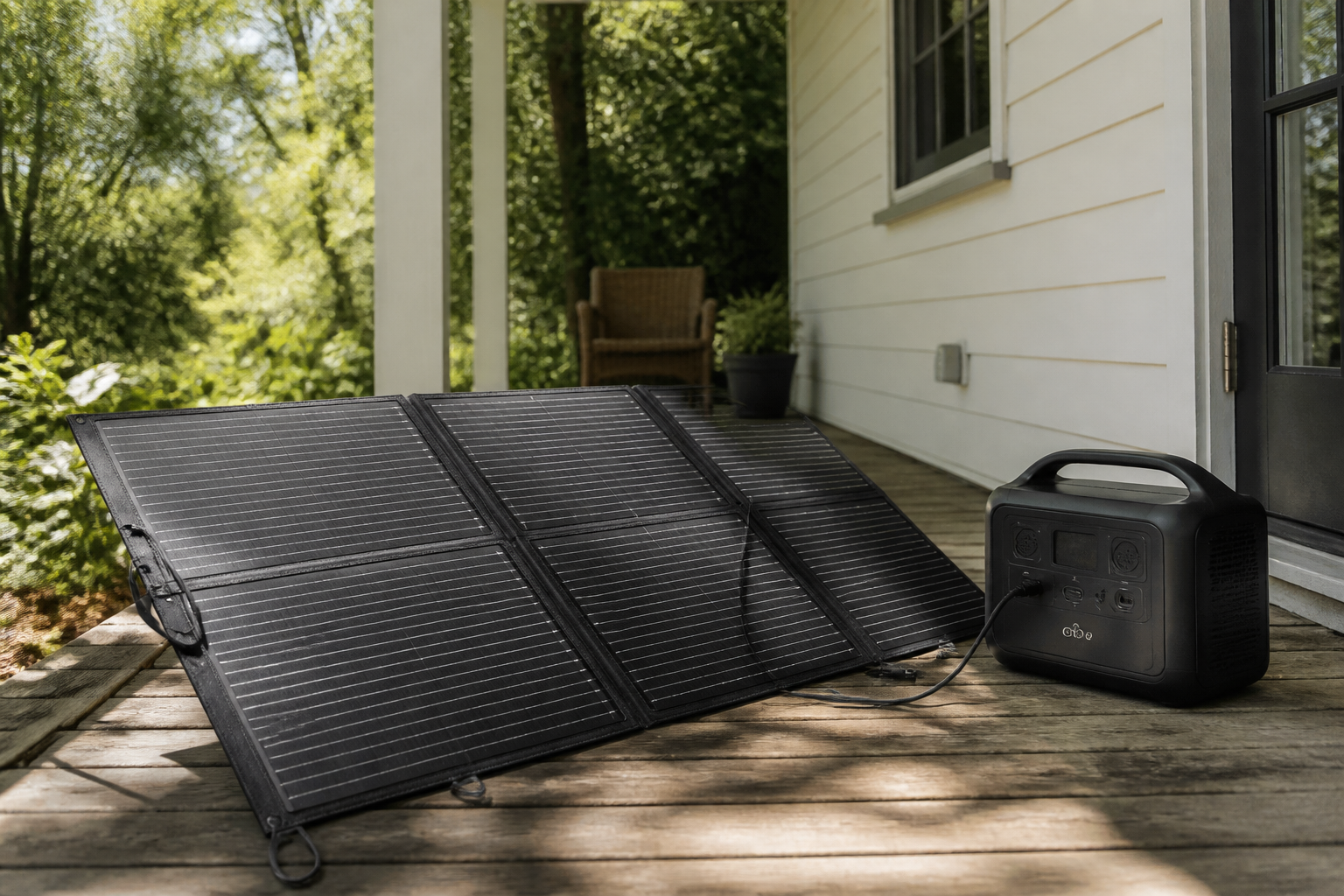
Portable solar panels paired with a power station give you an indefinitely renewable charging source that requires no fuel, no delivery, and no infrastructure — which is exactly what you need when an outage lasts longer than a single battery charge.
A 100-watt portable panel in direct summer sun produces roughly 300–500 Wh per day depending on your latitude, panel angle, and cloud cover. Two panels roughly doubles that. Paired with a 1,000 Wh power station, a two-panel setup can often keep the station near full during a summer outage with modest loads, or meaningfully extend runtime during a winter outage when sun hours are shorter.
The Department of Energy's PVWatts calculator (available free at pvwatts.nrel.gov) lets you enter your zip code and panel wattage to get a realistic daily output estimate for your specific location and time of year. Use it. Vendor claims are based on ideal conditions; real-world output in your climate may be 60–80% of the spec sheet number.
Portable panels do not require permits, professional installation, or roof modifications. They fold or roll up for storage, can be oriented toward the sun throughout the day, and work on a patio, driveway, or even a south-facing window ledge in a pinch. They are the most practical entry point for solar power for the vast majority of renters and homeowners who are not ready for a permanent rooftop install.
Option 3: Vehicle-to-Home Power, Power Banks, and Other Supplement Strategies
Several lower-cost options can meaningfully extend your backup power capacity when layered with the two primary options above — none of them requires installation, and most households already own the equipment.
Vehicle power: Many newer trucks and SUVs — and virtually all modern hybrid and electric vehicles — have onboard power outlets rated at 120V AC. Ford's F-150 PowerBoost and Lightning, Chevy's Silverado with PowerShift, and most Toyota hybrids have factory outlets capable of running household appliances directly. If you already own one of these vehicles, you may have a meaningful backup power source sitting in your driveway. Run the engine periodically to recharge the vehicle battery if using a non-EV; for an EV, monitor your state of charge carefully and keep a minimum reserve for transportation.
High-capacity USB power banks: For phones, tablets, small medical devices, and LED lanterns, a 20,000–30,000 mAh USB power bank costs $30–$60 and can recharge a smartphone eight to twelve times. Keep two charged and rotated every three months. This is not a glamorous preparedness item, but it may be the single most used piece of backup power equipment you own.
Load reduction as a power strategy: Reducing what you need to power is functionally identical to increasing your storage capacity. An LED lantern instead of overhead lights, a manual hand pump instead of an electric one, a propane camp stove instead of an electric range — each substitution removes load from your battery system and extends your effective runtime. FEMA's ready.gov guidance consistently emphasizes load reduction as a primary strategy before equipment investment, and the logic holds up in practice.
- Switch all lighting to LED or battery-powered lanterns to cut lighting load by 80% or more
- Unplug all phantom loads (TVs, cable boxes, gaming consoles) — they draw power even when 'off'
- Use a manual or propane cooking method to eliminate stove and oven load entirely
- Set the refrigerator to its coldest setting before an outage and open it as infrequently as possible
- Charge all devices, power stations, and vehicles before a forecast outage event
Why Most DIY Backup Power Plans Fail Before the Outage Even Happens
The most common failure in home backup power is not equipment failure — it is planning failure. People buy a power station, leave it on a shelf for two years, and discover during a storm that the battery has self-discharged to near zero, they have no solar panels to recharge it, and they never identified which outlets in their home are connected to which circuits.
A second common gap is not knowing your home's electrical layout. If you want to run a refrigerator off a power station, you need to either use an extension cord (functional but inconvenient) or know which outlet on which circuit your fridge is connected to. Without that basic map of your home, even good equipment becomes hard to use under stress.
The third failure is trying to solve too large a problem. People plan to power their whole home and spend $10,000–$30,000 on a permanent solar-plus-battery system — or they decide the cost is prohibitive and do nothing at all. The middle path, identifying your actual minimum loads and building a modest but functional system around them, gets skipped entirely. That middle path is where most households should be operating.
Building a written plan — what you will power, from what source, for how long, and how you will recharge — before you spend a dollar on equipment is what separates a preparedness investment that works from one that sits in a garage until it is useless.
Our Recommendation: Easy DIY Power Plan
Going without grid power for more than a day stops being an inconvenience and becomes a genuine health and safety problem — food spoilage, medical device failure, lost communication, and heat or cold exposure are all real risks that emerge on a timeline most people underestimate.
The frustrating gap is that most resources for solving this problem send you in one of two directions: a $500 generator that needs fuel and can't be used indoors, or a $15,000 professional solar installation that requires permits and months of planning. For the large majority of households, neither of those is the right answer — and the practical middle ground, building your own modest but reliable backup system from components you can buy and set up yourself, is surprisingly difficult to find straightforward guidance on. Most of what's out there assumes either an engineering background or a much larger budget than most families have.
The Easy DIY Power Plan is built specifically for that gap: it gives you simplified, non-technical steps to reduce your dependence on the grid and build a functional backup power system without professional installation. If you have been meaning to get your home's power situation sorted but keep stalling because the standard resources feel too complicated or too expensive, this is worth a serious look. Check out the Easy DIY Power Plan and see whether it matches your household's situation.
Our recommendation
Easy DIY Power Plan
Check availability →This article contains an affiliate link. If you buy through it, we may earn a commission at no extra cost to you.
Frequently asked questions
Can I power my refrigerator during an outage without a generator?
Yes. A portable power station in the 1,000 Wh range can run a standard refrigerator for 8–16 hours on a single charge. Paired with a 100–200W solar panel, you can recharge the station during daylight hours and potentially run the refrigerator indefinitely during a daytime outage with adequate sun. Keep the fridge closed as much as possible to reduce the load.
How long can a portable power station run a house?
A portable power station cannot run a full house — it is designed for essential loads only. A 1,000 Wh station running a refrigerator (150W average), a few LED lights (40W), and phone chargers might last 5–8 hours. The key is calculating your minimum load first and sizing storage to match that reduced draw, not your normal household consumption.
Is it safe to use a portable power station indoors?
Yes. Lithium-battery power stations produce no combustion emissions and are safe to use indoors, unlike gas generators, which produce carbon monoxide and must be operated outside. Always follow the manufacturer's ventilation and temperature guidelines, and keep the unit away from flammable materials.
How much solar do I need to run my house off-grid during an outage?
It depends on your minimum load. For the essential appliances most households actually need during an outage (refrigerator, lights, phone charging, small medical devices), 200–400 watts of portable solar panels paired with a 1,000–2,000 Wh battery is a realistic starting point for most U.S. climates. Use NREL's free PVWatts calculator to estimate actual daily output for your specific location.
Do I need a permit to set up a DIY backup power system?
Portable power stations and solar panels used as standalone units — not wired into your home's electrical panel — generally do not require permits in most U.S. jurisdictions. If you want to connect a backup system directly to your home's wiring, that typically requires a licensed electrician and a permit. Always check with your local building authority before any panel-connected installation.
Related guides
Sources
- U.S. Energy Information Administration — Residential Energy Consumption
- NREL PVWatts Calculator — Solar Energy Estimate Tool
- Ready.gov — Power Outages: Before, During, and After
- U.S. Department of Energy — Backup Power Systems Overview
General preparedness information, not medical or legal advice. Follow instructions from your local emergency authority during an active event.
Field notes by email
Get the next guide before you need it
One email when a new field guide drops — water, food, power, medicine. No spam, no daily noise, unsubscribe in one click.
Comments on this guide
Questions, corrections and field reports from your own setup are welcome.
No comments yet. Be the first to add a field report.