
Medicine
How to Treat a Wound Infection at Home When You Can't Get Antibiotics

By Ephraim Rusk · · 10 min read
This article contains an affiliate link. If you buy through it, we may earn a commission at no extra cost to you.
Quick answer
Clean the wound thoroughly with clean water, remove visible debris, and keep it open to drain. Honey, saline irrigation, and warm compresses have real evidence behind them for minor wound infections. Seek emergency care if you see spreading redness, red streaking, fever, or swelling that is not improving within 24 to 48 hours.
Treating a wound infection at home without antibiotics is a skill every prepared household needs — because access to professional care isn't always immediate, even in everyday emergencies. A cut from a garden tool, a puncture from a fence wire, or a scrape that wasn't cleaned well can progress from minor annoyance to serious problem within 48 to 72 hours if ignored.
Most people know to wash a wound. Far fewer know what comes next when the wound is already red, warm, and starting to swell — and the nearest urgent care is an hour away, or closed, or overwhelmed. This article covers the step-by-step process for managing a wound infection at the early stage using tools and materials you likely already have, and gives you clear lines for when home care is no longer enough.
Nothing in this article replaces professional medical evaluation when you can get it. The goal is to help you make the best decisions possible during the window between injury and care — not to encourage you to avoid medical treatment.
How to Recognize a Wound Infection Early
A wound infection shows five classic signs: redness around the wound edges, warmth to the touch, swelling, pain that increases rather than decreases after the first day, and pus or cloudy discharge. These are your body's inflammatory response to bacterial growth in the tissue.
Normal wound healing involves mild redness and tenderness for the first 24 hours. The key indicator of infection is trajectory — pain and redness that get worse over time, not better. If a wound that seemed fine yesterday is angrier today, treat that as infection until proven otherwise.
Two warning signs demand immediate evacuation regardless of your remote situation: red streaking extending outward from the wound along a limb (a sign of lymphangitis, indicating the infection is spreading through the lymphatic system) and fever above 101°F combined with a wound that looks infected. These indicate a systemic infection is possible and oral antibiotics — at minimum — are required.
- Increasing redness or warmth after the first 24 hours
- Swelling that grows rather than shrinks
- Pus, cloudy fluid, or foul odor from the wound
- Red streaking extending from the wound — evacuate immediately
- Fever above 101°F combined with wound symptoms — evacuate immediately
- Wound edges that won't stay closed or keep reopening
Step One: Clean the Wound Properly — This Is the Intervention That Matters Most
Thorough irrigation with clean water under pressure is the single most effective intervention for wound infection prevention and early treatment. A 2010 Cochrane review found that tap water is as effective as sterile saline for wound cleaning in most community settings, which is useful to know when supplies are limited.
Use a large syringe, a squeeze bottle with a small nozzle, or even a plastic bag with a pinhole to create pressure. Gravity rinsing is not enough. You need 500 to 1,000 mL of clean water delivered with enough force to physically flush bacteria and debris from the wound bed.
If the wound is already infected and has a crust or dried discharge sealing it, you need to remove that material to allow drainage. Soak the area with warm, clean water for 10 to 15 minutes to soften the crust, then gently clean with a clean cloth or gauze. Do not pack an infected wound closed — bacteria thrive in anaerobic (oxygen-free) environments. The goal is to keep the wound open enough to drain.
If you have it, a saline solution (1 teaspoon of non-iodized salt dissolved in 1 liter of boiled and cooled water) is useful for flushing. It will not kill bacteria, but it is gentle on tissue and physically removes contamination.
Evidence-Based Home Remedies for Minor Wound Infections
Several plant-based and household remedies have genuine clinical or laboratory evidence behind them for wound care — not all natural remedies are equal, and it is worth knowing which ones hold up.
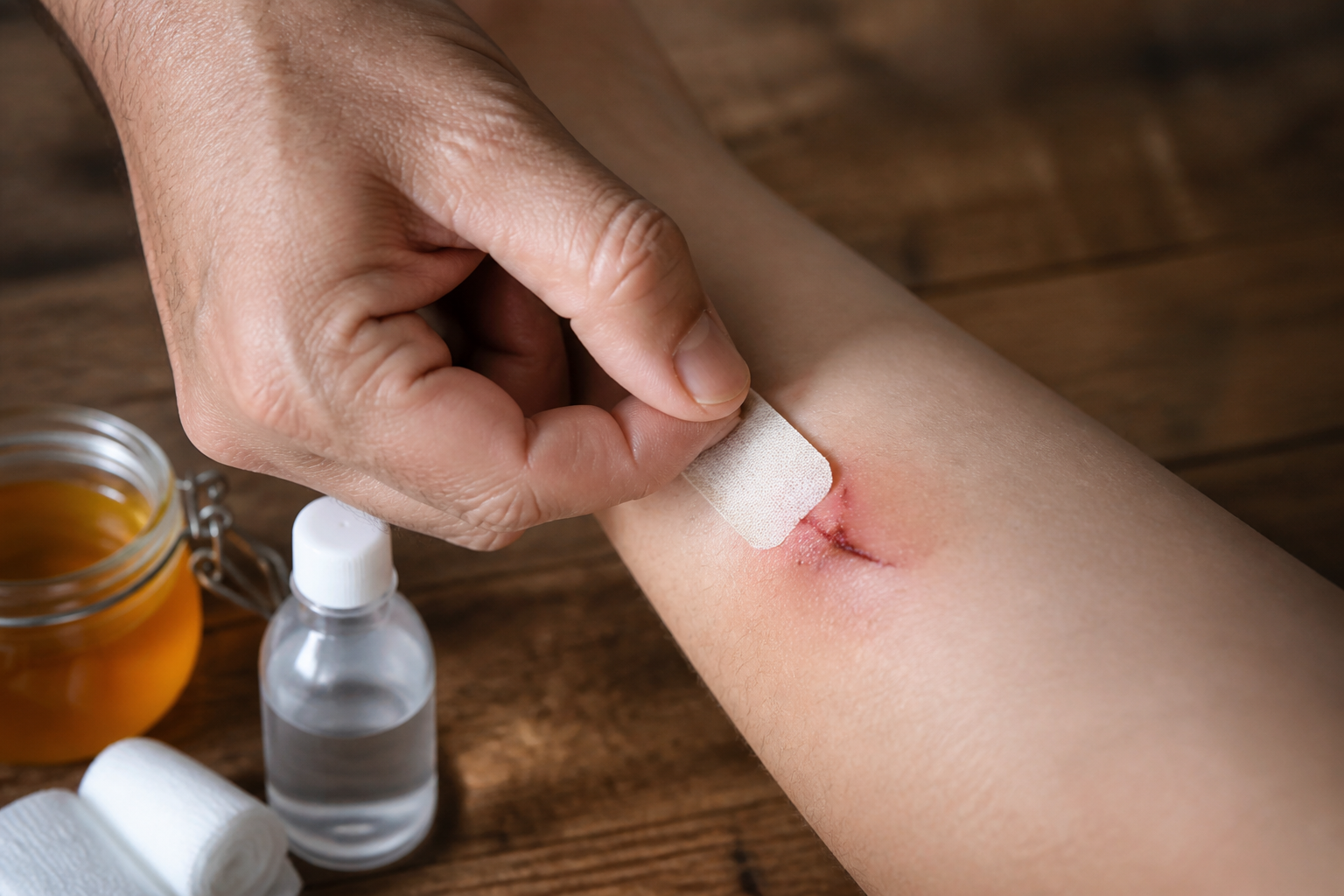
Honey, specifically medical-grade Manuka honey, has the strongest evidence. Its low pH, high sugar concentration, and hydrogen peroxide production create an environment that is difficult for bacteria to survive in. A 2011 Cochrane review found that honey dressings may accelerate wound healing compared to conventional dressings in some wound types. Raw honey is not identical to medical-grade Manuka honey, but in a no-option scenario, it is a reasonable option applied to the wound surface and covered with a clean dressing, changed every 24 hours.
Warm compresses applied for 15 to 20 minutes three to four times per day increase blood flow to the area, which supports immune response and encourages the wound to drain naturally. This is simple, free, and consistently recommended across wound care literature.
Diluted povidone-iodine (the brown antiseptic, diluted to a pale-tea color — roughly 0.5% rather than the full 10% from the bottle) can be used to cleanse an already-infected wound surface. Full-strength iodine is toxic to healing tissue; diluted iodine is antiseptic without as much tissue damage. Do not use hydrogen peroxide on an open wound — it damages new tissue and is no longer recommended in wound care guidelines.
Aloe vera gel applied topically has some evidence for reducing inflammation and supporting wound healing, though the evidence for treating active bacterial infection is limited. It is more useful as a soothing barrier after the wound begins to improve than as a first-line anti-infective.
- Honey (preferably Manuka) — apply to wound surface, cover with clean dressing, change every 24 hours
- Warm compresses — 15 to 20 minutes, 3 to 4 times per day
- Diluted povidone-iodine (pale-tea color) — use for wound surface cleansing only
- Saline irrigation — flush thoroughly, 500 to 1,000 mL minimum
- Aloe vera gel — topical use after initial infection begins to resolve
- Avoid: full-strength hydrogen peroxide, full-strength iodine, or sealing the wound closed
Managing the Infection Window: What to Watch For Over 24 to 72 Hours
A wound infection treated early at home should show clear improvement within 24 to 48 hours — less redness, less swelling, and any drainage becoming clearer rather than cloudier. If you are not seeing improvement by 48 hours, the situation has moved beyond home care territory.
Keep a simple log: note the border of the redness with a pen on the skin and mark the time. If the redness is expanding beyond that border six hours later, the infection is spreading despite your efforts. This is a hard line — expanding redness means evacuation.
Keeping the patient hydrated and adequately nourished supports immune function. Protein is particularly important for tissue repair. In a grid-down or extended off-grid scenario, this practical consideration matters as much as the wound dressing itself.
Pain management with ibuprofen (if available and not contraindicated) serves two functions: it reduces discomfort and, as an anti-inflammatory, may modestly reduce swelling around the wound. This does not treat the infection but supports the patient's ability to rest and maintain normal function while the body works.
Document changes in the wound each time you change the dressing. If the wound is deepening, if tissue is turning dark or black, or if the patient develops confusion or rapid heart rate, these are signs of potentially serious systemic infection. Evacuate immediately.
Our Recommendation: The Doctor's Book of Survival Home Remedies
A wound infection that isn't caught early can progress rapidly — from a swollen cut to a spreading cellulitis or worse within days. That narrow window between first signs and serious systemic involvement is exactly when most people realize they don't have enough information to make confident decisions.
The problem with online searches in that moment is noise: most results are either overly cautious (go to the ER) or completely unvetted folk remedies with no clinical grounding. What's missing is a structured, medically-informed reference you can hold in your hands when the internet is down or you're on the far side of a long dirt road.
The Doctor's Book of Survival Home Remedies by board-certified surgeon Dr. John Herzog is a 400-page guide covering roughly 20 common medical emergencies — including wound care and infection management — using plant, herb, and household remedies framed through a science-based lens rather than folklore. At $37, it is a practical addition to a medical prep kit for any household serious about managing health situations when professional care isn't immediately available. It won't replace a doctor, but it gives you a structured, authoritative reference for the window when you're on your own. For the next step, read Natural Remedies for Upset Stomach Without Medication: What Actually Works.
Our recommendation
The Doctor's Book of Survival Home Remedies
Check availability →This article contains an affiliate link. If you buy through it, we may earn a commission at no extra cost to you.
Frequently asked questions
Can a wound infection heal on its own without antibiotics?
Minor superficial infections sometimes resolve with thorough cleaning, drainage, and the body's own immune response. However, any infection that is spreading, not improving within 48 hours, or accompanied by fever requires antibiotics and medical evaluation. Home care buys time — it is not a reliable substitute for antibiotics once an infection is established in deeper tissue.
What is the fastest way to draw out infection from a wound?
Warm compresses applied for 15 to 20 minutes several times per day encourage the wound to drain naturally and increase local blood flow. Keep the wound open — do not seal a draining wound closed. Honey dressings changed every 24 hours also have clinical support for wound infection management.
Is hydrogen peroxide good for infected wounds?
No. Hydrogen peroxide is no longer recommended for wound care. It damages healing tissue and new cells, which can slow recovery and worsen the wound bed. Use clean water irrigation or diluted povidone-iodine instead.
What are the red streaks from a wound infection?
Red streaks extending from a wound along a limb are a sign of lymphangitis — the infection has entered the lymphatic system and is spreading. This is a medical emergency. Evacuate to professional care immediately; this condition requires systemic antibiotics.
How do you treat an infected wound when you can't see a doctor?
Irrigate thoroughly with clean water under pressure, keep the wound open to drain, apply warm compresses three to four times daily, and use diluted povidone-iodine or honey dressings. Monitor for spreading redness, fever, or red streaking — any of those signs mean the infection is beyond home care and evacuation is necessary.
Related guides
Sources
- CDC — Wound Care and Infection Prevention
- NIH / NCBI — Honey as a Topical Antibacterial Agent for Treatment of Infected Wounds
- NIH / NCBI — Wound Irrigation and Infection Prevention Review
- FEMA / Ready.gov — Emergency Medical Care Preparedness
General preparedness information, not medical or legal advice. Follow instructions from your local emergency authority during an active event.
Field notes by email
Get the next guide before you need it
One email when a new field guide drops — water, food, power, medicine. No spam, no daily noise, unsubscribe in one click.
Comments on this guide
Questions, corrections and field reports from your own setup are welcome.
No comments yet. Be the first to add a field report.