
Food
How to Get Enough Protein on a Plant-Based Emergency Food Supply (Without Buying Expensive Specialty Products)

By Ephraim Rusk · · 10 min read
This article contains an affiliate link. If you buy through it, we may earn a commission at no extra cost to you.
Quick answer
You can meet 50–80 g of daily protein on a fully plant-based emergency diet using dried legumes, whole grains, nuts, seeds, and nutritional yeast — all of which store for years. The key is combining these foods across meals so your amino acid profile is complete throughout the day.
Getting enough protein on a plant-based emergency food supply is entirely achievable — but it requires deliberate planning that most preppers skip. The standard advice is to stockpile rice, beans, and oats. That is a solid start. But a monotonous pile of calories with insufficient protein and poor amino acid variety will leave you fatigued, slow to recover from physical work, and vulnerable to illness — exactly the conditions you face when normal life breaks down.
Most plant-based households that have thought seriously about long-term food storage run into the same problem: they have calorie security but not protein security. Legumes are cheap and store for decades, but rotating through lentil soup and black bean rice every day for two weeks is a fast path to dietary fatigue, and you still may not be hitting adequate totals. Variety in how you use those staples is the actual solution — not buying expensive powders or specialty vegan products that have short shelf lives and high price tags.
This article breaks down the shelf-stable plant protein sources worth stockpiling, how to calculate whether your current supply actually covers your household's protein needs, and how to turn those boring staples into meals people will eat willingly — which matters more than most preparedness guides admit.
Why Protein Planning Is the Blind Spot in Most Prepper Pantries
Most emergency food planning focuses on calories first and macronutrients almost never. FEMA and Ready.gov guidance centers on storing at least 2,000 calories per person per day, which is a reasonable baseline — but it says nothing about protein targets, and that omission creates real nutritional risk.
The Recommended Dietary Allowance (RDA) for protein is 0.8 grams per kilogram of body weight for sedentary adults, per the USDA Dietary Guidelines. For a 155-pound (70 kg) adult, that is roughly 56 grams per day at minimum. Under physical stress — manual labor, cold exposure, illness recovery, or the chronic low-grade stress of a grid-down situation — actual needs climb. Research published by the National Institutes of Health suggests that moderately active to active adults need closer to 1.2–1.6 g/kg to preserve muscle mass and immune function.
Plant proteins are not inherently inferior, but they require more intentional sourcing. Most plant foods are not complete proteins on their own — they are missing or low in one or more essential amino acids. This does not mean you need to eat complementary proteins at every single meal, as the outdated advice once claimed, but you do need enough variety across the day to cover all essential amino acids. A pantry stocked with only white rice and one type of bean technically provides protein, but the lysine-methionine balance will be poor and palatability will crater within days.
The fix is simpler than most people expect: stock a wider range of legumes and grains, add a few high-density protein anchors like seeds and nutritional yeast, and have a real plan for how to cook them in ways that do not taste like punishment.
The Best Shelf-Stable Vegan Protein Sources and How Long They Actually Keep
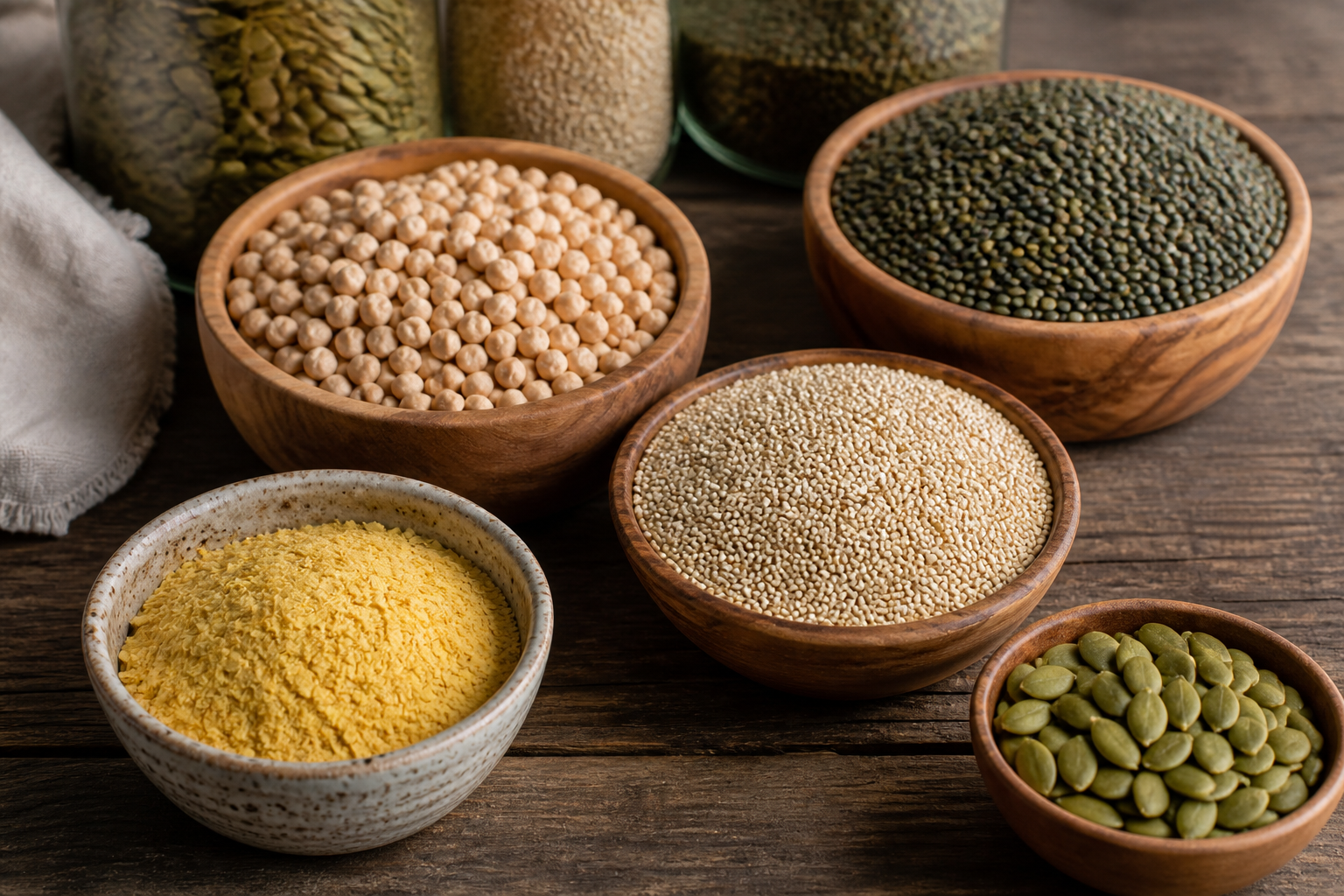
Dried legumes, whole grains, seeds, and nutritional yeast are the four categories that cover your protein needs from a long-term pantry — no refrigeration required, no specialty products needed.
Dried legumes are the backbone. Lentils, black beans, chickpeas, kidney beans, split peas, and soybeans all store well when sealed with oxygen absorbers in mylar bags or food-grade buckets. Lentils and split peas are faster-cooking and more fuel-efficient than whole beans, which matters if you are rationing propane or firewood. Protein content by dry weight: lentils roughly 25 g per 100 g, chickpeas roughly 19 g, black beans roughly 22 g. Properly stored, these remain nutritionally viable and safe to eat for 25–30 years, though texture and cooking time degrade after 8–10 years.
Whole grains contribute more protein than most people assume. Quinoa is the standout — it is one of the few plant foods that qualifies as a nutritionally complete protein, containing all nine essential amino acids in meaningful amounts, and stores for 2–3 years in sealed containers. Oats, amaranth, and whole wheat berries also add 10–17 g protein per 100 g dry weight. Storing a mix rather than relying solely on white rice raises your protein density significantly without changing the cost much.
Seeds deserve more shelf space than most preppers give them. Hemp seeds provide roughly 31 g protein per 100 g and a favorable omega-3 to omega-6 ratio. Sunflower seeds, pumpkin seeds (pepitas), and sesame seeds each offer 18–25 g per 100 g. These store 1–2 years at room temperature in sealed containers, longer in vacuum-sealed mylar. They are calorie-dense and nutrient-rich, and they add fat and texture that make other meals more satisfying.
Nutritional yeast is a high-value, low-volume protein anchor. Two tablespoons provide roughly 8 g of complete protein along with B-vitamins including B12 in fortified versions — a critical nutrient that plant-based diets must address separately. It stores 1–2 years in a sealed container and adds a savory, cheese-like flavor that makes simple grain-and-bean dishes far more palatable. It is one of the highest-leverage items you can add to a plant-based emergency pantry.
- Lentils: ~25 g protein/100 g dry, 25+ year shelf life sealed
- Chickpeas: ~19 g protein/100 g dry, 25+ year shelf life sealed
- Quinoa: ~14 g protein/100 g dry, complete amino profile, 2–3 year shelf life
- Hemp seeds: ~31 g protein/100 g, 1–2 year shelf life sealed
- Pumpkin seeds: ~25 g protein/100 g, 1–2 year shelf life sealed
- Nutritional yeast (fortified): ~8 g protein per 2 tbsp, complete protein, 1–2 year shelf life
- Dried soybeans: ~36 g protein/100 g dry, 25+ year shelf life sealed
- Whole oats: ~17 g protein/100 g dry, 2–3 year shelf life sealed
How to Calculate Whether Your Stored Food Actually Covers Protein Needs
Run the math before you need it — a quick household audit takes less than 20 minutes and will tell you immediately if you have a protein gap.
Start with your household's protein target. Multiply each person's weight in kilograms (pounds divided by 2.2) by 1.2 as a working daily target — this gives you a moderate-activity figure that provides a reasonable buffer above the bare minimum RDA. For a household of two adults at 70 kg each, that is 168 g of protein per day total. For a 30-day supply, you need roughly 5,040 g of protein across all stored food.
Next, calculate protein available from your current stockpile. Multiply stored dry weight of each food by its protein density. Example: 10 kg of dried lentils at 25 g protein per 100 g dry weight = 2,500 g protein. 10 kg of oats at 17 g/100 g = 1,700 g protein. 2 kg of pumpkin seeds at 25 g/100 g = 500 g protein. That example stockpile provides 4,700 g — about 28 days for the two-person household at the target, not the 30 you planned for. A small gap, easy to close with a couple more kilograms of lentils or a bag of hemp seeds.
This calculation also tells you where your diet will be monotonous. If 90% of your protein is coming from one source, that is a palatability problem as much as a nutrition problem. Diversify across at least three to four different legume or grain sources, and use seeds and nutritional yeast as high-density supplements that take up little storage space.
Making Stored Plant-Protein Foods Into Meals People Will Actually Eat
The hardest part of a plant-based emergency diet is not the nutrition — it is keeping people willing to eat the same category of foods for days or weeks. Meal fatigue is a real, documented phenomenon in disaster nutrition research, and it leads people to under-eat, which defeats the entire purpose of the stockpile.
Legumes alone can be prepared at least a dozen different ways that feel genuinely different from each other: pureed into hummus or dips, cooked into thick stews, sprouted and eaten raw (lentils and mung beans sprout reliably with just water and a jar), dry-roasted into a crunchy snack, mashed into patties, or cooked into soups with varying spice profiles. The spice and seasoning component of your food storage is as important as the protein sources themselves — cumin, smoked paprika, garlic powder, nutritional yeast, and dried herbs cost almost nothing, store for years, and completely change the character of the same base ingredient.
Quinoa is particularly versatile and underused in most prepper meal plans. It cooks in 15 minutes, requires less fuel than dried beans, and works in porridge-style breakfasts, grain salads, stuffed vegetable dishes (if your garden is producing), or as a straightforward rice substitute in any dish. Keeping quinoa as a rotation staple alongside rice significantly improves both nutritional completeness and meal variety.
Sprouting is worth knowing even if you never use it in normal life. Lentils, mung beans, chickpeas, and many seeds can be sprouted in 2–4 days using only water and a mason jar with a mesh lid. Sprouting increases bioavailability of nutrients, breaks down some of the antinutrients that cause digestive discomfort with heavy legume eating, and produces fresh, living food without any garden space or soil. It is one of the highest-value low-tech skills for a plant-based emergency diet.
Our Recommendation: Fuel Your Body — 30 High Protein Vegan Recipes
The protein gap in a plant-based emergency pantry is not a stockpile problem — it is a knowledge problem. Most households have or can easily afford the right staples. What they lack is a practical system for turning those staples into varied, protein-adequate meals that people will eat without complaint, week after week.
The honest friction with purely DIY approaches is time and mental load. Researching protein combinations, testing recipes for palatability, figuring out which techniques work with shelf-stable ingredients — that is real work, and most people do not do it until they are already in a stressful situation and running on limited cognitive bandwidth. Generic recipe searches also tend to pull results built around fresh produce, tofu, and specialty items that have no place in a long-term pantry.
Fuel Your Body: 30 High Protein Vegan Recipes is a digital ebook that does that legwork for you: 30 quick, high-protein plant-based recipes built for people who need to meet real protein targets without long prep times or hard-to-find ingredients. At $10 with a 60-day money-back guarantee, it is a low-risk way to build out the recipe side of your food resilience plan before you need it — when you have the time to actually read it, adapt it to your stored staples, and figure out what your household will actually eat. For the next step, read How to Grow Enough Food in a Small Backyard to Meaningfully Cut Your Grocery Bill.
Our recommendation
Fuel Your Body: 30 High Protein Vegan Recipes
Check availability →This article contains an affiliate link. If you buy through it, we may earn a commission at no extra cost to you.
Frequently asked questions
How much protein do you actually need per day on an emergency plant-based diet?
The USDA RDA is 0.8 g of protein per kilogram of body weight for sedentary adults — roughly 56 g/day for a 154-pound adult. Under physical stress or illness, most nutritional researchers suggest 1.2–1.6 g/kg is more appropriate. A practical planning target for an active adult in a grid-down situation is 70–100 g per day.
Do you need to combine proteins at every meal on a vegan diet?
No. The idea that you must combine complementary proteins at every single meal was popular in the 1970s but has since been revised. Current dietetic consensus, including the Academy of Nutrition and Dietetics position, is that eating a variety of plant protein sources across the day is sufficient to meet essential amino acid needs.
What is the longest-storing vegan protein source for a prepper pantry?
Dried legumes — particularly lentils, black beans, dried soybeans, and chickpeas — stored in sealed mylar bags with oxygen absorbers have documented shelf lives of 25–30 years. They are the highest-value long-term plant protein source by both cost and storage life.
Can you get enough B12 on a vegan emergency diet without supplements?
This is one of the genuine nutritional risks of a fully plant-based emergency diet. Fortified nutritional yeast is a reliable stored source of B12, but not all nutritional yeast is fortified — check the label. Including B12-fortified nutritional yeast and, if possible, B12 tablets or capsules in your medical/supplement stores is a prudent precaution for any plant-based household.
How do you sprout lentils without electricity or special equipment?
Rinse 1/4 cup of dried lentils and soak them in a mason jar of water overnight. Drain, rinse, and cover the jar mouth with cheesecloth or mesh secured with a rubber band. Tilt the jar upside down at an angle so excess water drains and air circulates. Rinse and drain twice daily. In 2–3 days at room temperature you will have edible sprouts. Mung beans and chickpeas work the same way.
Related guides
Sources
- USDA Dietary Guidelines 2020-2025 — Protein Needs and Plant-Based Sources
- NIH Office of Dietary Supplements — Protein: Fact Sheet for Health Professionals
- Ready.gov — Food and Water in an Emergency
- NIH — Vitamin B12: Fact Sheet for Health Professionals
General preparedness information, not medical or legal advice. Follow instructions from your local emergency authority during an active event.
Field notes by email
Get the next guide before you need it
One email when a new field guide drops — water, food, power, medicine. No spam, no daily noise, unsubscribe in one click.
Comments on this guide
Questions, corrections and field reports from your own setup are welcome.
No comments yet. Be the first to add a field report.