
Security
Home Security Without Electricity: How to Protect Your House During a Power Outage

By Ephraim Rusk · · 10 min read
This article contains an affiliate link. If you buy through it, we may earn a commission at no extra cost to you.
Quick answer
To secure your home during a power outage, layer passive deterrents (locked doors, covered windows, low profile) with non-electric perimeter alerts like tripwires, door jammers, and battery-powered motion sensors that function independently of the grid and Wi-Fi.
Home security without electricity is something most households have never actually thought through — until the lights go out and they realize their alarm panel is dead, their smart locks need Wi-Fi, and their floodlights are useless. A power outage, whether from a storm, grid failure, or a broader regional emergency, is precisely the moment when opportunistic break-ins spike and police response times stretch from minutes to hours or longer.
The uncomfortable truth is that the average home security system is designed for normal conditions. It assumes the grid is up, the internet is working, and a monitoring center can dispatch help within minutes. None of those assumptions hold during the kind of events that preppers plan for. If your entire security posture depends on infrastructure that fails the moment conditions get serious, you don't actually have a security plan — you have a good-weather plan.
This article walks through what actually works when the power is out: the specific threats that emerge, the passive and low-tech layers that hold up under real conditions, and the battery-operated and non-electric tools worth adding to a serious home defense setup.
Why Power Outages Create a Security Gap Most Households Don't Anticipate
A prolonged power outage changes neighborhood dynamics in ways that directly affect your personal security risk. Research following major disasters consistently shows that property crime — including looting and burglary — increases during and immediately after large-scale power failures, particularly after the first 24 to 48 hours when it becomes clear that restoration is not imminent.
The reasons compound quickly. Street lighting disappears, which reduces the natural surveillance that deters opportunistic offenders during normal times. People leave their homes to seek shelter, food, or family, leaving properties unoccupied. Emergency services are stretched thin responding to life-safety calls, which means property crime response times drop sharply — in some documented post-disaster situations, police have been essentially unavailable for property calls for days.
Meanwhile, the security systems most households rely on go offline in predictable ways. Hardwired alarm systems may have battery backup, but many backup batteries are undersized for multi-day outages and are rarely tested. Smart locks, video doorbells, and cloud-connected cameras all require either power or internet connectivity to function — often both. When the grid goes down, these systems become inert plastic on your walls and doors.
The gap this creates is real, and it is not a paranoid hypothetical. It is a documented, recurring pattern following hurricanes, ice storms, wildfires, and extended grid failures. Planning for it is straightforward once you understand which security tools are grid-dependent and which are not.
The Difference Between Active and Passive Security (And Why Passive Wins When the Power Is Out)
Passive security measures work without any power source — they rely on physical resistance, deterrence by appearance, or noise generation that needs no electricity. Active measures require power, connectivity, or human monitoring to function. During a power outage, your active systems fail at exactly the wrong moment, which is why building a strong passive foundation first is the correct order of operations.
The most effective passive security investments are also among the cheapest. Deadbolt quality matters more than most people realize — a Grade 1 ANSI-rated deadbolt with a three-inch strike plate and three-inch screws into the door frame stud is substantially harder to kick in than the typical builder-grade hardware installed in most residential construction. Door frame reinforcement kits address the fact that most forced-entry failures happen at the frame, not the lock itself.
Window security film — a heavy polyester laminate applied to the glass — does not prevent someone from breaking a window, but it holds the shattered glass together and significantly increases the time and noise required to create an opening large enough to climb through. Time and noise are exactly what passive deterrents are designed to impose.
Physical visual deterrents also carry weight. A dark, quiet house with no indication of occupancy or readiness is a softer target than one where someone clearly appears to be home and alert. During an outage, candlelight or lantern light visible from outside, a dog that makes noise, and signs that the property is occupied all shift a would-be burglar toward easier targets. Opportunistic offenders, who make up the majority of post-disaster property crime, do not want a confrontation — they want an easy score.
Non-Electric and Battery-Powered Perimeter Alerts That Actually Work
A perimeter alert system that works without grid power gives you early warning before an intruder reaches your door — and early warning is the most valuable thing a home security setup can deliver. You cannot defend what you cannot detect.
Tripwire perimeter alarms are among the oldest and most reliable non-electric early-warning tools. A simple tensioned line connected to a noisemaker — a set of cans, a spring-loaded alarm, or a purpose-built device — costs almost nothing and requires no power. Positioned around yard entry points, gates, or along the likely approach path to doors and windows, they convert invisible movement into audible alert. They do not identify who triggered them, but they give you the seconds needed to assess and respond rather than being caught completely off guard.
Battery-powered passive infrared (PIR) motion sensors are the powered tier above that. Quality PIR sensors designed for outdoor use run on standard AA or D batteries and have operational lives of weeks to months on a single set of cells — making them genuinely useful during extended outages. They do not require Wi-Fi, a hub, or a monitoring service. When motion is detected, they sound a local alarm or trigger a connected floodlight. Position them at the corners of your property and above the main entry points.
Door and window contact alarms — simple magnetic sensors that sound when separated — are another battery-powered layer that requires no infrastructure. They are unsophisticated, but unsophisticated is a feature when you are planning for conditions where infrastructure has failed. A loud piezo alarm mounted at a door is an effective deterrent regardless of whether the grid is up.
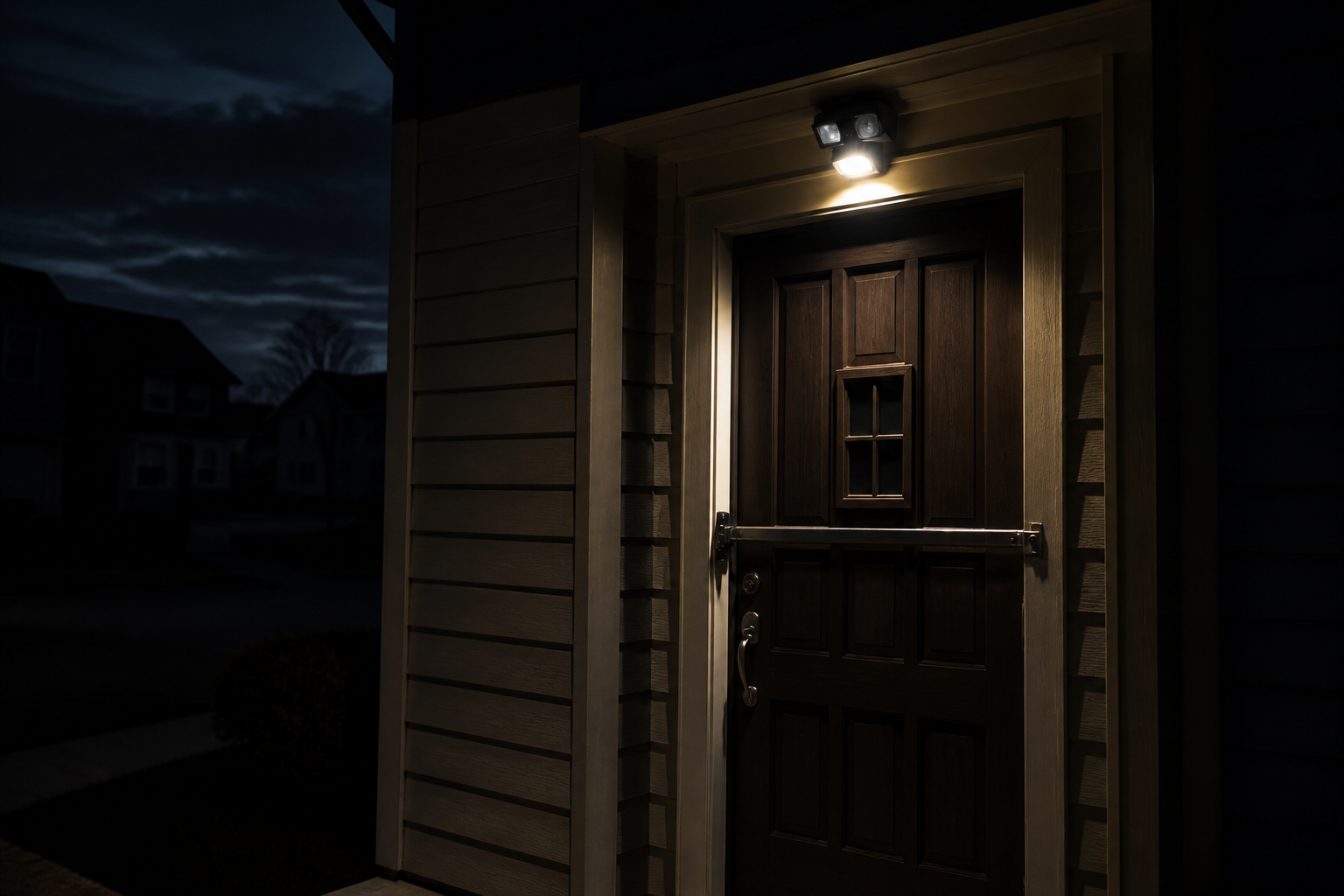
One underrated tool in this category is the door jammer or security bar. These are entirely passive devices that brace a door from the inside, using the floor as a lever point to absorb kick-in force. They require no power, no installation, and no connectivity. They work when everything else has failed.
Lighting Strategy When the Grid Is Down
Darkness favors intruders more than it favors you, which makes maintaining some form of exterior lighting one of the highest-leverage things you can do during an extended power outage. The goal is not to light up your property like a stadium — it is to eliminate the areas of deep shadow that allow someone to approach unseen.
Solar-powered path lights and floodlights are the most practical option for extended outages because they recharge daily without any grid connection. A row of solar path lights along a fence line or driveway provides both a basic deterrent and functional illumination without consuming your stored battery reserves. More importantly, solar floodlights with PIR motion activation provide the specific combination of triggered-on lighting that is most effective at startling and deterring an approaching intruder.
Battery-powered LED floodlights — separate from solar units — give you a backup option for cloudy periods or for positioning in areas without direct sun exposure. These can be run from USB battery banks, 12V automotive batteries, or purpose-built power stations. Running lights from a large power station overnight is a reasonable draw if you have stored capacity; a single 10-watt floodlight running eight hours pulls 80 watt-hours, which is within the range of mid-sized portable power stations.
Inside the house, light discipline matters. A single room lit while the rest of the house is dark signals occupancy without revealing your position or numbers to someone watching from outside. Keep interior lighting low and away from windows facing likely approach routes when the situation feels elevated.
Our Recommendation: The Anti-Looter Kit
The core problem this article addresses is specific: your standard home security setup is designed for normal conditions, and it fails at exactly the moment a real threat is most likely to materialize — when the grid goes down, police response is delayed, and opportunistic offenders know that most houses are effectively unprotected.
The honest limitation of building this system yourself, layer by layer, is friction. Sourcing a reliable PIR sensor, compatible door alarms, perimeter tripwires, a floodlight that will run off battery, and a door jammer separately requires research, compatibility checking, and the time to set it up correctly under non-emergency conditions. Most people who intend to do this eventually do not — or they buy mismatched components and end up with a system full of gaps.
The Anti-Looter Kit is a residential security package built specifically around the scenario this article describes: break-ins during crises when police response may be delayed or unavailable, with components — motion sensors, perimeter tripwires, door alarms, a floodlight, and a door jammer — designed to function during power outages. The kit draws on intelligence-agency-inspired approaches to perimeter awareness and is assembled as a coordinated system rather than a collection of unrelated parts. If you have been meaning to close the gap in your home security posture before the next outage, this is a reasonable place to start. For the next step, read Kubotan Self-Defense: Does It Actually Work Against a Stronger Attacker?.
Our recommendation
Anti-Looter Kit
Check availability →This article contains an affiliate link. If you buy through it, we may earn a commission at no extra cost to you.
Frequently asked questions
Do home security systems work during a power outage?
Most standard home security systems have a battery backup that lasts anywhere from a few hours to 24 hours depending on the panel and battery age. After that, hardwired systems go offline. Smart locks, video doorbells, and cloud-connected cameras typically fail sooner because they also require internet connectivity, which usually drops with the power. For outages longer than a day, you need non-electric or battery-powered alternatives that don't depend on grid or internet infrastructure.
What is the best way to secure a door without power?
A door jammer or security bar braced against the floor is one of the most effective ways to reinforce a door without any power source. Combined with a Grade 1 deadbolt and extended strike plate screws that reach the door frame stud, a door becomes substantially more resistant to kick-in — which is the most common forced-entry method. None of these measures require electricity or internet connectivity.
How do motion sensor lights work without electricity?
Solar-powered motion sensor floodlights charge a built-in battery during daylight hours and then draw from that battery to power the light and PIR sensor overnight. Battery-powered motion lights work the same way using replaceable AA or D cells. Neither type requires a connection to the electrical grid, making them practical options for extended power outages.
Does looting actually increase during power outages?
Historical and criminological research following major disasters — including hurricanes, ice storms, and extended grid failures — documents increases in opportunistic property crime during and immediately after events when street lighting fails, residents evacuate, and law enforcement is focused on life-safety emergencies. The increase is most pronounced in the 24-72 hour window when it becomes clear that power restoration is not imminent and police response to property crimes is significantly delayed.
Are tripwire alarms legal for home security use?
Defensive tripwire noise alarms — devices that make sound when a line is disturbed — are legal for home use in most U.S. jurisdictions when positioned on your own property and not designed to cause physical harm. They are distinct from booby traps, which are illegal. You should verify local ordinances, but a noise-generating perimeter alert on your own property is generally treated the same as any other alarm device.
Related guides
Sources
- FEMA: Dealing with Disaster-Related Stress and Crime — Ready.gov
- U.S. Department of Justice: Burglary of Single-Family Houses (Problem-Oriented Guides for Police)
- FEMA: Extended Power Outage Guidance
General preparedness information, not medical or legal advice. Follow instructions from your local emergency authority during an active event.
Field notes by email
Get the next guide before you need it
One email when a new field guide drops — water, food, power, medicine. No spam, no daily noise, unsubscribe in one click.
Comments on this guide
Questions, corrections and field reports from your own setup are welcome.
No comments yet. Be the first to add a field report.