
Security
How to Deter Looters After a Disaster: 5 Layers of Home Security When Police Response Is Delayed

By Ephraim Rusk · · 10 min read
This article contains an affiliate link. If you buy through it, we may earn a commission at no extra cost to you.
Quick answer
To deter looters after a disaster, layer your home security starting at the perimeter: use tripwire alarms, motion-activated lighting, door reinforcement, and interior sensors to create multiple detection and deterrence points that work without grid power. The goal is to make your home a harder, noisier target than the one next door.
How to deter looters after a disaster is one of the most practical security questions a household can ask — and one of the least comfortable ones. After Hurricane Katrina, FEMA documented widespread looting that began within hours of landfall, in areas where law enforcement was either overwhelmed or completely absent. The same pattern has repeated after major earthquakes, ice storms, and prolonged grid outages. This isn't doomsday speculation; it is a documented feature of large-scale disasters.
The hard reality is that your standard home security setup — the Ring doorbell, the monitored alarm subscription, the porch floodlight on a timer — depends on infrastructure that is often the first thing to fail. No cell signal, no cloud connection. No grid power, no siren. No police bandwidth, no response window measured in minutes. You are, for a meaningful stretch of time, effectively on your own.
This article walks through five practical security layers you can build before the next disaster, explains why each one matters during the specific conditions that follow a crisis, and closes with a hardware recommendation sized for exactly that situation.
Why Looting Spikes After Disasters (And Why Normal Security Fails First)
Looting after disasters is not random. It follows a predictable pattern driven by three converging factors: reduced law enforcement capacity, infrastructure failure, and the visible signal that a neighborhood has been abandoned or compromised. FEMA's post-disaster incident analyses and academic research on disaster criminology consistently show that property crime concentrates in areas with the most visible signs of disorder and the lowest perceived risk of consequence.
Normal home security systems fail precisely when those conditions emerge. Monitored alarm systems route through cellular or broadband networks that are among the first services degraded after a major event. Battery backup on commercial alarm panels typically runs four to eight hours — useful for a short outage, inadequate for a multi-day grid failure. Motion-activated lights wired into your home's electrical system go dark with the rest of the neighborhood. The visual deterrents that work in normal conditions stop working at the exact moment you need them most.
Understanding this failure mode is the starting point for building security that actually holds. The layers described below are designed around one constraint: they must work when the grid is down, when your phone has one bar or none, and when a 911 call may go unanswered for hours.
Layer 1 — Perimeter Detection: Make Approach the First Alert
The most valuable thing a security system can give you during a crisis is time, and time starts at your property line, not your front door. A perimeter detection layer — whether that is a driveway alarm, a tripwire-style sensor, or even a gravel path that is deliberately loud underfoot — means you know someone is moving toward the house before they reach it.
Tripwire alarms and battery-powered motion sensors placed at natural approach paths (driveway entrances, gaps in fencing, the side gate) serve a dual function: they alert you and they signal to a would-be intruder that the property is actively monitored. Most opportunistic looters are looking for easy, quiet targets. An unexpected alarm at the perimeter — even a simple audible chirp — changes their calculation immediately.
Placement matters more than quantity. Focus on chokepoints: the places a person has to pass through to reach your doors or windows. A sensor covering open lawn is far less useful than one positioned at a gate or a narrow path between structures. Keep sensors weatherproof and battery-powered; anything that requires a hardwired connection is a single point of failure in a grid-down scenario.
Some homesteaders supplement electronic sensors with low-tech measures: gravel under windows, thorny shrubs along fence lines, or tightly strung fishing line at ankle height with bells attached. These are not replacements for active alerting systems, but they add redundancy at essentially zero cost.
Layer 2 — Door and Entry Hardening: The Goal Is Time, Not Perfection
A determined, prepared intruder with enough time can defeat almost any door. The realistic security goal is not an impenetrable barrier — it is a door that takes long enough to breach that the noise and effort become prohibitive. Most residential break-ins, including those during disasters, involve opportunistic actors who will move on if a door resists the first attempt.
Standard residential door frames are the weak point, not the lock. A deadbolt on a hollow-core door in a weak frame can be defeated with one kick. Reinforcing the frame with a steel strike plate and three-inch screws (anchoring into the stud, not just the casing) dramatically increases kick resistance at minimal cost. Door security bars and jamming devices add a secondary mechanical layer that works regardless of lock quality — and works without electricity.
Sliding glass doors and patio entries are typically the softest targets in a residential structure. A cut-down wooden dowel in the track prevents the door from being forced open even if the lock is defeated. Sliding door security bars, which brace against the frame under tension, add another level. These measures are passive, cost almost nothing, and require no power.
Garage doors deserve specific attention. After earthquakes and high-wind events, manual release cords on automatic garage openers can be triggered from outside with a wire hook through the weather seal — a known exploit documented by security researchers. Zip-tie the emergency release cord to prevent this, or add a slide-bolt lock to the inside of the door that bypasses the opener entirely when you are sheltering in place.
Layer 3 — Lighting and Noise: The Two Cheapest Deterrents
Motion-activated lighting is among the most cost-effective deterrents for opportunistic intruders, but its effectiveness during a disaster depends entirely on whether it can operate independently of the grid. Battery-powered or solar-charged floodlights address this directly — they recharge during daylight hours and activate on motion through the night without any connection to your home's wiring.
The deterrence mechanism is straightforward: sudden bright light at night draws attention, both from the person who triggered it and from any neighbors who are awake and watching. In a post-disaster environment where the neighborhood is otherwise dark, a triggered floodlight is conspicuous in a way it would not be during normal conditions. That visibility cuts both ways — it makes a potential intruder's presence obvious and signals that the property has active countermeasures.
Noise plays a complementary role. Audible alarms — whether connected to door sensors, motion detectors, or perimeter tripwires — create a social deterrent that lighting alone does not. In the hours following a disaster, communities often self-organize neighborhood watches, and a triggered alarm may draw attention from multiple households simultaneously. Even in sparsely populated areas, a loud alarm changes the risk calculus for anyone who triggered it accidentally and confirms to them that the property is defended.
Combine lighting and audible alerting at the same detection points where possible. A motion sensor that triggers both a floodlight and an audible alert gives you the maximum deterrent output from a single device location.
Layer 4 — Interior Monitoring: Know What Is Happening Inside the House
Interior sensors — door contact alarms, window break sensors, interior motion detectors — serve a different purpose than perimeter detection. By the time these trigger, someone has already reached or breached the structure. Their value is in giving the household an immediate, unambiguous alert that transitions security from deterrence to response.
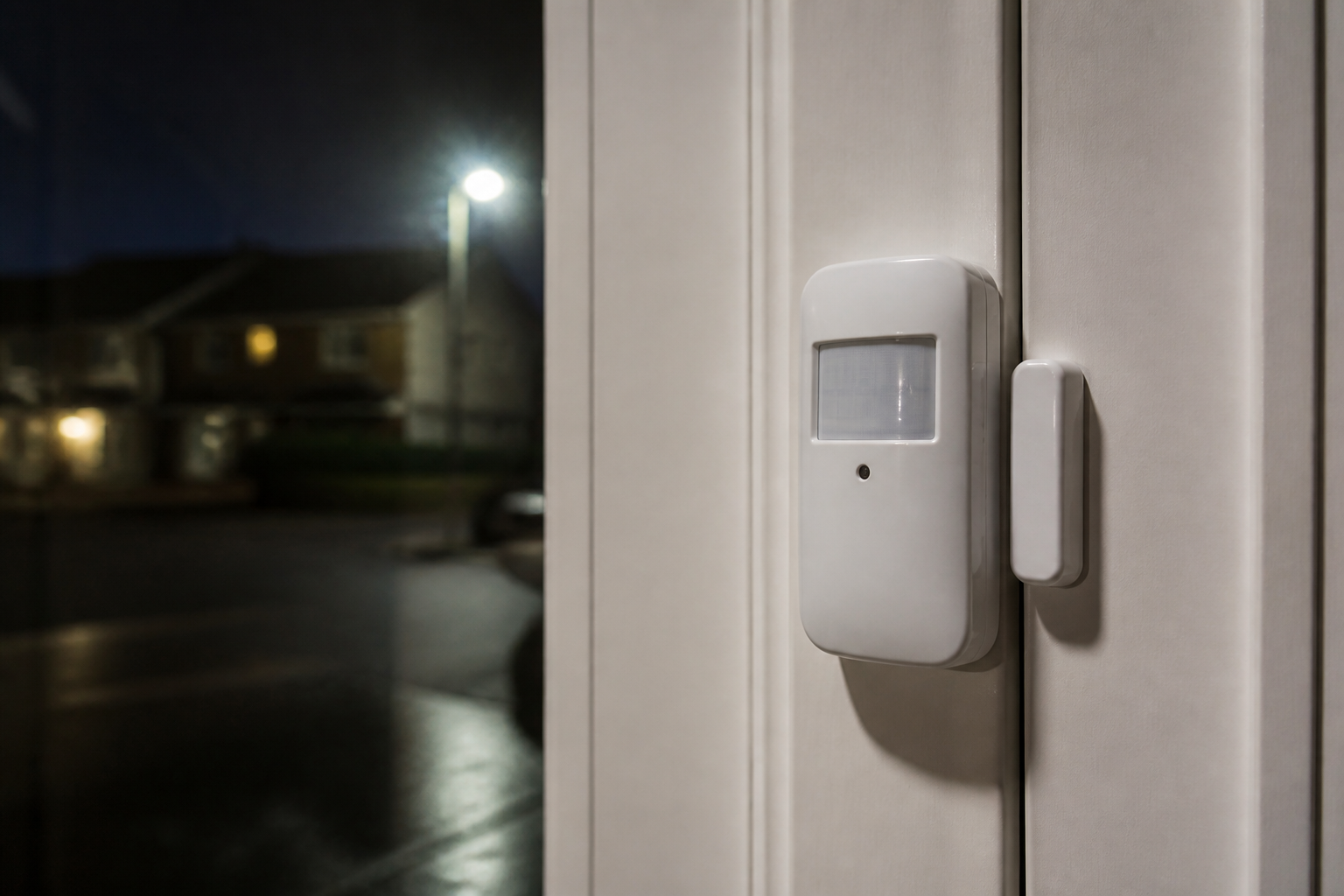
Battery-powered door and window contact sensors are among the simplest devices in any security toolkit. They require no installation expertise, no network connection, and no subscription. A sensor on every exterior door and ground-floor window creates a complete alerting layer for a few dollars per opening. Position the audible unit where it will wake a sleeping household — centrally located, not tucked away in a closet.
Interior motion sensors add coverage for entry points that contact sensors might miss: basement egress windows, skylight hatches, or any opening that is physically possible but not covered by a contact sensor. Place them to cover the most likely path from an entry point to the areas where the household is sheltering, not just the entry points themselves.
One practical detail that is easy to overlook: test battery levels in all sensors before a forecast storm or known severe weather event, not after it. A sensor with a low battery is worse than no sensor, because it creates a false sense of coverage. Keep spare batteries in the same kit as the sensors.
Our Recommendation: Anti-Looter Kit
The core problem this article establishes is a specific timing failure: your home's normal security infrastructure — monitored alarms, hardwired lighting, police response within minutes — may be partially or fully offline during exactly the period when property crime risk is highest. That gap is not theoretical; it has been documented after every major U.S. disaster in the past two decades.
The honest limitation of the DIY approach described in the sections above is coordination. Sourcing perimeter tripwires, compatible door sensors, a battery-powered floodlight, and a door jamming device from separate suppliers means testing compatibility yourself, figuring out placement without a coherent plan, and potentially ending up with components that do not work well together or that have overlapping gaps in coverage. That takes time and some trial and error — neither of which you have in the days before a forecasted hurricane or the hours after an unexpected grid failure.
The Anti-Looter Kit bundles the core components of a layered residential security system — motion sensors, perimeter tripwires, door alarms, a floodlight, and a door jammer — into a single coordinated package designed specifically for crisis conditions when police response may be delayed or unavailable, and built to operate during power outages. It is marketed as intelligence-agency-inspired, meaning the component selection and placement logic reflects a layered detection approach rather than a single line of defense. If you want to close the security gap this article describes without building the system component by component, this is the direct solution. Check current availability and pricing at the product page. For the next step, read Palm Stick Self-Defense for Beginners: How to Defend Yourself Against a Stronger Attacker in Close Quarters.
Our recommendation
Anti-Looter Kit
Check availability →This article contains an affiliate link. If you buy through it, we may earn a commission at no extra cost to you.
Frequently asked questions
Does looting actually increase after natural disasters?
Yes, though the scale varies significantly by event and location. Research in disaster criminology and post-event FEMA analyses document spikes in property crime — particularly in areas with visible signs of abandonment, reduced police presence, and infrastructure failures that disable alarm systems. Opportunistic looting is most common in the first 24-72 hours following a major disaster.
What is the best way to secure a door without electricity during a crisis?
A door security bar or jammer braced against the floor or frame is the most effective passive measure — it works mechanically and requires no power. Pairing it with a reinforced strike plate and three-inch screws anchored into the wall stud (not just the door casing) significantly increases kick resistance. These two measures together address the most common forced-entry method used against residential doors.
How long do battery-powered security sensors last without grid power?
It depends on the specific sensor and battery type, but most modern battery-powered door and motion sensors run for six months to two years on standard alkaline batteries under normal use. Lithium batteries perform better in cold conditions and typically last longer. Check manufacturer specs and test sensors before any forecasted severe weather event.
Will motion-activated lights actually deter looters after a disaster?
Motion-activated lighting is consistently cited in security research as a meaningful deterrent for opportunistic intruders. Its effectiveness during a disaster is higher than normal, because the surrounding area is likely dark — making a triggered floodlight especially conspicuous. The key requirement is that the light must be battery-powered or solar-charged to function during a grid outage; hardwired lights fail when power does.
Is it legal to set up tripwire alarms on your property?
Passive audible tripwire alarms — devices that emit a sound when a wire is disturbed — are generally legal on private property in the United States, but laws vary by state and municipality, and any device that causes physical harm (rather than just alerting) can create significant legal liability. Always verify local ordinances before installation, and use audible-alert-only devices for residential perimeter security.
Related guides
Sources
- FEMA: Disaster-Related Crime and Community Safety
- Ready.gov: Home Security Before and After a Disaster
- NIH / NCBI: Disaster Criminology — Property Crime Patterns After Natural Disasters
General preparedness information, not medical or legal advice. Follow instructions from your local emergency authority during an active event.
Field notes by email
Get the next guide before you need it
One email when a new field guide drops — water, food, power, medicine. No spam, no daily noise, unsubscribe in one click.
Comments on this guide
Questions, corrections and field reports from your own setup are welcome.
No comments yet. Be the first to add a field report.