
Security
Kubotan Self-Defense: Does It Actually Work Against a Stronger Attacker?

By Ephraim Rusk · · 10 min read
This article contains an affiliate link. If you buy through it, we may earn a commission at no extra cost to you.
Quick answer
A kubotan works in close-quarters situations when the user has trained specific pressure-point and impact techniques — without training, it offers little practical advantage over an empty hand. The tool multiplies skill, not luck.
Kubotan self-defense is one of the most searched topics in personal security — and also one of the most misunderstood. Millions of people carry a kubotan, palm stick, or tactical pen on a keychain or in a pocket, and most of them have never thrown a single trained strike with it.
That gap between carrying and knowing matters a great deal when a real threat closes the distance. A kubotan is a close-quarters tool, which means by the time you need it, escape may already be off the table and a stronger or possibly armed attacker may already be inside your personal space. In that scenario, a piece of aluminum on your keyring is only as useful as the technique behind it.
This article answers the honest question: does a kubotan actually work? The short answer is yes — under specific conditions and with specific training. The long answer is what follows.
What a Kubotan Actually Is (and What It Is Not)
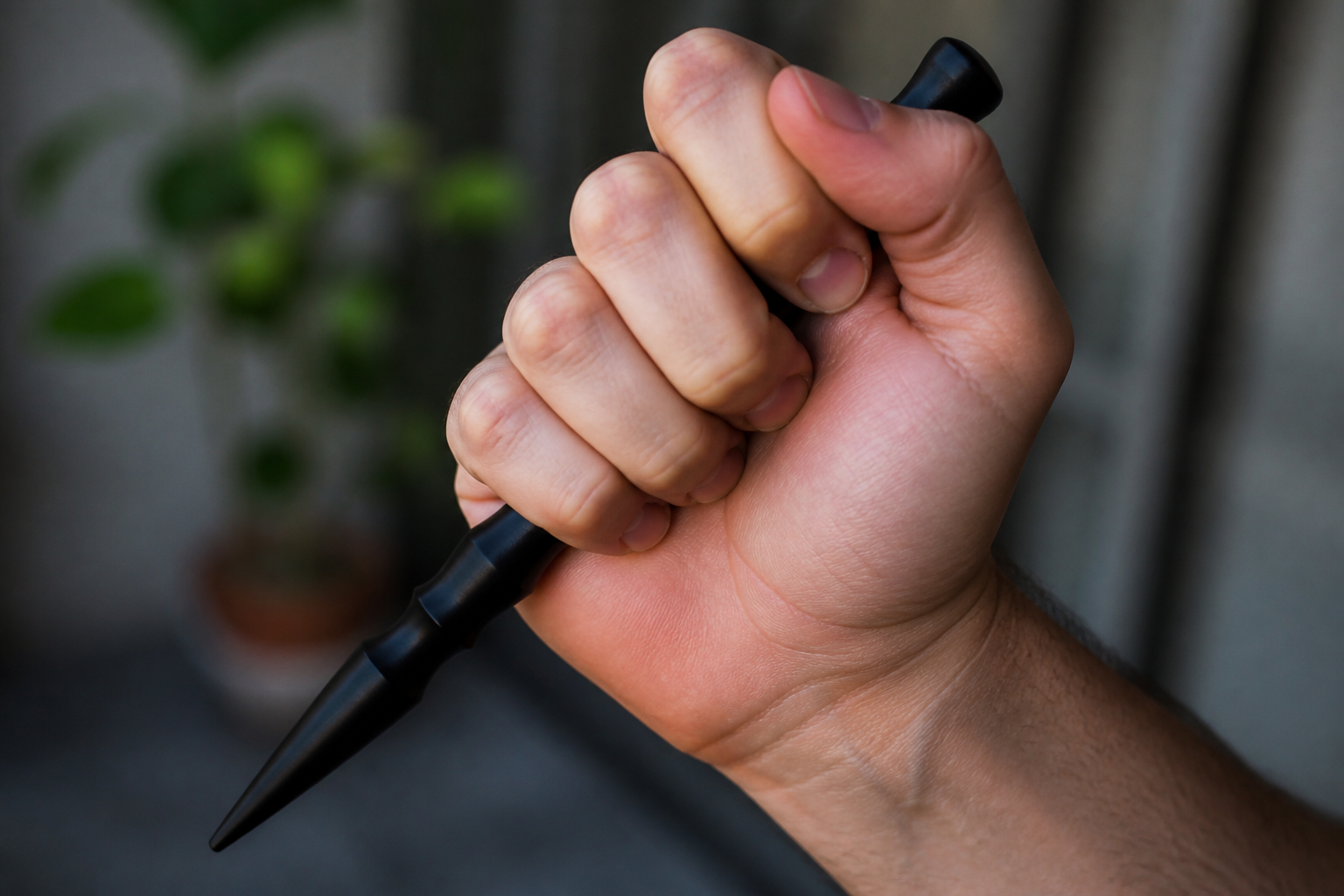
A kubotan is a short, rigid handheld striking and control tool, typically five to six inches long and roughly half an inch in diameter, designed to be gripped in the palm with the ends protruding. It was developed in the 1970s by Takayuki Kubota, a martial arts instructor who worked with the Los Angeles Police Department to give officers a non-lethal compliance and control option.
The same category includes palm sticks, pocket sticks, and — for everyday carry purposes — tactical pens, all of which function on the same mechanical principle: concentrating force through a hard, narrow contact point to amplify pressure on nerve clusters, tendons, and bone.
What a kubotan is not is a magic deterrent. It does not make you immune to a stronger attacker, does not replace situational awareness, and does not function as a stand-alone weapon the way a firearm does. Its value lies in giving a trained user a leverage and pain-compliance advantage in the kind of grappling, grabbing, and close-contact situations where a fist alone is less effective. That is a real advantage — but only when the technique is there.
The Honest Case for the Tool: Why Mechanical Advantage Matters
The core physics argument for a palm stick is straightforward: pressure applied through a small, hard surface area is dramatically more intense than the same force spread across a fist or palm. Research on pain-compliance techniques used in law enforcement consistently describes the effectiveness of focused pressure on motor-nerve points — locations like the mastoid behind the ear, the radial nerve on the forearm, or the common peroneal nerve at the knee — in causing temporary dysfunction without permanent injury.
For a smaller defender against a significantly larger attacker, that matters. A 130-pound person cannot reliably out-muscle a 220-pound person in a grip or clinch. But a well-placed press against a brachial nerve cluster with a palm stick can cause a grip to release regardless of the size difference. This is the genuine mechanical case for the tool — it partially compensates for a strength deficit in close quarters.
The caveat is that finding those nerve points under stress, with an uncooperative and possibly combative attacker, requires repetition. Knowing where the radial nerve sits on a diagram is not the same as being able to locate and engage it when someone has grabbed your wrist. That gap is what training closes.
Common Kubotan Techniques — and Why Most People Get Them Wrong
There are three broad categories of kubotan application: strikes, joint manipulation assists, and pressure-point control. Each has a different risk-to-effectiveness profile.
Strikes — using the protruding end to hammer or rake a target — are the highest-force option and the easiest to apply under stress. The bony structures of the hand, wrist, and forearm are common targets. These require less precision than pressure-point work, which makes them more reliable in a genuine adrenaline situation, but they are also the application most likely to escalate a confrontation rather than end it.
Pressure-point control is the technique most associated with kubotans in law enforcement context. It works well for wrist-grab escapes and come-along holds when applied correctly, but it demands practiced muscle memory. The single most common mistake beginners make is assuming they will be able to apply a fine-motor technique under the adrenal stress of an actual attack. Research on motor performance degradation under high stress — including studies cited by the Federal Law Enforcement Training Centers — consistently shows that fine motor skills deteriorate significantly. Gross motor patterns, practiced to the point of automaticity, hold up far better.
Joint manipulation with a palm stick — using it as a lever against a wrist or elbow — sits in between. It requires some precision but less than nerve-point work, and can be trained to a reliable level of gross-motor automaticity with consistent drilling.
Legal Considerations Before You Carry One
The legal status of kubotans and palm sticks varies significantly by jurisdiction, and you need to know your local law before you carry one.
In the United States, kubotans are legal to carry in most states, but several jurisdictions classify them alongside blackjacks or similar impact weapons, which can make carry or use legally complicated even in self-defense situations. The fact that your kubotan is attached to your keys does not universally exempt it from weapon classification. California, where the tool was popularized, has specific restrictions on certain versions. Outside the US, restrictions are often stricter — the UK, Australia, and Canada have laws that may classify a palm stick as a prohibited weapon regardless of intent.
The practical takeaway: check the statutes for your specific state, county, and any municipality you travel through regularly. If you have a concealed carry permit, that does not automatically cover a palm stick in most jurisdictions — they are legally distinct tools. When in doubt, consult a local attorney before you make a daily carry decision.
- Look up your state or country's definition of 'impact weapon' or 'prohibited weapon' — kubotans are sometimes included.
- Check whether attaching the tool to a keychain changes its legal classification in your area (in some places it does; in others it does not).
- If you travel by air, note that kubotans are prohibited in carry-on luggage by the TSA — checked baggage only.
- Document your training: in a self-defense legal case, demonstrated training history supports a reasonable-force argument.
- When in doubt, a tactical pen that is sold primarily as a writing instrument occupies a grayer legal space in most jurisdictions.
Our Recommendation: Hammer Concept Palm Stick Defense
The real problem this article has been circling is the gap between carrying a palm stick and actually being able to use it. In a close-quarters situation against a stronger attacker — precisely the scenario where the tool is most relevant — an untrained carrier is likely to fumble the draw, misapply the technique under stress, or hesitate at the moment that matters most.
Most people who want to fix that gap hit the same friction: local kubotan instruction is rare, in-person martial arts training is expensive and time-consuming to commit to, and the free video content scattered across the internet is inconsistent, unstructured, and often taught by people with unclear credentials. There is no organized beginner curriculum that takes you from zero to practiced technique without requiring a gym membership or years of commitment.
The Hammer Concept Palm Stick Defense course is built specifically for that beginner gap. It is a 26-lesson video course covering more than three hours of structured instruction on palm stick, kubotan, and tactical pen techniques for close-quarters defense against stronger or armed attackers — the exact scenarios where the tool's mechanical advantage matters most. The course costs €97 and comes with a 60-day money-back guarantee, so you can work through the material and decide whether the skill transfer is real before you are committed. If you carry a palm stick and have not yet built the technique to back it up, this is the logical next step. For the next step, read How to Deter Looters After a Disaster: 5 Layers of Home Security When Police Response Is Delayed.
Our recommendation
Hammer Concept Palm Stick Defense
Check availability →This article contains an affiliate link. If you buy through it, we may earn a commission at no extra cost to you.
Frequently asked questions
Is a kubotan legal to carry every day?
In most US states, yes — but not all. Several jurisdictions classify kubotans as impact weapons subject to the same restrictions as blackjacks or saps. Laws vary significantly by state, county, and country, so check your specific local statutes before carrying one. Attaching it to a keychain does not universally exempt it from weapon classifications.
How effective is a kubotan against a much larger attacker?
When used correctly, a kubotan can partially compensate for a size and strength disadvantage by concentrating force on nerve clusters and joint leverage points that cause pain or motor disruption regardless of the attacker's size. Without proper training, that advantage largely disappears — the tool amplifies skill, not raw force.
Can you learn kubotan technique without a martial arts background?
Yes. Kubotans were designed partly for law enforcement officers without extensive martial arts training. The most important techniques — basic strikes, wrist-grab escapes, and gross-motor pressure applications — can be learned and drilled to a functional level by beginners. Structured instruction helps avoid common errors that make the tool less effective under stress.
What is the difference between a kubotan, palm stick, and tactical pen?
All three operate on the same mechanical principle — a short, rigid tool gripped in the palm to concentrate force or leverage. A kubotan is the original design, typically a cylindrical keychain tool. A palm stick is a broader category that includes wooden or composite versions. A tactical pen combines writing function with the same defensive geometry, and often occupies a more legally ambiguous status that can be advantageous for everyday carry.
Does adrenaline make kubotan techniques harder to apply?
Yes, and this is one of the most important training considerations. High-stress situations degrade fine motor skills noticeably. Techniques that require precise nerve-point location under dynamic resistance become much harder to execute without extensive repetition. Training that builds gross-motor automaticity — patterns practiced until they are reflexive — holds up better under real-world stress conditions.
Related guides
Sources
- FLETC: Human Performance and Stress — Law Enforcement Officer Safety
- TSA Prohibited Items — Kubotan
- NIH: Neuroanatomy of Peripheral Nerve Compression and Pain Compliance
General preparedness information, not medical or legal advice. Follow instructions from your local emergency authority during an active event.
Field notes by email
Get the next guide before you need it
One email when a new field guide drops — water, food, power, medicine. No spam, no daily noise, unsubscribe in one click.
Comments on this guide
Questions, corrections and field reports from your own setup are welcome.
No comments yet. Be the first to add a field report.