
Food
How Much Food Can You Actually Grow in a Small Backyard? (Real Numbers, Not Hype)

By Ephraim Rusk · · 10 min read
This article contains an affiliate link. If you buy through it, we may earn a commission at no extra cost to you.
Quick answer
A well-managed 100 square foot backyard garden growing high-yield crops can realistically produce 100–200 pounds of vegetables per season, cutting a household's fresh produce bill by 50–90% depending on crop selection and location.
How much food can you actually grow in a small backyard? That question is worth answering with real numbers, not motivational estimates — because if the math doesn't work, the effort doesn't either.
The honest answer is that a 100 square foot plot — roughly a 10-by-10 patch — managed well and planted with high-yield crops can produce between 100 and 200 pounds of vegetables in a single growing season. At average U.S. grocery prices, that's a meaningful chunk of a household's fresh food budget. Scale it to 200 square feet and you're looking at the kind of output that genuinely replaces most of what a small family buys at the store each week.
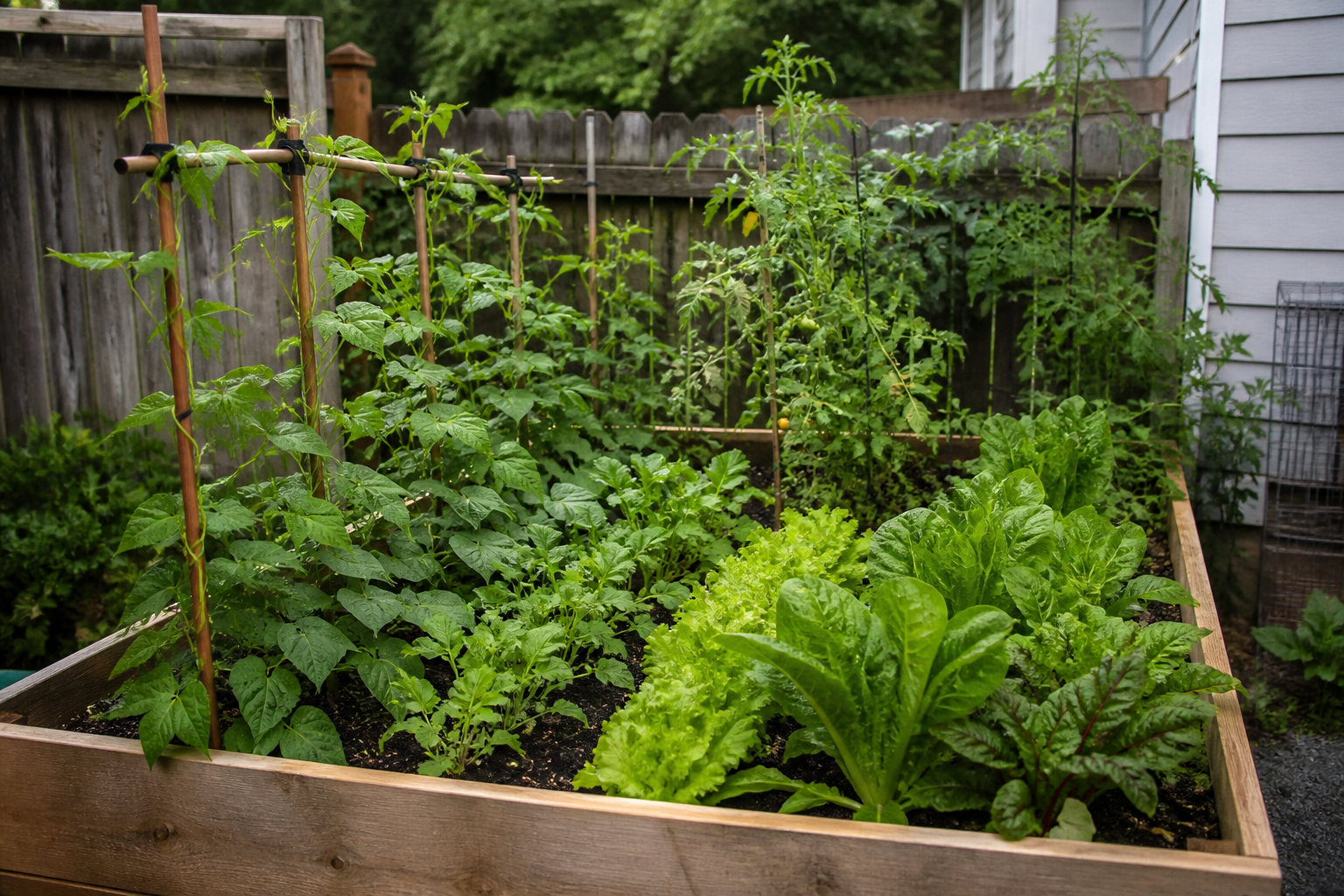
This article walks through the real production numbers by crop, the factors that compress or expand your yield, and a straightforward framework for getting the most food value out of whatever space you have — whether that's a true backyard, a side yard, or a collection of raised beds along a fence line.
What the Research Actually Says About Small Garden Yields
The most reliable production data for home vegetable gardens comes from university cooperative extension programs, which have tracked yield-per-square-foot across decades of trial gardens. According to research published through the National Gardening Association and corroborated by extension programs at land-grant universities, a well-maintained home vegetable garden produces an average of 1 to 2 pounds of vegetables per square foot per season — with high-value crops pushing considerably higher.
That 1–2 lb/sq ft figure is a useful baseline. It accounts for the full range of what most gardeners actually grow: some space-hungry crops like corn or sprawling squash, some moderate producers like peppers, and some genuine overachievers like bush beans and lettuce. If you deliberately select for density and yield — which a small-space gardener must — you can reliably hit 2 lb/sq ft and exceed it on your best beds.
To put that in concrete terms: a 50 sq ft raised bed at 1.5 lb average yields 75 pounds of food over a season. A 200 sq ft plot at the same rate produces 300 pounds. These aren't outlier numbers. They're what systematic, focused growing delivers — and they hold up across most U.S. climate zones when the crop selection is right.
The Crops That Produce the Most Food Per Square Foot
Crop selection is the single biggest lever in small-space food production — it matters far more than soil amendments, watering systems, or any other variable you can control.
Leafy greens are the undisputed leaders for weight-per-square-foot in a small plot. Loose-leaf lettuce, spinach, Swiss chard, and kale can yield 1–2 pounds per square foot per harvest, and because they're cut-and-come-again crops, a single planting produces multiple harvests across a season. Spinach planted in a 4-by-4 bed can realistically yield 10–15 pounds over a spring season before bolting — the equivalent of buying 15–20 bags of grocery store spinach.
Bush beans and pole beans are the best protein-forward option in a small footprint. Bush beans yield roughly 0.5–1 lb per plant, with plants spaced 4–6 inches apart. A single 4-by-8 bed (32 sq ft) planted in bush beans can yield 30–50 pounds over a season with successive plantings. Pole beans grown vertically on a trellis — a critical technique for small spaces — can produce 1–2 lb per plant across multiple pickings.
Tomatoes, specifically determinate or compact indeterminate varieties trained to a stake or cage, produce some of the highest dollar-value yields per square foot because the grocery store price for quality tomatoes is high year-round. A single healthy tomato plant yields 10–20 pounds in a season depending on variety and climate. Two plants in a 4 sq ft space return $15–40 worth of produce at current retail prices — modest in weight, but significant in saved dollars.
What to deprioritize in a small space: sweet corn (huge footprint, low yield per sq ft), sprawling melons and pumpkins unless trellised, and root vegetables like carrots and potatoes, which produce decent weight but at a very low grocery-store price point — meaning your space is worth more planted in something else.
- Loose-leaf lettuce: 1–2 lb/sq ft per cut, multiple harvests per season
- Spinach: 0.5–1 lb/sq ft, high grocery value per pound
- Swiss chard: 1–1.5 lb/sq ft, extremely long harvest window
- Bush beans: 0.5–1 lb per plant, 4–6 inch spacing, successive plantings
- Pole beans (trellised): 1–2 lb per plant across full season
- Compact tomatoes: 10–20 lb per plant, very high dollar value per pound
- Zucchini: 6–10 lb per plant, prolific — one or two plants is enough
Factors That Compress or Expand Your Real-World Yield
Published yield data assumes certain baseline conditions — and when those conditions aren't met, output drops fast. Understanding the main factors lets you diagnose your garden honestly rather than blaming the seed packet.
Sunlight is the non-negotiable. Vegetables are not shade-tolerant. Most fruiting crops (tomatoes, beans, peppers, squash) need a genuine 6–8 hours of direct sun per day. Leafy greens tolerate 4–6 hours, which makes them the right choice if your only available space is partially shaded. Trying to grow tomatoes in a spot that gets 4 hours of afternoon sun is one of the most common causes of poor yields that gardeners attribute to soil or pests when the real cause is light.
Soil quality has an outsized effect in a small-space garden. In a large farm, low-fertility zones get averaged out. In a 50 sq ft raised bed, every inch of soil matters. Beds built with a mix of quality compost — USDA research consistently shows compost application improves vegetable yields significantly — and balanced organic fertilizer routinely outperform neglected native soil by 50–100% in the first season alone.
Succession planting is what separates a garden that produces for 6 weeks from one that produces for 20. Most beginner gardeners plant everything at once, harvest a glut, then watch the bed sit empty. Sowing a new round of lettuce, beans, or radishes every 2–3 weeks — succession planting — keeps the same square footage producing continuously across the full season. This one habit can effectively triple the total output of a small plot without adding a single square foot.
Vertical growing is the most underused multiplier in small-space gardens. Trellising beans, cucumbers, small melons, and even some squash varieties moves production off the horizontal footprint and into unused air space. A 4-foot trellis along the back of a raised bed can support 8–12 pole bean plants that would otherwise require 32+ sq ft of ground space.
Running the Real Dollar Math on a 5-by-10 Plot
A 50 square foot garden — a 5-by-10 raised bed — is a realistic starting point for a household with limited space, and it's worth running the actual numbers rather than leaving this abstract.
At 1.5 lb per square foot average (a conservative but achievable target for deliberate crop selection), a 50 sq ft bed yields 75 pounds of vegetables per season. At the USDA Economic Research Service's tracked average retail price for fresh vegetables — roughly $1.50–$2.50 per pound depending on the crop mix — that represents $112–$187 in avoided grocery spending from a single bed in a single season. Plant it heavier toward spinach, tomatoes, and beans and that number moves toward the top of the range.
Double the bed size to 100 sq ft and the math roughly doubles: $225–$375 per season. A 200 sq ft plot — still entirely manageable in a modest backyard — can plausibly replace $450–$750 in annual grocery spending on fresh produce, which for many households represents the majority of their fresh vegetable budget. These figures align with data published by the National Gardening Association, which found that average household gardens return approximately $600 in produce value on about $70 in inputs — a roughly 8:1 return.
The 50–90% grocery bill reduction figure you see cited isn't unrealistic, but it applies to the fresh produce portion of a grocery bill specifically, not the total bill. For a family already spending $150–$200 per month on fresh vegetables, a well-run 100–200 sq ft garden can realistically cover most of that category.
Our Recommendation: The 5 Foot Farm
The gap this article keeps circling is the same one most small-space gardeners hit in year one: knowing that the potential is real, but not having a system — a specific crop sequence, spacing plan, and succession schedule designed for a small footprint rather than adapted down from large-garden advice.
Most free small-garden guides give you a plant list and a planting calendar and leave you to figure out the integration yourself. That works eventually, but it costs you one or two seasons of underperformance and trial-and-error while you dial in what actually belongs in your specific space. The gap isn't motivation or land — it's a simplified, tested system built specifically for small plots, with options for both a budget implementation and a more complete setup.
The 5 Foot Farm is an educational home-gardening guide built around exactly that simplified small-footprint system, with a stated goal of cutting grocery bills up to 90% and both a budget and premium implementation path so you're not forced into an all-or-nothing commitment. If the math in this article resonated and you're ready to move from numbers to a working plan, The 5 Foot Farm is worth a close look. For the next step, read No-Refrigeration Food Preservation Methods That Actually Work: 7 Techniques Used Before Electricity.
Our recommendation
The 5 Foot Farm
Check availability →This article contains an affiliate link. If you buy through it, we may earn a commission at no extra cost to you.
Frequently asked questions
How much food can you grow in a 10x10 garden?
A 100 sq ft (10x10) vegetable garden planted with high-yield crops and managed well can realistically produce 100–200 pounds of vegetables per season. At typical retail prices, that represents $150–$400 in avoided grocery spending depending on your crop mix.
Is a small backyard garden actually worth it financially?
Yes, for fresh produce specifically. The National Gardening Association has tracked average returns of around $600 in produce value on roughly $70 in annual inputs for home vegetable gardens. The return improves significantly when you focus your limited space on high-value crops like tomatoes, leafy greens, and beans rather than low-cost staples like potatoes.
What vegetables produce the most food in the least space?
Loose-leaf lettuce, spinach, Swiss chard, bush beans, pole beans (trellised), and compact tomato varieties consistently produce the highest combination of weight and grocery-dollar value per square foot. Zucchini produces very high weight but one or two plants is typically more than enough for a household.
Can a small garden really cut your grocery bill by 50% or more?
A 50–90% reduction is realistic for the fresh produce portion of your grocery bill — not your total grocery bill. A household spending $150–$200 per month on fresh vegetables can realistically replace most of that category with a well-managed 100–200 sq ft garden using succession planting and high-yield crop selection.
What is succession planting and why does it matter for small gardens?
Succession planting means sowing a new batch of a crop every 2–3 weeks rather than all at once. In a small garden it's essential — it keeps the same square footage producing continuously across the full season instead of delivering one large harvest and then sitting empty. It can effectively double or triple total seasonal output from the same plot size.
Related guides
Sources
- USDA Economic Research Service — Fruit and Vegetable Prices
- USDA National Institute of Food and Agriculture — Home Gardening and Compost Benefits
- University of Minnesota Extension — Vegetable Garden Yields for the Home Gardener
General preparedness information, not medical or legal advice. Follow instructions from your local emergency authority during an active event.
Field notes by email
Get the next guide before you need it
One email when a new field guide drops — water, food, power, medicine. No spam, no daily noise, unsubscribe in one click.
Comments on this guide
Questions, corrections and field reports from your own setup are welcome.
No comments yet. Be the first to add a field report.