
Food
No-Refrigeration Food Preservation Methods That Actually Work: 7 Techniques Used Before Electricity

By Ephraim Rusk · · 11 min read
This article contains an affiliate link. If you buy through it, we may earn a commission at no extra cost to you.
Quick answer
The most reliable no-refrigeration food preservation methods are salt curing, lacto-fermentation, dehydration, smoking, fat-packing (confit), root cellaring, and sugar or vinegar preservation. Each has been used for centuries and requires no electricity or special equipment to start.
No-refrigeration food preservation methods have kept families fed through wars, droughts, and economic collapses for centuries — and the techniques work just as well today as they did in 1890. If your power goes out for more than a few days, everything in your refrigerator and freezer is on a clock. Knowing how to preserve food without electricity is not a hobbyist skill; it is a practical household capability that directly determines whether you eat well or scramble during a disruption.
Most modern households have completely outsourced food preservation to the grid. We rely on refrigeration so thoroughly that a single extended outage can mean hundreds of dollars in spoiled groceries and no clear plan for what comes next. The families who fared best during the Great Depression, World War II rationing, and post-hurricane isolation were not the ones with the biggest freezers — they were the ones who knew how to cure, ferment, dry, and store food the old way.
This article covers seven specific, field-tested preservation techniques that require no refrigeration, no freeze-drying equipment, and no expensive commercial kits. Each one has a real track record. Each one is achievable in an ordinary kitchen or basement with materials you can source locally or already own.
Why Refrigeration Is a Single Point of Failure for Your Food Supply
The average American household keeps roughly three to five days of food that does not require refrigeration. Everything else — fresh produce, dairy, meat, leftovers — depends on an unbroken cold chain that collapses the moment the power goes out. According to the USDA, refrigerated food begins to enter the danger zone above 40 degrees Fahrenheit, and most perishables are unsafe after four hours at that temperature without power.
Grid outages lasting more than 72 hours are not rare. FEMA data shows that major disaster declarations in the United States have increased significantly over the past two decades, and extended outages from hurricanes, ice storms, and infrastructure failures regularly affect millions of households at a time. A chest freezer full of meat becomes a liability, not an asset, if you have no way to preserve its contents before they spoil.
The solution is not to abandon refrigeration — it is to hold it more loosely. Building competency in preservation methods that predate electricity means you have a genuine fallback that does not depend on buying expensive freeze-dried food. It also means you can meaningfully reduce your grocery bill by preserving seasonal surpluses rather than letting them go to waste.
Salt Curing: The Oldest Reliable Method for Preserving Meat and Fish
Salt curing works by drawing moisture out of food and creating an environment where harmful bacteria cannot grow — it is one of the oldest and most effective no-refrigeration preservation methods humans have ever developed. Done correctly, salt-cured meat and fish can remain shelf-stable for months, sometimes years, without any refrigeration.
Dry curing involves packing meat — typically pork belly, fatback, or fish fillets — directly in non-iodized salt, sometimes combined with curing salts containing sodium nitrite. The salt penetrates the tissue, lowers water activity, and inhibits the growth of pathogens including Clostridium botulinum. The USDA's Food Safety and Inspection Service publishes tested cure ratios for home use that take the guesswork out of safe salt concentrations.
Brine curing (wet curing) submerges meat in a saturated salt solution. This method was used extensively by military commissaries and merchant ships before refrigeration existed. A basic brine for meat is roughly one cup of non-iodized salt per gallon of water, though specific ratios and times vary by cut and thickness — always use a tested recipe from an extension service or USDA source rather than improvising. The key variables are salt concentration, temperature during curing, and time. Too little salt, too warm a curing environment, or too short a curing period are the common failure points.
For beginners, salt-cured fish is a lower-stakes starting point than red meat. Cod, salmon, and mackerel have been preserved this way across many cultures. The result — salt cod, gravlax-style preparations — stores well at cool room temperatures and rehydrates easily for cooking.
Lacto-Fermentation: How to Make Food Self-Preserving With Salt and Time
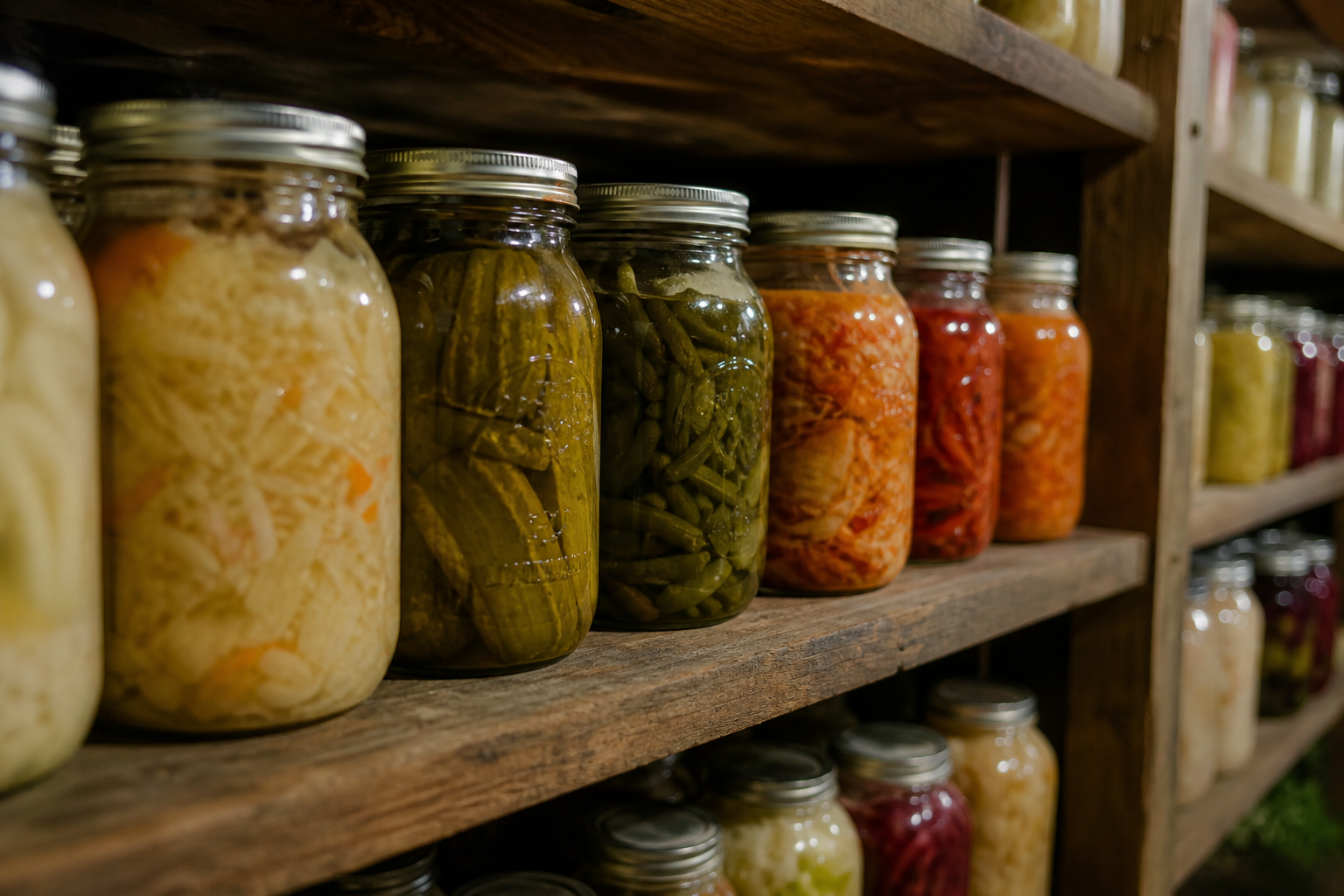
Lacto-fermentation uses naturally occurring Lactobacillus bacteria to produce lactic acid, which lowers the pH of food enough to prevent spoilage — turning ordinary vegetables into long-lasting, nutritionally dense preserved food with nothing more than salt, water, and time. Sauerkraut, kimchi, fermented pickles, and kvass are all lacto-fermented foods that store well for months without refrigeration when kept in cool, dark conditions.
The basic process for most vegetables is straightforward: shred or chop the vegetable, combine it with non-iodized salt at roughly 2 percent of the vegetable's weight, pack it tightly into a clean jar until brine rises above the surface, and keep it submerged and away from air. Within three to seven days at room temperature, active fermentation produces bubbles, a pleasantly sour smell, and a product that is both preserved and probiotic.
Fermentation is particularly valuable in a preparedness context because it actually increases the nutritional value of food during the preservation process. Research published through institutions including the National Institutes of Health has documented that fermentation can increase bioavailability of certain minerals and B vitamins, as well as producing beneficial microbial populations. This is a meaningful distinction from most preservation methods, which degrade nutritional content.
The main risk in lacto-fermentation is allowing the vegetables to contact air above the brine, which promotes mold rather than beneficial bacteria. A simple solution is to use a zip-lock bag filled with water as a weight to keep the vegetables submerged. Purpose-built fermentation crocks eliminate the problem entirely but are not necessary to start.
Dehydration, Smoking, and Fat-Packing: Three Methods That Build on Each Other
Dehydration, smoking, and fat-packing each remove or block the moisture that spoilage organisms need to survive — and they work even better when combined. Removing water content to below 10 percent effectively halts bacterial growth and dramatically extends shelf life at room temperature. The National Center for Home Food Preservation, based at the University of Georgia, publishes tested dehydration times and temperatures for dozens of food types.
Solar dehydration requires nothing but a drying rack, cheesecloth to keep insects off, and several days of direct sun with low humidity. Thin slices of fruit, meat jerky, and many vegetables dry adequately in three to five days under good conditions. Electric food dehydrators speed the process and allow year-round operation but are not a requirement. The standard internal temperature for safe meat jerky dehydration is 160 degrees Fahrenheit, which can be achieved in a low oven before transferring to a dehydrator if needed.
Smoking combines partial dehydration with the antimicrobial compounds in wood smoke — specifically phenols and aldehydes — to preserve meat and fish. Cold smoking (below 90 degrees Fahrenheit) flavors and partially preserves food but does not fully cook it; hot smoking (above 165 degrees Fahrenheit) both cooks and preserves. For long-term storage without refrigeration, hot smoking followed by vacuum sealing or fat-packing is the most reliable approach.
Fat-packing, or confit, submerges cooked meat completely in rendered fat — traditionally lard, duck fat, or tallow — sealing it from air and moisture. Duck confit stored in fat was a standard preservation method in France for centuries. Properly prepared, fat-packed meat kept at cool temperatures can remain edible for several months. The key is that the meat must be fully submerged and the fat must be free of water, which would enable bacterial growth at the fat-food interface.
Root Cellaring and Sugar or Vinegar Preservation: Low-Skill, High-Return Methods
Root cellaring uses the stable, cool, humid conditions of underground or semi-underground storage to extend the shelf life of whole vegetables and fruit by months without any processing — it is arguably the lowest-effort preservation method available and still one of the most effective. Temperatures between 32 and 40 degrees Fahrenheit with high humidity keep root vegetables, winter squash, apples, and many other crops in edible condition well into spring.
You do not need a dedicated root cellar to benefit from this method. An insulated corner of a basement, a buried garbage can with a vented lid, or even a crawlspace can provide adequate conditions for carrots, beets, turnips, potatoes, and parsnips. The University of Minnesota Extension publishes detailed guidance on improvised cold storage options for households without traditional cellars. The main enemies of root cellar storage are freezing, temperature fluctuation, and ethylene gas from apples or pears spoiling nearby crops — keep fruit and vegetables separated.
Sugar preservation — jams, jellies, and candied fruits — works because high sugar concentration lowers water activity just as salt does, starving microorganisms of the moisture they need. A correctly made jam with sufficient sugar (typically a 1:1 ratio of fruit to sugar by weight) and proper hot-water-bath canning will remain shelf-stable for at least a year. The USDA's Complete Guide to Home Canning is a free, authoritative resource for tested recipes.
Vinegar pickling creates an acidic environment (pH below 4.6) that prevents the growth of most pathogens, including Clostridium botulinum. The critical variable is using vinegar with at least 5 percent acetic acid — standard commercial white vinegar and apple cider vinegar both qualify. Homemade vinegar of uncertain strength is not safe for canning. Pickled vegetables, eggs, and even some meats store well for months at cool room temperatures when properly prepared with a tested recipe.
Our Recommendation: The Lost Superfoods
The real vulnerability in most households is not a lack of food — it is a lack of the specific knowledge to preserve food without the grid. If the power goes out tomorrow, most families can buy groceries for a few more days, but they have no practical system for keeping that food edible past the first week without electricity. That gap does not close by buying more canned goods; it closes by learning methods that work regardless of what infrastructure is available.
The problem with piecing together that knowledge yourself is the friction: reliable guidance is scattered across university extension publications, out-of-print homesteading books, and institutional food safety documents that were not written to be practically applied in a home kitchen. Building a working system from those sources takes real time and requires sorting good information from the substantial amount of unsafe folklore that circulates online about food preservation.
The Lost Superfoods is a $37 digital guide that consolidates 126 no-refrigeration food preservation and storage methods drawn from wartime and Depression-era practice — the periods when families with no grid access had to make this work or go hungry. The guide covers methods for building what it describes as 295 or more pounds of shelf-stable food a year on roughly $5 a week, using techniques that predate and do not require modern equipment. If you want a single organized resource that goes well beyond the seven methods covered here and is structured for practical household application rather than academic reference, it is a straightforward place to start. For the next step, read How to Get Enough Protein on a Plant-Based Emergency Food Supply (Without Buying Expensive Specialty Products).
Our recommendation
The Lost Superfoods
Check availability →This article contains an affiliate link. If you buy through it, we may earn a commission at no extra cost to you.
Frequently asked questions
How long can salt-cured meat last without refrigeration?
Properly dry-cured meat — such as salt pork or country ham — can last several months at cool room temperatures and up to a year or more in ideal conditions. The key variables are adequate salt concentration, a thorough and even cure penetrating to the center of the cut, and storage away from heat and humidity. Always use a tested recipe from the USDA or a university extension service rather than estimating salt ratios.
Is fermented food safe to eat without refrigeration?
Yes, actively lacto-fermented vegetables are safe to store at cool room temperatures for months when properly prepared. The lactic acid produced during fermentation lowers the pH enough to inhibit pathogen growth. The critical safety rule is keeping the vegetables fully submerged below the brine at all times — any vegetable matter exposed to air above the brine can grow mold rather than beneficial bacteria.
What is the easiest food preservation method for beginners without electricity?
Lacto-fermentation of vegetables is the most accessible starting point. It requires only fresh vegetables, non-iodized salt, a clean jar, and clean water. There is no special equipment, no heat processing, and no precise temperature control needed. Sauerkraut is the standard beginner project: shredded cabbage packed with 2 percent of its weight in salt, pressed until brine covers the surface.
Can you preserve food without refrigeration in a hot climate?
Yes, but the method matters more in hot conditions. Salt curing, vinegar pickling, dehydration, and sugar preservation all work in warm climates because they chemically or physically prevent spoilage rather than relying on temperature. Fermentation also works but proceeds faster in heat, so a three-day ferment in a cool basement may be a one-day ferment at 85 degrees Fahrenheit — watch the product rather than the clock. Root cellaring is the method most dependent on cool temperatures and is harder to use in hot climates without a basement or underground space.
Does smoking meat actually preserve it without refrigeration?
Hot smoking — at internal temperatures above 165 degrees Fahrenheit — does preserve meat by combining heat treatment with the antimicrobial compounds in wood smoke and partial dehydration. Cold smoking alone does not reliably preserve meat and should not be relied on for long-term no-refrigeration storage. For best results, hot-smoked meat should also be stored in a sealed, low-humidity environment or fat-packed after smoking to extend shelf life further.
Related guides
Sources
- USDA Food Safety and Inspection Service — Curing and Smoking
- National Center for Home Food Preservation — Drying Foods
- USDA Complete Guide to Home Canning
- University of Minnesota Extension — Root Cellars and Cold Storage
General preparedness information, not medical or legal advice. Follow instructions from your local emergency authority during an active event.
Field notes by email
Get the next guide before you need it
One email when a new field guide drops — water, food, power, medicine. No spam, no daily noise, unsubscribe in one click.
Comments on this guide
Questions, corrections and field reports from your own setup are welcome.
No comments yet. Be the first to add a field report.