
Food
How to Cut Your Grocery Bill 50–90% With a Small Home Garden (High-Yield Crops and Real Math)

By Ephraim Rusk · · 11 min read
This article contains an affiliate link. If you buy through it, we may earn a commission at no extra cost to you.
Quick answer
Growing high-yield crops like kale, bush beans, tomatoes, and zucchini in as little as 50 square feet of managed space can realistically offset 50 to 90 percent of a household's fresh produce spending. The key is selecting crops by value per square foot, not by what you find interesting to grow.
Cutting your grocery bill with a small home garden is genuinely achievable — but only if you plant the right things. Most first-time kitchen gardeners spend a season growing crops that cost them more in water and time than they'd have spent at the register, then conclude gardening 'doesn't pay.' The problem isn't the garden. It's the crop selection.
The average American household spends roughly $5,000 per year on groceries, with fresh produce making up a disproportionate share of that cost per calorie. A well-planned small-footprint garden — even one confined to a patio, a raised bed, or a narrow side yard — can realistically replace a significant portion of that line item. Some households report cutting their produce spending by 70 to 90 percent once their system is dialed in.
This article gives you the real math on which crops deliver the most food value per square foot, how to stack your growing calendar to extend harvests, and what a realistic savings estimate looks like for a beginner-level small garden. No hype, no exaggerated yields — just numbers you can plan around.
Why Most Small Gardens Fail to Save Money (And What Changes That)
The single biggest reason small gardens fail to cut grocery costs is poor crop selection relative to space. A gardener who plants one watermelon vine, a row of sweet corn, and a few pumpkins has dedicated 80 square feet to crops that retail for pennies per pound and deliver a single, brief harvest. Meanwhile, that same space planted with salad greens, climbing beans, and cherry tomatoes could produce harvestable food every week from June through October.
The second failure mode is planting for novelty rather than volume. Unusual heirloom varieties and specialty crops have their place, but if your goal is to reduce the grocery bill, you need crops that produce continuously across a season, are priced high enough at retail to justify the space, and store or preserve well enough that you're not throwing away surplus.
The third issue is underutilizing vertical space. Most gardeners think in terms of ground square footage. Adding a basic trellis or cattle-panel arch to a 4-by-8 raised bed can effectively double or triple its productive capacity by training vining crops — beans, cucumbers, peas — upward rather than outward. This is the mechanical heart of high-density, small-footprint production.
The Best High-Yield Vegetables to Grow Per Square Foot (With Real Numbers)
Yield per square foot varies enormously by crop, and matching that yield to retail price is how you calculate actual grocery savings. The following are among the highest-value crops for a small garden, based on typical home-garden yield data and average U.S. grocery retail prices.
Leaf lettuce and salad mix are at the top of the list. A single 4-square-foot patch can produce a fresh salad every week for 10 to 12 weeks in spring and fall, and pre-washed salad mix retails for $4 to $6 per bag. A 32-square-foot bed of cut-and-come-again greens — lettuce, arugula, spinach, kale — can realistically replace $200 to $300 worth of bagged salad per season, with two plantings.
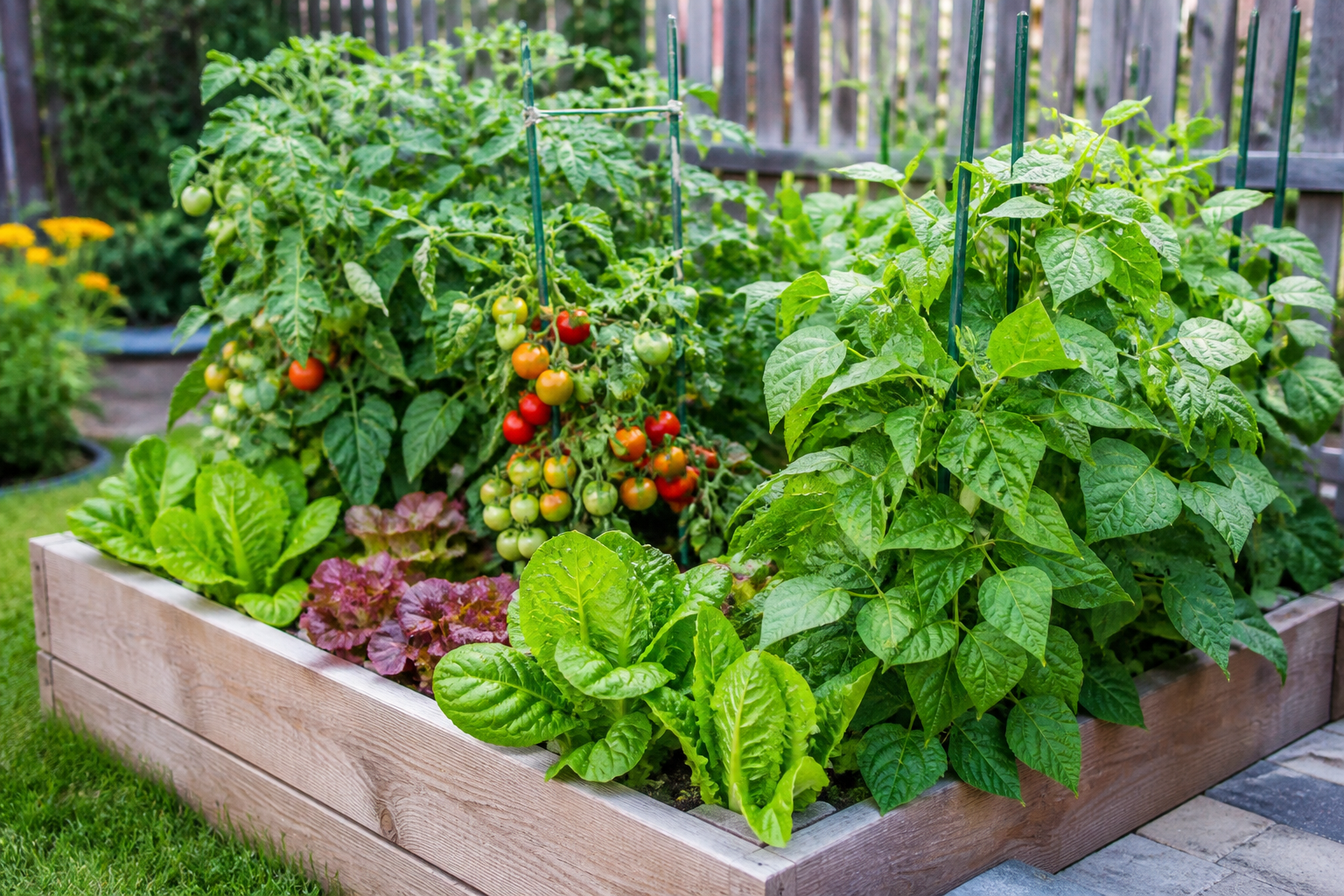
Cherry tomatoes are the next anchor crop. A single indeterminate plant trained vertically can yield 10 to 20 pounds of fruit over a season. At $3 to $5 per pint at retail, one healthy plant occupying roughly 4 square feet of bed space (plus vertical trellis) can represent $40 to $80 in grocery equivalents. Plant four to six and the math compounds quickly.
Bush beans are one of the most reliable space-efficient protein crops. Planted at 6-inch spacing, a 4-by-4 area can yield 5 to 8 pounds of green beans per planting, and you can succession-plant every three weeks for continuous harvest. Green beans average $2.50 to $3.50 per pound at the grocery store. Zucchini is similarly productive — one plant per household is often more than enough, producing 6 to 10 pounds per week at peak.
Herbs deserve a separate mention. Fresh basil, cilantro, parsley, and chives retail at $2 to $4 per small bunch and have short shelf lives, meaning you buy them frequently and throw away a lot. A 2-square-foot herb pot eliminates that purchase almost entirely. Per square foot, fresh culinary herbs may be the single highest-value crop a home gardener can grow.
- Cut-and-come-again salad greens: high weekly value, two seasons per year
- Cherry and paste tomatoes: high per-pound retail, continuous production
- Bush beans: reliable protein crop, easy succession planting
- Zucchini and summer squash: extremely high output per plant
- Cucumbers: climb vertically, high water content value in summer
- Fresh culinary herbs: highest dollar-per-square-foot of any crop
How to Do the Actual Math on Garden Grocery Savings
Realistic savings estimates require honest numbers — not catalog-copy yield claims. Here is a conservative framework for a beginner working with 50 to 100 square feet of managed growing space.
Assume a 4-by-8 raised bed (32 sq ft) planted with a salad green mix and two tomato plants, plus one 4-by-4 bed (16 sq ft) of bush beans and one container of herbs. At conservative yields, this setup can realistically produce: 15 to 20 pounds of salad greens ($60–$100 retail value), 20 to 40 pounds of tomatoes ($40–$80), 12 to 18 pounds of green beans ($30–$60), and a continuous herb supply ($60–$90 over the season). That's a rough total of $190 to $330 in grocery equivalents from roughly 50 square feet.
Startup costs for a basic raised bed — lumber, soil, seeds, basic tools — typically run $150 to $300 for a first-year build. In Year 1, you may break even or come out slightly ahead. In Year 2 and beyond, with soil already established, seed costs drop to $20 to $40 per bed and the savings become genuine. This is why framing gardening as a multi-year system matters more than chasing a first-season payoff.
Scaling up from 50 to 200 square feet of well-managed, high-yield planting is where the 70 to 90 percent grocery reduction claims become credible — particularly for households that also learn basic preservation skills like blanching and freezing surplus beans, canning tomatoes, and dehydrating herbs. The garden and the pantry work together; neither delivers full results alone.
Extending Your Harvest: Succession Planting and Season Extension Basics
A single planting of any crop only covers a few weeks of harvest; succession planting and simple season extension techniques are what turn a garden into a consistent food source rather than a June abundance and a September empty bed.
Succession planting means sowing a new round of the same fast-maturing crop every two to three weeks rather than all at once. This is especially effective for lettuce, cilantro, spinach, and bush beans — crops that mature in 45 to 60 days and then decline. Stagger three plantings of bush beans two weeks apart, and you have continuous fresh bean harvests across 8 to 10 weeks instead of one large harvest that exceeds what you can eat fresh.
Season extension stretches your productive window. A simple low tunnel made from 9-gauge wire hoops and row cover fabric can protect cold-hardy greens — kale, spinach, arugula, mache — through light frosts down to the mid-20s Fahrenheit in many climates. That can add four to eight weeks to both ends of your season, significantly increasing total annual yield from the same footprint. USDA Plant Hardiness Zone data is the reference point for understanding your local frost dates and planting windows.
Cold frames and unheated hoop houses extend this further, and even a basic south-facing cold frame built from reclaimed windows and lumber can allow year-round greens production in USDA Zones 6 and above. These structures cost $30 to $80 in materials and require no power. For a household serious about cutting grocery costs, a cold frame is one of the highest-return investments per dollar in the entire garden system.
Our Recommendation: The 5 Foot Farm
If you do not have a reliable system guiding your crop choices, layout, and timing, it is easy to put real effort into a garden that produces frustration more than food — and that is the specific problem this article has been walking through.
The gap most home gardeners run into is not motivation or even space — it is not having a clear, simplified framework that tells them exactly what to plant where, when to plant it, and how to arrange a small footprint for maximum edible output. Free information on gardening is abundant but scattered, often contradictory, and rarely organized around the goal of actually reducing your grocery bill rather than enjoying a hobby.
The 5 Foot Farm is an educational home-gardening guide built around a simplified system designed specifically to cut grocery spending — the guide's own framing targets up to 90 percent reductions — by growing food in a small footprint. It offers both a budget implementation path and a premium one, so you can start at whatever level makes sense for your situation right now and scale up. If you have been thinking about starting a serious kitchen garden but keep stalling because you are not sure you are doing it right, this is a direct answer to that friction. Take a look and see whether the system fits your space and goals. For the next step, read How to Store 3 Months of Food Without Refrigeration (The Practical Household Guide).
Our recommendation
The 5 Foot Farm
Check availability →This article contains an affiliate link. If you buy through it, we may earn a commission at no extra cost to you.
Frequently asked questions
How much space do I actually need to cut my grocery bill with a garden?
As little as 50 square feet of well-managed, high-yield planting can generate $200 to $300 in grocery equivalents per season. Scaling to 150 to 200 square feet, combined with basic food preservation, is where households commonly report 50 to 90 percent reductions in fresh produce spending.
What vegetables give you the most food value per square foot?
Cut-and-come-again salad greens, cherry tomatoes, bush beans, cucumbers on a vertical trellis, and fresh culinary herbs consistently deliver the highest grocery-equivalent value per square foot. Herbs in particular often have the best dollar-per-square-foot return of any crop.
Is it cheaper to grow your own vegetables or buy them?
After the first year, growing your own is almost always cheaper for high-value crops like salad greens, tomatoes, and herbs — sometimes dramatically so. Year 1 startup costs (beds, soil, tools) can offset savings, but Year 2 onward, seed costs drop sharply and the margin becomes clear.
How do I make my small garden produce food all season long?
Succession planting — sowing a new batch of fast-maturing crops every two to three weeks — is the core technique. Pair it with row cover or a simple cold frame to extend both ends of your season, and a 50-square-foot garden can produce harvestable food for six to nine months in most U.S. climates.
Can apartment or container gardeners meaningfully cut their grocery bills?
Yes, within realistic limits. A sunny patio or balcony with containers can support herbs, salad greens, cherry tomatoes, and bush beans — the four highest-value crop categories. Expect $100 to $200 per season in grocery offsets from a well-managed container setup, with higher returns as you refine your system.
Related guides
Sources
- USDA Economic Research Service — Food Expenditure Data
- USDA Plant Hardiness Zone Map — Frost Date and Zone Reference
- USDA National Agricultural Library — Home Vegetable Gardening
General preparedness information, not medical or legal advice. Follow instructions from your local emergency authority during an active event.
Field notes by email
Get the next guide before you need it
One email when a new field guide drops — water, food, power, medicine. No spam, no daily noise, unsubscribe in one click.
Comments on this guide
Questions, corrections and field reports from your own setup are welcome.
No comments yet. Be the first to add a field report.