
Skills
How to Build a Family Emergency Communications Plan (Step-by-Step for Real Emergencies)

By Ephraim Rusk · · 11 min read
This article contains an affiliate link. If you buy through it, we may earn a commission at no extra cost to you.
Quick answer
A family emergency communications plan designates two meeting places, one out-of-state contact, and a set communication hierarchy (text first, then call, then contact) so every member knows exactly what to do when cell networks fail or the family is separated during a disaster.
A family emergency communications plan is the single most overlooked piece of household preparedness — and the one most likely to matter in the first 90 minutes of any real emergency. You can stock six months of food and a full medical kit, but if your kids are at school, your spouse is across town, and the cell towers are jammed or down, none of that gear helps you reunite safely.
Most families assume they'll just call or text. That assumption fails predictably. After Hurricane Katrina, landline and cellular infrastructure was disrupted across the Gulf Coast for days. After the 9/11 attacks, New York City's wireless networks were congested to the point of near-uselessness for hours. FEMA and Ready.gov both document this pattern across major disaster types: cell networks are among the first systems to fail or become overwhelmed. Texting typically gets through longer than voice calls, but even that has hard limits under load.
This guide walks you through building a real, working family emergency communications plan — one that accounts for separation, network failure, and the specific chaos of a sudden-onset event. It is not a theoretical framework. It is a practical checklist you can complete in one sitting and practice this weekend.
Why Cell Phones Alone Are Not a Communications Plan
Cell networks fail in emergencies for two distinct reasons: infrastructure damage and network congestion. Understanding the difference matters because your backup strategy depends on which failure you're preparing for.
Infrastructure damage — downed towers, severed fiber, flooded switching equipment — takes the network down hard and can last days to weeks. This is the Katrina scenario. No amount of battery charge helps when the tower itself is gone. Congestion is more common and more survivable: the network is intact but overwhelmed because everyone in a city is trying to reach their family at the same moment. In this case, SMS text messages often push through because they use far less bandwidth than voice calls and the protocol retries automatically.
The Federal Communications Commission notes that during major emergencies, wireless call completion rates can drop dramatically within minutes of the triggering event. Landlines, where they still exist, have historically held up better during congestion events — though they are equally vulnerable to physical infrastructure damage. The practical lesson: your plan needs to work assuming cell voice calls are unavailable. Text, landline, and in-person coordination are your real tools.
There is also a simpler failure mode that families underestimate: your phone dies, or it's at home when you're at work. Any communications plan that depends on every family member having a charged, functional phone in their hand is already fragile. Build the plan for the worst-case device situation, not the best-case.
The Core Architecture: Two Meeting Places, One Out-of-State Contact
Every functional family emergency communications plan is built on three pre-decided elements: a near meeting place, a far meeting place, and one out-of-state contact person.
The near meeting place is somewhere within walking distance of your home — a neighbor's address, a church, a specific corner. This is where the family goes if something happens at or near the house itself: a fire, a gas leak, a localized evacuation. Everyone knows it without looking it up. It should be a specific physical address, not a vague description like 'the park.'
The far meeting place is outside your immediate neighborhood — a relative's home in another part of town, a community center, a school your kids already know. This location activates when the neighborhood itself is the problem: a wildfire evacuation, a chemical spill, a flood that has made local roads inaccessible. Again: a specific address on paper, not a mental note.
The out-of-state contact is the most counterintuitive element, and the most important one. During a regional disaster, local cell circuits are most congested. Long-distance calls often complete more reliably than local calls during the same event — the congestion is concentrated in the affected area's exchanges. You designate one person who lives outside your region, give every family member their number memorized or written down, and that person becomes the communication hub. Everyone checks in with them; they relay status to other family members. This approach is explicitly recommended by FEMA and Ready.gov and has been validated repeatedly in real disaster after-action reports.
- Near meeting place: specific address within walking distance of home
- Far meeting place: specific address outside your neighborhood
- Out-of-state contact: one person, number memorized by every family member
- All three elements written on a physical card every member carries
Building Your Communication Hierarchy (When to Text, Call, or Show Up)
A communication hierarchy tells every family member exactly what to try first, second, and third — so no one wastes ten minutes calling when they should be texting, or waits for a call that will never come through.
The recommended order for most disaster scenarios is: send a text message first, then try a voice call, then contact the out-of-state coordinator, then proceed to the designated meeting place. The logic is simple — text succeeds when voice fails, and showing up is the most reliable method of all. If you reach the meeting place and nobody is there yet, you wait. The plan tells you how long to wait before moving to the secondary location.
For families with school-age children, the hierarchy has to account for school lockdown and reunification protocols. Most school districts have their own emergency procedures that may prevent you from simply picking up your child at a non-standard location. You need to know your specific district's policy — the name of the person at the school to call, the documentation required for alternate-adult pickup, and the school's own designated reunification site. This information belongs in your written plan, and it changes if your child changes schools.
Families with members who have disabilities, medical dependencies, or limited mobility need to build explicit accommodations into the hierarchy. Who is responsible for reaching that family member? What alternate transport is available? Does a neighbor or caregiver need to be part of the plan? These are not edge cases — they are the scenarios that kill people in disasters precisely because they were assumed rather than planned.
- Step 1: Send a text message to all family members
- Step 2: Try a voice call if texts are not confirmed received
- Step 3: Call the out-of-state contact and leave your status
- Step 4: Proceed to the near or far meeting place based on the situation
- Step 5: Wait the agreed time, then move to the secondary location if needed
The Physical Plan: What to Write Down and Where to Keep It
A plan that exists only in your memory or on your phone fails the moment your phone is dead, lost, or unreachable. Every family member needs the core information in a durable, physical format they carry with them.
The standard format is a wallet card — credit-card sized, laminated if possible, one for every family member including children. It carries: both meeting place addresses, the out-of-state contact name and phone number, each family member's cell number, the school's emergency number, and a one-line summary of the communication hierarchy ('Text first, then call, then go to meeting place'). That is not a lot of information. It fits on an index card. There is no excuse for not having it.
At home, the full plan document should be printed and stored somewhere accessible to everyone — not in a locked safe, not in the emergency binder buried in the closet. A common location is on the refrigerator, inside a kitchen cabinet door, or with the household emergency kit. The full document adds the items the wallet card omits: school reunification protocols, neighbor contacts, medical information for each family member, utility shutoff locations, and any special needs accommodations.
Digital backup matters too, but it's secondary. Store a photo of the plan on each family member's phone in the camera roll — not in an app that requires a login or network access. Some families use a shared note in an offline-capable notes app. The point is that any digital copy must be accessible without cell service or internet, because those are exactly the conditions under which you'll need it.
How to Practice the Plan (And Why Most Families Skip This Step)
A written plan that has never been practiced is a hypothesis, not a plan. The single most common reason family emergency plans fail in real events is that nobody actually walked through the steps before the emergency happened.
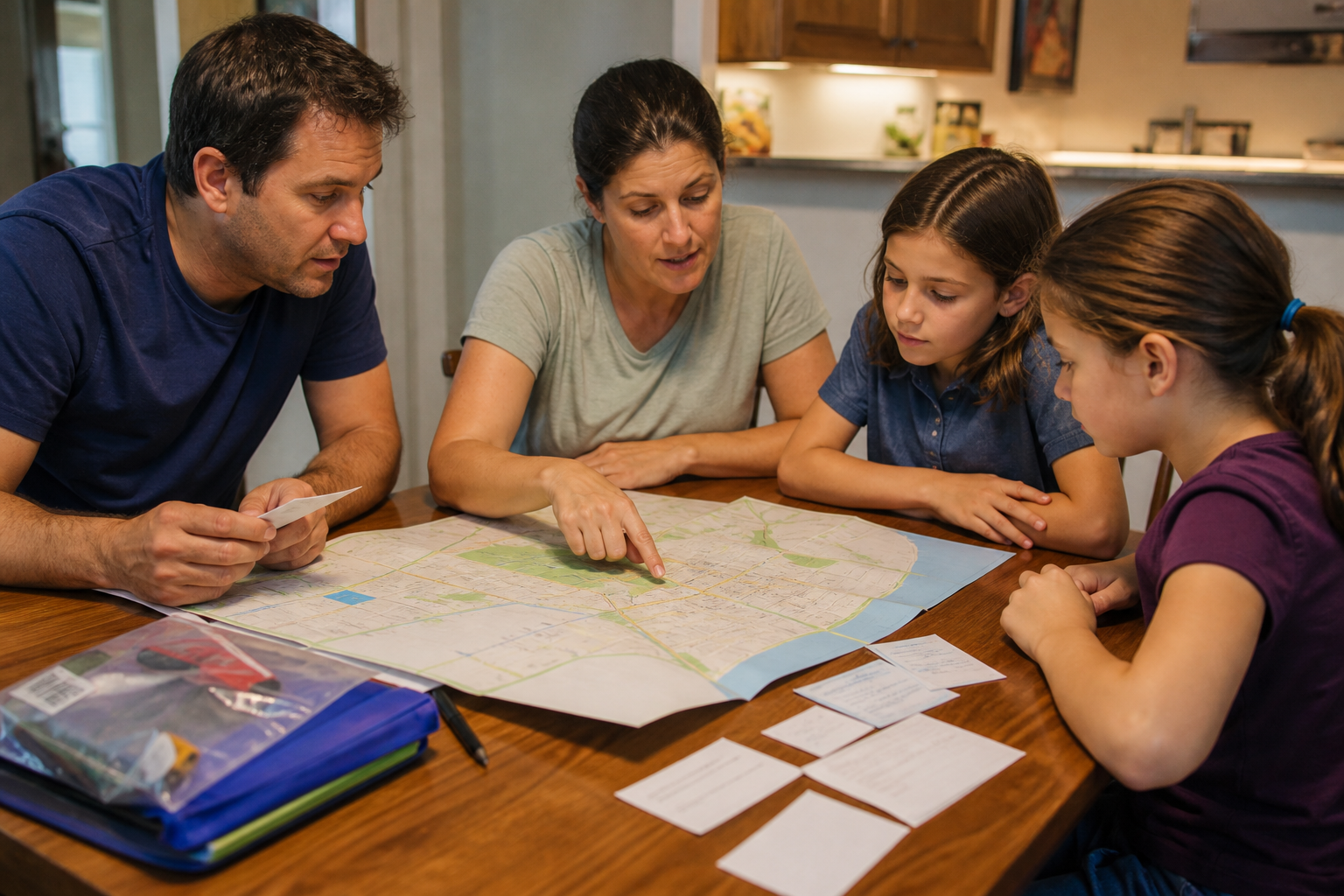
Practice does not need to be elaborate. A tabletop drill — everyone sits down, someone reads a scenario, and each person says out loud what they would do — takes 20 minutes and surfaces gaps immediately. You will discover that your teenager does not actually have the out-of-state contact memorized. You will discover that your near meeting place is across a busy arterial that would be impassable if there were an active emergency on your block. You will discover that nobody knows the school's alternate-pickup policy. These are good discoveries to make in your living room.
A physical walkthrough — actually driving or walking both meeting place routes — adds another layer. Kids especially benefit from physically being at the location before an emergency; familiar places are far less disorienting under stress. Time the walk. Know which route avoids the main road. If your far meeting place involves driving, identify an alternate route in case the primary road is blocked.
FEMA recommends reviewing and updating your plan at least once a year, and any time a significant family change occurs: a new school, a new job location, a move, a new family member. Put a calendar reminder on the same date every year. The update review takes 30 minutes. The cost of not doing it can be measured in hours of separation during an actual emergency.
- Annual tabletop drill: scenario read-aloud, each member states their response
- Physical walkthrough of both meeting place routes at least once
- Confirm out-of-state contact is still reachable and willing
- Update for any school, job, or address changes
- Verify school reunification policy has not changed
Our Recommendation: Survival Manual
Not having a documented, practiced family communications plan means your household's reunification during a real emergency depends entirely on improvisation — and improvisation under stress, with overloaded cell networks and scattered family members, is a poor substitute for a practiced procedure.
The gap in building this plan yourself is not motivation — it's structure. Most families start, hit a decision point they haven't thought through (What is our far meeting place? Who is our out-of-state contact? What are the school's actual pickup rules?), and stop. Free templates from FEMA and Ready.gov give you the framework but not the guided process to work through every decision, the reminders for what you missed, or the broader context of how communications fits into the rest of your preparedness picture.
The Survival Manual is a $47 digital package (marked down from $197) that includes a structured 90-day emergency preparedness plan with checklists, video tutorials, and offline access via Android app. It covers communications planning alongside water storage, medical prep, and home security — the full family readiness picture, not a single isolated topic. If you work through it and it doesn't deliver value, there is a 60-day money-back guarantee. It is a reasonable investment for a family that wants a guided process rather than a blank template and a good-faith effort to fill it in. For the next step, read How to Preserve Food Without Electricity Long-Term: 6 Methods Homesteaders Actually Use.
Our recommendation
Survival Manual
Check availability →This article contains an affiliate link. If you buy through it, we may earn a commission at no extra cost to you.
Frequently asked questions
What should a family emergency communication plan include?
At minimum: two designated meeting places (one near home, one farther away), one out-of-state contact whose number every family member has memorized or written down, a communication hierarchy (text first, then call, then show up), school reunification procedures, and all information printed on a physical card each member carries.
Why use an out-of-state contact in an emergency plan?
During a regional disaster, local cell circuits become heavily congested while long-distance lines are less affected. An out-of-state contact acts as a relay hub: each family member checks in with that one person, who then relays status to other members. This approach is recommended by FEMA and Ready.gov and has been validated in multiple disaster after-action reviews.
Do texts go through when cell service is down during an emergency?
SMS texts often succeed when voice calls fail because they use far less network bandwidth and automatically retry. However, texting also fails when infrastructure itself is physically damaged. Texts are your best first option, but any plan that ends at 'we'll text' is incomplete — you need physical meeting places for when texts don't go through either.
How often should you update your family emergency plan?
FEMA recommends reviewing your plan at least once a year and updating it any time a significant change occurs: a new school, a job change that alters your daytime location, a move, or a new family member. A 30-minute annual review is enough to catch outdated contacts and changed circumstances.
How do you make an emergency communications plan for kids?
Children need the core information in a format they can actually use: a laminated wallet card with the out-of-state contact number, both meeting place addresses, and a parent's cell number. Practice the plan verbally so they can say the steps back to you. Physically walk or drive both meeting place routes with them so the locations are familiar before any emergency happens.
Related guides
Sources
- FEMA: Make a Plan — Ready.gov
- FCC: Keeping Communications Working During Emergencies
- CDC: Emergency Preparedness and You — Family Planning
General preparedness information, not medical or legal advice. Follow instructions from your local emergency authority during an active event.
Field notes by email
Get the next guide before you need it
One email when a new field guide drops — water, food, power, medicine. No spam, no daily noise, unsubscribe in one click.
Comments on this guide
Questions, corrections and field reports from your own setup are welcome.
No comments yet. Be the first to add a field report.