
Skills
How to Preserve Food Without Electricity Long-Term: 6 Methods Homesteaders Actually Use

By Ephraim Rusk · · 11 min read
This article contains an affiliate link. If you buy through it, we may earn a commission at no extra cost to you.
Quick answer
The most reliable ways to preserve food without electricity long-term are salt-curing, lacto-fermentation, pressure canning (using a propane or wood-fire heat source), root cellaring, dehydration, and fat-packing. Each method has been used for centuries and requires no grid power once you have the basic supplies and know-how.
How to preserve food without electricity long-term is one of those questions most preparedness resources gloss over — they tell you to stock up, but not what to do when the food you already have starts to go bad. A three-day power outage empties a full freezer in under 48 hours. A longer disruption — hurricane aftermath, ice storms, infrastructure failures — turns that into a genuine food-security crisis for a family with no preservation skills.
I spent six years as a wildland firefighter eating meals prepared in remote conditions, and the last decade homesteading on a property that routinely loses grid power for days at a stretch. What I can tell you from both of those experiences is that food preservation without electricity is not complicated — but it is a learned skill. There are specific methods, specific failure points, and a real learning curve that is far shorter than most people assume.
This article walks through six preservation methods that working families can realistically learn and use — not as a romantic hobby, but as a practical skill set. No specialist background required. Each section covers what the method actually does, what it takes to start, and where beginners most commonly go wrong.
Why Your Freezer Is the Biggest Vulnerability in Your Food Storage Plan
Most American households store the majority of their perishable food in a freezer — which means most households are one power outage away from losing weeks of food in less than two days. The USDA states that a full, unopened freezer will keep food safe for approximately 48 hours; a half-full freezer loses safe temperatures in about 24 hours. After that, you are looking at spoilage or a race to cook and consume everything at once.
That vulnerability matters even more in a longer emergency. Grid outages after major hurricanes in the Gulf Coast region have lasted two to three weeks in some areas. Wildfire-related blackouts in the western United States can affect the same community multiple times per season. In those scenarios, a freezer full of food becomes a liability the moment the power goes out.
The practical fix is not bigger freezers or more generators — fuel runs out, and generators require maintenance and storage that most suburban families cannot manage. The fix is shifting a meaningful portion of your food preservation to methods that never required electricity in the first place. The six methods below are the ones homesteaders and off-grid households have standardized on because they are reliable, scalable, and teachable.
Salt-Curing and Smoking: The Oldest Long-Term Meat Preservation Methods
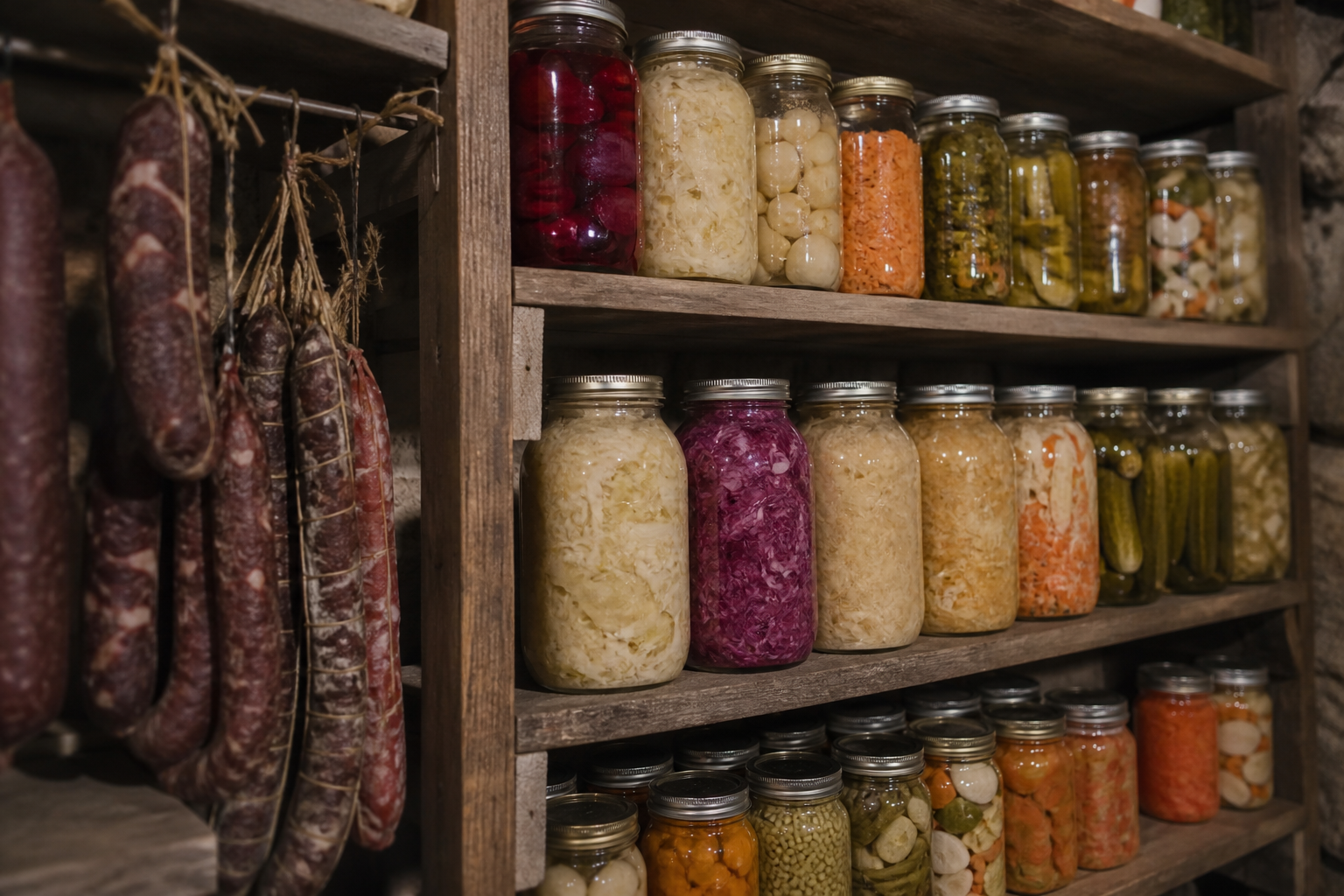
Salt-curing works by drawing moisture out of meat and creating an environment where most spoilage bacteria cannot survive — it is one of the oldest food preservation techniques in human history, and it works without any power at all.
Dry-curing involves packing meat — most commonly pork, beef, or fish — in a mixture of salt and optionally sugar and curing salts (sodium nitrate or nitrite). The cure draws out moisture over days to weeks depending on thickness, then the meat is hung to air-dry or cold-smoked. Done correctly, some dry-cured products like salt pork or prosciutto-style hams are shelf-stable for months at cool temperatures. The USDA and the National Center for Home Food Preservation both publish tested cure ratios and timing guidelines — following tested recipes matters here, because under-curing can create unsafe conditions.
Cold-smoking alone does not preserve meat — the temperature is too low to cook it. The combination of a full salt cure followed by smoking adds flavor and a surface barrier against insects and mold. Hot-smoking (above 165°F internal temperature) does cook the meat and extends shelf life somewhat, but the smoked product still requires refrigeration or further curing for true long-term storage.
Beginner mistake: using table salt that contains iodine or anti-caking additives instead of pure pickling salt or kosher salt. Iodized salt can interfere with fermentation and curing chemistry. Buy plain salt — it is inexpensive and the difference matters.
Lacto-Fermentation and Vinegar Pickling: Preservation That Gets Easier as You Practice
Lacto-fermentation uses naturally occurring bacteria — primarily Lactobacillus species — to convert sugars in vegetables into lactic acid, which preserves the food and inhibits pathogen growth. All you need to start is vegetables, non-iodized salt, water, and a clean jar. Sauerkraut and kimchi are the most familiar examples, but the same process works for cucumbers, carrots, green beans, garlic, and most other garden vegetables.
The practical advantage of lacto-fermentation for off-grid households is that it is genuinely low-cost, requires no specialized equipment beyond mason jars, and produces a product that in cool conditions (root-cellar temperatures of 35 to 50°F) can last for months. Fermented vegetables also retain or increase certain nutrients compared to heat-processed alternatives, according to research published by food science programs at several land-grant universities.
Vinegar pickling — the kind most people associate with store-bought pickles — is a different process. It uses acetic acid (vinegar) rather than produced lactic acid to create a low-pH environment that inhibits spoilage. Vinegar pickles require heat processing in a water-bath canner for shelf stability and do not have the same probiotic profile as lacto-fermented products, but they are also beginner-friendly and use equipment many households already own.
Where beginners go wrong with lacto-fermentation: not keeping vegetables fully submerged under the brine. Exposed vegetables above the brine line are in contact with air and can develop mold. A small zip-lock bag filled with brine placed on top of the jar contents works as an inexpensive weight to keep everything submerged.
Pressure Canning and Water-Bath Canning: High-Value Skills Worth Learning Once
Canning is the closest thing to a universal off-grid preservation skill — once the jars are sealed, they are shelf-stable at room temperature for one to five years depending on the food, and require no power to store. The limiting factor is that canning requires a reliable heat source, not grid electricity specifically. A propane burner, a wood cook stove, or even a well-managed fire can drive a canner.
Water-bath canning works for high-acid foods: fruits, pickles, jams, jellies, and tomatoes (with added acid). The boiling water temperature (212°F at sea level) is sufficient to destroy spoilage organisms in high-acid environments. Low-acid foods — vegetables, meats, beans, soups — require a pressure canner, which reaches 240°F and destroys Clostridium botulinum spores that would otherwise survive in a low-acid, sealed jar.
This distinction is not optional — it is a food safety line. Using a water-bath canner for low-acid foods is one of the most common and dangerous mistakes in home canning. The USDA's Complete Guide to Home Canning is available free online and provides tested, safe recipes. Tested recipes matter because the processing time for each food is calculated based on tested density and pH, and modifying them arbitrarily can create unsafe products.
The time investment to learn canning is real but finite. Most people who go through the process two or three times develop a workable routine. The equipment — a pressure canner, jar lifter, canning funnel, and a case of mason jars — represents a one-time cost that pays back over many seasons of use.
Root Cellaring and Dehydration: No Equipment Required to Start
Root cellaring is the simplest electricity-free preservation method: you are using cool, humid, stable underground temperatures to slow spoilage of vegetables and fruits naturally. A proper root cellar maintains 32 to 40°F and 90 to 95 percent humidity — conditions that keep potatoes, carrots, beets, turnips, cabbages, and winter squash edible for months without any processing. If you do not have a dedicated root cellar, an unheated basement corner, a buried trash can, or even an insulated pit in the ground can approximate those conditions well enough to meaningfully extend shelf life.
Dehydration removes the moisture that bacteria, molds, and yeasts need to function. Sun-drying, air-drying, and low-heat fire or solar drying all work without electricity. A simple solar food dehydrator can be built from scrap lumber and window screen, and plans are freely available. Dehydrated vegetables, fruits, and jerky that are stored in airtight containers away from light and humidity can remain usable for one to several years depending on the food and storage quality. The National Center for Home Food Preservation publishes research-tested drying times and temperatures.
Fat-packing — a less commonly discussed method — involves cooking and then submerging meat in rendered fat (lard, tallow, or duck fat) in a sealed container. The fat excludes air and, when stored in cool conditions, can preserve cooked meat for weeks to months. This is the principle behind the French technique of confit. It requires no electricity and no specialized equipment, just a reliable heat source and rendered fat, which itself is a by-product of other food processing.
Our Recommendation: The Lost Frontier Handbook
Every method in this article solves the same underlying problem: if the power goes out for more than 48 hours and you have no preservation skills, the food you worked hard to buy and store will spoil. That is not a hypothetical risk — it is a documented pattern in every major extended outage event.
The gap with free resources is real and consistent. Individual techniques are scattered across YouTube channels, government PDFs, and forum threads — each one useful in isolation, but there is no single structured path that takes a busy working family from zero experience to competent practice across all the core skills: food preservation, water filtration, off-grid cooking, medicinal remedies, and land use. Stitching that together on your own takes months of research time most families do not have, and the inconsistency in source quality means you will inevitably find conflicting advice that makes it harder, not easier, to get started.
The Lost Frontier Handbook was built specifically for that gap — a single, structured resource covering food preservation, water filtration, off-grid cooking, medicinal remedies, and how to find free land in the US, written for families without a specialist background. It is not a reference manual you will flip through once and shelve. If you are ready to stop relying entirely on a freezer and a power grid for your family's food security, the Handbook gives you a single starting point that covers the full skill set.
Our recommendation
The Lost Frontier Handbook
Check availability →This article contains an affiliate link. If you buy through it, we may earn a commission at no extra cost to you.
Frequently asked questions
How long can food be preserved without electricity?
It depends on the method. Salt-cured meats stored cool can last months to over a year. Properly pressure-canned foods are shelf-stable for one to five years. Lacto-fermented vegetables in a cool root cellar last several months. Dehydrated foods stored in airtight containers away from light and heat can last one to four years or more depending on the food. Root-cellared vegetables like potatoes and carrots typically last four to eight months in proper conditions.
Is it safe to can food without a pressure canner?
Only for high-acid foods. Fruits, pickles, jams, and properly acidified tomatoes can be safely processed in a water-bath canner. Low-acid foods — vegetables, meats, beans, and soups — must be pressure-canned to reach the 240°F temperature needed to destroy Clostridium botulinum spores. Using a water-bath canner for low-acid foods is a documented cause of botulism poisoning and should never be done.
What is the easiest food preservation method to start with at home?
Lacto-fermentation is the easiest entry point — it requires only vegetables, non-iodized salt, water, and a clean mason jar. Sauerkraut is the most common starting project: shredded cabbage, salt, and time. No special equipment, no heat source, no canning experience needed. Once you understand the process, the same method applies to most garden vegetables.
Can you dehydrate food without a dehydrator or electricity?
Yes. Sun-drying and air-drying are the original methods and still work reliably in low-humidity climates. A simple solar dehydrator — a wood frame with window screen and a dark backing to absorb heat — can be built inexpensively and will process most fruits, vegetables, and thin-sliced meats effectively. In humid climates, a low fire or wood stove with good airflow can substitute.
How do I keep meat from spoiling without a refrigerator?
The most reliable no-electricity methods for meat preservation are dry salt-curing, smoking combined with curing, dehydration into jerky, and fat-packing (confit). Each method works by either removing moisture, creating an inhospitable chemical environment for bacteria, or excluding air. All require learning correct ratios and timing — the USDA and National Center for Home Food Preservation publish free, tested guidelines for each method.
Related guides
Sources
- USDA Complete Guide to Home Canning
- National Center for Home Food Preservation — Curing and Smoking
- National Center for Home Food Preservation — Fermenting
- USDA Food Safety — Freezing and Food Safety
General preparedness information, not medical or legal advice. Follow instructions from your local emergency authority during an active event.
Field notes by email
Get the next guide before you need it
One email when a new field guide drops — water, food, power, medicine. No spam, no daily noise, unsubscribe in one click.
Comments on this guide
Questions, corrections and field reports from your own setup are welcome.
No comments yet. Be the first to add a field report.