
Water
How to Collect Rainwater at Home for Drinking Water: A Practical Setup Guide

By Ephraim Rusk · · 10 min read
This article contains an affiliate link. If you buy through it, we may earn a commission at no extra cost to you.
Quick answer
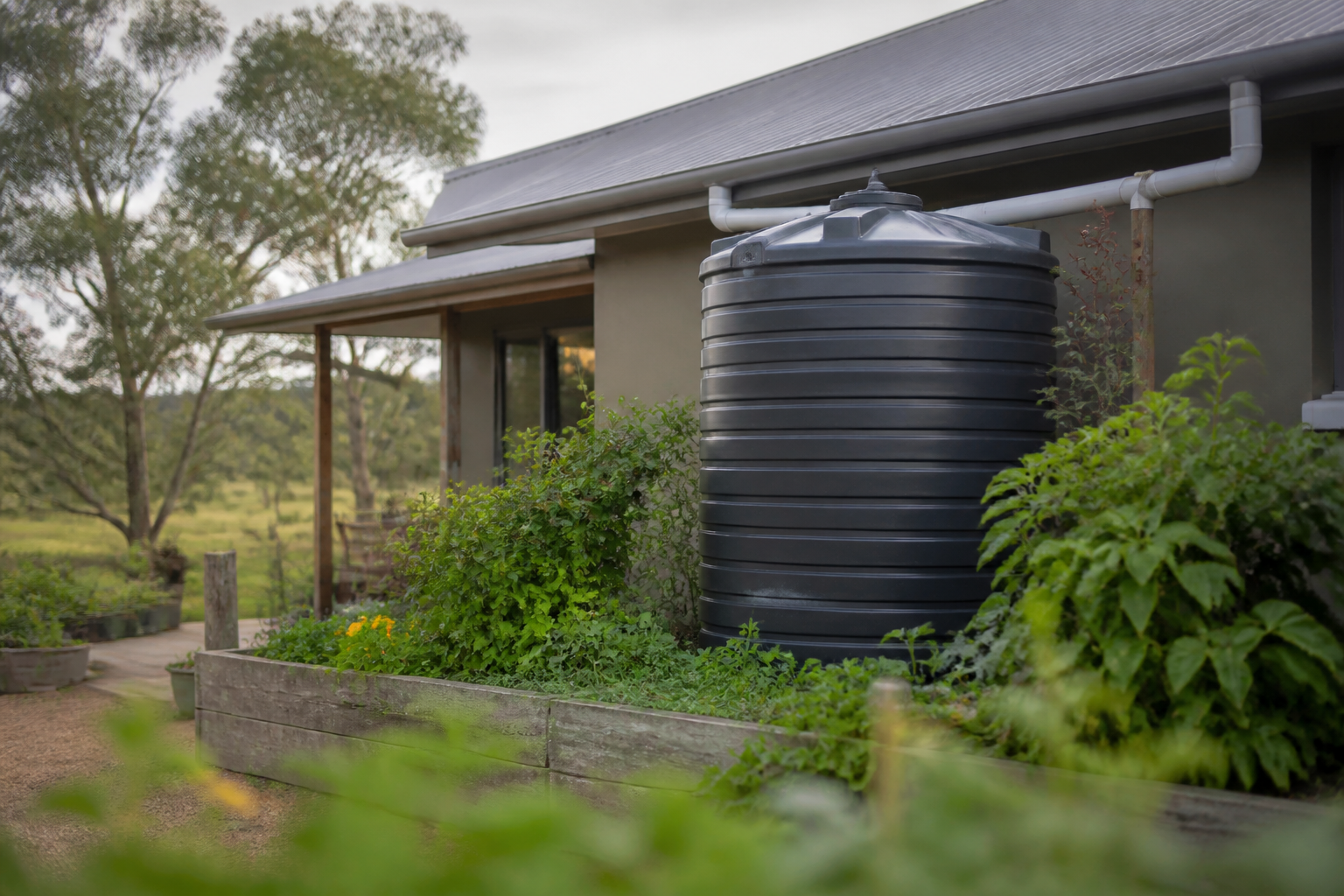
You can collect rainwater for drinking at home by routing roof runoff through gutters into a sealed storage tank, then filtering it through sediment and carbon filters and disinfecting with UV or chemical treatment. A well-designed residential system can yield tens of gallons per day depending on roof size and local rainfall.
How to collect rainwater at home for drinking water is one of the most practical questions a prepared household can ask — and one of the least straightforwardly answered. Most guides either stop at a 55-gallon barrel for the garden or leap straight into off-grid fantasy builds. Neither is useful if your actual goal is a reliable supplement to municipal water during a drought, a boil-water order, or a multi-day supply disruption.
The case for residential rainwater harvesting has gotten stronger in the last few years. Prolonged drought conditions, aging municipal infrastructure, and increasingly unpredictable rationing events have pushed more households toward wanting at least partial independence from the tap. The question is no longer whether rainwater collection is a fringe idea — it is whether your setup is legal, safe, and actually sized for what you need.
This guide covers the core mechanics: legality, yield math, filtration requirements for potable use, and the common mistakes that turn a promising system into a mosquito breeding ground. We will end with one product that solves the provisioning problem at the household scale without requiring a full civil-engineering background.
Is Rainwater Harvesting Legal Where You Live?
Rainwater collection laws vary by state, and in some cases by county — check your jurisdiction before you build anything. The good news is that outright bans have become rare. As of the mid-2020s, most U.S. states either explicitly permit residential rainwater harvesting or have no law restricting it. A shrinking number of western states with senior water-rights frameworks historically limited collection, but several — including Colorado and Utah — have since passed legislation allowing limited residential use.
The typical legal framework you will encounter involves a storage-capacity cap (often 100 to 2,500 gallons depending on the state), a requirement that the water be used on the property where it was collected, and, when potable use is intended, a requirement to meet state health department standards for filtration and disinfection. Some states require a permit; most do not for systems under the capacity threshold.
Before purchasing any hardware, spend fifteen minutes on your state's department of environmental quality or natural resources website. Search for 'rainwater harvesting' plus your state name. The EPA also maintains a general overview of state-by-state frameworks as a starting reference. Knowing your legal ceiling tells you exactly how large a system you are allowed to build — which feeds directly into your yield calculation.
How Much Water Can You Actually Collect? The Yield Math
Your potential daily yield depends on three numbers: your roof's collection area, your local average rainfall, and your system's runoff efficiency coefficient. The basic formula is: Gallons = (Roof Area in sq ft) x (Rainfall in inches) x 0.623 x (Efficiency Coefficient).
The 0.623 factor converts inches of rain over square feet into gallons. The efficiency coefficient accounts for losses to evaporation, splash, and first-flush diversion — a well-maintained metal or asphalt-shingle roof typically runs 0.85 to 0.90. An 1,800-square-foot roof footprint in a region averaging 2 inches of rain per month yields roughly 1,800 x 2 x 0.623 x 0.87, or about 1,950 gallons per month — approximately 65 gallons per day averaged across the month.
That number sounds large until you account for dry spells. Rainwater harvesting is most effective as a provisioning system — building stored volume during wet periods to draw from during dry ones — rather than a real-time supply. This is why tank sizing matters as much as collection area. A system designed only around peak-month yield will leave you short during the dry season when you need it most.
FEMA's baseline emergency water estimate is one gallon per person per day for drinking and sanitation. A realistic comfortable-use household budget, including cooking and basic hygiene, is closer to 3 to 5 gallons per person per day. For a four-person household, that is 12 to 20 gallons per day of functional minimum. Even a modest roof catchment in a region with average annual rainfall can comfortably exceed that target if the storage volume is there to bridge dry gaps.
Filtration and Disinfection: What Rainwater Actually Needs Before You Drink It
Rainwater collected from a roof is not safe to drink without treatment — it picks up bird feces, dust, atmospheric pollutants, and roof coating chemicals on the way down. The treatment train for potable use has three stages: pre-filtration, fine filtration, and disinfection.
Pre-filtration starts at the gutter. A leaf screen and a first-flush diverter — a device that automatically discards the first several gallons of each rain event, which carry the highest concentration of surface contamination — remove the bulk of particulate matter before water even reaches your tank. Skipping the first-flush diverter is the single most common mistake in DIY systems and the one most likely to contaminate your stored volume.
Fine filtration means at minimum a 5-micron sediment filter followed by an activated carbon block filter. The sediment filter catches particulates the pre-filter missed; the carbon filter reduces organic compounds, chlorine byproducts, and many pesticides. For potable use, most health authorities recommend adding a disinfection step: UV purification (effective against bacteria and viruses, no chemical residue) or chemical disinfection with unscented household bleach at the EPA-recommended rate of 8 drops per gallon for clear water.
Some households also add a reverse osmosis stage at the point of use for drinking and cooking water. RO removes dissolved solids and heavy metals that filters and UV do not address. Whether you need it depends on your local atmospheric pollution levels and roof material — galvanized metal roofs, for example, can introduce zinc into stored water at concentrations worth testing for. An inexpensive mail-in water test after your first collection season will tell you whether your existing treatment train is doing the job.
Sizing and Siting Your Storage Tank
Your storage tank should hold enough water to bridge your longest expected dry stretch, not just your average weekly rainfall gap. For most of the continental U.S., sizing for 20 to 30 days of minimum household use is a reasonable target — that is 240 to 600 gallons for a four-person household at 3 to 5 gallons per person per day.
Tank material matters. Food-grade polyethylene tanks are the most common choice: UV-resistant, durable, and available in sizes from 250 to 5,000 gallons. Avoid repurposed chemical drums unless you can verify the original contents and have thoroughly cleaned them. The interior of your tank should be dark or opaque to suppress algae growth — a clear tank in direct sun will turn green within weeks.
Siting the tank as close to the downspout as possible reduces the length of conveyance pipe and the opportunities for contamination. If you are gravity-feeding your filtration system, elevating the tank on a sturdy platform gives you usable pressure without a pump. If the tank sits at grade, a small 12-volt transfer pump — the kind that runs off a battery or solar panel — is a practical addition that also gives you a backup option during a power outage.
Keep the tank covered and sealed. An open tank is an invitation for insects, debris, and animals. Mosquito breeding in improperly covered rainwater tanks is a documented public health concern in several states, and some jurisdictions will cite you for it. A screened overflow outlet and a gasketed lid on the fill port cost very little and prevent most contamination problems.
Our Recommendation: Joseph's Well
The core problem this article addresses is real: municipal water is not a guaranteed resource, and a household without any independent water provisioning capacity is fully exposed every time the tap becomes unreliable — whether from drought rationing, infrastructure failure, or a prolonged emergency.
The gap in the DIY approach is that doing it correctly takes significant research, component sourcing, and calibration. Getting the first-flush diversion wrong, undersizing the tank, or skipping a filtration stage does not give you independence — it gives you a contamination risk. Most households that start down the DIY path either over-engineer and over-spend or under-engineer and underperform.
Joseph's Well is a purpose-built DIY home water provisioning and collection system designed to deliver up to 40 gallons per day of independent water supply — positioned specifically for households that want real separation from municipal supply during droughts, rationing events, or rising water bills. It packages the design decisions — collection, storage sizing, and treatment sequencing — into a system intended for residential installation without a contractor. If consistent, independent water provisioning at the household scale is your goal, Joseph's Well is worth a close look. For the next step, read How Much Water Does a Household Actually Need for a 30-Day Emergency?.
Our recommendation
Joseph's Well
Check availability →This article contains an affiliate link. If you buy through it, we may earn a commission at no extra cost to you.
Frequently asked questions
Is it safe to drink rainwater collected from your roof?
Rainwater collected from a roof requires treatment before drinking. Roof surfaces accumulate bird droppings, dust, and chemical residues. A first-flush diverter, sediment and carbon filtration, and UV or chemical disinfection are the minimum steps to make it potable.
How many gallons of rainwater can you collect per day?
Daily yield depends on roof area and local rainfall. A 1,500-square-foot collection surface during a 1-inch rain event can yield over 800 gallons in that event alone. Averaged across a month, a well-sized system in a moderate-rainfall region can provide 20 to 60 gallons per day.
Is rainwater harvesting legal in all states?
Most U.S. states permit residential rainwater harvesting, though many set storage-capacity limits and some require a permit for potable use. A few western states have historically restricted it due to water-rights laws, but most have since relaxed those rules. Always verify your state and county regulations before building.
What size rainwater tank do I need for a family of four?
For emergency provisioning at 3 to 5 gallons per person per day, a family of four needs 240 to 600 gallons of storage to cover 20 to 30 dry days. For comfortable daily use including cooking and hygiene, size toward the higher end of that range.
What is a first-flush diverter and do I really need one?
A first-flush diverter automatically discards the first few gallons of each rain event, which carry the highest concentration of roof contaminants. For any potable system, it is not optional — skipping it is the most common reason DIY rainwater systems produce contaminated stored water.
Related guides
Sources
- EPA — Rainwater Harvesting: Conservation, Credit, Codes, and Cost
- CDC — Private Water Systems: Rainwater Collection
- Ready.gov — Water Storage for Emergencies
General preparedness information, not medical or legal advice. Follow instructions from your local emergency authority during an active event.
Field notes by email
Get the next guide before you need it
One email when a new field guide drops — water, food, power, medicine. No spam, no daily noise, unsubscribe in one click.
Comments on this guide
Questions, corrections and field reports from your own setup are welcome.
No comments yet. Be the first to add a field report.