
Water
How to Collect Water at Home During a Drought: 5 Methods That Actually Work

By Ephraim Rusk · · 10 min read
This article contains an affiliate link. If you buy through it, we may earn a commission at no extra cost to you.
Quick answer
During a drought, homeowners can collect usable water through rainwater harvesting, condensate capture from HVAC units, greywater reuse, fog collection, and atmospheric water generation — with rainwater and greywater systems typically yielding the highest daily volume for the least cost.
Home water collection during a drought is not a fringe hobby — it is the practical gap between a household that keeps functioning and one that lines up at a distribution site. When municipal systems impose Stage 3 restrictions, when rural wells drop below pump depth, or when water bills triple in a dry summer, the question stops being theoretical.
Most preparedness advice jumps straight to storage: fill barrels, stack cases. Storage is important, but a barrel empties in days. What a drought actually demands is a way to keep water coming in when the normal sources slow or stop. That requires collection infrastructure, and the options are more accessible than most people realize.
This article walks through five real methods for collecting water at home during a drought — what each one produces per day, what it realistically costs to set up, and where each one quietly fails under real-world conditions. If you have been searching for a drought water collection setup that fits a suburban or rural household, this is the breakdown you need.
Why Drought Disrupts Home Water Supply More Than People Expect
A drought does not just reduce rainfall — it compresses the entire water system your household depends on simultaneously. Municipal surface reservoirs drop. Groundwater aquifers that feed private wells take months or years to recharge. Water authorities impose tiered restrictions, sometimes cutting outdoor use first and then indoor non-essential use next. And when a region enters severe or exceptional drought status, utilities sometimes implement supply rotations that mean your tap simply stops for hours each day.
According to the U.S. Drought Monitor, the continental United States has seen at least some portion of its land area in severe-to-exceptional drought status in every year on record since 2000. For households in the Southwest, the intermountain West, and parts of the Southeast, drought is no longer a periodic disruption — it is an operating condition.
Private well owners face an additional vulnerability that municipal customers often overlook: when the water table drops, a well pump can run dry even if the aquifer has not been fully depleted. Deepening a well costs between $15 and $30 per foot drilled, and the process can take weeks. That gap — between when your well fails and when a driller can show up — is exactly the window a home collection system is meant to fill.
Understanding that gap is what makes collection different from storage. Storage is a buffer. Collection is a supply chain. You need both, and the goal of this article is to make the collection side concrete and buildable.
Method 1: Rainwater Harvesting — Highest Volume, Most Regulated
Rainwater harvesting is the most productive home water collection method available during a drought, but it only works between dry spells — and legality varies significantly by state.
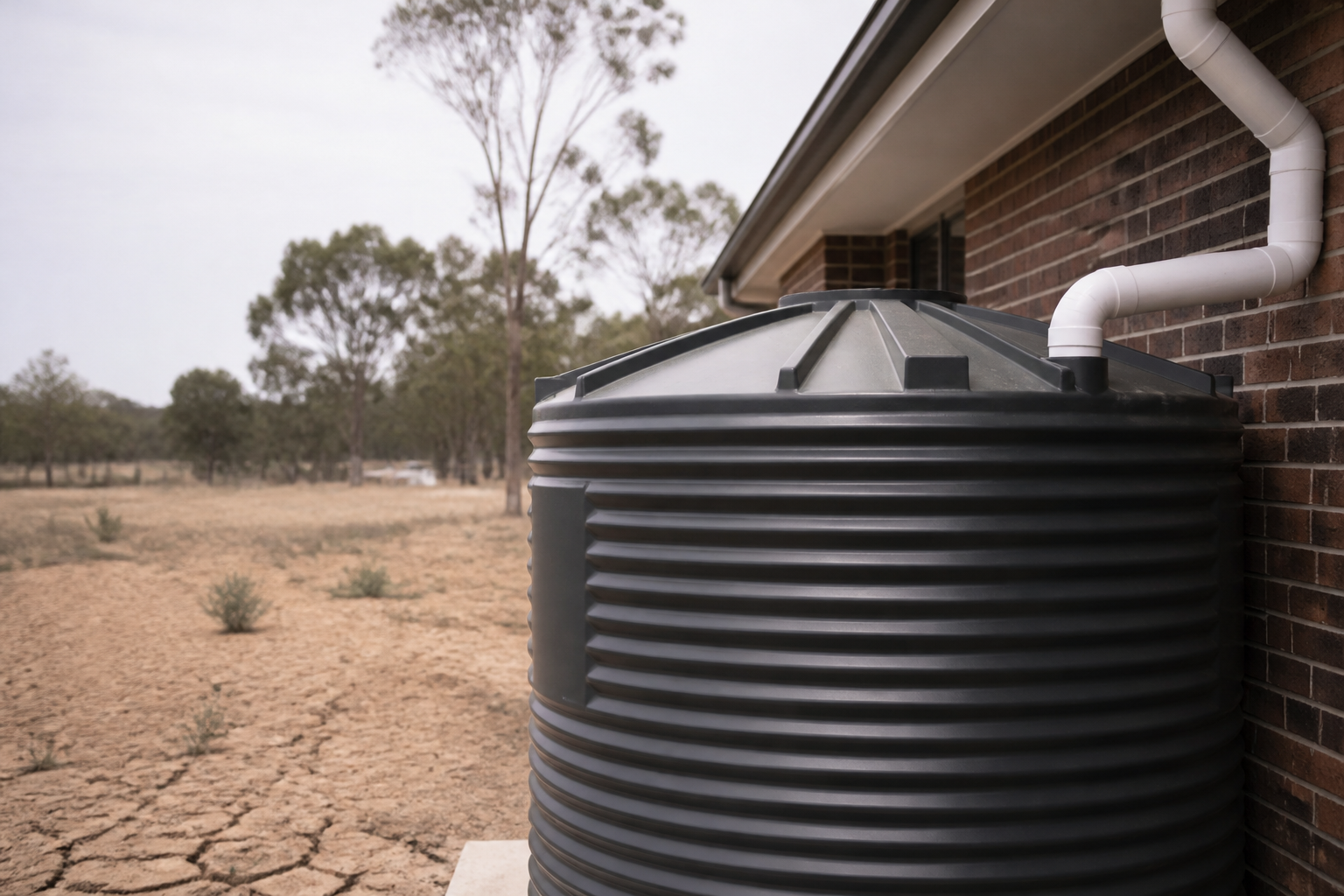
A basic system catches roof runoff through gutters, routes it into a first-flush diverter that discards the initial dirty flow, and stores the clean remainder in covered cisterns or food-grade tanks. A 1,000-square-foot roof in a region receiving one inch of rain yields roughly 600 gallons per rain event, minus losses from evaporation and first-flush diversion. That is meaningful volume if you catch it when it does fall.
The critical drought-specific problem with rainwater harvesting is timing. By definition, a drought means extended dry periods between precipitation events. If your area is in D3 or D4 drought status, you may go 60 to 90 days between meaningful rain events — and you cannot harvest what is not falling. Rainwater harvesting during a drought works best as a supplemental system tied to large storage capacity, so the occasional rain event is captured in full and drawn down slowly.
Legality: As of 2025, Colorado, Utah, and a handful of other states have historically restricted or metered residential rainwater collection, though several have loosened those laws in recent years. Check your state's current statute and your local municipality's ordinance before building. The EPA maintains a summary of state-level rainwater harvesting regulations that is a good starting point.
Realistic yield during a drought: highly variable. In a region seeing one inch of rain per month, a 1,500-square-foot roof system with 500 gallons of storage could yield 10 to 20 gallons per day averaged across the month — but that number drops to near zero in a dry stretch and spikes sharply after a storm.
Method 2: HVAC Condensate Capture — Free Water You Are Already Making
A central air conditioning system pulls moisture out of indoor air as a byproduct of cooling, and most households simply drain that condensate to the ground. Capturing it costs almost nothing and requires no permits in any state.
A standard residential AC unit in a humid climate produces between 5 and 20 gallons of condensate per day during active cooling — more in high-humidity conditions, less in already-dry air. In a drought scenario where outdoor humidity is very low, output drops, often to 2 to 5 gallons per day. That is not enough to run a household, but it is enough to water a garden, flush toilets, or supplement other collection methods.
The setup is straightforward: reroute the condensate drain line from the floor drain or exterior discharge point into a collection container. Use food-grade containers if you intend the water for any use near humans or food production. Condensate is distilled-quality water but can pick up microbial contamination from dirty evaporator coils or standing water in the drain pan, so treat it as non-potable by default unless your system is well-maintained.
This method shines as a free add-on to another primary collection system. Do not build your drought water plan around it, but do not leave those free gallons draining into the dirt either.
Method 3: Greywater Reuse — Multiply Every Gallon You Already Use
Greywater reuse is not collection in the traditional sense, but it is the most immediate way to stretch your water supply during a drought — and in a restriction environment, it can free up municipal water for the uses where clean water genuinely matters.
Greywater is the wastewater from sinks, showers, bathtubs, and laundry — everything except toilet waste, which is blackwater. In a typical U.S. household, roughly 50 to 80 percent of indoor water use generates greywater. Reusing that water for toilet flushing or direct subsurface irrigation can cut net water consumption by 30 to 40 percent, according to research from the Water Research Foundation.
Simple greywater systems — a laundry-to-landscape setup, for example — are legal in most U.S. states under a basic permit or notification process. Complex indoor greywater reuse (routing shower water to a toilet flush tank, for example) requires more permitting and a treatment stage in most jurisdictions. Arizona, California, and New Mexico have some of the most permissive greywater codes in the country; other states are more restrictive.
During a drought, greywater reuse is best thought of as a force multiplier. If your household uses 80 gallons per day and you reuse 30 of those for toilet flushing, you have effectively increased your drought-resilient capacity by 30 gallons without collecting a single drop of new water. That arithmetic matters when municipal allocations are being cut.
Methods 4 and 5: Fog Collection and Atmospheric Water Generation
Fog collection and atmospheric water generation (AWG) both extract water from air rather than precipitation, making them theoretically functional during dry stretches — but each carries important limitations that are worth understanding before you invest.
Fog collection uses a mesh net strung in the path of coastal or mountain fog. As fog passes through the mesh, water droplets coalesce and drip into a collection trough below. Pilot projects in coastal Chile, Morocco, and California's Central Valley have demonstrated yields of 4 to 12 liters per square meter of mesh per day under favorable fog conditions. The critical constraint is geographic: fog collection only works where fog is a regular occurrence, and inland drought zones rarely qualify. If you live within a few miles of a reliably foggy coastline, a fog fence is a legitimate low-cost supplemental system. For most drought-affected households in the interior West, it is not applicable.
Atmospheric water generation extracts moisture from ambient air through refrigerative condensation (the same principle as an air conditioner) or desiccant absorption. Commercial AWG units are real and functional, but they have two meaningful constraints. First, efficiency drops sharply in low-humidity conditions — which is precisely what most drought environments produce. Many units need at least 30 to 50 percent relative humidity to operate effectively. Second, the electricity cost is significant: generating one gallon of water via AWG can require 300 to 500 watt-hours of electricity depending on conditions and unit efficiency. That said, newer systems and emerging designs continue to push those thresholds lower, and AWG remains a genuinely useful option in humid drought zones (the Southeast, for example) where humidity stays up even when rainfall is scarce.
Neither fog collection nor AWG is a standalone drought solution for most U.S. households. They are best understood as niche supplements — powerful in the right geography, but not the foundation of a home water independence system.
Our Recommendation: Joseph's Well
The core problem this article keeps returning to is the same one every method runs into: in a real drought, the most productive collection methods — rainwater and greywater — require either unpredictable weather or a significant reduction in what you already use, while the weather-independent options either need the right geography or carry high operating costs. The result is that most households assemble a collection plan that looks good on paper but falls short when a 60-day dry stretch actually arrives.
The honest gap in the DIY approach is integration and consistency. Building a rainwater system, a condensate capture line, and a greywater reuse setup are each individually manageable projects — but combining them into a reliable daily yield that can approach 30 to 40 gallons without depending on rain requires planning, sizing, and coordination that most homeowners work out the hard way, after a system fails when they need it most.
Joseph's Well is a DIY home water provisioning and collection system designed specifically around that problem — producing up to 40 gallons a day without relying on municipal supply, and built to give a household genuine independence during droughts, shutoffs, and rationing events. If you have been piecing together your own collection setup from scratch and hitting the gaps described in this article, it is worth looking at what Joseph's Well puts together as an integrated system.
Our recommendation
Joseph's Well
Check availability →This article contains an affiliate link. If you buy through it, we may earn a commission at no extra cost to you.
Frequently asked questions
Is it legal to collect rainwater during a drought?
In most U.S. states, yes — but with varying restrictions on volume, storage capacity, and permitted uses. States like Colorado and Utah have historically been the most restrictive, though laws have loosened in recent years. Always check your current state statute and local municipality ordinance before building a rainwater system. The EPA's state-by-state summary is a useful starting point.
How much water can I realistically collect at home during a drought?
It depends heavily on your methods and geography. HVAC condensate might yield 2 to 20 gallons per day depending on humidity. Greywater reuse can effectively free up 20 to 40 gallons per day you are already using. Rainwater harvesting during a drought is intermittent — meaningful after a rain event, zero during dry stretches. A combined system is the only reliable approach to consistent daily yield.
Can I drink water collected from my roof?
Roof-collected rainwater can be made potable, but it requires proper filtration and disinfection — at minimum a sediment filter, activated carbon stage, and UV or chemical treatment. Roofing materials, bird droppings, and airborne contaminants all enter the water stream. Treat roof-collected water as non-potable until it has passed through a verified treatment system.
Does atmospheric water generation work in dry climates?
Most current AWG units need at least 30 to 50 percent relative humidity to operate effectively, which limits their usefulness in arid drought conditions like the Southwest. In humid drought zones — the Southeast, for example — AWG can be a viable supplement. Electricity consumption is also significant, typically 300 to 500 watt-hours per gallon, so off-grid or solar power integration matters for long-term use.
What is the fastest way to increase home water supply during a drought emergency?
The fastest gains usually come from greywater reuse and HVAC condensate capture, since both work with infrastructure you already have. Rerouting a laundry drain to subsurface irrigation or capturing AC condensate into a tank can be done in a day. Rainwater harvesting and integrated collection systems take more time to build but deliver higher total volume once in place.
Related guides
Sources
- U.S. Drought Monitor — Current Drought Conditions and Historical Data
- EPA — Rainwater Harvesting: Conservation, Credit, Codes, and Cost
- CDC — Emergency Water Storage and Collection Guidance
- USGS — Groundwater and Drought: Understanding Aquifer Response
General preparedness information, not medical or legal advice. Follow instructions from your local emergency authority during an active event.
Field notes by email
Get the next guide before you need it
One email when a new field guide drops — water, food, power, medicine. No spam, no daily noise, unsubscribe in one click.
Comments on this guide
Questions, corrections and field reports from your own setup are welcome.
No comments yet. Be the first to add a field report.