
Water
How to Produce 40 Gallons of Water a Day Without Municipal Supply (And Why Most DIY Methods Fall Short)

By Ephraim Rusk · · 11 min read
This article contains an affiliate link. If you buy through it, we may earn a commission at no extra cost to you.
Quick answer
Producing 40 gallons of water per day at home without municipal supply is achievable by combining rainwater harvesting, atmospheric water generation, or well-supplemented collection — but each method has real yield limits that most DIY guides understate. The bottleneck is usually collection surface area, weather conditions, and filtration capacity, not the storage tank.
Producing enough water at home without municipal supply — reliably, day after day — is a fundamentally different problem from storing a two-week emergency reserve. If you can generate 40 gallons a day, a drought, a boil order, a municipal shutoff, or a rate hike becomes a manageable inconvenience instead of a crisis. That number, 40 gallons per day, is roughly the median U.S. household's indoor daily use according to the EPA, so hitting it means you're not rationing — you're just running a different system.
Most preparedness content stops at storage: buy a few barrels, rotate them annually, done. That advice is sound for short disruptions. But if your local utility starts mandatory rationing — which water districts in the Southwest and Southeast are doing with increasing frequency — or if you're moving toward a homestead model where you want real independence, you need a production system, not just a reserve. The challenge is that most DIY approaches to home water production are either badly undersized, legally restricted in some states, or dependent on conditions (rain, humidity) that aren't always present when you need them most.
This article walks through the realistic math and methods behind home water production at the 40-gallon-per-day threshold: what actually works, what the common shortfalls are, and how to build toward genuine water independence rather than a false sense of it.
Why 40 Gallons Per Day Is the Right Target
Forty gallons per day is the approximate threshold where a household stops emergency-rationing and starts living normally — or close to it. The EPA's WaterSense program estimates that the average American uses about 82 gallons of water per day indoors and outdoors combined, but indoor-only use for a single person runs closer to 50 to 60 gallons. A family of four sharing a frugal indoor water budget — short showers, no running taps, efficient appliances — can realistically get by on 80 to 120 gallons per day total, meaning a system producing 40 gallons per day covers roughly one person's needs or supplements a household significantly.
If you're planning for two or more people, 40 gallons per day from a home production system combined with even a modest stored reserve changes your position dramatically. You're not waiting out a 72-hour emergency; you're operating sustainably through weeks of disruption. The USDA and FEMA both recommend one gallon per person per day as a minimum survival threshold, but that figure covers only drinking and basic sanitation — not hygiene, cooking, or any cleaning. A system producing 40 gallons per day gives you real operational capacity, not just survival margin.
This is also the threshold worth engineering toward because most single-method DIY systems fall short of it. A standard 50-gallon rain barrel on a 1,000-square-foot roof collects only what falls on it — roughly 600 gallons per inch of rainfall, which sounds like a lot until you realize that during a drought the rainfall rate may be near zero for weeks. Understanding the 40-gallon benchmark forces you to think in terms of system design, not just hardware.
Rainwater Harvesting: Real Output vs. What Guides Promise
Rainwater harvesting is the most accessible home water production method, but its real daily yield is highly variable and often oversold in DIY guides. The basic formula is straightforward: collection area in square feet multiplied by rainfall in inches multiplied by 0.623 gives you gallons collected, accounting for an approximate 80 percent efficiency factor for first-flush diverters and evaporation loss. A 1,000-square-foot roof catching one inch of rain yields roughly 500 usable gallons — but that only counts in months when rain actually falls.
The problem is averaging. An annual rainfall of 40 inches sounds like it should produce about 20,000 gallons per year from a 1,000-square-foot collection area — which is true on a calendar-year basis. But rain doesn't fall in even daily increments. It falls in events separated by dry stretches, and during a drought or water-rationing event — precisely when you need your system most — those events may stop for 30, 60, or 90 days. A system designed only around rainwater harvesting is seasonally dependent and may produce zero water during the weeks it matters most.
Legal restrictions add another layer of complexity. As of 2026, rainwater harvesting is legal in all 50 U.S. states, but several states still restrict how much you can collect or how it can be used. Colorado, for example, limits collection to two 110-gallon containers per household for outdoor use only without a specific permit. Utah allows collection up to 2,500 gallons. Before investing in a large collection system, verify your state's current regulations — the National Conference of State Legislatures maintains a regularly updated summary.
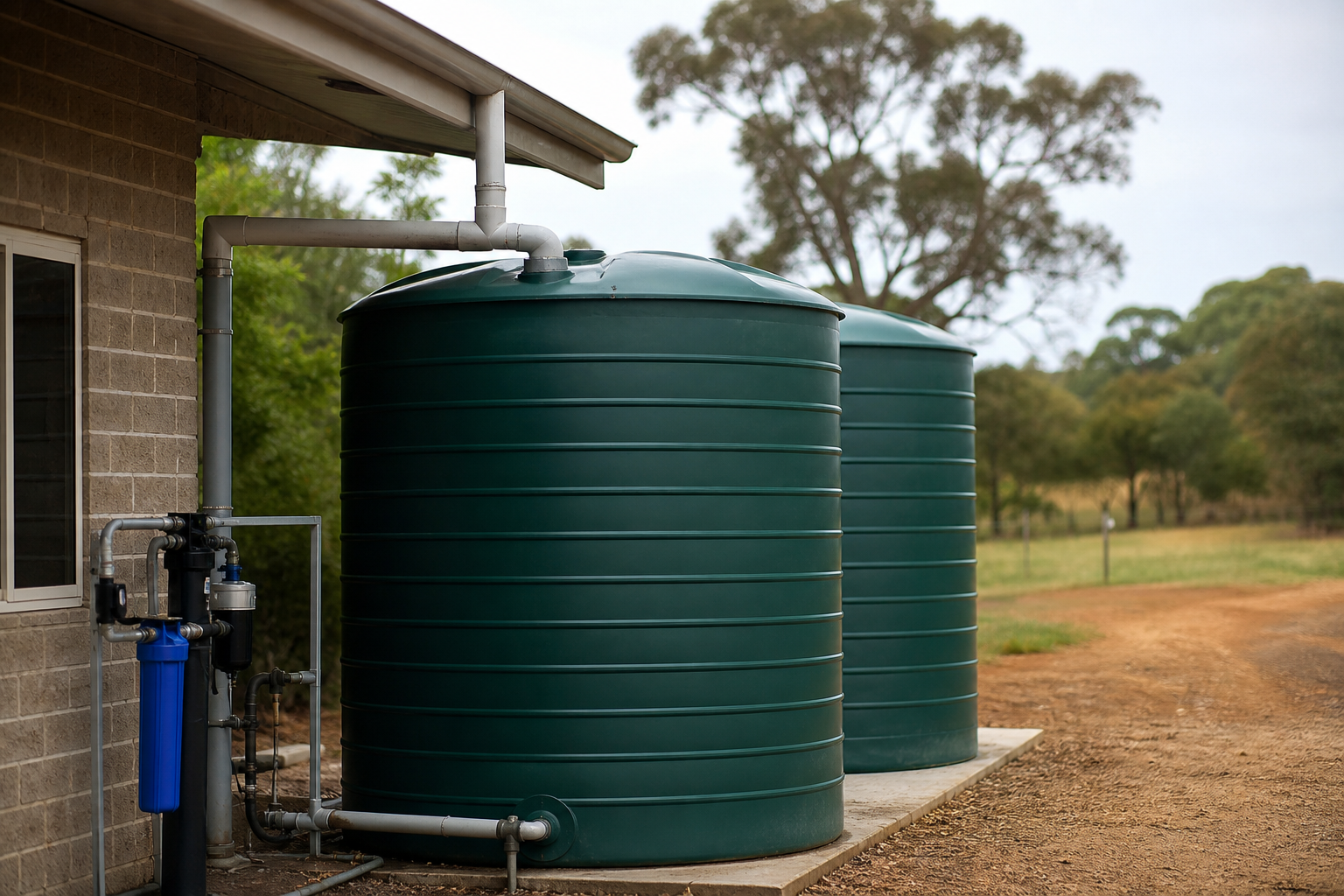
To realistically approach 40 gallons per day from rainwater alone, you need either a large collection surface (think 2,000-plus square feet of effective roof area), significant storage capacity to carry you through dry spells, or reliable rainfall that doesn't drop below 2 to 3 inches per month. Most suburban homes can hit that collection area requirement, but the storage requirement to buffer a 30-day dry period at 40 gallons per day means holding 1,200 gallons in reserve — six standard 200-gallon tanks, which is a real footprint and real investment.
Other Home Water Production Methods: Atmospheric, Well Supplementation, and Condensate Recovery
Beyond rainwater, three other home-scale methods can contribute meaningfully to a 40-gallon-per-day target: atmospheric water generation (AWG), supplemental well use, and HVAC condensate recovery — each with distinct trade-offs in cost, energy, and reliability.
Atmospheric water generators pull moisture directly from ambient air and condense it into drinkable water. Consumer-grade AWG units designed for home use typically produce 5 to 30 liters per day depending on relative humidity and temperature. They work best above 60 percent relative humidity and above 65 degrees Fahrenheit, making them highly effective in humid climates and nearly useless in arid ones — again, worst performance when drought conditions are most likely. Energy consumption is also a real cost: most residential AWG units draw 200 to 400 watts continuously, meaning a 30-liter-per-day unit running 24 hours consumes roughly 5 to 10 kWh per day, which is significant if you're also running off-grid power.
Well supplementation — using a shallow or deep residential well alongside a filtration system — is the most reliable continuous-production method when geology permits it. A properly permitted residential well producing even 1 to 3 gallons per minute can easily exceed 40 gallons per day. The barrier is cost and location: well drilling typically runs $3,500 to $15,000 or more depending on depth and local geology, and not all properties have viable aquifer access. If you have an existing well, even a low-yield one, it's worth having it assessed as a supplemental source.
HVAC condensate is an underused source. A standard central air conditioning system can produce 5 to 20 gallons of condensate water per day in humid summer conditions. This water is distilled-quality in terms of dissolved solids but may contain biological contaminants from the drip pan and coil — it should be filtered and disinfected before use, and is better suited for non-potable applications like garden irrigation unless properly treated. It's essentially free production capacity that most households are currently sending to the floor drain.
Where Most DIY Home Water Systems Quietly Fail
The most common failure in DIY home water production is treating any single method as a complete solution rather than one layer of a system. Rainwater harvesting stalls during drought. AWG underperforms in low humidity. Condensate recovery stops when temperatures drop and the AC shuts off. A well can be contaminated or seasonally low. Each method has a specific failure mode, and they often share the same failure mode: they underperform or stop entirely during the exact environmental conditions that trigger water shortages.
The second most common failure is undersizing storage relative to collection rate. Collecting 40 gallons of rain in a single storm event is meaningless if your tank is already full and the overflow is going to waste, or if you collected it in February and need it in August. Storage capacity and collection capacity have to be engineered together, with a clear-eyed estimate of the longest expected dry period in your region.
Filtration and purification are where many otherwise functional systems become health hazards. Rainwater collected from a roof picks up bird and rodent feces, atmospheric pollutants, lead from old flashing, and biological material. AWG condensate can harbor bacteria in the collection reservoir. None of these sources are safe for drinking without multi-stage filtration — minimally a sediment pre-filter, an activated carbon stage, and either UV disinfection or chemical treatment. The CDC's guidance on private water systems is explicit: any non-utility water source requires testing and treatment before potable use. Skipping this step is where DIY systems cause real harm.
Finally, regulatory compliance is frequently ignored until it causes a problem. Unpermitted water capture systems, unpermitted wells, or systems that discharge to stormwater without approval can result in fines or forced removal. Building a system that has to be torn out is worse than building no system at all. Do the permit research first, not after installation.
- Single-method reliance: every method has a climate-specific failure mode
- Storage undersized for dry-period bridging (plan for your longest expected dry stretch, not average)
- Filtration skipped or underpowered for the actual contaminants in your source water
- Legal non-compliance: rainwater caps, unpermitted wells, or discharge rules violated
- No redundancy: if the pump fails or the filter clogs, the whole system goes down
Our Recommendation: Joseph's Well
The core problem this article establishes is real: building a home water production system capable of 40 gallons per day requires integrating multiple methods, sizing storage correctly for dry-period bridging, and getting the filtration right — and most households doing this for the first time make expensive, time-consuming mistakes in the design phase before they ever collect a drop.
The gap in the pure DIY approach isn't motivation — anyone reading this far has plenty of that. The gap is system design: knowing which methods are viable for your climate, how to size collection surface and storage together, and how to specify filtration appropriate for your actual source water. Getting those decisions wrong means either a system that doesn't produce enough when you need it, or one that produces water that isn't safe to drink. Hiring a water systems consultant to walk you through it adds cost and time most people don't have.
Joseph's Well is a DIY home water provisioning and collection system engineered specifically for this problem — designed to help households achieve up to 40 gallons per day of water production independent of municipal supply, with a system approach rather than a single-method solution. It's built for the use case this article addresses: drought resilience, rationing independence, and real reduction in utility dependence. If you're serious about moving from water storage to water production, Joseph's Well is worth a close look as a structured starting point. For the next step, read How to Collect Rainwater at Home for Drinking Water: A Practical Setup Guide.
Our recommendation
Joseph's Well
Check availability →This article contains an affiliate link. If you buy through it, we may earn a commission at no extra cost to you.
Frequently asked questions
Is it legal to collect rainwater at home in all 50 states?
Rainwater harvesting is legal in all 50 U.S. states as of 2026, but several states restrict collection volume or limit how harvested water can be used. Colorado caps collection at two 110-gallon containers per household without a permit. Utah allows up to 2,500 gallons. Always verify your state's current regulations before installing a system, since rules have changed frequently over the past decade.
How much water can I realistically collect from my roof?
Use this formula: roof collection area in square feet, multiplied by rainfall in inches, multiplied by 0.623, gives you approximate gallons collected at roughly 80 percent efficiency. A 1,000-square-foot roof catching one inch of rain yields about 500 usable gallons. Output drops to zero during dry spells, so storage capacity to bridge those gaps is as important as the collection system itself.
Do atmospheric water generators work in dry climates?
Atmospheric water generators perform poorly in low-humidity environments. Most consumer units require relative humidity above 60 percent and temperatures above 65 degrees Fahrenheit to produce meaningful output. In arid climates — precisely where drought water shortages are most common — AWG units may produce a fraction of their rated capacity or fail to produce usable water at all.
Is rainwater safe to drink without treatment?
No. Rainwater collected from a roof contains bird and animal feces, atmospheric pollutants, and potentially heavy metals from roofing materials. The CDC recommends multi-stage treatment for any non-utility water source before drinking, at minimum including sediment filtration, activated carbon filtration, and disinfection via UV light or chemical treatment. Skipping this step is a documented cause of waterborne illness in private water system users.
How much water storage do I need to bridge a 30-day drought?
At 40 gallons per day for one person, a 30-day dry period requires 1,200 gallons of storage capacity. For a two-person household at the same daily rate, that doubles to 2,400 gallons. Storage must be sized to your longest expected dry period in your specific region, not the annual rainfall average, which can be misleading when rainfall is concentrated in a few seasonal events.
Related guides
Sources
- EPA WaterSense — Statistics and Facts on Home Water Use
- CDC — Private Water Systems: What You Need to Know
- USGS — Rainwater Harvesting: Policy, Regulations, and Collection
- FEMA — Water in an Emergency (Ready.gov)
General preparedness information, not medical or legal advice. Follow instructions from your local emergency authority during an active event.
Field notes by email
Get the next guide before you need it
One email when a new field guide drops — water, food, power, medicine. No spam, no daily noise, unsubscribe in one click.
Comments on this guide
Questions, corrections and field reports from your own setup are welcome.
No comments yet. Be the first to add a field report.