
Food
How to Store 3 Months of Food Without Refrigeration (The Practical Household Guide)

By Ephraim Rusk · · 11 min read
This article contains an affiliate link. If you buy through it, we may earn a commission at no extra cost to you.
Quick answer
You can store three months of food without refrigeration by combining dry storage methods (oxygen-sealed grains and legumes), fat-based preservation (lard, confit), fermentation, and dehydration. Families have done this routinely for centuries — the methods are low-cost, proven, and require no special equipment to start.
How to store food without refrigeration for the long term is one of the most practical questions a prepared household can ask — and one of the most poorly answered online. Most guides either tell you to buy expensive freeze-dried meal kits or list survival clichés without explaining the actual mechanics. Neither helps you feed your family when the grid goes down or your refrigerator fails.
The reality is that humans stored food safely for millennia before electricity existed. Wartime and Depression-era households built months-long food reserves using nothing more than salt, fat, acid, heat, and dry air — and they did it on tight budgets because they had no other choice. Those methods still work. They are not primitive backups; they are fundamentally sound preservation science.
This guide walks through the actual strategies a household can use today to build a 90-day no-refrigeration food supply — what works, what the real limits are, what order to tackle it in, and what it realistically costs to start. No fear-mongering, no $3,000 prep packages required.
Why Grid-Down Food Storage Is a Different Problem Than Just Buying Extra Groceries
Buying an extra week of refrigerated groceries is not a food storage plan — it's a shopping trip. The moment a prolonged power outage, a supply chain disruption, or a job loss enters the picture, a fridge full of perishables becomes a 48-hour countdown clock rather than a resource.
The USDA recommends discarding most refrigerated foods after four hours without power and most frozen foods within 24 to 48 hours once thawing begins. That makes refrigeration-dependent food a liability in any serious disruption, not an asset. A genuine 90-day reserve has to be built entirely outside those categories.
The good news: shelf-stable food is generally cheaper per calorie than refrigerated food. Staples like dried beans, white rice, oats, pasta, and cooking oil are among the most calorie-dense and affordable foods on the market. Building a no-refrigeration pantry is often less expensive than people expect — the challenge is knowing which preservation methods to apply to which foods, and in what order.
The 5 Core No-Refrigeration Preservation Methods (And What Each Is Best For)
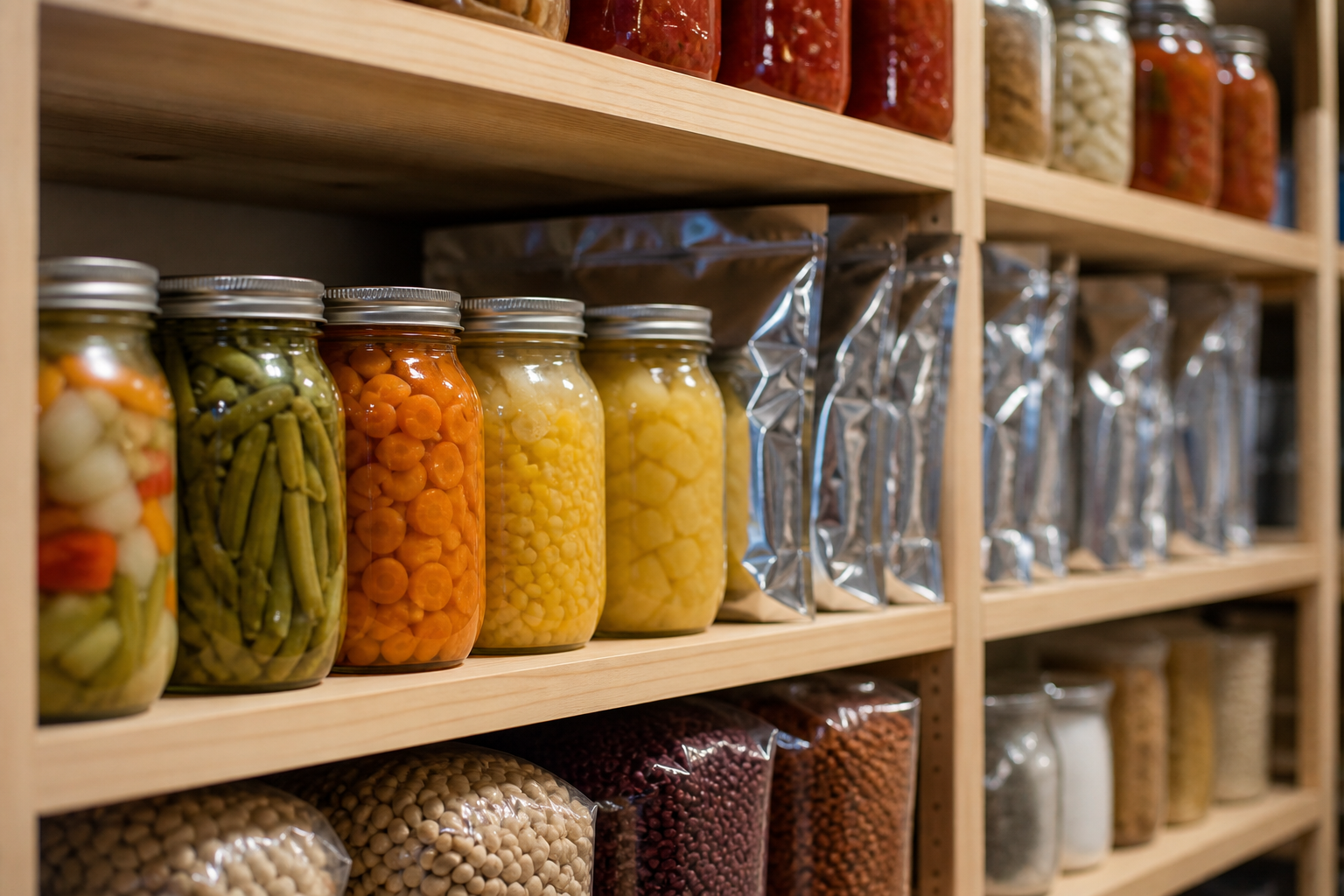
Dry storage with oxygen removal is the foundation of long-term no-power food reserves. White rice, hard wheat berries, dried corn, dried beans, lentils, rolled oats, and similar low-moisture staples will store safely for 25 to 30 years when sealed in food-grade containers with oxygen absorbers, according to research from Utah State University Extension. The mechanism is simple: remove available oxygen and you deny spoilage organisms the environment they need to reproduce. Mylar bags inside food-grade buckets with 300-500cc oxygen absorbers are the practical household implementation.
Dehydration removes moisture — the other primary condition spoilage organisms require. A basic food dehydrator runs between $40 and $80 and lets you preserve garden vegetables, fruit, and herbs at home. The USDA's Complete Guide to Home Canning and Preservation notes that dried foods stored in airtight containers away from light and heat remain safe and nutritionally useful for 1 to 4 years depending on the food type. Dehydrating at the peak of summer harvest is one of the most cost-effective ways to extend your pantry.
Fermentation preserves food through beneficial microbial activity that produces lactic acid, dropping pH below the level where harmful pathogens can survive. Sauerkraut, kimchi, salt-brined vegetables, and lacto-fermented pickles are the household-accessible examples. These require only vegetables, non-iodized salt, and a clean jar. No heat, no electricity. A properly fermented vegetable in a cool environment can remain stable and safe for 6 to 18 months.
Fat-based preservation — confit, lard storage, and rendered-fat packing — was the primary method Depression and wartime households used for preserving cooked meat without refrigeration. Cooked meat fully submerged in rendered fat and stored in a cool, dark location keeps safely for weeks to months. This method requires understanding of food safety basics (the meat must be fully cooked through and the fat must fully exclude air and moisture), but it is historically documented and effective.
Pressure canning is the only method the USDA endorses for safely home-canning low-acid foods like meat, beans, and vegetables. Done correctly with a calibrated pressure canner, home-canned goods store at room temperature for 1 to 5 years. It has a steeper learning curve and equipment cost than the other methods, but it is the one that lets you preserve genuinely diverse, protein-rich meals in jars — including full stews, broths, and cooked beans.
Building a 90-Day No-Refrigeration Supply: A Realistic Starting Framework
Start with calories, then add protein, then add variety. This sequencing matters because caloric shortfall is what creates a genuine survival crisis — micronutrient deficiency and flavor fatigue are real problems, but they develop slowly. Caloric collapse happens within days.
A rough caloric target for one adult is 2,000 calories per day, or about 180,000 calories for 90 days. A 50-pound bag of white rice contains roughly 80,000 calories. A 25-pound bag of pinto beans contains roughly 40,000 calories. Two bags of rice and one bag of beans, sealed in Mylar with oxygen absorbers, costs approximately $60 to $80 at a warehouse store and covers a significant portion of one adult's caloric needs for 90 days — without refrigeration, without power, and with a 25-year shelf life.
Add cooking fats (coconut oil and refined olive oil both store 18 to 24 months without refrigeration), salt, baking soda, dried pasta, oats, and honey, and you have a functional foundation. Honey is notably one of the few foods with an effectively indefinite shelf life when kept sealed and dry — archaeologists have recovered edible honey from ancient Egyptian tombs. From there, layer in dehydrated vegetables, home-canned proteins, and fermented foods to build nutritional completeness and prevent meal fatigue.
FEMA's Ready.gov guidelines recommend starting with a 72-hour emergency supply and building toward two weeks, then extending further. The 90-day target is achievable incrementally — even adding $10 to $20 of shelf-stable staples per week builds meaningful depth over a few months without straining most household budgets.
- Week 1-2: Seal 25 lbs of white rice and 10 lbs of dried beans in Mylar bags with oxygen absorbers
- Week 3-4: Add cooking oil (coconut or refined olive), salt, and honey
- Week 5-6: Acquire a pressure canner and practice with a small batch of beans or broth
- Week 7-8: Begin dehydrating garden or farmers-market produce at peak season
- Week 9-12: Add dried pasta, oats, baking essentials, and your first fermentation batch
The Real Limits and Failure Points (What Most Guides Skip)
Seal quality is the single biggest failure point in long-term dry storage. An oxygen absorber does nothing if the Mylar bag has a pinhole leak or an incomplete heat seal. Every bag should be checked 24 hours after sealing — if the absorber has hardened and the bag has visibly contracted around its contents, the seal is good. If the bag still feels soft and the absorber is warm or pliable, reseal it.
Temperature matters more than most people realize. The FDA and USDA both note that storage temperature significantly affects shelf life — food stored at 50 degrees Fahrenheit lasts far longer than food stored at 80 degrees. A basement or interior room is meaningfully better than a garage or attic in most climates. If your storage space regularly exceeds 75 degrees, shorten your expected shelf-life estimates by 30 to 50 percent.
Pressure canning errors are dangerous, not merely wasteful. Under-processed low-acid foods can harbor Clostridium botulinum, the anaerobic bacterium responsible for botulism. This is not a reason to avoid pressure canning — it is a reason to follow tested USDA recipes exactly, use a properly calibrated canner gauge, and never improvise processing times. The USDA's National Center for Home Food Preservation maintains free, tested recipes for this reason.
Nutritional gaps in an all-shelf-stable diet are real and worth planning for. Fat-soluble vitamins (A, D, E, K), vitamin C, and B12 can become scarce in a long-duration shelf-stable diet. Dehydrated vegetables, canned fish, and fermented foods help, but a basic multivitamin supply is a sensible addition to any serious 90-day pantry.
Our Recommendation: The Lost Superfoods
The core problem this article addresses is real and practical: most households have no idea how to preserve food outside of a refrigerator, and that single dependency makes them one power outage away from watching their food supply spoil.
The honest gap in the DIY approach described above is depth of knowledge. Knowing that fat-based preservation and fermentation work is a starting point — but knowing exactly which fats, at what ratios, processed in what way, for which cuts of meat, stored under which conditions, is where most people run out of confidence and stall. Free online resources are scattered, inconsistent in quality, and rarely organized around actual Depression-era or wartime practice where these methods were proven at scale under genuine scarcity.
The Lost Superfoods is a $37 digital guide that addresses exactly that knowledge gap. It documents 126 no-refrigeration food preservation methods drawn from wartime and Depression-era practice, with the claimed framework that a family can build and maintain 295 or more pounds of stored food per year on roughly $5 per week. At that price point, it is a low-cost reference for households who want more than a surface-level primer — a practical library of methods, not a sales pitch for expensive gear. If you have been building your dry-storage foundation and are ready to go deeper into traditional preservation techniques, it is a reasonable next step to explore. For the next step, read How to Get Enough Protein on a Plant-Based Emergency Food Supply (Without Buying Expensive Specialty Products).
Our recommendation
The Lost Superfoods
Check availability →This article contains an affiliate link. If you buy through it, we may earn a commission at no extra cost to you.
Frequently asked questions
How long can food be stored without refrigeration?
It depends heavily on the food and the storage method. White rice and dried beans sealed with oxygen absorbers can last 25 to 30 years. Dehydrated vegetables store 1 to 4 years. Home-canned goods last 1 to 5 years. Fermented vegetables in a cool environment stay stable for 6 to 18 months. Honey has an effectively indefinite shelf life when kept sealed and dry.
Is it safe to store food without refrigeration?
Yes, when done correctly using tested methods. Dry storage with oxygen removal, pressure canning following USDA-tested recipes, fermentation with adequate salt, and dehydration are all established, food-safe preservation approaches. The key is following tested procedures — particularly for pressure canning, where under-processing low-acid foods creates a botulism risk.
What foods store the longest without refrigeration?
Honey, white rice, hard wheat berries, dried corn, and dried beans sealed with oxygen absorbers have the longest verified shelf lives — 25 years or more under proper conditions. Salt, pure vanilla extract, white distilled vinegar, and white sugar also have very long stable shelf lives when stored sealed and dry.
How much does it cost to build a 3-month emergency food supply?
A basic 90-day caloric foundation for one adult — rice, beans, cooking oil, salt, and oats — can be assembled for $100 to $150 at current warehouse store prices. Adding variety through dehydrated produce, home-canned proteins, and fermented foods raises that cost, but the incremental approach of $10 to $20 per week makes it manageable for most households over a few months.
Do I need special equipment to store food long-term without a refrigerator?
For dry-storage basics, you need food-grade Mylar bags, oxygen absorbers, and food-grade buckets — total startup cost under $40. A basic dehydrator runs $40 to $80. A pressure canner for home canning costs $80 to $150. Fermentation requires only mason jars and non-iodized salt. None of these require power for storage after the initial processing.
Related guides
Sources
- USDA National Center for Home Food Preservation — Drying Foods
- USDA National Center for Home Food Preservation — Pressure Canning
- FEMA / Ready.gov — Food and Water in an Emergency
- Utah State University Extension — Shelf Life of Foods
General preparedness information, not medical or legal advice. Follow instructions from your local emergency authority during an active event.
Field notes by email
Get the next guide before you need it
One email when a new field guide drops — water, food, power, medicine. No spam, no daily noise, unsubscribe in one click.
Comments on this guide
Questions, corrections and field reports from your own setup are welcome.
No comments yet. Be the first to add a field report.