
Power
How to Generate Electricity Off-Grid Without Solar Panels: 5 Real Alternatives Worth Knowing

By Ephraim Rusk · · 10 min read
This article contains an affiliate link. If you buy through it, we may earn a commission at no extra cost to you.
Quick answer
You can generate electricity off-grid without solar panels using micro-hydro turbines, small wind generators, thermoelectric generators, biogas systems, or hand-crank and pedal generators — each with different output levels, costs, and site requirements. The right choice depends on what natural resources your property has access to.
If you have typed 'how to generate electricity off-grid without solar panels' into a search bar, you are probably not anti-solar — you are just running the numbers honestly. A grid-tied solar install averages $20,000 to $30,000 before incentives, takes months to permit and install, and still leaves you dark the moment the inverter fails or a wildfire evacuation cuts your grid connection. Solar is a solid long-term investment for the right household. It is not the only tool.
The good news is that electricity generation does not begin and end with photovoltaic panels. Humans were capturing mechanical, thermal, and chemical energy long before the first solar cell was commercialized, and those methods have not disappeared — they have gotten smaller, cheaper, and more accessible to a household working without a contractor. Some of these alternatives produce modest supplemental power. Others, given the right site conditions, can cover serious daily loads. All of them are worth understanding before you commit to a single technology.
This article walks through five legitimate, non-solar pathways to off-grid electricity generation, explains what each one realistically delivers, and gives you the honest trade-offs on cost, skill, and site requirements. No exaggeration, no hype — just the information you need to decide which approach fits your property and your preparedness goals.
Micro-Hydro Power: The Most Reliable Off-Grid Option When You Have Running Water
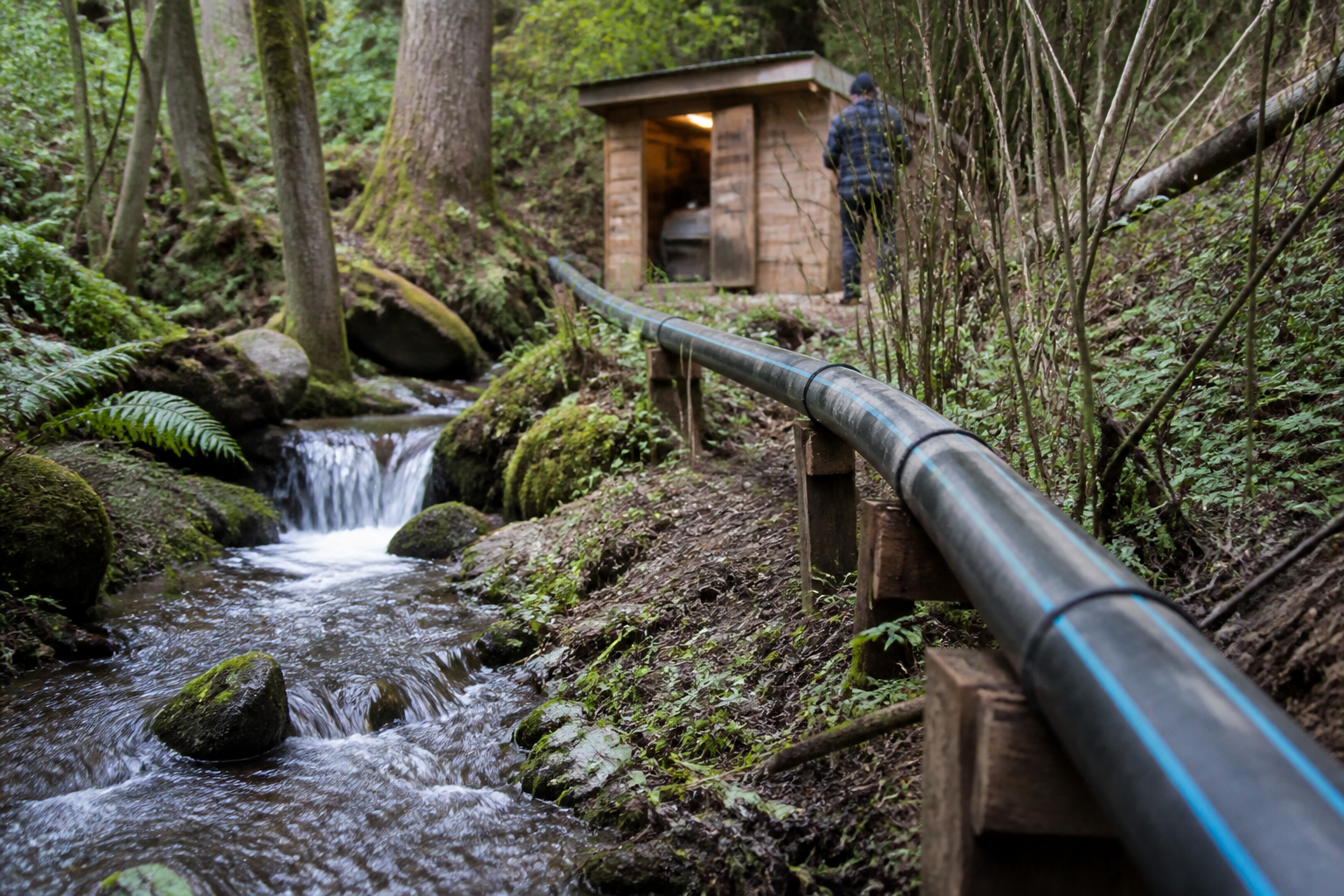
Micro-hydro is widely considered the most dependable off-grid electricity source available to a rural household — if your property has a stream or creek with sufficient flow and elevation drop. Unlike solar or wind, moving water does not take a day off. A properly sized micro-hydro system can produce power 24 hours a day, 7 days a week, which dramatically reduces the battery storage you need compared to intermittent sources.
The physics are straightforward: you divert a portion of a stream through a penstock pipe, drop it to a turbine generator, and capture the kinetic energy as electricity. Output is determined by two factors — flow rate (measured in gallons per minute) and head (the vertical drop in feet between your intake and your turbine). Even a modest stream with 50 feet of head and 20 gallons per minute can produce 300 to 500 watts continuously, which adds up to roughly 7 to 12 kilowatt-hours per day — enough to run lights, a small refrigerator, and device charging with power to spare.
The primary barriers are site-specific. You need a perennial water source on or immediately adjacent to your property, and most jurisdictions require water-rights permits before you divert flow even on private land. Contact your state's water resources agency before you buy any equipment. Installation costs for a small system (500W to 2kW) typically run $2,000 to $8,000 depending on pipe run length and turbine choice — significant, but often one-third to one-fifth the cost of an equivalent solar-plus-storage system.
Turbine manufacturers like Waterfall Energy, Harris Hydro, and Canyon Industries publish output calculators online that let you estimate production from your site measurements before you spend a dollar. If you have running water, get those numbers first — micro-hydro may be the most cost-effective electricity decision you ever make.
Small Wind Turbines: Worthwhile in the Right Landscape, Oversold Everywhere Else
Small wind turbines can generate meaningful off-grid power, but only at sites with average annual wind speeds above 10 mph — a threshold that eliminates most suburban and heavily wooded rural properties right away. Before evaluating turbine brands or tower heights, look up your site's wind resource using the NREL Wind Prospector tool or your state's wind map. If your average wind speed is below 10 mph, a turbine will underperform its rated output significantly and the payback period may never arrive.
Rated wattage on small turbines is almost always measured at a single high wind speed — commonly 28 to 31 mph — that most sites rarely see. A turbine rated at 400 watts might produce an average of 40 to 80 watts at a site with 12 mph average winds. That is still useful supplemental power, particularly when paired with solar to cover overcast days, but it will not run your household on its own. The American Wind Energy Association and NREL both publish guidance on realistic small-turbine output that is worth reading before purchase.
Tower height matters more than turbine brand for most installations. Wind speed increases with height, and turbulence — which reduces output and accelerates wear — decreases above the tree canopy and nearby obstructions. The general recommendation is to mount a turbine at least 30 feet above anything within 500 feet. Towers, permits, and installation often cost more than the turbine itself. Budget $3,000 to $8,000 for a complete small-turbine installation at a genuinely good wind site.
Where wind makes the most sense is as a complement to solar — the two sources are often anti-correlated, meaning windy days tend to be cloudy and vice versa. A hybrid solar-wind system with shared battery storage can achieve higher overall reliability than either source alone.
Thermoelectric and Biomass Generators: Low Output, High Reliability, Real Niche Uses
Thermoelectric generators (TEGs) convert a temperature difference directly into electricity using the Seebeck effect — no moving parts, no combustion turbine, just two dissimilar metals and a heat source on one side and a heat sink on the other. They are extremely reliable and essentially maintenance-free. The trade-off is efficiency: most practical TEG units convert only 3 to 8 percent of heat input into electricity, which caps real-world output at the household scale.
That said, TEGs have a genuine place in a preparedness context. Commercial units like the BioLite CampStove or the larger ThermoElectric modules available from suppliers like Hi-Z Technology or Marlow Industries can charge USB devices, run LED lighting, or trickle-charge a 12V battery from a wood fire, propane flame, or the surface of a wood stove. For a cabin or off-grid retreat where you are already burning wood for heat, capturing even 10 to 30 watts of electricity from that waste heat is a zero-fuel-cost addition.
Biomass gasification generators take the biomass concept further — they combust wood chips, agricultural waste, or charcoal in a controlled low-oxygen environment to produce syngas, which then runs a modified internal combustion generator. Gasification systems capable of producing 1 to 5 kW exist and have been used in off-grid and rural electrification contexts for decades. They require ongoing fuel management and more mechanical skill to maintain than a standard generator, but they can run indefinitely on locally sourced wood fuel — a meaningful advantage when stored gasoline or propane has run out.
Neither of these technologies is a whole-home power solution on its own. Think of them as high-reliability, low-output complements to a larger system, or as niche solutions for a specific load — keeping communications gear and lighting running when other sources are offline.
Human-Powered and Pedal Generators: Modest Output, Zero Dependence on Weather or Fuel
Human-powered generators are not a primary power source for a modern household — let us be direct about that. A fit adult pedaling a bicycle generator at steady effort produces roughly 50 to 150 watts, which over one hour of sustained work generates 0.05 to 0.15 kilowatt-hours. Your household refrigerator alone uses roughly 1 to 2 kWh per day. Pedal power will not run your home.
What pedal and hand-crank generators do offer is unconditional availability — no sun, no wind, no water, no fuel required. For charging communication devices, running a small radio, powering LED lights, or maintaining a small battery bank during a multi-day outage, a quality pedal generator is a genuine asset. The Pedal Power Generator units sold by companies like Windstream Power and several smaller manufacturers can sustain 100 to 200 watts into a 12V battery bank for as long as someone is pedaling.
In a grid-down scenario where your primary off-grid generation systems have failed or are depleted, human power is the backstop that does not run out as long as people are physically able. That backstop value is worth more than the wattage number suggests. A hand-crank emergency radio or a small Goal Zero-style hand generator should be in every preparedness kit regardless of what other power systems you have in place.
The FEMA and Ready.gov guidance on emergency power planning consistently recommends hand-crank devices as a baseline communication and lighting backup — not because they are powerful, but because they are unconditional.
Our Recommendation: The Ultimate Energizer Guide
Every approach covered in this article requires either significant site-specific resources — running water, consistent wind, or a biomass fuel supply — or accepts real limits on output. For a household that lacks a good hydro or wind site and is not ready for the cost of a full solar install, the question of where to start exploring alternative generation concepts can feel like a dead end.
The gap in most free DIY research is that it stops at the conventional options: solar, wind, hydro. The build plans, wiring diagrams, and step-by-step instructions for less mainstream generation concepts are scattered, inconsistent in quality, and often require significant prior electrical knowledge to evaluate. That friction — not lack of interest — is what keeps most households stuck on the utility grid longer than they want to be.
The Ultimate Energizer Guide is a $49 digital guide that presents an alternative home-energy-generation concept with step-by-step DIY instructions. It is worth being straightforward here: the sales page itself states the concept 'was not technically assessed,' so this is an unverified DIY concept, not a proven commercial technology — approach it as an unconventional idea to explore rather than a guaranteed solution. If you work through it and it does not meet your needs, there is a 60-day money-back guarantee. For a household actively researching non-solar off-grid power options and willing to evaluate an alternative concept on its own merits, it is a low-risk way to add one more idea to your toolkit. For the next step, read DIY Home Energy Generation Ideas That Can Cut Your Electric Bill (Without a Full Solar Install).
Our recommendation
The Ultimate Energizer Guide
Check availability →This article contains an affiliate link. If you buy through it, we may earn a commission at no extra cost to you.
Frequently asked questions
What is the cheapest way to generate electricity off-grid without solar?
If your property has a perennial stream, micro-hydro is typically the most cost-effective option — systems start around $2,000 to $3,000 and produce continuous power. If you lack running water or consistent wind, small thermoelectric setups (capturing heat from a wood stove) and pedal generators are the lowest upfront cost options, though their output is limited to lighting and device charging.
Can a small wind turbine power a whole house off-grid?
A small residential wind turbine alone is unlikely to power a full household. Most small turbines rated at 400 to 1,000 watts produce well below their rated output at average wind speeds, and whole-home daily consumption typically runs 20 to 30 kWh. Wind works best as a supplement to solar or hydro in a hybrid system, not as a standalone source.
How much electricity can a micro-hydro system generate?
Output depends on your stream's flow rate and vertical drop (head). A site with 50 feet of head and 20 gallons per minute can produce roughly 300 to 500 watts continuously — about 7 to 12 kWh per day. Larger head or higher flow rates scale output up proportionally. Use an online micro-hydro calculator with your site measurements to get a realistic estimate before purchasing equipment.
Do thermoelectric generators really work for home power?
Thermoelectric generators work reliably but at low efficiency — typically 3 to 8 percent of heat input becomes electricity. Practical output from a wood stove surface is usually 10 to 50 watts, enough for LED lighting and USB device charging. They are best used as a low-maintenance supplement for households already burning wood for heat, not as a primary generation source.
Is it legal to generate your own electricity off-grid?
Generating electricity for your own off-grid use is legal in all U.S. states, though local building codes and utility interconnection rules vary. Micro-hydro specifically requires water-use permits in most states before you divert stream flow, even on private property. Check with your state's water resources agency and local planning department before building any water-diversion system.
Related guides
Sources
- NREL: Small Wind Guidebook — U.S. Department of Energy
- FEMA: Emergency Power Planning for People with Access and Functional Needs
- U.S. Department of Energy: Microhydropower Systems
- Ready.gov: Power Outages — Emergency Preparedness
General preparedness information, not medical or legal advice. Follow instructions from your local emergency authority during an active event.
Field notes by email
Get the next guide before you need it
One email when a new field guide drops — water, food, power, medicine. No spam, no daily noise, unsubscribe in one click.
Comments on this guide
Questions, corrections and field reports from your own setup are welcome.
No comments yet. Be the first to add a field report.