
Power
How to Reduce Your Electric Bill with a DIY Backup Power Setup (Without a Full Solar Install)

By Ephraim Rusk · · 10 min read
This article contains an affiliate link. If you buy through it, we may earn a commission at no extra cost to you.
Quick answer
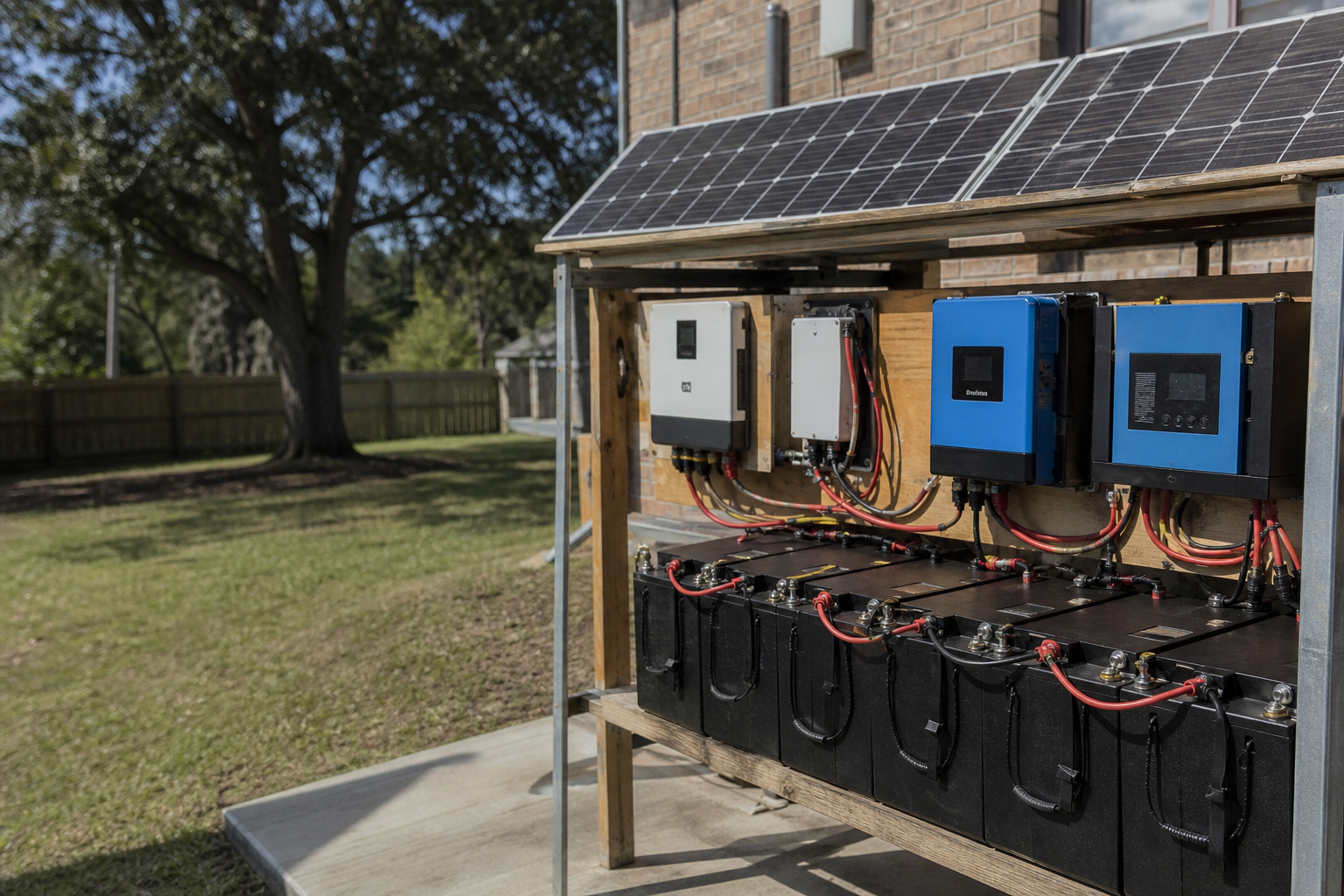
You can meaningfully reduce your electric bill and build real backup power capacity by starting small — a battery bank, a few solar panels, and a load-shifting strategy — without a full professional solar install. The key is identifying your highest-drain appliances first, then replacing or backing up those loads in priority order.
Figuring out how to reduce your electric bill with a DIY backup power setup is one of the most searched questions in the preparedness space right now — and for good reason. Utility rates in the U.S. have climbed more than 30 percent since 2020, according to the U.S. Energy Information Administration, and grid reliability hasn't kept pace. People are paying more for power that's less dependable than it used to be.
The standard advice is to go solar. And yes, a full rooftop system can make a serious dent in your bill over time. But the average residential installation runs $18,000 to $25,000 before incentives — a number that stops most households before they even start. What rarely gets discussed is the middle path: a staged, DIY backup power approach that costs a fraction of that, can be built incrementally, and starts paying dividends before it's ever 'finished.'
This article walks through that middle path. We'll cover how to audit your actual power load, which circuits matter most for preparedness, how to size and build a starter backup system on a realistic budget, and where most DIY attempts go wrong. No engineering degree required, and no contractor needed.
Start With a Load Audit: Know What You're Actually Powering
Before buying a single panel or battery, you need to know exactly where your electricity is going — because most households are wasting power on loads that are cheap to fix without any hardware at all.
A load audit is simple: go circuit by circuit and list every device on it, its wattage (found on the label or in the owner's manual), and roughly how many hours per day it runs. Multiply wattage by daily hours to get watt-hours per day. Add those up across your whole home and you have your baseline consumption.
What you'll usually find is that two or three categories — water heating, space conditioning (heating and cooling), and always-on appliances like refrigerators and chest freezers — account for 60 to 80 percent of your total bill. The U.S. Department of Energy consistently reports that water heating alone makes up about 18 percent of the average household's energy use. That's the number to attack first.
The goal of the audit isn't just to find waste. It's to separate your 'critical' loads — the ones you genuinely need during a grid outage or a financial squeeze — from your 'comfort' loads. A well-built DIY backup system handles critical loads reliably. Trying to back up your whole house from the start is how people overspend and give up.
Which Circuits to Prioritize for a Backup Power Plan
For both bill reduction and genuine preparedness, prioritize backing up the circuits that affect food safety, lighting, communication, and basic water pressure — in that order.
Refrigeration tops the list. A standard full-size refrigerator draws 100 to 400 watts but only runs its compressor roughly 30 to 40 percent of the time, meaning its effective daily consumption is often 1 to 2 kilowatt-hours. A well-insulated chest freezer running in the same role can cut that number nearly in half. This is one of the easiest wins: swap a chest freezer for your secondary food storage, and your backup power needs drop significantly.
Lighting is almost free to back up in 2026. LED lighting across a typical home draws a fraction of what it did a decade ago. A full evening's lighting load — every occupied room — can realistically run under 100 watts total. A modest battery bank handles this all night without breaking a sweat.
Water pressure matters more than people expect. Most residential well pumps are 240V and draw 750 to 1,500 watts — a serious load for a DIY system. If you're on a well, either size your backup system to handle the pump or store enough water on hand that you can go 72 hours without running it. FEMA's Ready.gov recommends storing at least one gallon per person per day as a baseline; two to four gallons is more realistic for comfort and hygiene.
Medical equipment, if anyone in your household depends on it, overrides all of the above. CPAP machines, home oxygen concentrators, and insulin refrigeration are non-negotiable first priorities and should be documented and sized for before anything else.
- Refrigeration / chest freezer: 1-2 kWh/day, high priority
- LED lighting: under 0.5 kWh/night, very easy to back up
- Phone and device charging: minimal draw, back up with a basic power bank
- Well pump (if applicable): 750-1,500W, size carefully or plan water storage
- Medical devices: size these first, no exceptions
How to Size a Starter DIY Backup System Without Overbuying
The most common and expensive mistake in DIY home backup power is trying to size the system for the worst-case scenario right out of the gate — and then either running out of money or building something too complex to maintain.
A practical starter system for most households covers three days of critical loads at 50 percent depth of discharge on the battery bank. Use your load audit to add up the watt-hours per day for your critical circuits, multiply by three days, then double that number — that's your target usable battery capacity in watt-hours before you account for discharge limits. Most quality lithium iron phosphate (LiFePO4) batteries can be safely discharged to 80 percent, which means your required total capacity is your three-day number divided by 0.8.
On the solar side, a simple rule of thumb is to size your panels to replace roughly one day's critical load per day of average sun hours in your region. The National Renewable Energy Laboratory's PVWatts tool is a free, reliable way to find average peak sun hours by zip code — use it rather than guessing.
For a household with 3 kWh per day in critical loads, you're looking at roughly 11 to 12 kWh of battery capacity and somewhere between 1,500 and 2,500 watts of panels, depending on your location and seasonal variation. That's a real system, but it's also a system you can build incrementally — one battery at a time, one panel pair at a time — without throwing everything at it in one purchase.
Don't forget the balance of system: charge controller, inverter, wiring, fusing, and disconnect switches. These are not optional, and underbuilding them is a fire hazard. The National Electrical Code (NFPA 70) governs solar and battery installations; even a DIY system should be built to code, and many jurisdictions require a permit and inspection for battery storage systems above a certain capacity.
Where DIY Backup Power Plans Fail (And How to Avoid It)
Most DIY backup power projects fail in one of four ways: undersized wiring, mismatched components, no real plan for cloudy stretches, and decision paralysis from information overload.
Undersized wiring is the safety issue. A wire that's adequate for 15 amps on a normal circuit becomes a fire risk when you're running 50 or 80 amps from a battery bank through it. Use the American Wire Gauge (AWG) tables, and when in doubt, go one size heavier. Fusing every circuit at the battery is non-negotiable.
Mismatched components waste money and performance. A 12V battery bank paired with a 48V inverter is a common beginner mistake. So is pairing a high-wattage panel array with a charge controller that can't handle the input current. Read the specs on every component before you buy, and build a wiring diagram — even a rough sketch on paper — before you spend anything.
Cloudy stretch planning is what separates a backup system from a genuine grid-independence strategy. If your area sees four or five consecutive overcast days in winter — common across most of the northern U.S. — your system needs either more battery depth, a backup charging source (a generator run for a few hours, a wind turbine, or a grid-tie option), or a clear plan to reduce load during that stretch.
Decision paralysis is real and common. The technical depth available online is enormous, and a lot of it is contradictory. People spend months researching and never build anything. The practical answer is to start with a modest, well-documented system design — one you understand completely — and expand from there, rather than trying to design the perfect system on the first pass.
Our Recommendation: Easy DIY Power Plan
Dependence on a grid that's both increasingly expensive and increasingly unreliable is a genuine household vulnerability — and as this article lays out, the stakes show up in both your monthly bill and your family's resilience when the power goes out.
The honest friction with the DIY approach is the planning layer. The technical steps themselves aren't impossibly hard, but assembling a coherent, correctly sequenced plan from scattered forum posts, YouTube channels, and spec sheets is genuinely time-consuming — and mistakes in the planning phase are where real money gets wasted on wrong components or where safety gets compromised. Most free resources either go too deep into engineering or stay too shallow to be actionable.
The Easy DIY Power Plan is built specifically for people who want to reduce their grid dependence through real, practical steps — without needing a technical background or hiring a contractor. It gives you a simplified, structured path through exactly the decisions this article covers: load prioritization, system sizing, and component selection — organized so you can act on it rather than just study it. If you've read this far and you're ready to move from research to a real plan, it's worth a look.
Our recommendation
Easy DIY Power Plan
Check availability →This article contains an affiliate link. If you buy through it, we may earn a commission at no extra cost to you.
Frequently asked questions
How much does a DIY home backup power system cost to build?
A starter DIY backup system covering critical loads (refrigeration, lighting, device charging) typically runs $1,500 to $4,000 in components depending on battery chemistry and panel wattage. LiFePO4 batteries cost more upfront but last significantly longer than lead-acid alternatives. Costs drop if you build incrementally over time rather than all at once.
Can a DIY solar setup actually reduce my monthly electric bill?
Yes, but the reduction depends on how much of your load you offset and your utility's net metering policy. Even a modest system covering 3-5 kWh per day can reduce a typical bill by 20 to 40 percent. Off-setting your highest-cost time-of-use periods (usually late afternoon and evening) delivers the biggest bill impact per dollar invested.
Do I need a permit for a DIY home battery backup system?
In most U.S. jurisdictions, yes. Battery storage systems above a certain capacity (often 1 kWh or more) require a permit and may need inspection. Requirements vary by state and municipality. Check with your local building department before installation — unpermitted systems can create insurance and resale issues and may not meet safety codes.
What is the best battery type for a home DIY backup power system?
Lithium iron phosphate (LiFePO4) is the current best-practice recommendation for most DIY home setups — safer chemistry than other lithium types, longer cycle life (typically 2,000 to 4,000 cycles), and tolerant of deeper discharge than lead-acid. The higher upfront cost is generally offset by the longer lifespan.
How long will a DIY battery backup system power my home during an outage?
That depends entirely on your battery capacity and your load. A 10 kWh battery bank powering only critical loads (refrigerator, lights, phone charging) at roughly 3 kWh per day will last three or more days. Running higher loads like electric heat, well pumps, or air conditioning cuts that dramatically. Sizing your system to your actual critical loads — not your full household load — is the key to realistic expectations.
Related guides
Sources
- U.S. Energy Information Administration — Electricity Prices and Trends
- U.S. Department of Energy — Water Heating Energy Use
- NREL PVWatts Calculator — Solar Resource by Location
- Ready.gov — Water Storage for Emergencies
General preparedness information, not medical or legal advice. Follow instructions from your local emergency authority during an active event.
Field notes by email
Get the next guide before you need it
One email when a new field guide drops — water, food, power, medicine. No spam, no daily noise, unsubscribe in one click.
Comments on this guide
Questions, corrections and field reports from your own setup are welcome.
No comments yet. Be the first to add a field report.