
Power
DIY Home Energy Generation Ideas That Can Cut Your Electric Bill (Without a Full Solar Install)

By Ephraim Rusk · · 10 min read
This article contains an affiliate link. If you buy through it, we may earn a commission at no extra cost to you.
Quick answer
You can reduce your electric bill with DIY home energy generation by starting with small, targeted systems — such as micro-solar for specific loads, wind micro-turbines, or alternative energy concepts — without committing to a full whole-home solar installation. The right approach depends on your location, budget, and local regulations.
DIY home energy generation is one of the most searched topics among prepper households and cost-conscious homeowners alike — and for good reason. The average U.S. residential electric bill hit $137 per month in 2023 according to the U.S. Energy Information Administration, and it has trended upward for a decade. If you are looking for ways to cut that number without spending $20,000 on a contractor-installed solar array, you are not alone.
The problem is that most of the advice online jumps straight to two extremes: buy a full grid-tied solar system, or go completely off-grid. Neither option is realistic for most households right now. What actually exists in between those poles is a wide range of partial, DIY-friendly approaches — each with real tradeoffs that most guides gloss over.
This article walks through the practical options for small-scale home energy generation, what each one realistically delivers, what the common pitfalls are, and how to decide where to start. At the end, I will point you to one low-cost digital guide designed for people who want to explore an alternative generation concept before committing to any major investment.
Why Most Households Never Start a DIY Energy Project (And Why That Changes)
The single biggest barrier to DIY home energy generation is not money — it is the perceived complexity of the whole thing. People look at a full solar quote, see 30 line items and a 10-year payback calculation, and walk away. That is a reasonable reaction to an unreasonable starting point.
The smarter entry point is what energy professionals sometimes call 'load isolation' — identifying one specific, high-draw appliance or circuit and targeting it with a small generation or storage system. A chest freezer, a well pump, a home office circuit. You are not replacing the grid; you are reducing how much you pull from it in one specific area.
That reframe matters because it makes the project finite, testable, and affordable. A 200-watt panel, a charge controller, and a battery bank to run a chest freezer costs roughly $300 to $500 in parts if you source carefully. That is a real weekend project with a measurable result on your next bill — not a multi-month contractor engagement.
Regulatory complexity is real too. Some states and municipalities have rules about grid-tied generation systems, interconnection agreements, and permit requirements. Any DIY generation project that connects to your home's main panel should be cleared with your local utility and building department first. Systems that stay completely off the grid — charging batteries that run standalone loads — generally face fewer restrictions, though local codes vary.
Small-Scale Solar: The Realistic Starting Point for Most DIYers
Small-scale solar is the most accessible DIY home energy generation option for most households because the components are widely available, well-documented, and the physics are straightforward.
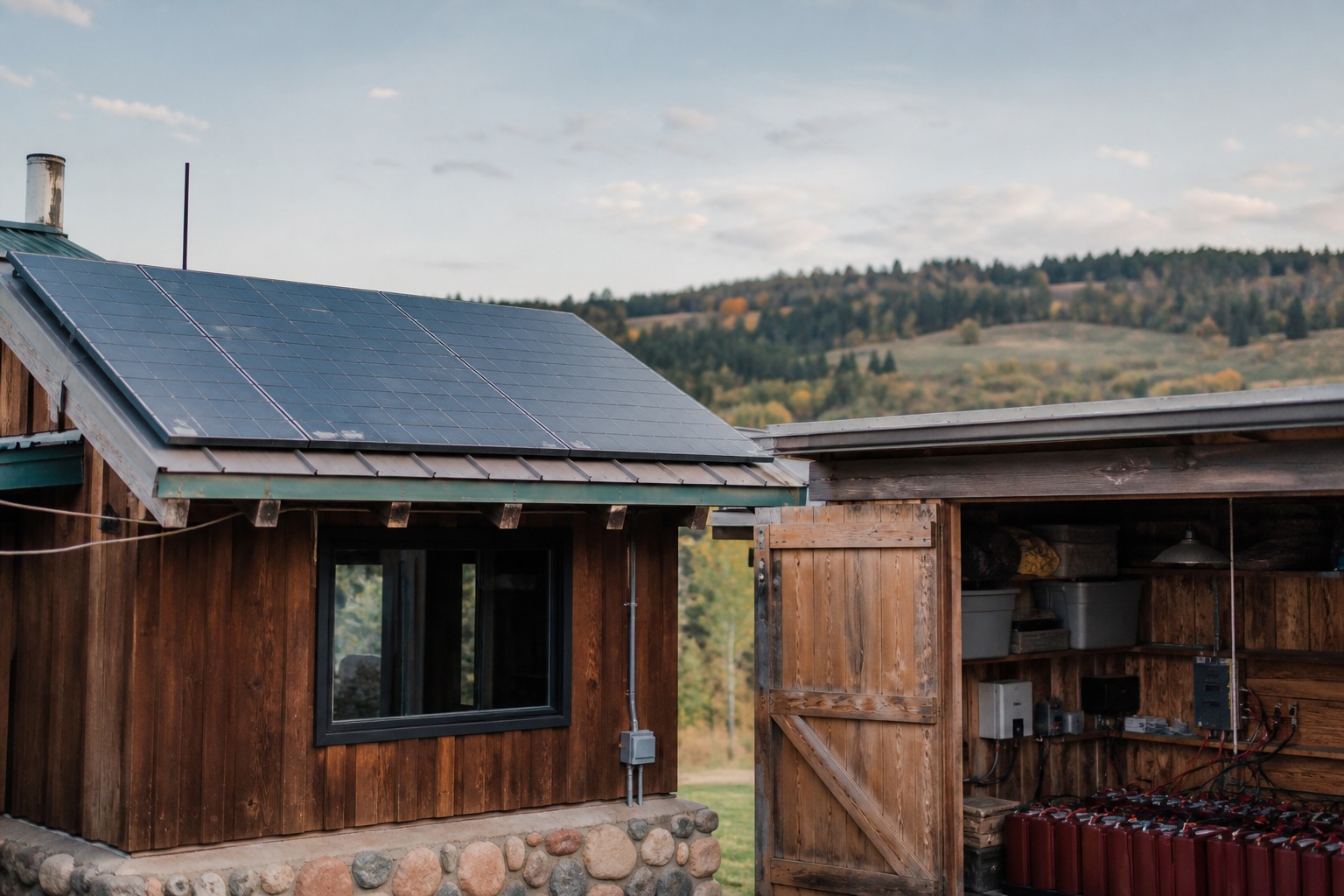
A basic off-grid solar setup has four components: panels, a charge controller, a battery bank, and an inverter if you need AC power. For a 12-volt DC system running a single load like a chest freezer or LED lighting circuit, you may not even need the inverter. The USDA Rural Energy for America Program and the National Renewable Energy Laboratory both publish consumer-level guidance on sizing these systems, and it is worth reading before you buy anything.
Realistic output expectations matter here. A single 200-watt panel in a location with five peak sun hours per day will produce roughly 1 kWh per day under good conditions. A chest freezer uses approximately 1 to 1.5 kWh per day. That is a near-match — but cloudy weeks, panel angle, and temperature all affect real-world output. Size your battery bank to cover at least two to three days of the target load without sun.
The honest limitation: small-scale solar handles targeted loads well but is not a realistic whole-home solution at the DIY level without significant investment in panels and battery capacity. Use it to reduce your bill on specific high-draw items, not to eliminate your utility connection.
- 200W panel + 20A PWM charge controller + 100Ah AGM battery: approximately $280 to $400 in parts
- Best suited for: chest freezers, lighting circuits, phone/device charging, small fans
- Not well-suited for: electric water heaters, central HVAC, electric ranges
- Check local net-metering rules before connecting any system to your main panel
Other DIY Generation Options: Wind, Micro-Hydro, and Alternative Concepts
Solar is not the only path — it is just the most accessible one in most locations. Wind, micro-hydro, and various alternative energy concepts each have a legitimate use case, and each has significant constraints.
Small wind turbines work well in rural and semi-rural settings with consistent wind above 10 mph. The U.S. Department of Energy's Wind Energy Technologies Office notes that most residential micro-turbines produce between 400 watts and 20 kilowatts, and they pair well with solar in hybrid off-grid systems because wind production often peaks when solar is weakest — cloudy days, nighttime. The main barriers are noise ordinances in many suburbs, minimum lot size requirements, and upfront cost, which typically starts around $3,000 for even a small turbine with installation.
Micro-hydro is the most efficient small-scale generation option when you have running water on your property — a creek or stream with sufficient flow and head (elevation drop). Even a modest system can produce continuous power 24 hours a day, unlike solar or wind. The EPA and state agencies regulate water use and diversion rights carefully; this is not a system you set up without checking your water rights and local regulations first.
Beyond those established technologies, there are alternative and experimental energy generation concepts circulating in the DIY community — approaches that draw on different physical principles and are not yet part of mainstream engineering consensus. Some of these have attracted real interest from self-reliant households looking to reduce grid dependence. They deserve honest evaluation: some may offer practical value in the right context, others remain unverified at the consumer level. I will address one of these in the recommendation section below, with appropriate transparency about what is and is not established.
How to Evaluate Any DIY Energy Claim Before You Spend Money
The DIY energy space has a long history of overpromised results, and a few simple filters protect you from wasting money on projects that will not deliver.
First, look for independent verification. Established technologies — solar panels, charge controllers, wind turbines — have standardized efficiency ratings from recognized bodies like the IEC (International Electrotechnical Commission) and NREL (National Renewable Energy Laboratory). If a product or guide makes performance claims, ask whether those claims have been tested by an independent third party. If the answer is no, treat the output estimates as unverified.
Second, check for local regulatory conflicts before building. Some alternative generation concepts, and even some conventional ones, may require permits or may be restricted in certain municipalities. Your local building department and utility company are the authoritative sources here — not YouTube comments or forum posts.
Third, calculate the real payback. Divide the total project cost by the monthly savings you realistically expect (using conservative output estimates). If the payback period exceeds the expected lifespan of the components, the project does not make financial sense regardless of how interesting the technology is. A $500 project that saves $15 per month has a 33-month payback — reasonable. A $3,000 project that saves $10 per month has a 25-year payback — not reasonable for most households.
Fourth, start small. Buy the guide, build the proof of concept, measure the actual output before scaling up. This applies to solar, wind, and any alternative concept equally. The information cost of evaluating a $39 guide is far lower than the material cost of a failed build.
- Ask: Has this been independently tested and by whom?
- Ask: Is this legal in my municipality and does it require a permit?
- Ask: What is the realistic — not best-case — monthly output?
- Ask: What is the actual payback period at conservative estimates?
- Ask: Can I start with a small proof-of-concept before committing full budget?
Our Recommendation: Energy Revolution System
Here is the core problem this article has been building toward: conventional DIY energy generation options — solar, wind, micro-hydro — are real and proven, but they all have meaningful upfront costs, local regulatory complexity, and skill requirements that put them out of reach for many households right now. If your electric bill is climbing and you cannot yet afford even a $500 entry-level solar setup, you are stuck watching the meter run.
The honest gap in the DIY energy space is a low-cost starting point for exploring alternative generation concepts — something you can evaluate and learn from before committing to hardware. Most free information online is either too surface-level to act on or is selling a $3,000 system. What is harder to find is a detailed conceptual guide to a non-mainstream approach, available at a price that makes the risk of evaluation very low. That gap matters because the evaluation cost should always be less than the build cost.
The Energy Revolution System is a digital DIY guide presenting an alternative home energy generation concept aimed at households that want to reduce their electric bill without a full solar install. At $39 (regularly $149), the entry cost is low enough that the guide pays for itself if it prevents even one bad hardware purchase. I want to be direct about something important: the sales page for this guide states plainly that it 'was not technically assessed,' and some implementations may be restricted locally — that is language I take seriously, and you should too. This is not a proven, peer-reviewed technology. It is a conceptual DIY framework that may be worth exploring if you are the kind of person who evaluates ideas carefully before building. It comes with a money-back guarantee, which means you can work through the material and decide for yourself whether the concept warrants further investment. If you are in research mode and want an inexpensive way to get familiar with alternative energy generation ideas before committing to any build, it is worth a look.
Our recommendation
Energy Revolution System
Check availability →This article contains an affiliate link. If you buy through it, we may earn a commission at no extra cost to you.
Frequently asked questions
What is the cheapest way to generate your own electricity at home?
Small off-grid solar setups targeting a single high-draw appliance are typically the cheapest entry point, with basic systems starting around $300 to $500 in parts. Micro-wind and micro-hydro require higher upfront investment and are better suited to rural properties with the right natural resources.
Can I legally generate my own electricity at home?
In most U.S. states, yes — but the rules vary significantly. Off-grid systems that do not connect to your utility's grid face fewer barriers. Grid-tied systems require interconnection agreements and permits in most jurisdictions. Check with your local utility and building department before installing any system connected to your main panel.
How much can a DIY solar setup reduce my electric bill?
A small 200-watt off-grid system targeting one appliance like a chest freezer can realistically reduce your bill by $10 to $20 per month depending on your utility rate and local sun hours. Larger multi-panel systems can reduce bills by 30 to 60 percent, but require proportionally higher upfront investment.
Is DIY home energy generation safe?
Systems wired into your home's main electrical panel carry real shock and fire risk and should be done by a licensed electrician or inspected after installation. Standalone battery-based systems operating below 48 volts DC are generally lower risk but still require proper fusing and battery ventilation. Never skip safety precautions to save money.
Do alternative or experimental home energy generators actually work?
Some alternative generation concepts circulate widely in DIY communities but have not been independently verified at the consumer level. Established technologies like solar and wind have well-documented performance data from bodies like NREL. Any alternative concept should be treated as unverified until tested independently, and evaluated with a conservative payback calculation before building.
Related guides
Sources
- U.S. Energy Information Administration — Average Retail Price of Electricity, Residential Sector
- U.S. Department of Energy — Small Wind Electric Systems Consumer Guide
- National Renewable Energy Laboratory — Homeowner's Guide to Going Solar
- USDA Rural Energy for America Program (REAP) — Overview
General preparedness information, not medical or legal advice. Follow instructions from your local emergency authority during an active event.
Field notes by email
Get the next guide before you need it
One email when a new field guide drops — water, food, power, medicine. No spam, no daily noise, unsubscribe in one click.
Comments on this guide
Questions, corrections and field reports from your own setup are welcome.
No comments yet. Be the first to add a field report.