
Power
How to Keep Food Cold Without Power During an Extended Outage (7 Proven Methods)

By Ephraim Rusk · · 10 min read
This article contains an affiliate link. If you buy through it, we may earn a commission at no extra cost to you.
Quick answer
To keep food cold without power, pack your existing fridge or freezer tightly with ice blocks or frozen water bottles, minimize door openings, and use insulated coolers, root cellars, or evaporative clay-pot coolers as backups. A fully packed freezer stays food-safe for up to 48 hours without power; a fridge lasts only 4 hours once the door is opened.
How to keep food cold without power is one of the first real problems a household faces the moment a blackout stretches past dinnertime. Most families have two to four days of perishables in the fridge at any given time — meat, dairy, leftovers, medications — and every hour the grid stays down, that investment edges closer to the trash can.
The USDA puts the threshold plainly: a refrigerator maintains safe temperatures for about four hours after power loss, provided you keep the door closed. After that, without intervention, you are on the clock. A standard freezer buys you 48 hours if full, 24 hours if half-full. That sounds like a margin — until a multi-day storm, a regional infrastructure failure, or a grid event stretches the outage to a week or more.
The good news is that people kept food cold and safe for centuries without electricity, and the methods they used are still available to you right now. This article walks through seven practical approaches, what each one costs in time and money, and how long each one realistically buys you — no expensive equipment required.
Why Your Fridge Fails Faster Than You Think
A modern refrigerator is a well-insulated box with a motorized heat pump — and nothing more. The moment the compressor stops, it is not generating cold; it is simply losing it. How quickly depends on how full the unit is, how well-sealed the door gaskets are, and how often you open the door.
The USDA Food Safety and Inspection Service (FSIS) sets the danger zone at 40°F and above. Bacterial growth on perishables like raw meat, cooked leftovers, soft cheeses, and cut produce accelerates rapidly above that temperature. After two hours in the danger zone, many foods are no longer considered safe for consumption — and you typically cannot tell by smell alone.
A half-empty fridge with an older gasket and a household that opens the door to 'check' every thirty minutes may lose safe temperature in two hours or less. Understanding this timeline is not meant to alarm you — it is meant to help you act fast and prioritize correctly when an outage begins. Knowing which foods to eat first, which to move to a cooler, and which to let go is a genuine skill that reduces waste and protects your family.
Method 1 and 2: Maximize What You Already Have
The fastest, cheapest interventions use your existing appliances more intelligently — no purchases required.
First, stop opening the fridge. This sounds obvious but is almost universally ignored. Every door-open event exchanges the cold air inside for warm room air. Decide what you need before you open the door, retrieve everything at once, and close it. If your household commits to this, you can extend the safe window of an untouched refrigerator from four hours to six or more.
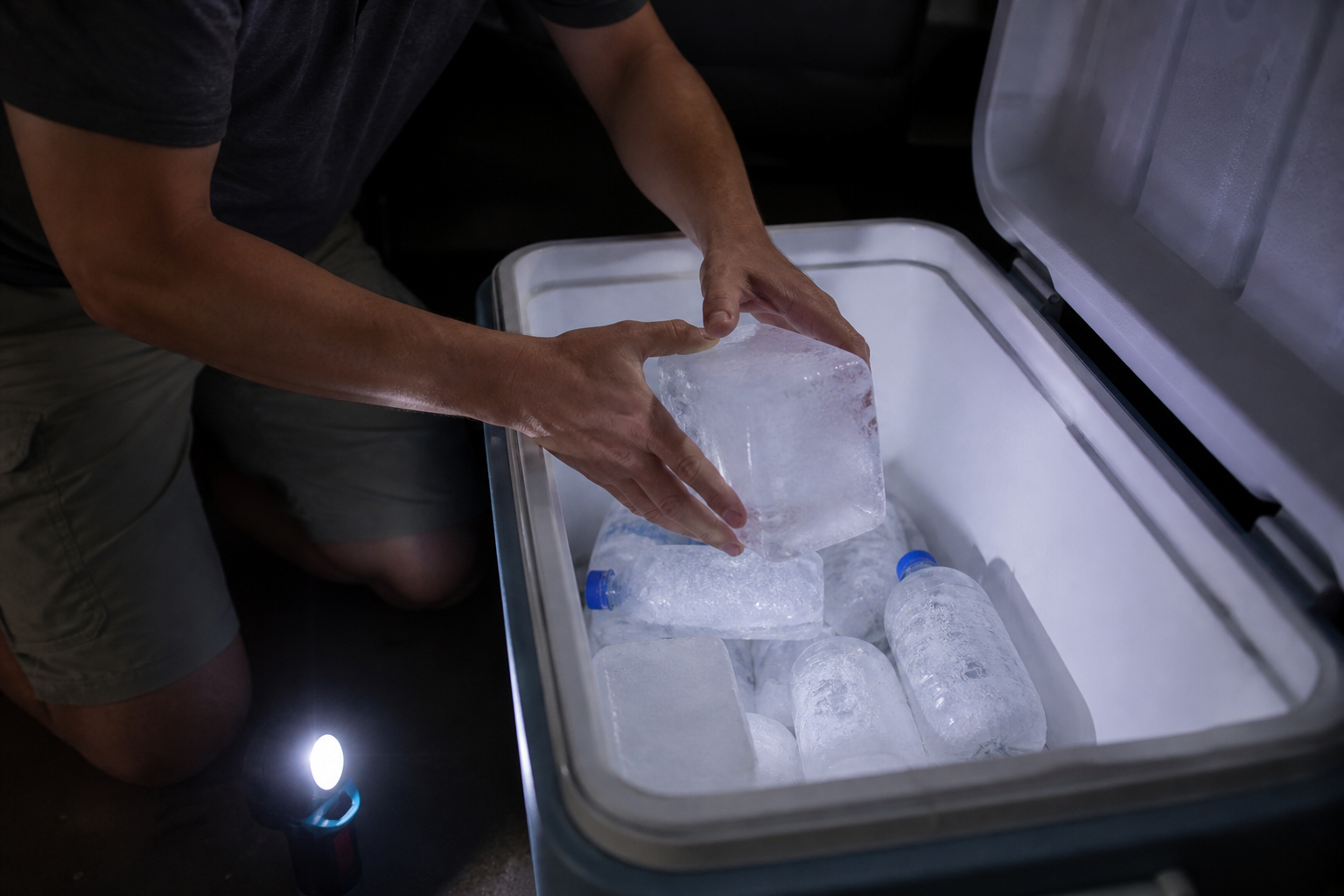
Second, fill every empty space in your freezer with water-filled containers before an outage. Thermal mass is the principle at work: a densely packed freezer loses temperature more slowly because there is more frozen material absorbing ambient heat. Gallon zip-lock bags of water, empty juice containers topped off, or dedicated reusable ice blocks all serve this purpose. A full freezer will hold 48 hours of safe temperature; a half-full one may lose it in 24. Pre-freezing water costs you nothing and takes ten minutes.
When an outage begins, transfer frozen water bottles or block ice from the freezer into the refrigerator compartment to actively buy it more time. The freezer, now insulating itself, and the fridge, receiving supplemental cold mass, both perform significantly better than if left alone.
Methods 3, 4, and 5: Low-Tech Cooling That Works for Days
Once your in-place appliances are exhausted, three passive techniques extend your food safety window by days without electricity.
Insulated coolers with block ice are the workhouse of short-to-medium outages. Block ice melts far more slowly than cubed ice — a single block in a quality cooler can maintain below-40°F temperatures for three to five days. If you can source dry ice (available at many grocery stores and gas stations), the window extends further, though dry ice requires ventilation and insulated gloves to handle safely. The CDC notes that dry ice at around minus-109°F will keep frozen food frozen for 24 to 48 hours in a well-insulated cooler, depending on quantity.
Root cellars and buried or earthen storage represent an older and genuinely reliable passive cooling method. Below ground in most of the continental United States, soil temperature stabilizes between 50°F and 60°F year-round — warmer than a fridge but cold enough to significantly slow bacterial growth and extend the usable life of many foods. Root vegetables, hard cheeses, whole uncut fruits, and cured meats do well in these conditions. You do not need a dedicated structure: a five-gallon bucket buried three feet deep with a sealed lid works as a small-scale version.
Evaporative cooling via a pot-in-pot cooler (also called a zeer pot) is a technique proven across dry climates for generations. Place a smaller clay pot inside a larger one, fill the gap with wet sand, cover with a wet cloth, and keep it in a shaded, breezy location. Evaporation draws heat out of the inner chamber, dropping internal temperatures by 20 to 40 degrees Fahrenheit below ambient air temperature in low-humidity environments. In a dry summer climate, this can bring the interior to near-refrigerator temperatures. In humid climates, the effect is reduced but still meaningful for slowing spoilage. The method costs under ten dollars in materials.
- Block ice in a quality cooler: 3-5 days of below-40°F
- Dry ice in an insulated cooler: 24-48 hours of frozen food stability
- Root cellar or buried container: indefinite passive 50-60°F storage
- Zeer pot / clay-pot cooler: 20-40°F below ambient in dry climates
- Shaded stream immersion (sealed containers): effective short-term in cold-water environments
Methods 6 and 7: Preservation That Removes the Cold Requirement Entirely
The most resilient long-term solution to grid-down food safety is not finding better ways to stay cold — it is converting perishables into shelf-stable forms that do not need refrigeration at all.
Canning, either water-bath for high-acid foods or pressure canning for low-acid foods like meats and vegetables, creates sealed, room-temperature-stable food that can last one to four years according to USDA guidelines. If you have advance warning of an extended outage — or if you are building a preparedness pantry now — canning your garden surplus, bulk meat purchases, and high-value proteins means those foods are simply not at risk during a power failure. The USDA National Center for Home Food Preservation provides tested, safe recipes and processing times for free.
Salting, curing, and dehydrating are complementary methods that similarly remove the conditions bacteria need to thrive — primarily water activity. Jerky, dried beans, salted fish, cured meats, and dehydrated vegetables store for months to years without any refrigeration. These are not exotic techniques: every culture that existed before electrification used them. Learning one or two of them — even at the basic level — fundamentally changes your household's resilience posture, because it means a week-long power outage does not threaten your food supply at all.
The practical approach is to layer these methods. In an outage, your first priority is eating perishables before they cross into the danger zone, in order of risk: raw meat and seafood first, then dairy, then cooked leftovers, then whole fruits and vegetables last. Meanwhile, your preserved pantry — canned, dried, cured — is completely unaffected and available throughout.
Our Recommendation: David's Shield
A multi-day power outage without a food preservation plan is not just inconvenient — it means losing several hundred dollars of groceries in the span of hours, and potentially making your family sick on food that looked and smelled fine.
The methods in this article are all sound, but there is a real friction point most households hit: knowing which method to use when, how to execute it safely, how to sequence it alongside water storage and basic medical needs, and how to do all of that without relying on powered equipment that is itself compromised in a blackout. Free information is scattered across dozens of agency websites, and pulling it together under pressure is its own kind of stress.
David's Shield is a $67 faith-based, Amish-inspired survival guide built specifically for this gap — low-tech, off-grid readiness for blackout and EMP scenarios, with practical sections covering food storage, water purification, shelter hardening, and basic medical care, all favoring simple, no-gadget methods over battery-dependent solutions. It is the kind of consolidated, print-friendly reference you can have in hand when the power is already out and your phone is dead. It comes with a 60-day money-back guarantee, so if it does not fit your household's needs, you are not out anything. If a no-electricity approach to extended outage preparedness is what you are building toward, it is worth a close look.
Our recommendation
David's Shield
Check availability →This article contains an affiliate link. If you buy through it, we may earn a commission at no extra cost to you.
Frequently asked questions
How long can a refrigerator keep food cold without power?
A refrigerator will keep food safe for about 4 hours after power loss, as long as the door stays closed. A full freezer holds safe temperatures for 48 hours; a half-full freezer for around 24 hours. After those windows, food should be checked with a thermometer — anything above 40°F for more than 2 hours should be discarded according to USDA guidelines.
What foods can be saved during a power outage and what should be thrown out?
Raw meat, poultry, seafood, soft cheeses, milk, cooked leftovers, and cut produce should be discarded if held above 40°F for more than 2 hours. Hard cheeses, whole uncut fruits and vegetables, fruit juices, butter, and peanut butter are generally safe longer. When in doubt, throw it out — foodborne illness is not detectable by smell alone.
Does a zeer pot (clay pot cooler) actually work?
Yes, in low-humidity environments. A pot-in-pot cooler uses evaporative cooling to drop interior temperatures by 20 to 40 degrees Fahrenheit below ambient air temperature. The effect is significant in arid or semi-arid climates and reduced in humid regions. It will not reach refrigerator temperatures in humid summer conditions, but it meaningfully extends food life compared to room-temperature storage.
Is dry ice safe to use in a cooler for food storage?
Yes, with precautions. Dry ice (solid carbon dioxide) must be handled with insulated gloves to prevent frostbite, and the cooler should not be completely airtight since CO2 gas must vent. Keep dry ice coolers in ventilated spaces, not sealed vehicles or rooms. Placed in a well-insulated cooler, dry ice can keep frozen food frozen for 24 to 48 hours depending on quantity.
How do I keep food cold during a power outage without ice?
Without ice, your best options are a root cellar or buried container (stable 50-60°F year-round), a zeer pot evaporative cooler (effective in dry climates), or converting perishables immediately into shelf-stable forms through canning, salting, or dehydration. Eating high-risk perishables first — raw meat, dairy, cooked leftovers — before they reach the danger zone is the most practical immediate step.
Related guides
Sources
- USDA FSIS — Food Safety During Power Outages
- USDA National Center for Home Food Preservation
- CDC — Food Safety and Power Outages
- Ready.gov — Food and Water in an Emergency
General preparedness information, not medical or legal advice. Follow instructions from your local emergency authority during an active event.
Field notes by email
Get the next guide before you need it
One email when a new field guide drops — water, food, power, medicine. No spam, no daily noise, unsubscribe in one click.
Comments on this guide
Questions, corrections and field reports from your own setup are welcome.
No comments yet. Be the first to add a field report.