
Power
DIY Off-Grid Power Generation Without Solar or Utility Hook-Up: 5 Real Options Compared

By Ephraim Rusk · · 10 min read
This article contains an affiliate link. If you buy through it, we may earn a commission at no extra cost to you.
Quick answer
You can generate usable home power off-grid without solar panels using small wind turbines, micro-hydro systems, propane or diesel generators, biogas digesters, or alternative low-energy-generation concepts built from DIY guides. Each method has real cost, site, and skill requirements — no single option works for every property.
DIY off-grid power generation without solar is a legitimate goal, and more households are pursuing it than ever — but the internet mostly serves up either 'go full solar' or 'buy a generator.' Neither answer fits everyone. Solar requires roof access, significant upfront capital, grid-tie permitting in many jurisdictions, and enough sun hours to pencil out. A gasoline generator buys you 72 hours of noise, fuel logistics, and a monthly maintenance headache. There is a real gap in between.
If you are trying to cut your dependence on the utility grid, build a resilient backup system, or power a remote structure with no utility hook-up at all, you have more options than most guides admit — and some of those options are within reach of a motivated homeowner with basic tools and a weekend. This article lays out five real approaches, what each one actually demands in cost and skill, where each one falls short, and how to decide which path fits your property and your goals.
One thing you will not find here is hype. Every method below has documented trade-offs. I will name them plainly — because a system you build on bad information is worse than no system at all.
Why 'Just Get Solar' Does Not Work for Everyone
Solar photovoltaic systems dominate the off-grid conversation because they have dropped dramatically in cost over the past decade — but 'cheaper than it used to be' is not the same as 'right for your situation.' The U.S. Department of Energy notes that residential solar installations still average between $15,000 and $25,000 before incentives, and federal tax credits require you to owe enough federal income tax to actually claim them.
Beyond cost, solar has a hard site dependency. Shaded lots, north-facing rooftops, heavily forested rural land, and properties at high latitudes in winter can produce so little output that the math never closes. Some municipalities and HOAs still impose permitting barriers or outright restrictions on visible panel arrays.
None of this means solar is bad. It means it is one tool, not the only tool. The households that end up most resilient are usually the ones that understand several generation methods and match the right one to their land, their budget, and their load requirements.
Option 1: Small Wind Turbines (Micro-Wind)
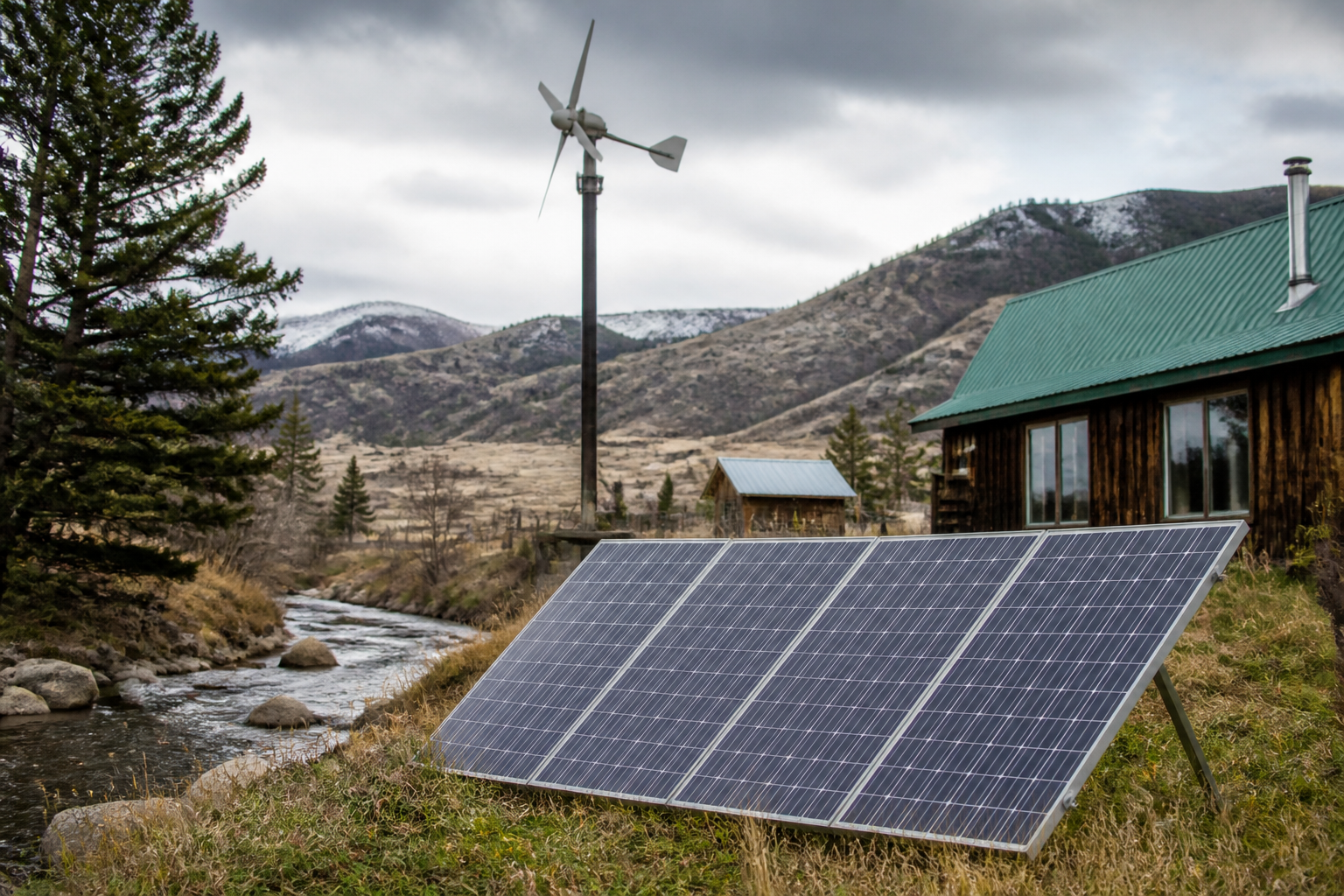
A small wind turbine rated between 400 watts and 2 kilowatts can power lights, a chest freezer, phone charging, and basic communications in a well-sited location. The American Wind Energy Association and the Department of Energy both identify a minimum average wind speed of 10 mph (4.5 m/s) at hub height as a rough threshold for small residential turbines to produce useful output.
Cost for a legitimate small turbine system — turbine, tower, charge controller, and battery bank — runs from roughly $3,000 to $8,000 installed for a DIY-capable homeowner. That is real money, but it is substantially less than a full solar array, and wind generates at night and in overcast weather that kills solar output.
The catch: wind is highly site-specific and often unpredictable at the micro level. A ridge that looks exposed may have turbulent air that stresses a turbine mechanically. Permitting for towers above 35 feet is required in most jurisdictions. And most rural counties have setback requirements that make tower placement non-trivial on smaller lots. Do a proper wind resource assessment — the DOE's Wind Exchange tool is a free starting point — before spending a dollar on hardware.
Option 2: Micro-Hydro Power
Micro-hydro is the most underrated off-grid power source for households with a year-round water source and adequate head (elevation drop). A system using as little as 2 gallons per minute with a 50-foot head can generate 100 watts continuously — that is 2.4 kilowatt-hours per day, running 24 hours, from a very small stream.
Unlike wind and solar, micro-hydro output is nearly constant and highly predictable once installed. It does not require a battery bank in most configurations because the generation is continuous. The DOE's Office of Energy Efficiency identifies micro-hydro as one of the lowest-cost-per-kilowatt-hour generation sources available to rural properties with suitable sites.
The hard constraint is obvious: you need flowing water with measurable head and flow rate on or immediately adjacent to your property. Water rights law varies dramatically by state — in many western states you must hold a water right to divert any stream flow, even on your own land. NRCS (Natural Resources Conservation Service) field offices can help you assess whether a site qualifies. If you have the resource, though, micro-hydro is worth serious investigation before any other option.
Options 3 and 4: Propane Generators and Biogas Digesters
A propane standby generator is the fastest path to reliable backup power for most households — but it is a fuel-dependent system, not true energy independence. A properly sized dual-fuel or propane generator running off a buried 500-gallon tank can cover essential loads for weeks during a grid outage. FEMA's ready.gov guidance specifically lists propane generators as a viable long-duration backup for households that cannot install fixed renewable systems.
The realistic cost is $800 to $4,000 for the generator itself, plus $500 to $1,500 for a buried tank and fill. Propane prices fluctuate and supply chains can be disrupted in regional emergencies — the same events that knock out the grid. This is a resilience tool, not an independence tool, and it should be understood that way.
Biogas digesters occupy the opposite end of the spectrum: genuinely renewable, fuel-independent, and practical only for homesteaders with consistent organic waste inputs — livestock manure, food scraps at scale, or dedicated energy crops. A small-scale digester can produce enough methane to fuel a cookstove or a modified small engine. The USDA's AgStar program documents dozens of farm-scale installations. For a suburban or small-lot household, the feedstock volume simply is not there to make digester output meaningful. For a working homestead with animals, it deserves a hard look.
Neither of these options replaces a renewable generation system for true off-grid living. They are most valuable as part of a layered approach: renewable primary generation backed up by a fuel-based system for extended low-output periods.
Option 5: Alternative Low-Power Generation Concepts and DIY Guides
Beyond the four mainstream options above, there is a category of alternative energy generation concepts that circulate primarily in DIY and preparedness communities — designs that claim to produce usable power from configurations that do not fit neatly into conventional renewable categories. These range from documented low-power thermoelectric setups to more speculative electromagnetic concepts.
It is worth being direct about what this category is and is not. Some of these concepts are grounded in real physics at a small scale and have legitimate hobbyist applications. Others make efficiency or output claims that have not been independently validated by engineers or researchers. The honest position is that a DIY guide presenting an 'alternative home energy generation concept' is exactly that — a guide to building and testing a concept yourself, with your own hands and materials, not a guaranteed utility replacement.
For a household that wants to experiment, learn, and potentially develop a supplemental low-power source for things like device charging or small LED lighting loads, a low-cost digital guide can be a legitimate starting point — provided you go in with realistic expectations and treat it as a learning project rather than a plug-and-play solution. The value in these guides, when they are well-structured, is in the schematic clarity, parts sourcing, and step-by-step build sequence — not in any validated output guarantee.
If you pursue this path, document your build, test output honestly with a cheap multimeter, and compare results to what the guide claims. That is good practice for any DIY energy project, conventional or otherwise.
Our Recommendation: The Ultimate Energizer Guide
The core problem this article addresses is real: most households that want to reduce or escape grid dependence hit a wall because the mainstream options — solar, wind, standby generators — either cost too much upfront, require site conditions they do not have, or simply trade one dependency (the utility) for another (the fuel truck).
The gap in the DIY space is that credible, step-by-step build guidance for alternative generation concepts is scattered, poorly documented, and often buried in forum threads that assume existing electrical knowledge. Most free resources give you the concept without the schematic. Most commercial installers will not touch a non-standard build. The result is that a lot of households with genuine interest and basic hands-on skills never actually start a project.
The Ultimate Energizer Guide is a $49 digital guide presenting a DIY alternative home energy generation concept with step-by-step build instructions. The publisher's own sales page notes that the concept 'was not technically assessed,' so this should be treated as an unverified DIY concept to build and test yourself — not a validated utility replacement. That is the honest framing, and it is also the right frame for any experimental build project. If you go in as a curious, hands-on learner willing to evaluate your own results, a structured guide at this price is a low-risk way to start. It comes with a 60-day money-back guarantee, so if the material does not deliver enough to be worth your time, you are not out the money.
Our recommendation
The Ultimate Energizer Guide
Check availability →This article contains an affiliate link. If you buy through it, we may earn a commission at no extra cost to you.
Frequently asked questions
What is the cheapest way to generate electricity off-grid without solar panels?
For most households, a propane or dual-fuel generator with a stored fuel supply is the lowest upfront cost path to off-grid power — typically $800 to $4,000 for the generator. Micro-hydro is cheaper per kilowatt-hour over time if you have a suitable water source, but requires more site-specific investment. DIY guide-based alternative concepts cost the least to start (often under $50 for the guide plus low-cost parts), but output is unverified and results vary.
Can you generate electricity at home without solar or wind?
Yes. Micro-hydro, propane generators, biogas digesters, and various small-scale thermoelectric or alternative DIY builds can all generate electricity without solar panels or a conventional wind turbine. Each has real site, cost, or skill requirements. None of the non-generator options are plug-and-play, and output claims for unvalidated DIY concepts should be tested and verified personally before relying on them.
How much wind speed do you need for a small home wind turbine?
The U.S. Department of Energy identifies an average wind speed of at least 10 mph (4.5 m/s) at hub height as a general minimum threshold for a small residential turbine to produce useful power. Below that, most small turbines produce too little output to justify the installation cost. Use the DOE's Wind Exchange mapping tool to assess your site before purchasing hardware.
Is micro-hydro power practical for a homestead?
Micro-hydro is practical if you have a year-round flowing stream or spring with measurable head (vertical drop) and adequate flow rate on or adjacent to your property. Even modest flow — around 2 gallons per minute with 50 feet of head — can produce continuous usable power. The main barriers are site availability, water rights law (which varies by state), and permitting for the diversion structure.
Are DIY alternative energy guides worth buying?
A DIY energy guide is worth buying if you approach it as a learning and build project rather than a guaranteed power solution. Guides that present unverified alternative concepts should be evaluated against your own tested results. At $49 or less with a money-back guarantee, the financial risk is low — the real investment is your time. The value is in structured build instructions and parts guidance, not in any output claim the concept has not independently validated.
Related guides
Sources
- U.S. Department of Energy — Small Wind Electric Systems
- U.S. Department of Energy — Microhydropower Systems
- USDA AgStar — Biogas Basics
- Ready.gov — Power Outages (Generators and Backup Power)
General preparedness information, not medical or legal advice. Follow instructions from your local emergency authority during an active event.
Field notes by email
Get the next guide before you need it
One email when a new field guide drops — water, food, power, medicine. No spam, no daily noise, unsubscribe in one click.
Comments on this guide
Questions, corrections and field reports from your own setup are welcome.
No comments yet. Be the first to add a field report.