
Power
How to Reduce Home Electricity Dependence Without a Full Solar Install: A Practical DIY Plan

By Ephraim Rusk · · 10 min read
This article contains an affiliate link. If you buy through it, we may earn a commission at no extra cost to you.
Quick answer
You can meaningfully reduce home electricity dependence without a full solar install by combining load reduction, battery backup for critical circuits, and small-scale generation — all as DIY projects that cost far less than a professional solar system.
Reducing home electricity dependence without a full solar install is achievable for most households, and it starts with understanding that grid independence is a spectrum — not an all-or-nothing switch. Most people searching this topic are not looking to go fully off-grid next Tuesday. They want to stop being helpless when the power goes out for three days, cut a utility bill that keeps climbing, and have some control over what happens in their own home.
A professional grid-tied solar installation is a legitimate long-term investment, but the median installed cost in the United States runs between $15,000 and $30,000 before incentives, and the permitting and installation process can take months. For a household that wants resilience now, that timeline and price point are simply not realistic.
The good news is that the most impactful steps toward grid independence are not the ones that require a rooftop full of panels. They are the unglamorous, practical decisions about what loads you run, when you run them, and how you store and generate small amounts of power for the moments that actually matter. This article walks through each layer of that strategy.
Why Grid Dependence Is a Real Preparedness Problem
The average U.S. customer experienced about 5.5 hours of power interruption in 2022, according to the U.S. Energy Information Administration — and that figure excludes major events. When major weather events are included, outages in affected regions routinely stretch to days or weeks. Dependence on the grid is not just a financial issue; it is a safety issue tied to refrigerated medications, medical equipment, heat in winter, and communication.
FEMA's guidance consistently recommends households be prepared to be self-sufficient for at least 72 hours, and increasingly for up to two weeks in disaster-prone areas. Very few households are actually positioned to meet that standard when it comes to power. Food spoilage begins in a refrigerator within four hours of a power loss. Sump pumps, well pumps, and CPAP machines stop working. Heat and cooling systems fail.
The practical question is not whether grid dependence is a problem — it clearly is — but which interventions give you the most resilience per dollar and per hour of effort. That is what this article is built around.
Step One: Cut Your Load Before You Add Any Generation
The single most cost-effective step toward grid independence is reducing what you actually need to power — because every watt you eliminate is a watt you never have to generate or store. This is load reduction, and it compounds: a smaller load means smaller (cheaper) backup systems.
Start with your highest-consumption appliances. In a typical U.S. home, space heating and cooling account for roughly 43% of energy use, water heating for about 18%, and large appliances for another 13%, according to the U.S. Energy Information Administration's Residential Energy Consumption Survey. Addressing even one of these categories creates meaningful slack.
Practical load reduction steps include: switching to LED lighting throughout the home (a 60-watt incandescent replaced with a 9-watt LED saves over 75% on that circuit), installing a programmable or smart thermostat to reduce HVAC runtime, using a tankless or heat-pump water heater, eliminating phantom loads with switched power strips, and identifying which appliances are genuinely critical versus merely convenient. That last distinction matters most in a backup power context — you are not trying to run everything, you are trying to run the right things.
Before you spend a dollar on batteries or panels, do a load audit. Walk through your home with a plug-in energy monitor (they run about $25–$50) and record the actual wattage of every device you would want to power during an outage. Most people are surprised to find their true critical load is well under 1,000 watts — a number that changes every calculation about what backup capacity you actually need.
- Replace incandescent bulbs with LEDs throughout the home
- Install a programmable thermostat to reduce HVAC runtime
- Use a plug-in energy monitor to find phantom loads
- Identify your true critical load (medical, refrigeration, communication)
- Switch high-draw appliances to propane or manual alternatives where practical
Step Two: Build a Battery Backup for Critical Circuits
A battery backup system covers your critical loads — refrigerator, lights, phone charging, medical devices — for hours to days without any generation source at all. It is the most immediately useful layer of grid independence and can be built incrementally.
The simplest entry point is a portable power station: a lithium battery with a built-in inverter, USB ports, and AC outlets. Units in the 500–1,000 watt-hour range cost between $400 and $800 and can run a full-size refrigerator for 8–15 hours depending on the model and cycle frequency. They charge from a wall outlet during normal grid operation and can later be paired with a small solar panel to extend runtime.
A step up from a portable station is a dedicated whole-house or partial-house battery backup wired through a transfer switch. This approach requires more upfront investment and, in most jurisdictions, a licensed electrician for the transfer switch installation — but it allows you to back up a specific set of circuits (the refrigerator, a few lights, the router, and perhaps a well pump) without any manual intervention during an outage.
Lithium iron phosphate (LiFePO4) chemistry is the current standard for DIY home battery builds: it offers a longer cycle life (typically 2,000–4,000 full cycles), better thermal stability, and safer discharge behavior than older lead-acid or lithium cobalt oxide chemistries. If you are building your own battery bank, this is the chemistry to work with.
Key sizing rule: multiply your critical load in watts by the number of hours you want coverage, then divide by 0.85 to account for inverter efficiency losses. A 400-watt critical load for 24 hours requires roughly 11.3 kilowatt-hours of usable battery capacity. That is a real number that tells you exactly what you are shopping for.
Step Three: Add Small-Scale Generation to Extend Your Window
Small-scale generation extends how long your backup power lasts — turning a 24-hour buffer into a multi-day or indefinite capability. The most practical options for a DIY household are portable solar panels, a propane or dual-fuel generator, and micro-wind in appropriate locations.
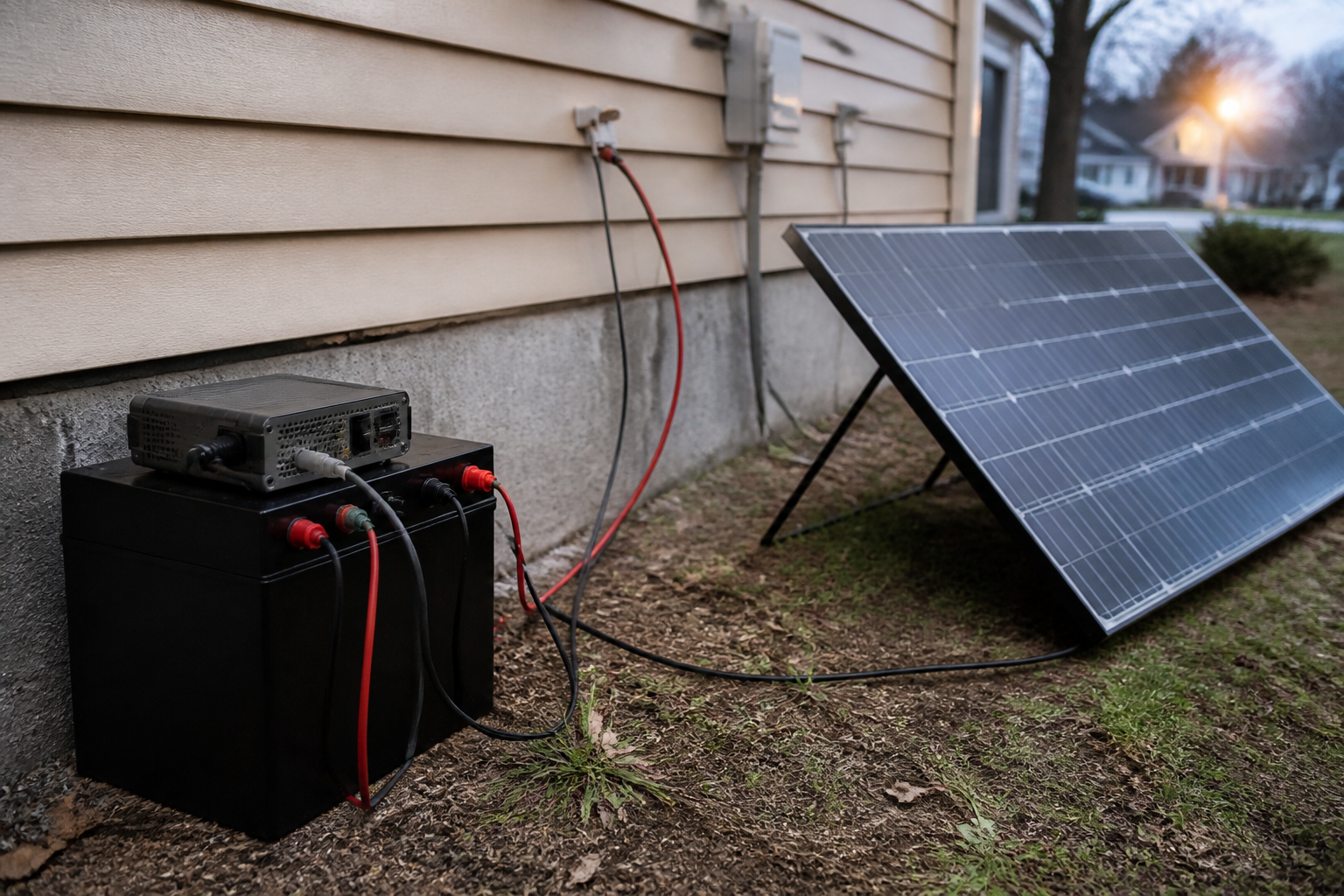
Portable solar panels in the 100–400 watt range (foldable or rigid) can be connected directly to a portable power station or a dedicated charge controller and battery bank. They require no permits in most areas, no permanent mounting, and can be repositioned to track sunlight. A 200-watt panel in average U.S. sunlight conditions will produce roughly 800–1,000 watt-hours per day — enough to keep a modest battery bank topped off through a multi-day outage if your critical load is managed.
A propane generator is a legitimate complement to a battery system for high-draw tasks: running a well pump, charging a large battery bank quickly, or powering a window AC unit during a summer emergency. The advantage of propane over gasoline is indefinite shelf life — stored propane does not degrade the way gasoline does after 3–6 months. Size your generator to your surge load (the startup wattage of your largest motor), not your continuous load.
Micro-wind turbines are worth considering only in genuinely windy locations with consistent wind speeds above 10 mph. The economics and permitting complexity make them a niche option, but in the right geography they produce power at night and in overcast conditions when solar panels cannot — a meaningful complement to a solar-battery system.
The key principle across all generation options: match the source to the use case. Solar is quiet, low-maintenance, and ideal for sustained low-level charging. A generator is loud, fuel-dependent, and ideal for short high-power tasks. Using each for what it does best minimizes cost and complexity.
- Portable solar panels (100–400W): no permits, repositionable, pairs with any battery
- Propane generator: indefinite fuel shelf life, best for surge loads and fast recharging
- Dual-fuel generator: flexibility between gasoline and propane
- Micro-wind turbine: night and overcast generation, only viable in consistently windy areas
- Hand-crank or pedal generators: very low output, useful only for small devices
Our Recommendation: Easy DIY Power Plan
The core problem this article describes is straightforward: grid dependence leaves your household exposed to outages that FEMA's own guidance says you should be able to weather for at least 72 hours — and most households cannot. The gap between knowing that and knowing exactly what to do about it is where most people get stuck.
The honest limitation of the DIY path is that the information is scattered. Load audits, battery sizing formulas, transfer switch configurations, propane storage guidelines — all of it is findable, but assembling it into a coherent, sequenced plan takes real time and requires you to evaluate a lot of conflicting advice. Most people either over-invest in equipment they do not need yet or stall out entirely because the decision tree feels too complex.
The Easy DIY Power Plan is built for exactly that gap: it is a simplified, non-technical home backup energy plan designed for people who want to reduce grid dependence through their own hands-on work, without the complexity and cost of a professional solar installation. If you have worked through the concepts in this article and want a structured step-by-step plan to execute them at home, it is a practical place to start. For the next step, read How to Protect Your Home from EMP and Blackout Without High-Tech Gear: A Practical Room-by-Room Plan.
Our recommendation
Easy DIY Power Plan
Check availability →This article contains an affiliate link. If you buy through it, we may earn a commission at no extra cost to you.
Frequently asked questions
How long can I run my refrigerator on a battery backup?
A modern full-size refrigerator draws about 100–200 watts while running but cycles on and off, averaging 1–2 kWh per day. A 1,000 Wh portable power station will typically run a refrigerator for 8–15 hours depending on how often the compressor cycles and ambient temperature. A dedicated 5–10 kWh battery system can cover 2–5 days of refrigeration.
Do I need a permit to install a battery backup system at home?
Requirements vary by jurisdiction. A portable power station requires no permit. A permanently wired battery system connected to your home circuits typically requires a permit and, in most areas, a licensed electrician for the transfer switch. Check with your local building department before any permanent installation.
What is the cheapest way to have backup power at home?
The cheapest effective approach combines load reduction (eliminating unnecessary consumption) with a modestly sized portable power station charged from the grid during normal operation. A 500–1,000 Wh unit costing $400–$700 covers most critical loads — phone charging, lighting, and partial refrigeration — through a 24–48 hour outage at the lowest entry cost.
How much solar do I need to run my house without the grid?
The answer depends entirely on your load. The average U.S. home uses about 29 kWh per day, which would require a very large and expensive solar-plus-battery system. If you reduce your critical load to 3–5 kWh per day — covering refrigeration, lighting, and communication — a 1–2 kW solar array with 10–15 kWh of battery storage becomes a realistic DIY target.
Is propane or gasoline better for emergency generator fuel?
Propane stores indefinitely without degradation, making it significantly better for preparedness purposes. Gasoline degrades in 3–6 months even with stabilizer, requires more careful storage, and is harder to obtain after a major regional disaster. The tradeoff is that propane generators typically produce slightly less power per unit of fuel than comparable gasoline models.
Related guides
Sources
- U.S. EIA — Average Retail Price and Reliability Data (2022 Electric Power Annual)
- U.S. EIA — Residential Energy Consumption Survey: End Uses
- FEMA — Emergency Supply List and 72-Hour Preparedness Guidance
- U.S. DOE — Guide to Home Energy Storage
General preparedness information, not medical or legal advice. Follow instructions from your local emergency authority during an active event.
Field notes by email
Get the next guide before you need it
One email when a new field guide drops — water, food, power, medicine. No spam, no daily noise, unsubscribe in one click.
Comments on this guide
Questions, corrections and field reports from your own setup are welcome.
No comments yet. Be the first to add a field report.