
Skills
How to Make a 72-Hour Emergency Plan for Your Family (Step-by-Step)

By Ephraim Rusk · · 10 min read
This article contains an affiliate link. If you buy through it, we may earn a commission at no extra cost to you.
Quick answer
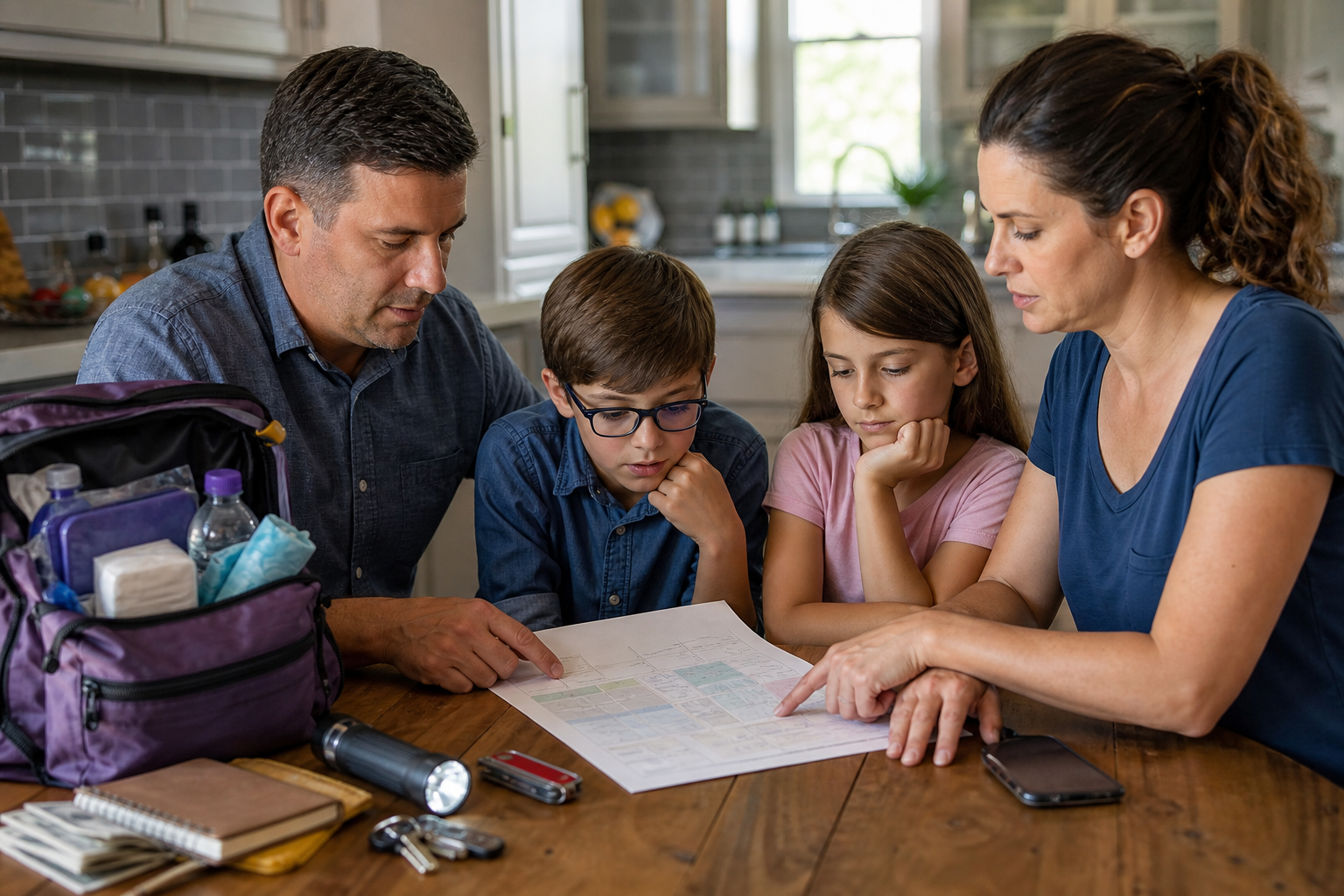
A 72-hour family emergency plan covers four things: a written communication tree, a meeting point inside and outside your neighborhood, a go-bag per person, and a documented home-safety checklist. You can build all four in a single afternoon using free templates from Ready.gov.
Searching 'how to make a 72-hour emergency plan' is the right instinct — because most preparedness advice stops at gear lists and never gets to the part where your family actually knows what to do. A bag full of supplies sitting in a closet is not a plan; it is a starting point.
FEMA data consistently shows that households with a written, practiced plan recover faster from disasters than those without one — regardless of how much gear they own. The plan is the multiplier. Knowing who calls whom, where everyone meets, and what each person is responsible for eliminates the confusion that costs real time in the first hour of an emergency.
This guide walks through every layer of a solid 72-hour family emergency plan — communication, evacuation routes, roles, medical prep, and a home-security check — in a logical build order you can complete in one afternoon. No scaremongering, no gear-brand overload. Just the structure that works.
Why 72 Hours Is the Right Planning Window
The 72-hour window reflects a real logistical reality: local emergency services are typically overwhelmed in the first one to three days after a major disaster. FEMA and Ready.gov both recommend households plan to be self-sufficient for at least 72 hours — some guidance now extends that to two weeks for certain hazards, but 72 hours is the floor that protects you from the most common scenarios.
Fires, earthquakes, severe storms, and extended power outages all share the same early pattern: infrastructure is disrupted, roads may be impassable, and first responders are triaging larger emergencies. Your plan does not need to cover every possible scenario. It needs to cover the first 72 hours of any scenario — shelter, water, communication, and medical — well enough that your family can function without outside help.
Think of 72 hours as your minimum viable plan. Once you have it built, extending it to a week or two weeks is mostly a matter of adding supplies, not rebuilding the whole structure.
Step 1 — Build Your Family Communication Tree
A communication tree tells every family member exactly who to contact, in what order, if normal contact fails — and it should be written on paper, not just stored in a phone that may be dead or lost.
Start with an out-of-area contact: someone in another city or state who everyone can call or text to check in with. Local phone lines often get jammed during a regional disaster, but calls to out-of-area numbers frequently go through when local ones cannot. Every family member, including children, should have this number memorized or written on a card in their bag.
Your tree should also document each person's school, workplace, and typical daily route, plus two meeting points: one close to home (a neighbor's driveway, a specific street corner) for scenarios where you can stay nearby, and one farther away (a library, a community center, a relative's address) for scenarios requiring evacuation. Write it all down. Laminate a copy for each person's go-bag.
The Red Cross recommends practicing the communication plan at least once a year — a five-minute drill where everyone checks in using the out-of-area contact is enough to expose gaps.
- Out-of-area contact: name, phone, and a backup number
- Each person's daytime location on a typical weekday
- Primary meeting point: within walking distance of home
- Secondary meeting point: reachable without passing through your neighborhood
- Text first, call second — texts move through congested networks more reliably
Step 2 — Map Your Evacuation Routes and Shelter-in-Place Rules
Every household needs at least two routes out of the neighborhood and a clear rule for when to leave versus when to stay.
Shelter-in-place is often the right call for events like chemical spills, active shooter situations nearby, or severe weather — situations where moving through the open increases risk. Evacuation is appropriate for wildfire, flooding in a flood zone, gas leaks, or when local authorities issue an order. The decision rule should be written into your plan so no one wastes time debating it under stress.
For evacuation routes, drive both routes with your family before you need them. Note where bridges are (bridges close in floods), where railroad crossings are (trains block roads), and where your local emergency shelters are located — your county emergency management website will list these. Mark the routes on a physical paper map stored in your go-bag; GPS and phone maps require data connections that may not be available.
Also document your home's utility shutoffs: gas main, water main, and electrical panel. Every adult in the household should be able to locate and operate all three without instruction.
Step 3 — Assign Roles and Account for Every Household Member
A plan without assigned roles defaults to everyone doing the same thing and nobody doing the critical things — assigning roles before an emergency eliminates that failure mode.
In a two-adult household, one person typically manages communications and documents (grabbing go-bags, ID packets, insurance papers) while the other manages physical tasks (shutting off utilities, accounting for children or pets, loading the vehicle). In a single-adult household, walk through the sequence in advance and identify which steps can be done by an older child.
Children should have a specific, age-appropriate job. Even a seven-year-old can be responsible for grabbing their own pre-packed bag and knowing the meeting point. Giving children a role reduces panic and keeps them focused.
Account for anyone with medical needs, mobility limitations, or communication challenges. If a household member requires refrigerated medication, that goes on the plan — what is the backup, how long can they go without it, and what is the nearest facility that can help? If a family member is hearing-impaired, how do your shelter-in-place alert systems account for that? These are the details that generic gear lists miss entirely.
- Person A: communications lead — call out-of-area contact, grab documents and go-bags
- Person B: logistics lead — utility shutoffs, vehicle, account for children and pets
- Children: grab their own bag, move to primary meeting point
- Medical needs: document backup plan for any prescription or device
- Pets: carrier location, vaccination records, pet food allocation in go-bag
Our Recommendation: Survival Manual
The gap this article addresses is real: knowing you need a plan and actually having one written, organized, and practiced are two different things — and the second one takes structured guidance most households never sit down to build.
The free templates and checklists from Ready.gov are a solid starting point, but they leave the actual work of sequencing, prioritizing, and filling in household-specific details entirely to you. For a family doing this for the first time, that blank page is where most plans stall. Walking someone through water storage quantities, communication trees, medical prep, and home security one step at a time — in the right order — is a different problem than just supplying a checklist.
The Survival Manual is a $47 digital ebook and Android app (marked down from $197) built around a 90-day emergency preparedness plan. It covers exactly the domains this article touches — water storage, communications, medical prep, and home security — with checklists, video tutorials, and offline access so the plan is available when cell service is not. If it does not work for your household, there is a 60-day money-back guarantee. If you have been meaning to get a real plan in place for your family, this is a concrete next step. For the next step, read Home Food Preservation Without Electricity: 6 Methods That Actually Work.
Our recommendation
Survival Manual
Check availability →This article contains an affiliate link. If you buy through it, we may earn a commission at no extra cost to you.
Frequently asked questions
What should be in a 72-hour emergency kit for a family of four?
Plan for one gallon of water per person per day (12 gallons total), three days of non-perishable food per person, a first-aid kit, copies of important documents, a battery or hand-crank radio, flashlights, extra batteries, medications, and one complete change of clothes per person. Add pet supplies and infant or elder-care items as needed.
How often should you update your family emergency plan?
Review your plan at least once a year and after any major life change — a new address, a new household member, a change in medication, or a child starting a new school. Many families use daylight saving time as a calendar trigger: update the plan and swap out food and water supplies on the same day you change the smoke alarm batteries.
What is an out-of-area contact and why do you need one?
An out-of-area contact is a person who lives in a different region who all family members can check in with during a disaster. Local phone networks often get congested or damaged in regional emergencies, but calls and texts to numbers outside the affected area are more likely to go through. Having one shared contact means separated family members can leave messages through a common relay point.
Should you shelter in place or evacuate during a disaster?
Shelter in place when moving outside increases your risk — chemical spills, nearby violence, or severe weather are examples. Evacuate when staying is the greater danger — wildfire, flash flooding, or a mandatory evacuation order from local authorities. Write the decision rule into your plan before an emergency so the choice is made calmly in advance, not under stress.
How do you make an emergency plan for a family with young children?
Give each child an age-appropriate role and make sure they know the out-of-area contact number and the primary meeting point. Pre-pack a child-sized go-bag they can carry themselves. Practice the plan as a low-stress drill once a year. For infants, document formula or feeding needs, extra diapers, and any medical items in the plan itself.
Related guides
Sources
- Ready.gov — Make a Plan
- FEMA — Emergency Supply List
- CDC — Emergency Preparedness and You
- American Red Cross — Make a Family Emergency Plan
General preparedness information, not medical or legal advice. Follow instructions from your local emergency authority during an active event.
Field notes by email
Get the next guide before you need it
One email when a new field guide drops — water, food, power, medicine. No spam, no daily noise, unsubscribe in one click.
Comments on this guide
Questions, corrections and field reports from your own setup are welcome.
No comments yet. Be the first to add a field report.