
Skills
How to Preserve Food Without Refrigeration: 7 Methods That Actually Work

By Ephraim Rusk · · 10 min read
This article contains an affiliate link. If you buy through it, we may earn a commission at no extra cost to you.
Quick answer
You can preserve food without refrigeration using canning, salt curing, dehydrating, fermentation, root cellaring, smoking, or fat-packing (confit). Each method uses a different mechanism — removing water, raising acidity, or blocking oxygen — and most require only basic equipment and pantry staples to start.
How to preserve food without refrigeration is one of the most searched homesteading questions on the internet right now — and it is not just off-gridders asking it. Working families worried about extended power outages, rising grocery prices, and supply chain gaps are all looking for the same thing: practical, low-tech ways to build a food supply that does not depend on a running freezer.
The average American household loses $300 to $500 worth of food per major power outage, according to USDA estimates. A single week without grid power can wipe out months of grocery spending. The fix is not buying a bigger generator — it is learning the preservation methods humans relied on for thousands of years before electricity existed.
These seven methods are real, proven, and scalable. You do not need a farmstead or a professional kitchen. You need a few hours, the right information, and a willingness to practice before you actually need the skill.
Why Refrigeration Is a Single Point of Failure
Refrigeration is reliable right up until it is not — and when it fails, it fails completely and fast. A full refrigerator stays safe for about 4 hours without power; a full freezer holds temperature for 24 to 48 hours if left unopened, according to the USDA Food Safety and Inspection Service. After that, perishables enter the danger zone (40°F to 140°F) where bacterial growth accelerates rapidly.
This is not a rare edge case. The U.S. Energy Information Administration reports that the average American customer experienced roughly eight hours of power interruptions in 2023 — and major weather events routinely push that to days or weeks in affected regions. Wildfires, ice storms, hurricanes, and aging infrastructure all create multi-day outage scenarios that a refrigerator simply cannot survive.
The households that handle these events without food loss share one trait: they already know at least one or two preservation methods and have the supplies to use them. That is the skill gap this article addresses.
Method 1 and 2: Canning and Lacto-Fermentation (The Acid Approach)
Both canning and fermentation preserve food by making the environment too acidic for harmful bacteria to survive — they just achieve that acidity by different routes.
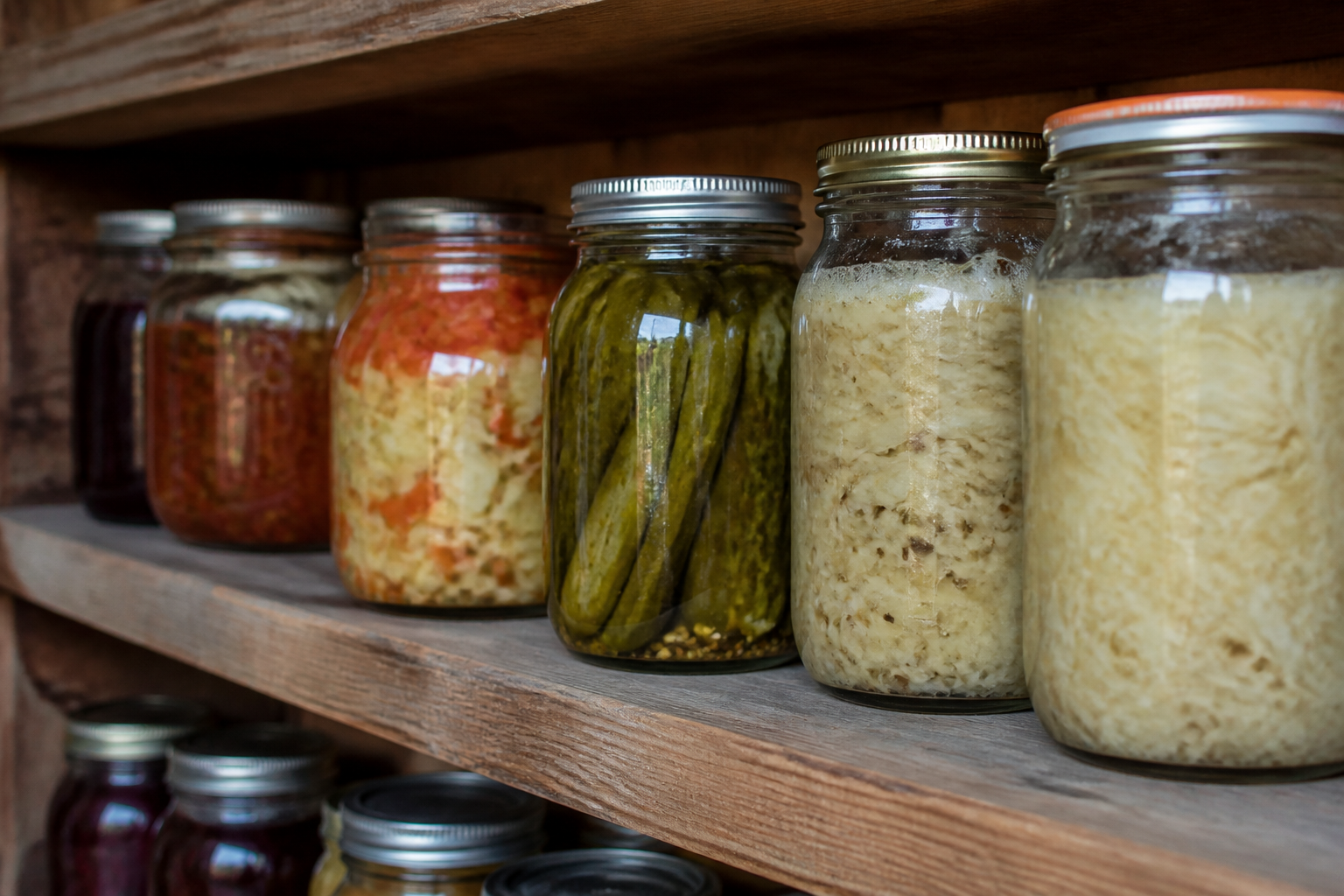
Water bath canning works for high-acid foods: tomatoes, fruits, jams, pickles, and most condiments. You heat jars to 212°F, which kills pathogens and drives air out, then a vacuum seal forms as jars cool. Shelf life is 1 to 5 years for properly processed jars stored in a cool, dark place. Pressure canning extends this to low-acid foods — meats, beans, and most vegetables — by reaching 240°F, hot enough to destroy Clostridium botulinum spores. The USDA National Center for Home Food Preservation publishes free, tested recipes for both methods.
Lacto-fermentation is simpler and requires no heat source. You submerge vegetables in a salt brine (typically 2% salt by weight), and naturally occurring Lactobacillus bacteria produce lactic acid that preserves the food and creates live cultures beneficial to gut health. Sauerkraut, kimchi, and traditional dill pickles are all lacto-fermented. A jar of shredded cabbage and salt can be shelf-stable for months at cool room temperature. The learning curve is low — most beginners have an edible result within a week.
Method 3 and 4: Salt Curing and Smoking (The Moisture Approach)
Bacteria need water to survive, so removing or binding water is one of the oldest and most reliable preservation strategies humans have.
Salt curing draws moisture out of meat through osmosis and simultaneously makes the remaining water chemically unavailable to microorganisms. A dry-cured salt pork or salt fish, done correctly, can last weeks at room temperature and months in cool storage. The ratio matters: USDA guidelines specify minimum salt concentrations to achieve preservation, and curing blends that include sodium nitrite (like Prague Powder) are used for longer-cure products to inhibit botulism. This is an area where following a tested recipe is non-negotiable — do not improvise ratios.
Smoking adds a second layer of preservation: the smoke creates antimicrobial compounds on the meat's surface (phenols, aldehydes, and organic acids), and the heat from smoking further reduces moisture content. Hot smoking cooks and partially dries simultaneously; cold smoking is primarily about flavor and surface protection and must be combined with curing for safety. Traditionally smoked meats were a staple protein source for entire winters before refrigeration existed. A simple barrel smoker or even a DIY smoke setup can make this accessible for a family homestead.
Method 5, 6, and 7: Dehydrating, Root Cellaring, and Fat-Packing
Dehydrating removes enough moisture (typically below 10% water content) that microbial growth stalls. A food dehydrator or a standard oven on its lowest setting works for fruits, vegetables, jerky, and herbs. Properly dehydrated food stored in airtight, oxygen-reduced containers (using oxygen absorbers) can last 5 to 25 years depending on the food type. The National Center for Home Food Preservation provides tested times and temperatures for each food category.
Root cellaring requires almost no equipment — just a cool (32°F to 40°F), dark, moderately humid space. A basement corner, an in-ground pit, or even a buried trash can can extend the shelf life of root vegetables, cabbages, apples, and squash by months without any processing at all. Temperature and humidity are the only variables you manage. Many varieties of potatoes, carrots, beets, and turnips hold well into spring in proper cold storage.
Fat-packing (confit) is the least-known method on this list but one of the oldest. Cooking meat slowly in its own fat, then sealing it completely submerged under that fat, creates an anaerobic environment that prevents spoilage. Traditional duck confit stored this way lasted months in French farmhouse cellars at cool temperatures. The fat itself must fully cover the meat — any air exposure invites mold. This method pairs naturally with curing: most classic confit recipes salt the meat first, then cook in fat.
The Real Barrier: Skills Take Practice Before You Need Them
Every method above is well-documented in government extension publications and academic resources. The gap is not information — it is integrated, practical knowledge you can actually use under pressure.
Reading a canning guide is not the same as having done three batches and knowing what a proper seal sounds like, what a failed one looks like, and how to adjust your altitude correction. Reading about lacto-fermentation is not the same as having tasted your way through the process and knowing when a jar is ready versus off. These skills compound: a family that practices one method per season builds a robust, real-world skill set within a year.
The common DIY barrier is not cost — most of these methods are cheap. It is the scattered, often contradictory information that makes it hard for a busy household to know where to start, what to do first, and what actually matters for safety versus what is optional. A consolidated, household-level resource that walks through these skills in sequence, with the context of why each step matters, is the thing most families are actually missing.
Our Recommendation: The Lost Frontier Handbook
A power outage that wipes out your refrigerator and freezer is not a theoretical scenario — it is a when, not an if, for most American households. The methods in this article work, but only if you have practiced them before you are standing in front of spoiling groceries.
The gap in free DIY resources is fragmentation: USDA guides cover canning safely, extension service PDFs cover dehydrating, YouTube covers fermentation, and none of it is organized for a busy working family trying to build real skills in the margins of a full week. Stitching that together yourself takes months and still leaves holes.
The Lost Frontier Handbook is designed specifically for that household — not homesteaders with unlimited time, but working families who want consolidated, practical instruction covering food preservation, water filtration, medicinal remedies, off-grid cooking, and more in one place. If you want to move from reading about these skills to actually practicing them, this is a useful place to start. For the next step, read How to Make a 72-Hour Emergency Plan for Your Family (Step-by-Step).
Our recommendation
The Lost Frontier Handbook
Check availability →This article contains an affiliate link. If you buy through it, we may earn a commission at no extra cost to you.
Frequently asked questions
How long can food be preserved without refrigeration?
It depends on the method. Properly canned foods last 1 to 5 years. Dehydrated foods stored with oxygen absorbers can last 5 to 25 years. Salt-cured meats last weeks to months. Fermented vegetables last months at cool room temperature. Root-cellared produce holds for several months depending on the variety.
Is it safe to preserve meat without refrigeration?
Yes, when you follow tested, authoritative recipes exactly. Salt curing, pressure canning, and smoking have documented safety records when done correctly. The critical risks — especially botulism — are well understood and preventable by following USDA-tested ratios and procedures. Improvising recipes or ratios is where things go wrong.
What is the easiest food preservation method to start with?
Lacto-fermentation is the lowest barrier to entry. You need a jar, salt, and vegetables. Sauerkraut is a reliable first project: shred cabbage, mix with 2% salt by weight, pack tightly into a jar, keep vegetables submerged, and let it ferment at room temperature for 1 to 4 weeks. No special equipment required.
Can you preserve food without electricity?
Yes — all seven methods in this article require little to no electricity. Canning needs a heat source (a propane camp stove works). Fermentation, salt curing, root cellaring, and fat-packing need none at all. Smoking needs fire, not grid power. Dehydrating can be done in a solar dehydrator built from a window frame and screen.
What foods cannot be preserved without refrigeration?
Fresh dairy milk, raw eggs, and fresh soft cheeses have no reliable room-temperature preservation method for home use. Hard aged cheeses, powdered milk, and commercially shelf-stable dairy are the practical substitutes. Some foods like fresh lettuce simply do not preserve well by any method and are better replaced with longer-storing alternatives in a preparedness food plan.
Related guides
Sources
- USDA National Center for Home Food Preservation — Complete Canning and Preservation Guides
- USDA Food Safety and Inspection Service — Refrigeration and Food Safety
- U.S. Energy Information Administration — Electric Power Annual: Reliability Data
General preparedness information, not medical or legal advice. Follow instructions from your local emergency authority during an active event.
Field notes by email
Get the next guide before you need it
One email when a new field guide drops — water, food, power, medicine. No spam, no daily noise, unsubscribe in one click.
Comments on this guide
Questions, corrections and field reports from your own setup are welcome.
No comments yet. Be the first to add a field report.