
Skills
How to Preserve Meat Without Refrigeration at Home: 5 Methods That Actually Work

By Ephraim Rusk · · 11 min read
This article contains an affiliate link. If you buy through it, we may earn a commission at no extra cost to you.
Quick answer
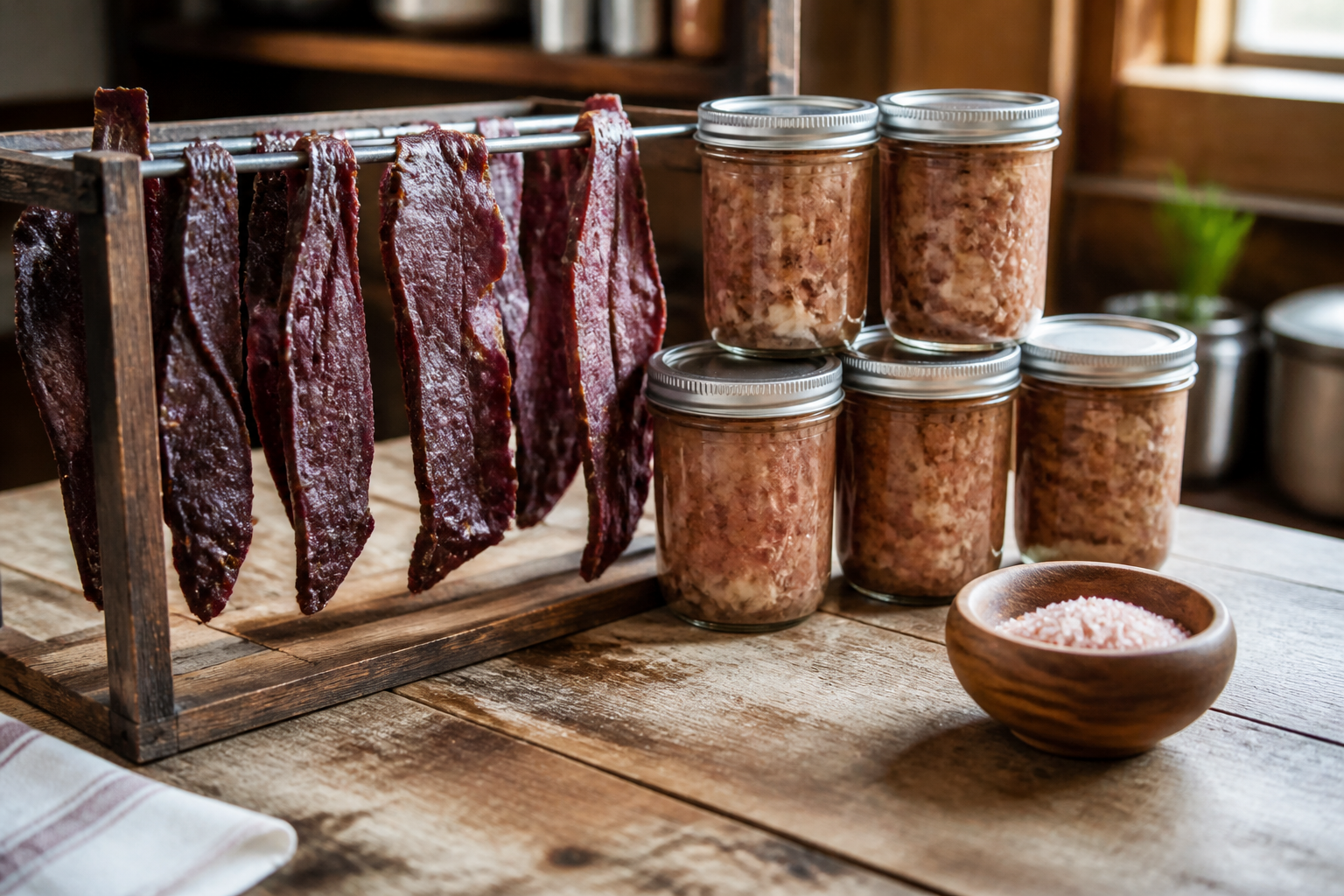
Meat can be safely preserved without refrigeration using salt curing, smoking, pressure canning, dehydrating, or fat packing (confit). Each method works by removing moisture, limiting oxygen, or raising salt concentration enough to prevent bacterial growth — and all five can be done at home with basic equipment.
How to preserve meat without refrigeration is one of those skills most households treat as optional — right up until a prolonged outage, a move off-grid, or a sudden supply disruption makes it urgent. At that point, the gap between knowing the theory and having actually done it becomes very real, very fast.
Americans collectively lost an estimated $15 billion worth of food during power outages in a single year, according to data cited by the USDA — and meat is the first casualty. A chest freezer full of protein can be unsalvageable in as little as 48 hours without power. If you have no practiced fallback, that loss isn't just financial; it's a serious blow to your family's food security at exactly the moment food security matters most.
The five methods covered here — salt curing, smoking, pressure canning, dehydrating, and fat packing — are not historical curiosities. They are the same techniques working homesteaders and off-grid families use right now to store months' worth of protein without a single kilowatt of electricity. Each section below explains how the method works, what food-safety principles underpin it, and what you need to get started at home.
Why Meat Spoils So Fast (and What You're Actually Stopping)
Meat spoils quickly because it provides an ideal environment for bacterial growth: high moisture content, moderate pH, and abundant nutrients. The primary threats are pathogenic bacteria — Salmonella, Listeria, Clostridium botulinum, and Staphylococcus aureus — along with molds and naturally occurring enzymes that break down tissue even in the absence of bacteria.
Every preservation method you'll read about below works by attacking one or more of those conditions. Salt draws out moisture and raises the osmotic pressure to a level most bacteria cannot survive. Heat (smoking, canning) kills bacteria outright and, when combined with a sealed environment, prevents recontamination. Dehydration reduces water activity — the measure of available water — below the threshold at which bacteria can reproduce. Fat sealing physically blocks oxygen, which many spoilage organisms require.
Understanding the mechanism matters because it tells you when a method is working and when it's not. Meat that smells off, shows mold you didn't intentionally introduce, or has an unusual texture after processing has likely failed at one of these control points. The USDA and the National Center for Home Food Preservation provide specific water activity and pH benchmarks for safe preservation; references are listed in the sources section below.
Salt Curing: The Oldest Method and Still One of the Most Reliable
Salt curing works by drawing moisture out of meat and creating a high-salinity environment that most spoilage and pathogenic bacteria cannot survive in — it is the foundation of bacon, ham, salt pork, and dozens of traditional preserved meats worldwide.
There are two main approaches: dry curing and brine curing (also called wet curing or brining). In dry curing, you pack meat directly in salt — often combined with sugar and, for cured products like bacon or ham, curing salts containing sodium nitrite. The cure is applied by weight (a standard dry cure runs roughly 2.5 percent of the meat's weight in curing salt plus additional table salt) and the meat is held at 36–40°F during the cure period, which can range from a few days for thin cuts to several weeks for a whole ham leg.
Curing salts — sold under brand names like Prague Powder or Instacure — contain sodium nitrite, which serves a specific and critical function: inhibiting Clostridium botulinum, the bacterium responsible for botulism. This is not optional for certain cured meats, particularly those that will be held at room temperature or smoked at low temperatures. The USDA and the National Center for Home Food Preservation publish tested cure ratios; use them. Eyeballing curing salt is genuinely dangerous because both under-dosing (insufficient protection) and over-dosing (nitrite toxicity) carry real risks.
For long-term shelf-stable storage without refrigeration, salt pork — heavily salted pork belly or fatback packed into a crock — is one of the simplest starting points. Properly made, it can last months stored in a cool, dark location. It requires no special equipment beyond a food-grade container and non-iodized salt (iodized salt can interfere with curing chemistry).
Cold Smoking and Hot Smoking: Combining Heat, Smoke Chemistry, and Salt
Smoking preserves meat through a combination of heat, drying, and the antimicrobial compounds in wood smoke — but the method and temperature determine whether you end up with a shelf-stable product or one that still requires refrigeration.
Hot smoking (cooking temperatures of 165°F internal and above) produces fully cooked meat that is safe to eat immediately, but it is not inherently shelf-stable unless the moisture content has been driven down significantly through extended smoking and pre-salting. Think of hot-smoked fish or smoked sausage: they're cooked, but they'll still spoil within days at room temperature without additional preservation steps.
Cold smoking — typically done at temperatures between 68°F and 86°F — does not cook the meat; it slowly dries it and deposits antimicrobial phenols and aldehydes from the smoke. For cold smoking to produce a shelf-stable product, it must be combined with prior salt curing. This is how traditional smoked hams, smoked bacon, and smoked fish like lox are made: cure first, then cold smoke over many hours or even days. Done correctly, the resulting product can be stored without refrigeration for weeks to months depending on the cut and cure.
The safety risk with cold smoking is precisely the temperature range: 68–86°F overlaps with the USDA's 'danger zone' for bacterial growth (40–140°F), so meat that hasn't been adequately cured before cold smoking can support bacterial growth during the smoking process. Never cold smoke uncured meat. For home practitioners starting out, hot smoking cured meat is the safer entry point; cold smoking of whole muscle cuts is an intermediate skill.
Pressure Canning and Dehydrating: Two Practical Methods for Busy Households
Pressure canning is the most accessible shelf-stable meat preservation method for most households because it doesn't require the controlled-environment expertise of curing or smoking — it requires following a tested recipe and operating a pressure canner correctly.
Meat is a low-acid food, which means it must be processed in a pressure canner (not a water-bath canner) at 240°F — a temperature only achievable under pressure — to destroy Clostridium botulinum spores. Water-bath canning meat is not safe; the temperature ceiling of boiling water (212°F at sea level) is insufficient to eliminate botulism risk in low-acid foods. The USDA's Complete Guide to Home Canning provides validated processing times for beef, pork, chicken, venison, and fish in both pints and quarts. Those times are not suggestions; they are the result of tested thermal penetration studies.
Properly pressure-canned meat stored in a cool, dark location will typically maintain quality for 2–5 years. The jars are self-evident about seal failure — a lid that flexes, a broken seal, or any sign of bubbling or off-odor when opened means discard, do not taste. Pressure canning also gives you ready-to-eat meals: canned beef stew, canned chicken broth, or canned pulled pork that requires nothing but a can opener and a fire to serve.
Dehydrating meat — making jerky — is the most accessible starting point for households with no prior preservation experience. The USDA recommends pre-cooking meat to 160°F (165°F for poultry) before or after dehydrating, because dehydrator temperatures alone may not reliably reach the internal temperatures needed to kill pathogens like E. coli O157:H7. The standard approach is to either pre-cook strips in simmering water or marinade, dehydrate, then briefly heat finished jerky in a 275°F oven for 10 minutes. Properly dried jerky — brittle or leathery with no soft spots — stored in airtight packaging in a cool, dark place will keep for 1–2 months at room temperature or up to 6 months if vacuum-sealed.
Fat packing (confit) is the fifth method worth knowing: meat — typically duck, pork, or chicken — is slow-cooked in its own rendered fat until fully cooked, then submerged and sealed under the solidified fat in a crock or jar. The fat physically excludes oxygen and, combined with the heat of cooking, produces a product that historically kept for months in a cool cellar. This method requires consistent cool temperatures (below 50°F) to remain safe over the long term; it is not a room-temperature shelf-stable product in a warm climate.
Our Recommendation: The Lost Frontier Handbook
The core problem this article addresses is real: without practiced, hands-on knowledge of meat preservation, a power outage or off-grid transition can cost a family hundreds of dollars in spoiled protein and leave a critical gap in long-term food security.
The honest limitation of learning these methods piecemeal — from scattered blog posts, YouTube videos, and forum threads — is that the safety-critical details (cure ratios, processing times, temperature thresholds) are easy to miss or misapply when there's no coherent framework pulling them together. Most free resources also assume a level of prior homesteading experience that busy working families don't have, and they rarely address the full picture: preservation is only useful if you can also source, grow, or forage what you're preserving.
The Lost Frontier Handbook is a self-reliance and homesteading skills guide built specifically for working families, not specialists. It covers food preservation alongside medicinal remedies, water filtration, off-grid cooking, and guidance on finding free land in the US — the full stack of skills that make household self-reliance actually functional rather than theoretical. If you're at the point where you want one organized, practical resource that covers these interconnected skills without assuming you're already a homesteader, it's worth a look. For the next step, read How to Build a Family Emergency Communications Plan (Step-by-Step for Real Emergencies).
Our recommendation
The Lost Frontier Handbook
Check availability →This article contains an affiliate link. If you buy through it, we may earn a commission at no extra cost to you.
Frequently asked questions
How long can cured meat last without refrigeration?
It depends heavily on the method and conditions. Properly dry-cured and smoked whole muscle cuts (like a cured ham) can last weeks to months in a cool, dry environment. Pressure-canned meat stored in a cool, dark location typically maintains quality for 2–5 years. Jerky lasts 1–2 months at room temperature in airtight packaging, or up to 6 months vacuum-sealed. Temperature, humidity, and the quality of the initial cure all affect actual shelf life.
Is it safe to smoke meat without curing it first?
Hot smoking (achieving an internal temperature of 165°F or higher) is safe without prior curing because the heat kills pathogens. Cold smoking without prior curing is not safe — the temperature range used in cold smoking falls within the bacterial danger zone, and without salt to inhibit growth, pathogens can multiply during the process. Always cure meat before cold smoking.
Can you can meat without a pressure canner?
No. Meat is a low-acid food that must be processed at 240°F to destroy Clostridium botulinum spores — a temperature only achievable in a pressure canner. Water-bath canning cannot reach this temperature and is not safe for meat. Using a pressure canner and following USDA-tested processing times is the only validated home method for shelf-stable canned meat.
What salt should I use for curing meat at home?
Use non-iodized salt (kosher salt or pure sea salt) for the base cure. Iodized salt can interfere with curing chemistry and produce off-flavors. For products that will be stored at room temperature or cold-smoked, you also need curing salt (Prague Powder No. 1 for short-term cures, No. 2 for long-term dry-cured products) containing sodium nitrite, which inhibits botulism. Use curing salts at USDA-recommended ratios — do not estimate.
What is the easiest meat preservation method for beginners?
Dehydrating (making jerky) is the most accessible starting point — it requires only a food dehydrator or an oven, basic ingredients, and no specialized curing knowledge. Follow USDA guidelines on pre-cooking meat to 160°F before or after dehydrating to ensure pathogen kill. Pressure canning is the next step up for longer shelf life and greater variety, and it's well within reach for anyone willing to follow tested recipes carefully.
Related guides
Sources
- USDA Complete Guide to Home Canning — Principles of Home Canning
- National Center for Home Food Preservation — Drying Meats (Jerky)
- USDA Food Safety and Inspection Service — Smoking Meat and Poultry
- USDA Food Safety and Inspection Service — Danger Zone (40°F–140°F)
General preparedness information, not medical or legal advice. Follow instructions from your local emergency authority during an active event.
Field notes by email
Get the next guide before you need it
One email when a new field guide drops — water, food, power, medicine. No spam, no daily noise, unsubscribe in one click.
Comments on this guide
Questions, corrections and field reports from your own setup are welcome.
No comments yet. Be the first to add a field report.