
Power
EMP Protection for Home Electronics: Faraday Cage vs. Surge Protector (What Actually Works)

By Ephraim Rusk · · 10 min read
This article contains an affiliate link. If you buy through it, we may earn a commission at no extra cost to you.
Quick answer
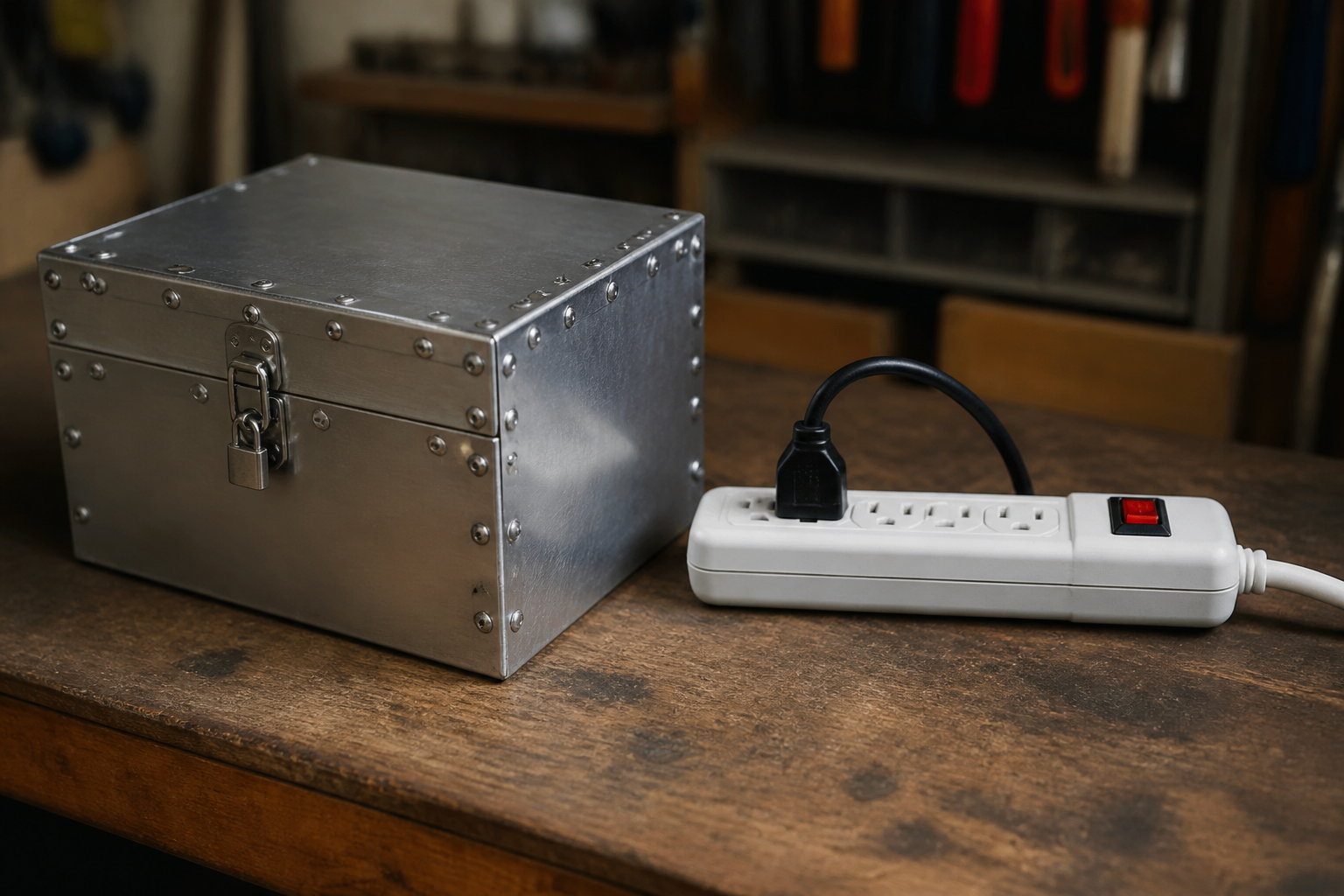
A standard surge protector offers zero protection against an EMP — it is designed for voltage spikes on live grid power, not the radiated electromagnetic pulse that follows a nuclear detonation or solar superstorm. A properly built or purchased Faraday enclosure is the only practical way to shield unplugged electronics from EMP damage.
How to protect home electronics from an EMP is one of the most searched — and most misunderstood — questions in preparedness. The answer matters because the stakes are real: a high-altitude nuclear detonation or a Carrington-scale geomagnetic storm could damage or destroy unshielded electronics across a wide geographic area, and recovery from either event would take months to years according to grid vulnerability assessments by the U.S. Department of Energy.
The confusion usually starts at the hardware store. Surge protectors look protective, they carry ratings in joules, and they are specifically sold to guard against electrical spikes. So it feels reasonable to assume one would help against an EMP. It will not. Understanding why requires separating two completely different physical threats — and once you understand the difference, building a genuinely useful protection plan becomes straightforward.
This article walks through what an EMP actually does to electronics, why surge protectors fail against it, what a Faraday cage does and does not protect, and how a realistic household prep plan accounts for both.
What an EMP Actually Does to Electronics
An electromagnetic pulse damages electronics through rapidly changing electric and magnetic fields that induce voltage spikes inside conductors — including the circuit traces, wiring, and antenna-like leads inside every device you own. The source does not matter much to the physics: a nuclear EMP, a directed-energy weapon, or a severe geomagnetic storm all create the same basic problem — unwanted current injected into circuits that cannot tolerate it.
A nuclear EMP is typically described in three components. The E1 component arrives in nanoseconds and is fast enough to overwhelm most solid-state electronics before any protection circuit can respond. The E2 component resembles a natural lightning surge and lasts up to a second. The E3 component is a slow geomagnetic disturbance similar to what a solar storm produces, and it primarily threatens long conductors like power lines and transformers rather than consumer devices directly.
The practical implication is that devices connected to the grid at the time of an event are doubly vulnerable: the pulse can reach them through the air and through the power lines simultaneously. Devices that are both unplugged and unshielded face only the radiated component — which is still a real threat for sensitive modern electronics, but a survivable one if you have shielding in place.
It is worth being direct about what is confirmed versus uncertain here. Government studies — including the 2008 and 2017 EMP Commission reports — confirm that modern infrastructure and electronics are more vulnerable than older, simpler equipment. Exactly how vulnerable any specific consumer device is to a specific event involves variables that are genuinely difficult to test in civilian conditions. The honest answer is that the risk is real and taken seriously by the Department of Homeland Security, while precise damage predictions for your particular laptop or radio are not available.
Why a Surge Protector Cannot Stop an EMP
A surge protector fails against an EMP for a fundamental design reason: it is built to clamp voltage that arrives through wired connections, not to block radiated electromagnetic energy arriving through the air.
Standard surge protectors use metal oxide varistors — small components that short excess voltage to ground when it exceeds a threshold. That works well for a lightning strike that travels down the power line because the energy arrives at a speed the MOV can intercept. An E1 EMP pulse rises in nanoseconds, which is faster than most MOVs can respond. More importantly, the radiated field component of an EMP couples directly into device circuits without needing a wired path at all — the MOV never sees it.
There is also a physical exposure problem. A surge protector is itself connected to the grid. During a major event, that connection is a liability rather than an asset, because the power lines act as a large receiving antenna and can carry induced currents many times larger than what the protector was rated to handle.
Some manufacturers market devices as 'EMP surge protectors' or give them very high joule ratings. This does not change the physics. Unless a device is specifically tested and certified to military EMP hardening standards — a very different and expensive engineering discipline — joule ratings tell you nothing about EMP performance. No standard home surge protector meets those standards.
How a Faraday Cage Works — and Where It Falls Short
A Faraday cage works by surrounding a device in a conductive enclosure that redistributes electromagnetic energy around the outside, preventing it from reaching the interior. When done correctly, this is proven physics and genuinely effective shielding for radiated EMP components.
The key word is 'correctly.' Several common DIY approaches fail in practice. Gaps in the shielding material — including unshielded seams, openings, or the mesh size of the conductor — determine what frequencies get through. A paint-can Faraday cage with a loose lid may provide partial attenuation but not full protection. For meaningful EMP shielding, the conductive enclosure needs continuous electrical contact at all seams, and any penetration (like a power cord) needs a proper RF filter or needs to be absent entirely.
A Faraday cage also only protects what is inside it at the time of the event. This is the most important practical limitation for a household. You cannot put your refrigerator, your well pump, or your furnace controller in a metal box. The devices you can realistically protect are the portable ones: a backup radio, a handheld GPS, a spare phone, medical devices with electronic components, a small laptop with critical data, and spare components for solar or backup power systems.
Grounding a Faraday cage is a topic that generates genuine disagreement among engineers. The DHS and some EMP researchers suggest that for a small, isolated enclosure used to store devices (not connected to anything), grounding may not be necessary and could in some scenarios create a conduction path rather than prevent one. For a household storage container, a well-sealed ungrounded metal enclosure is a reasonable approach. For anything integrated into a building's electrical system, the question is more complex and outside the scope of DIY prep.
DIY Faraday options that have practical merit include nested metal trash cans with tight-fitting lids lined with non-conductive material (cardboard or foam) to prevent direct contact with stored electronics, ammo cans with conductive tape sealing the lid gasket area, and commercially rated military surplus containers. The non-conductive liner matters because direct metal contact with device cases can provide a conduction path rather than blocking one.
- Nested metal trash cans with cardboard or foam liner
- Military surplus ammo cans with conductive tape on lid seam
- Commercially rated Faraday bags for individual devices
- Purpose-built Faraday enclosures designed to spec
Building a Realistic Household EMP Protection Plan
A practical household EMP protection plan starts by sorting your electronics into two categories: things you can protect and things you cannot.
Things you cannot realistically protect include grid-connected appliances, your main electrical panel, smart meters, vehicles with modern electronic control units parked outside, and anything too large to fit in an enclosure. For these, the prep strategy shifts from protection to redundancy and manual fallback: hand-pump water sources, non-electronic heating options, manual tools, and food stores that do not require refrigeration.
Things you can protect include spare communications equipment (a battery-powered or hand-crank NOAA weather radio is the highest-value item for most households), a backup handheld radio, spare batteries and charging equipment, a basic medical device backup if you depend on electronics for health, a small laptop or tablet with offline maps and reference documents, and spare electronic components for any solar or backup power system you run.
The discipline that separates effective prep from gear accumulation is regular rotation. Equipment stored in a Faraday enclosure is not available for daily use, which means you need to decide in advance what gets stored versus what stays accessible, and you need to periodically verify stored batteries hold charge. A written inventory of what is in each enclosure and when it was last checked is worth more than a third metal can.
Beyond device-level protection, a grid-down power plan matters. Even if your backup radio survives an EMP, it needs power. Stored batteries with a known charge date, a small solar charger kept in a Faraday bag when not in use, and a hand-crank radio as the last-resort baseline give you a realistic communications capability that does not depend on the grid recovering quickly.
Our Recommendation: Grid Phantom
The core problem this article lays out is real and unresolved for most households: an EMP event would likely damage or destroy unshielded electronics, and the common assumption that a surge protector handles this is simply wrong. Most people are more exposed than they think.
The gap in the standard DIY approach is knowledge. Building even a basic Faraday enclosure correctly requires understanding which frequencies matter, how seams and gaps affect shielding effectiveness, what to prioritize protecting, and how to integrate that protection into a broader grid-down power strategy. The online information on this is genuinely scattered, contradictory on specifics like grounding, and rarely addressed as a connected system rather than a collection of individual tips.
Grid Phantom is a resource specifically focused on EMP and grid-down power protection for households — addressing the planning and protection gaps that this article outlines. If you have read this far and recognized that your current setup has real vulnerabilities, Grid Phantom is worth a closer look as a structured starting point for filling them in. Visit the product page to see what it covers and decide whether it fits where you are in your prep. For the next step, read How to Reduce Home Electricity Dependence Without a Full Solar Install: A Practical DIY Plan.
Our recommendation
Grid Phantom
Check availability →This article contains an affiliate link. If you buy through it, we may earn a commission at no extra cost to you.
Frequently asked questions
Will a surge protector protect my electronics from an EMP?
No. A surge protector is designed to clamp voltage spikes traveling through wired connections. An EMP's most damaging component (E1) rises in nanoseconds — faster than most surge protectors can respond — and also couples radiated energy directly into device circuits without needing a wired path at all. A surge protector provides no meaningful EMP protection.
Does a Faraday cage need to be grounded to work?
For a small, standalone storage enclosure not connected to any external wiring, most EMP researchers and DHS guidance suggest grounding is not required and may not improve protection. What matters most is a continuous conductive enclosure with no gaps or unshielded seams. Grounding becomes a more complex engineering question when the enclosure is integrated into a building's electrical system.
What electronics should I prioritize protecting from an EMP?
Focus on portable items you would need most in a prolonged grid-down situation: a battery-powered or hand-crank NOAA weather radio, handheld communications radio, spare batteries and a small solar charger, a basic laptop or tablet with offline reference data, and any medical electronics you depend on. Large grid-connected appliances cannot be realistically shielded and require a separate fallback strategy.
Can a metal trash can work as a Faraday cage?
A nested metal trash can with a tight-fitting lid can provide meaningful shielding if the lid makes continuous conductive contact with the can and the stored electronics do not touch the metal interior directly. Use cardboard or foam as a liner. A loose-fitting lid with gaps significantly reduces effectiveness. It is a reasonable low-cost option when built carefully.
How likely is an EMP event that would actually damage home electronics?
A nuclear high-altitude EMP from a hostile actor is a low-probability but high-consequence scenario that the U.S. EMP Commission and Department of Homeland Security treat as a credible threat. A severe geomagnetic storm — the natural equivalent — is considered more probable over a multi-decade horizon; the 1859 Carrington Event would cause catastrophic infrastructure damage if it occurred today. Neither can be predicted, which is why preparedness agencies recommend treating both as planning scenarios rather than theoretical concerns.
Related guides
Sources
- Electromagnetic Pulse Protection and Resilience Guidelines, DHS Cybersecurity and Infrastructure Security Agency
- Geomagnetic Storms and Their Impacts on the U.S. Power Grid, Oak Ridge National Laboratory / DOE
General preparedness information, not medical or legal advice. Follow instructions from your local emergency authority during an active event.
Field notes by email
Get the next guide before you need it
One email when a new field guide drops — water, food, power, medicine. No spam, no daily noise, unsubscribe in one click.
Comments on this guide
Questions, corrections and field reports from your own setup are welcome.
No comments yet. Be the first to add a field report.