
Power
How to Protect Your Home from EMP and Blackout Without High-Tech Gear: A Practical Room-by-Room Plan

By Ephraim Rusk · · 11 min read
This article contains an affiliate link. If you buy through it, we may earn a commission at no extra cost to you.
Quick answer
You can protect your home from extended blackouts and EMP events without expensive electronics by hardening four systems: water storage and purification, food preservation, shelter warmth, and basic medical care — all using low-tech methods that work regardless of grid status.
Searching for how to protect your home from an EMP or extended blackout without high-tech gear puts you in a small but serious group of people who have already noticed a problem: most preparedness advice leads straight to an expensive shopping list. Solar panels, Faraday cages, generator transfer switches, lithium battery banks — the gear-first approach can easily run into thousands of dollars before your family is genuinely safer.
The uncomfortable truth is that the households most likely to survive a prolonged grid-down event are not the ones with the most electronics. They are the ones that reduced their dependence on electricity in the first place. That is the core insight behind Amish and other traditional off-grid communities, who manage food preservation, water access, shelter, and medical care with simple, proven methods that an EMP pulse simply cannot touch.
This article walks through a room-by-room, system-by-system plan for genuine blackout and EMP readiness using low-tech approaches. No fear-mongering about imminent catastrophe — just concrete, actionable steps you can start this weekend regardless of your budget.
What an EMP or Extended Blackout Actually Threatens in Your Home
An EMP or major grid failure threatens your home's critical systems in a specific order: water access goes first, food safety follows within hours to days, shelter becomes dangerous in extreme weather within days, and medical care degrades over days to weeks. Understanding this sequence matters because it tells you where to spend your preparation time.
A large-scale blackout — whether caused by a geomagnetic storm, infrastructure attack, or simple grid overload — removes electric pumps from municipal water systems, stops refrigeration, eliminates powered heating and cooling, and makes most modern medical equipment useless. FEMA consistently recommends preparing for a minimum of 72 hours of self-sufficiency, but realistic grid-restoration timelines after major events have run from days to weeks.
An electromagnetic pulse event, whether from a high-altitude nuclear detonation or a severe solar storm like the 1989 Quebec blackout, adds one additional layer: it can damage or destroy the electronic components in appliances, vehicles, and communications equipment that are plugged in or exposed at the time. The good news for low-tech preppers is that non-electronic equipment — cast iron cookware, hand pumps, mechanical tools, candles, wool blankets — is completely unaffected by EMP. Your vulnerability is proportional to your dependence on powered devices.
The four systems to harden, in priority order: water, food, shelter temperature, and basic medical care. Each has well-established low-tech solutions that have worked for generations of off-grid households.
Water: The First 72 Hours and Beyond Without Electric Pumps
Safe drinking water is your most urgent need in any grid-down scenario — the human body tolerates only about three days without it, and waterborne illness from improvised sources kills faster than hunger.
Start with stored water. FEMA and the CDC recommend one gallon per person per day for drinking and basic sanitation. For a family of four, two weeks of water storage means 56 gallons — achievable with food-grade 55-gallon drums, which cost roughly $25-$40 used and require no electricity to maintain. Store them in a cool, dark location and rotate annually.
For longer-term or post-EMP scenarios where municipal supply is uncertain, you need a non-electric purification method. Gravity-fed ceramic or carbon block filters require no power and can process hundreds of gallons before needing replacement media. Boiling is the oldest and most reliable purification method — a standard propane camp stove or wood fire handles this indefinitely. Chemical treatment with unscented household bleach (8 drops per gallon, 30-minute contact time) is a CDC-endorsed backup that requires no equipment at all.
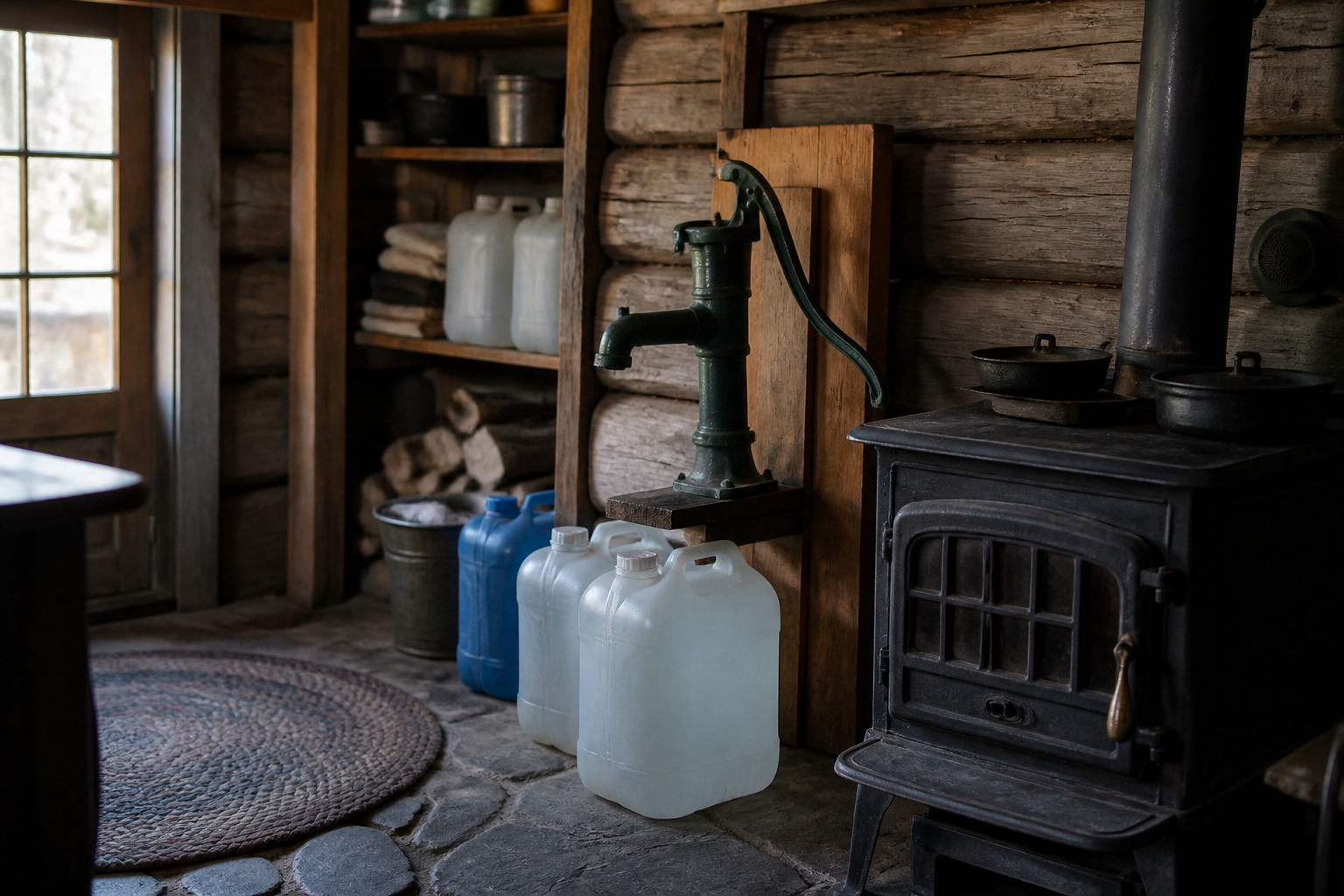
If you have a well, the single most valuable upgrade you can make is adding a hand pump alongside the electric pump. Bison Pump and Simple Pump are two well-known brands that allow manual draw from depths up to 200 feet. This is a $500-$1,500 investment but it is the one piece of 'gear' that truly cannot be replicated with improvisation in a crisis.
- Store at least 1 gallon per person per day in food-grade containers
- Gravity ceramic filter for ongoing purification — no power required
- Boiling over open flame — works with wood, propane, or alcohol stoves
- Unscented liquid bleach treatment (CDC protocol: 8 drops per gallon)
- Hand pump for well-owners as a permanent electric-pump backup
Food Safety and Preservation Without Refrigeration
Refrigerators stop working within hours of a blackout, and a full freezer stays safe for roughly 48 hours if kept closed — after that, you are managing a perishables crisis.
The low-tech solution is to not depend on refrigeration for your core food supply in the first place. Traditional food preservation methods — dry storage of grains and legumes, home canning, salt-curing, fermentation, and dehydration — keep staple foods stable for one to five or more years at room temperature. A three-month rotating pantry of rice, dried beans, oats, canned vegetables, and canned protein requires no electricity to store and no special equipment to prepare beyond a heat source.
Root cellaring is another Amish-derived method worth understanding. A simple earthen or basement root cellar maintains temperatures between 32 and 40 degrees Fahrenheit through the thermal mass of surrounding soil, extending the storage life of root vegetables, apples, and hard squash by months without any refrigeration. Even apartment dwellers can approximate this with an insulated cooler placed against a north-facing exterior wall in winter.
For cooking without electricity, a two-burner propane camp stove with a 20-pound tank (roughly 20 hours of cook time) handles most family meal preparation. Wood-burning rocket stoves and biomass camp stoves are renewable-fuel alternatives that work indefinitely as long as you have access to fuel. Cast iron cookware is the correct tool for all open-flame cooking — it handles extreme heat, lasts decades, and is completely EMP-proof.
- Dry staples: white rice, dried beans, oats, pasta, salt, sugar — 1-year-plus shelf life
- Home canning and fermentation for vegetables, fruits, and proteins
- Root cellar or cool-storage improvisation for fresh produce
- Propane camp stove plus 20-lb tank as primary no-power cooking setup
- Cast iron cookware for open-flame durability
Shelter Hardening and Temperature Without Electric Heat or AC
Loss of heating or cooling is the grid-down threat most people underestimate — hypothermia and heat stroke are genuine killers, and both can develop faster than most households expect without active temperature management.
For cold climates, the core strategy is reducing the space you need to heat. Designate one interior room — ideally with few windows and insulated walls — as your thermal refuge. A single wood-burning stove or propane heater rated for indoor use can maintain a survivable temperature in a small space at a fraction of the fuel cost of heating a whole house. Wool blankets, sleeping bags rated to 0 degrees Fahrenheit, and layered clothing dramatically reduce the temperature your shelter needs to reach to keep you safe.
For hot climates, passive cooling is the low-tech answer. Blocking direct sunlight with exterior shutters, heavy curtains, or reflective window film reduces solar heat gain by up to 77 percent according to Department of Energy data. Cross-ventilation — opening windows on opposite sides of the house during cooler nighttime hours and closing them before the outdoor temperature rises in the morning — can keep interior temperatures 10 to 15 degrees cooler than the outdoor peak without any powered equipment.
Shelter hardening also means weatherproofing against the physical damage that often accompanies grid-failure events: storm shutters, reinforced entry doors, and a roof inspection before hurricane or winter storm season are all no-tech investments that pay dividends whether or not a major grid event occurs.
Our Recommendation: David's Shield
An extended blackout or EMP event does not just cut your power — it removes every system in your home that depends on electricity simultaneously: your water pump, your refrigerator, your heating system, and your access to medical information. That layered failure is what makes grid-down scenarios genuinely dangerous for unprepared households.
The gap in purely DIY preparation is time and organization. The individual methods — water storage, food preservation, passive shelter management, basic medical care — are each well-documented, but pulling them into a single, coherent household plan takes research hours most families do not have. Free online resources are also scattered, inconsistent in quality, and often gear-heavy in a way that prices out budget-conscious households.
David's Shield is a $67 digital guide built specifically around this problem. It draws on Amish and traditional off-grid practices to cover blackout and EMP readiness across the four systems that matter most: water purification, food storage, shelter hardening, and basic medical care — with an explicit focus on simple, no-tech methods over gadgets. It is not a gear catalog; it is a household operations manual for living without the grid. A 60-day money-back guarantee means you can evaluate it against your own situation without financial risk. If you want a single organized resource to build your low-tech grid-down plan around, this is a reasonable place to start. For the next step, read DIY 3D Solar Sphere for Small Off-Grid Power: What the Concept Promises and What to Realistically Expect.
Our recommendation
David's Shield
Check availability →This article contains an affiliate link. If you buy through it, we may earn a commission at no extra cost to you.
Frequently asked questions
Does an EMP really destroy all electronics in a home?
A high-altitude EMP can damage or destroy unshielded electronics depending on pulse strength and the device's sensitivity, but non-electronic items — hand tools, cast iron cookware, mechanical equipment, stored food and water — are completely unaffected. The practical takeaway is that reducing reliance on powered systems reduces your EMP vulnerability directly.
How long should I prepare for a blackout to last?
FEMA recommends a minimum 72-hour baseline, but historical major grid failures have lasted days to weeks. A two-week self-sufficiency target covers the realistic range of most natural-disaster and infrastructure-failure scenarios without requiring extreme or costly preparation.
What is the cheapest way to purify water without electricity?
Boiling is the most reliable and cheapest method — it requires only a heat source and a container. Chemical treatment with unscented household bleach (8 drops per gallon, 30-minute wait) is even cheaper and requires no equipment. Both are endorsed by the CDC for emergency water treatment.
Can I stay warm without electricity during a winter blackout?
Yes. Concentrate occupants in one small interior room, use a wood stove or approved indoor propane heater as a heat source, layer wool clothing and zero-degree sleeping bags, and seal drafts. Passive measures alone can keep a well-insulated small space survivable well below freezing outdoors.
Are Amish-style preparedness methods actually practical for modern households?
The core methods — dry food storage, gravity water filtration, root cellaring, passive heating and cooling, and basic first aid — are practical for any household regardless of lifestyle. They require some upfront organization and modest cost but no special skills or infrastructure beyond what most homes already have.
Related guides
Sources
- FEMA: Emergency Water Storage and Purification Guidelines
- CDC: Emergency Water Supply and Purification
- US Department of Energy: Passive Cooling and Window Heat Gain
- FEMA: Extended Power Outage Preparedness
General preparedness information, not medical or legal advice. Follow instructions from your local emergency authority during an active event.
Field notes by email
Get the next guide before you need it
One email when a new field guide drops — water, food, power, medicine. No spam, no daily noise, unsubscribe in one click.
Comments on this guide
Questions, corrections and field reports from your own setup are welcome.
No comments yet. Be the first to add a field report.