
Security
How to Secure Your Home During a Grid-Down Emergency (Before Police Response Fails You)

By Ephraim Rusk · · 10 min read
This article contains an affiliate link. If you buy through it, we may earn a commission at no extra cost to you.
Quick answer
To secure your home during a grid-down emergency, layer low-tech and battery-powered deterrents: harden entry points with door jammers and reinforced strike plates, set perimeter tripwire or motion alerts, and add battery-operated door and window alarms. These work without Wi-Fi, a monitoring contract, or mains power — exactly the conditions during a real grid failure.
Grid-down home security is one of the most searched and least honestly answered topics in the preparedness space. Most of what ranks on Google describes products that require a working router, a cellular data plan, or a live monitoring subscription — all of which vanish the moment extended grid failure, a major storm, or a regional blackout hits your area.
The hard truth is that opportunistic property crime tends to rise during prolonged power outages and civil disruptions, precisely because normal deterrents disappear and police response times stretch from minutes to hours — or stop entirely. FEMA's own emergency planning guidance acknowledges that self-reliance, not emergency services, is the realistic first layer of protection in the early phase of any large-scale disaster.
This article walks through what actually fails during a grid-down event, which security methods hold up without power, and how to build a practical layered defense that doesn't depend on the internet, a working siren company, or the assumption that a patrol car is five minutes away.
Why Your Existing Home Security System Is Likely Useless When the Grid Goes Down
The majority of modern home security systems — including nearly every popular consumer brand — depend on at least one of three things that disappear during an extended grid-down event: mains power, a cellular or broadband data connection, and a live monitoring center that is itself operational.
Most system backup batteries are sized for a few hours, not days. A typical alarm panel battery is rated for 4 to 24 hours of standby. After Hurricane Maria in 2017, parts of Puerto Rico went without grid power for nearly a year; after Winter Storm Uri in Texas in 2021, outages lasted weeks in some areas. A 24-hour backup is not a safety margin — it's a false sense of one.
Camera systems that use cloud recording stop recording when the router loses power, even if the cameras themselves have a battery backup. Smart locks revert to manual mode but often lose their audit trail and remote access entirely. Professional monitoring centers do have generator backup, but their ability to dispatch police to your address is only as good as the local 911 system, which is itself under heavy load during large-scale events.
The practical result: the moment a serious grid-down event begins, most households are operating with zero electronic security — exactly when the social friction that normally deters crime starts to erode.
The Three Layers of Grid-Independent Home Defense
Effective grid-down home security relies on the same layered model used by physical security professionals: detection at the perimeter, delay at the entry point, and alert or response at the interior. Each layer buys time and raises the apparent cost of entry for an opportunistic intruder.
Layer one is perimeter detection — knowing someone is approaching before they reach your doors or windows. Low-tech options include gravel paths (footsteps are audible), thorny hedges under windows, and tripwire-style perimeter alert systems that use a physical mechanism rather than Wi-Fi. Battery-powered passive infrared (PIR) motion sensors with a local audible alarm or a floodlight serve the same purpose and function independent of grid power as long as fresh batteries are maintained.
Layer two is entry delay — making your doors and windows meaningfully harder to breach quickly. The FBI's Uniform Crime Reports consistently show that most residential break-ins take less than 60 seconds at the entry point. A standard residential door with a single-bolt lock and an unstrengthened strike plate can be kicked in with one or two blows. Reinforcing the strike plate with 3-inch screws into the structural framing, adding a door jammer or security bar at the floor, and applying security film to glass panels each add meaningful time without requiring any power source.
Layer three is interior alert — ensuring that anyone who does breach an entry point triggers an immediate, loud, local alarm that wakes occupants and signals to the intruder that the element of surprise is gone. Battery-operated door and window contact alarms are simple, cheap, and reliable. They require no hub, no internet, and no monitoring contract.
Perimeter Tripwires and Motion Alerts: What Works, What Doesn't
Perimeter tripwire alert systems fall into two broad categories: mechanical-acoustic (a physical mechanism that produces sound when a line is broken) and electronic (a sensor that triggers an audible alarm). Both can function without grid power; the electronic versions require batteries.
Mechanical tripwire alarms — sometimes called perimeter alarm kits or camp alarms — use a thin wire or fishing line connected to a pin on a small cartridge or noisemaker. When the line is disturbed, the pin pulls and the device fires or sounds. They are extremely low-tech, weather-tolerant, and require zero electricity. The tradeoff is that they are single-use or require manual reset, and their effective range is limited to the specific path where the wire is set.
Electronic PIR motion sensors designed for battery operation are more versatile. Look specifically for models that advertise operation during power outages — meaning they store their alarm function locally and do not require a network connection to trigger. Many consumer-grade 'smart' sensors only send a phone notification; they do not sound a local alarm if the router is down. That distinction matters enormously in a grid-down scenario.
Floodlights with integrated PIR sensors and battery backup (or solar charging) serve a dual purpose: they alert you to movement and they expose an intruder to visibility, which is itself a significant deterrent. Studies on crime prevention through environmental design consistently find that lighting is one of the most cost-effective deterrents for opportunistic property crime.
One honest limitation: no perimeter system stops a determined, patient intruder. These systems are optimized against the opportunistic actor who is looking for the easiest target on the block. In most grid-down scenarios, that is the realistic threat profile — not a coordinated tactical team.
Door and Entry Point Hardening: The Steps Most People Skip
Door hardening is the single highest-leverage physical security improvement most households can make, and the majority of it requires no power to function.
The weakest point in most residential doors is not the lock — it is the strike plate, which is typically held in place by short screws that bite only into the door casing, not the structural framing. Replacing these with 3-inch screws that reach the jack stud behind the casing is a 20-minute job that makes a door dramatically more kick-resistant. This is confirmed by physical security research from organizations like the Door Security and Safety Foundation.
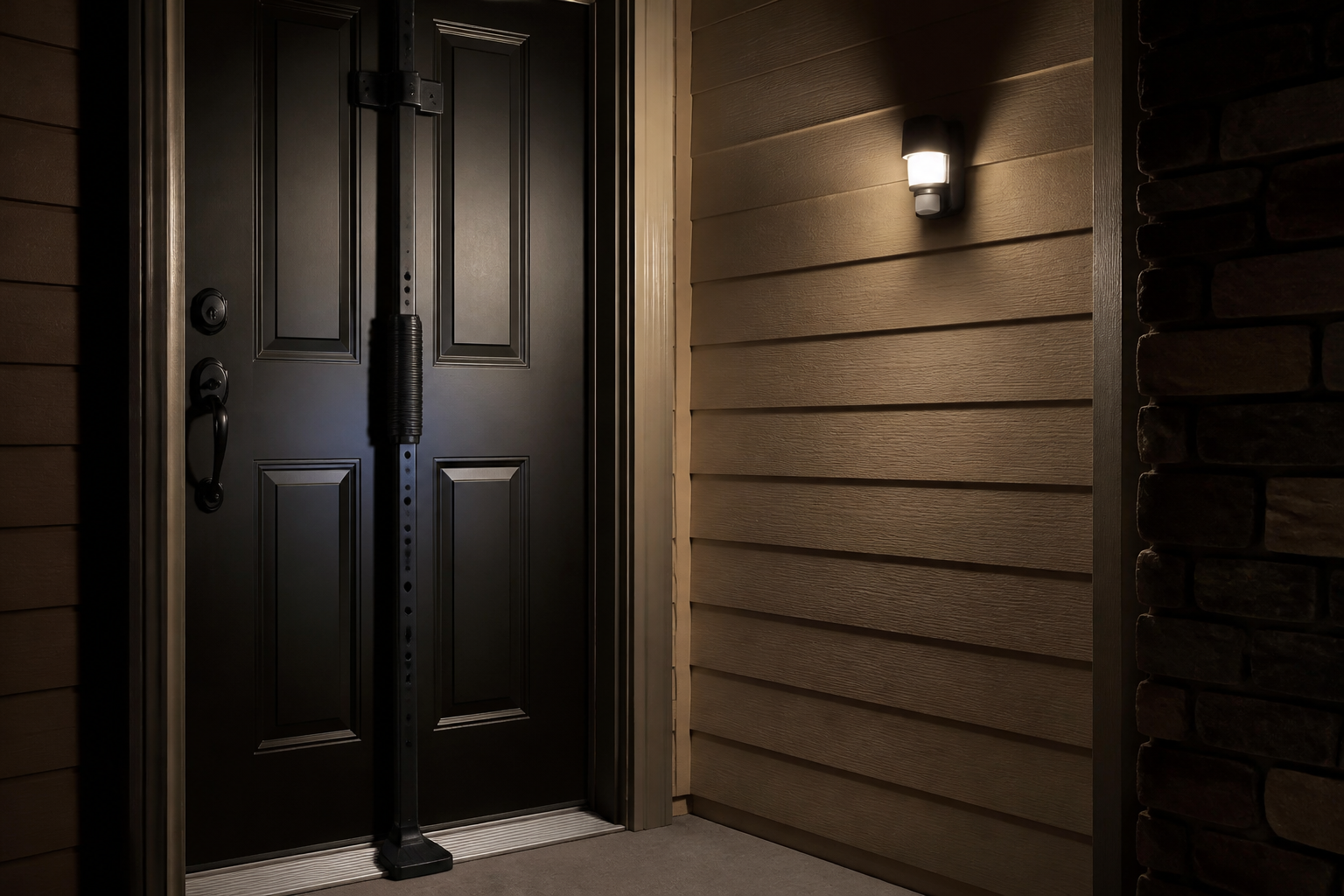
A door jammer or security bar works by bracing the door against the floor rather than relying on the lock mechanism at all. When properly positioned, a good floor-braced door jammer can withstand several hundred pounds of force applied to the door — far beyond what a standard kick-in delivers. These devices are passive, mechanical, and completely grid-independent.
Sliding glass doors and windows are secondary entry points that are frequently overlooked. A simple cut-to-length wooden dowel or steel bar in the track prevents the door from being forced open even if the latch is defeated. Window contact alarms — small battery-operated devices that sound when the circuit between frame and sash is broken — add an audible alert layer at essentially no installation complexity.
One practical note on glass: security window film does not make glass unbreakable, but it significantly slows forced entry by holding shards together after the glass breaks. The intruder must continue striking the same panel rather than reaching through cleanly. That extra time and noise matters.
Our Recommendation: The Anti-Looter Kit
The problem this article has been building toward is straightforward: in a real grid-down emergency, the layered perimeter-detection, entry-delay, and interior-alert system described above has to work without power, without Wi-Fi, and without the assumption that help is nearby — and assembling that system from scratch means sourcing multiple compatible components, hoping they work together, and figuring out placement on your own.
The gap with the fully DIY approach is not that the individual components are hard to find — it is that sourcing a tripwire perimeter system, a battery-powered floodlight, compatible door contact alarms, and a reliable door jammer as separate purchases from separate manufacturers creates real friction: incompatible sensitivities, no unified placement logic, and no guarantee that all the pieces function during an outage rather than depending on a hub that goes dark when the router does. Most people who start down that road end up with three items installed and two still in boxes.
The Anti-Looter Kit addresses exactly this gap. It bundles motion sensors, perimeter tripwires, door alarms, a floodlight, and a door jammer into a single residential security kit designed around the specific scenario where police response is delayed or unavailable — the same grid-down, civil disruption context this article has described. The kit is marketed as functional during power outages, which maps directly to the core requirement: none of these components should require mains power or an internet connection to do their job. If you want to implement the layered defense described here without sourcing each piece independently, this kit is worth a close look. For the next step, read Palm Stick Self-Defense for Beginners: How to Use a Kubotan or Tactical Pen When You Can't Run.
Our recommendation
Anti-Looter Kit
Check availability →This article contains an affiliate link. If you buy through it, we may earn a commission at no extra cost to you.
Frequently asked questions
How long do backup batteries last in home security systems during a power outage?
Most residential alarm panel backup batteries are rated for 4 to 24 hours of standby. After that, the system goes offline. For grid-down events lasting days or weeks, standalone battery-operated sensors and alarms — which use replaceable AA or lithium cells — are far more reliable than systems with a single rechargeable backup pack.
Do Ring cameras and smart doorbells work during a power outage?
Ring cameras and most Wi-Fi-based smart cameras stop recording to the cloud when your router loses power, even if the camera itself has battery backup. Some models will store limited local footage, but real-time alerts and remote viewing require a working internet connection. In a grid-down scenario, they effectively stop functioning as security devices.
What is the best way to secure a front door without electricity?
The most effective non-electric front door hardening combines three things: replacing short strike plate screws with 3-inch screws reaching the structural framing (resists kick-ins), adding a floor-braced door jammer or security bar (passive mechanical resistance), and a battery-operated door contact alarm (audible alert if the door is opened). None of these require power to function.
Does crime actually increase during power outages?
Research and post-event crime data consistently show that opportunistic property crime — burglary, looting, theft — rises during extended power outages and civil disruptions. Reduced lighting, slower police response, and the absence of functioning alarm systems all lower the perceived risk for opportunistic offenders. The effect is most pronounced after the first 24-48 hours of an outage, when normal deterrents have visibly failed.
Are perimeter tripwire alarms legal to use on residential property?
Passive acoustic tripwire alert systems — those that produce sound when a line is disturbed — are legal for residential use in most U.S. jurisdictions when deployed in areas you control (your yard, around your home). They are distinct from booby traps, which are illegal. Always verify local ordinances, and ensure any device you deploy cannot injure a person who triggers it.
Related guides
Sources
- FEMA: Individual and Community Preparedness — Self-Reliance in Disasters
- FBI Uniform Crime Reporting: Burglary
- U.S. Department of Energy: Power Outage Preparedness
- NIH/NCBI: Crime and Power Outages — Environmental Factors in Opportunistic Property Crime
General preparedness information, not medical or legal advice. Follow instructions from your local emergency authority during an active event.
Field notes by email
Get the next guide before you need it
One email when a new field guide drops — water, food, power, medicine. No spam, no daily noise, unsubscribe in one click.
Comments on this guide
Questions, corrections and field reports from your own setup are welcome.
No comments yet. Be the first to add a field report.