
Security
Palm Stick Self-Defense for Beginners: How to Use a Kubotan or Tactical Pen When You Can't Run

By Ephraim Rusk · · 10 min read
This article contains an affiliate link. If you buy through it, we may earn a commission at no extra cost to you.
Quick answer
Effective palm-stick self-defense requires learning a small set of pressure-point and impact techniques and drilling them under simulated stress — owning a kubotan or tactical pen without that training gives you a false sense of security rather than a real defensive capability.
Palm stick self-defense for beginners is one of the most searched topics in personal security — and for good reason. A kubotan, tactical pen, or purpose-built palm stick is small enough to carry everywhere, legal in most jurisdictions, and physically accessible to people who lack size, strength, or formal martial-arts experience. But there's a gap between owning one of these tools and knowing how to use it under pressure against someone who is actively trying to hurt you.
Most people who carry a tactical pen or kubotan have never done a single drill with it. They bought it, clipped it to a bag, and considered the problem solved. That works fine until it doesn't — and in a genuine close-quarters confrontation with a larger or aggressive attacker, an untrained tool becomes a liability as often as an asset. The attacker can take it. You can fumble the grip. You can strike the wrong target and achieve nothing.
This article covers what beginner palm-stick training actually looks like, which techniques hold up under stress, what the research and law-enforcement literature say about impact tools at close range, and how to build genuine skill rather than just purchasing the feeling of it.
What a Palm Stick Actually Is (and What It Isn't)
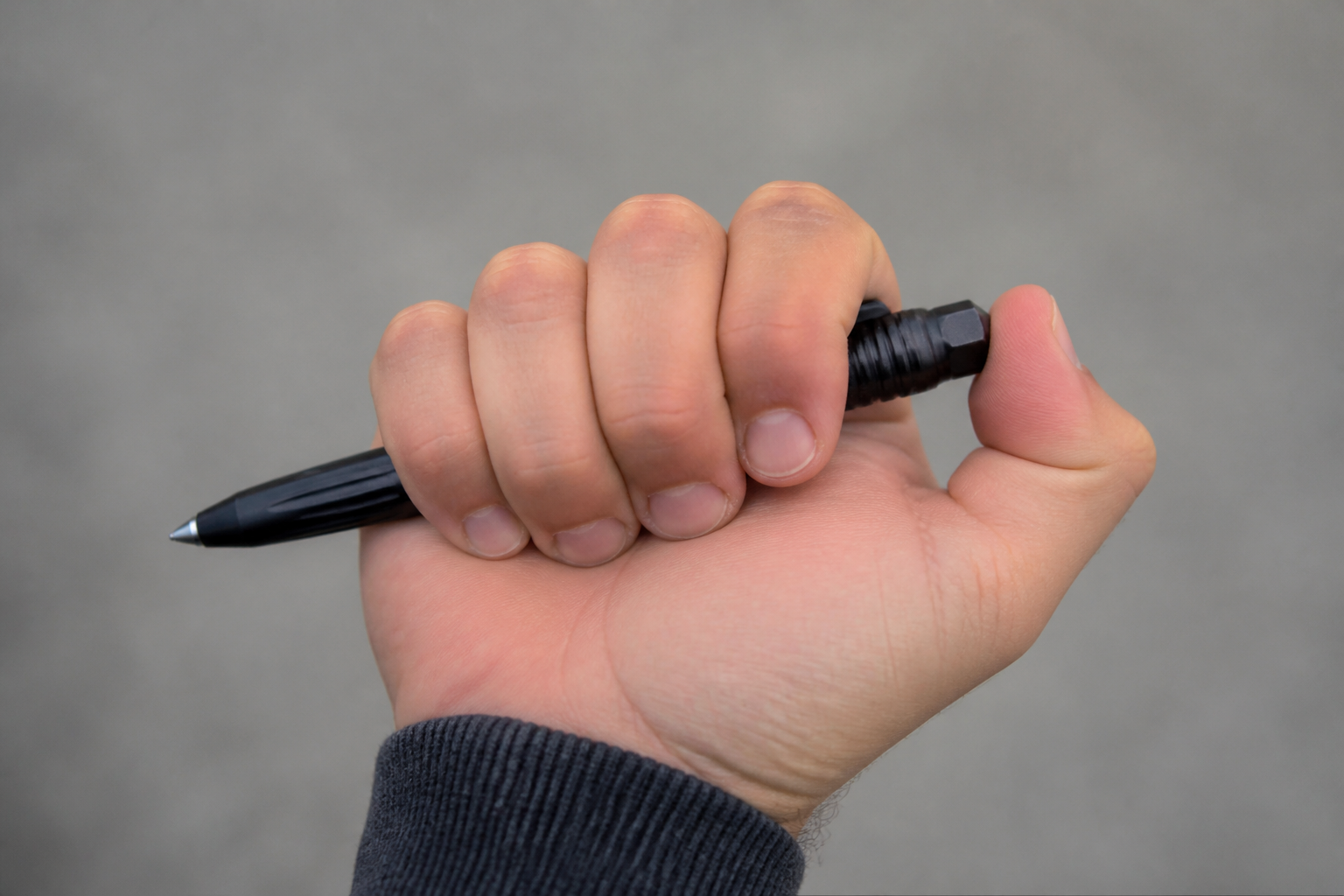
A palm stick is any short, rigid implement — typically 5 to 6 inches long — held in the closed fist so that it protrudes from one or both ends, concentrating striking force onto a smaller surface area and adding structural reinforcement to the hand. The kubotan, developed by Soke Takayuki Kubota in the 1970s for law-enforcement use, is the best-known example. Tactical pens, glass-breaker tools, and purpose-built defense sticks all belong to the same functional category.
What makes these tools appealing for preparedness-minded people is their everyday legitimacy. A tactical pen is a pen. A kubotan often rides a keychain. They pass through most social environments without raising flags, and in many states and countries they occupy a legal gray zone that is considerably friendlier than edged weapons or firearms. That said, local laws vary significantly — always verify what is legal to carry and deploy in your jurisdiction before you carry anything.
What a palm stick is not: it is not a force multiplier that compensates for zero training. It amplifies whatever skill you bring to it. Against a larger, determined attacker, a tool with no trained technique behind it is marginally better than an empty hand — and sometimes worse, because fumbling a weapon in a grapple gives the attacker something to use against you. The tool is a component of a system, not the system itself.
Why Close-Quarters Scenarios Demand a Different Skill Set
Close-quarters defense — inside arm's reach, in confined spaces, against someone who has already closed the distance — is fundamentally different from the wider striking range most people imagine when they think about self-defense. At that range, escaping is often not an option: you're against a wall, in a vehicle, in a hallway, or simply outpaced.
Research on law-enforcement use-of-force incidents consistently shows that most physical confrontations happen within 21 feet and often well inside that — what force-science researchers refer to as the reaction-time gap. At close range, gross motor movements degrade significantly under the adrenal stress response. Fine motor control — the kind required for precise joint locks or intricate striking combinations — becomes unreliable. This is one reason palm-stick instruction that works emphasizes a small number of gross-motor-compatible techniques over elaborate systems.
The practical implication for beginners is that you do not need to learn fifty techniques. You need to learn five to eight that work with adrenaline in your system, practice them until they are automatic, and understand when and how to apply them. Pressure points on the radial nerve, the brachial plexus tie-in, and the common peroneal nerve are primary targets for pain-compliance with a palm stick — but they require correct tool placement and enough repetition to find them under stress, not just intellectual knowledge of where they are.
Confined-space defense also changes your footwork and positioning options. Preparedness scenarios — a home invasion, a vehicle confrontation, a grid-down environment where normal security infrastructure is absent — frequently involve exactly these constraints. Training that addresses close-quarters positioning from the start is more transferable to real emergencies than open-mat sparring that assumes room to move.
The Techniques That Actually Hold Up Under Stress
The techniques most likely to function under genuine stress are those built on large muscle groups, simple mechanics, and pain response — not fine-motor precision or memorized sequences. For palm-stick beginners, a practical starting framework includes three categories: grip and retention, pressure-point compliance, and impact targeting.
Grip and retention comes first because it is the prerequisite for everything else. The palm stick must be held in a way that resists being stripped. Law-enforcement kubotan curriculum typically uses a reinforced closed fist — the stick protrudes from the little-finger side — with the thumb wrapped over the top. Practicing grip under simulated resistance (a training partner trying to grab your hand) reveals quickly whether your hold is actually secure.
Pressure-point compliance is the primary non-impact use of the tool. The radial nerve on the outer forearm, the brachial plexus tie-in at the neck-shoulder junction, and the mandibular angle behind the jaw are the three most commonly taught compliance targets. Applied correctly, even light pressure from a palm stick tip to these locations produces a strong pain response. Applied incorrectly — wrong angle, wrong depth, wrong location by even an inch — they produce nothing. This is the argument for drilling, not just reading about it.
Impact targeting, when compliance fails or the situation escalates, focuses on large, reliable target areas: the common peroneal nerve on the outer knee (disrupts stance), the mastoid area behind the ear (disorienting), and the solar plexus region. Strikes to these areas with a palm stick are meaningfully harder than empty-hand strikes to the same locations. However, any impact technique carries legal and physical risk — understanding force escalation law in your jurisdiction is as important as the physical technique itself.
What experienced instructors and use-of-force researchers both emphasize is that the value of a technique is not its theoretical damage potential but its probability of execution under stress. Simple, drilled, gross-motor-compatible movements win on that metric every time.
Building Real Skill: What Beginner Training Should Actually Look Like
Real beginner palm-stick training follows a progression: grip and stance, static technique drilling, slow partner resistance, then scenario-based practice. Skipping steps — going straight to scenario work without drilling basics — produces the same problem as never training at all: movements that fall apart when stress arrives.
The minimum effective dose for building a reliable motor pattern is generally accepted in motor learning research to be in the range of 300 to 500 quality repetitions of a movement before it begins to consolidate. That number climbs when you add the requirement that the movement survive an adrenal stress response. This does not mean you need years of practice before you have any capability — it means the first training session matters, and consistent short sessions (15 to 20 minutes, three times a week) build more durable skill than one long session every few months.
Scenario-based practice is where technique meets context. For preparedness households, relevant scenarios include: confrontation in a hallway or doorway, defense in a vehicle, response to a grab or choke, and dealing with a size or strength mismatch. Running these scenarios slowly at first — at 30 percent speed with a cooperative partner — and gradually increasing resistance gives you honest feedback about what works for your body type and physical condition.
If in-person instruction is not accessible — due to location, cost, or time — structured video-based instruction taught by qualified instructors can provide the framework, provided it is paired with genuine solo drilling and, where possible, any amount of partner work. The critical difference between useful video instruction and YouTube rabbit holes is curriculum structure: a logical progression that builds each technique on the previous one, with clear instruction on common errors.
Our Recommendation: Hammer Concept Palm Stick Defense
The core problem this article has laid out is straightforward: carrying a kubotan, tactical pen, or palm stick without trained technique behind it gives you the feeling of preparedness without the substance of it — and in a real close-quarters confrontation, that gap is dangerous.
The common workaround is to search for free content online. The honest gap there is structure. Free video content is scattered, inconsistent in quality, and rarely built as a progressive curriculum — you get isolated techniques with no coherent path from beginner grip to stress-tested scenario practice. In-person instruction from a qualified instructor solves that problem but is expensive, geographically restricted, and often unavailable in the formats and schedules that fit a working household.
The Hammer Concept Palm Stick Defense course is a structured 26-lesson video program spanning more than three hours, built specifically for beginners who need to defend themselves in close-quarters scenarios against a stronger or armed attacker when escape is not an option. It covers the palm stick, kubotan, and tactical pen within a single coherent system — exactly the tool overlap most people already own across those three categories. The course is priced at €97 with a 60-day money-back guarantee, which removes the financial risk of finding out whether the instruction is right for your situation. If you carry one of these tools and have not yet put real training behind it, this is a reasonable and low-risk place to start. For the next step, read Home Security Without Electricity: How to Protect Your House During a Power Outage.
Our recommendation
Hammer Concept Palm Stick Defense
Check availability →This article contains an affiliate link. If you buy through it, we may earn a commission at no extra cost to you.
Frequently asked questions
Is a kubotan legal to carry?
Legality varies by country, state, and sometimes city. In the United States, kubotans are legal to carry in most states but are restricted or banned in a few jurisdictions, and are generally prohibited in airports and government buildings. In some European countries and Canada, they may be classified as prohibited weapons. Always check your specific local laws before carrying any impact tool.
Can a smaller person realistically defend themselves with a palm stick against a bigger attacker?
Yes, with trained technique — but not without it. The palm stick's primary advantage for a smaller defender is that it concentrates force onto nerve and pressure-point targets that are accessible regardless of size difference, and it reinforces the striking hand against structural damage. Without training on how to access those targets under stress, the size-equalizing benefit largely disappears.
How long does it take to become competent with a kubotan or tactical pen?
A focused beginner can build a functional baseline — reliable grip, two to three pressure-point techniques, and one or two impact targets — in four to eight weeks of consistent practice (15 to 20 minutes, three sessions per week). Full competence under realistic stress takes longer and ideally includes some form of resisted partner drilling.
What is the difference between a kubotan and a tactical pen for self-defense purposes?
Functionally, they work the same way as palm sticks — both concentrate striking force and allow pressure-point application. The tactical pen has the everyday legitimacy advantage of being a working pen, which makes it easier to carry in environments where a dedicated kubotan might draw attention. The kubotan's dedicated design sometimes offers better grip texture and tip geometry for compliance techniques. Training principles for both are identical.
Do palm stick techniques work if you have no martial arts background?
Yes. Palm-stick instruction designed for beginners specifically avoids techniques that require prior grappling or striking experience. The most effective beginner techniques rely on gross motor movements and anatomical leverage rather than athletic skill, which is why law enforcement agencies have historically used kubotan training for officers with no martial arts background.
Related guides
Sources
- NIH — Motor Learning and Skill Consolidation: Repetition and Stress Effects
- FEMA / Ready.gov — Personal Safety and Emergency Preparedness
General preparedness information, not medical or legal advice. Follow instructions from your local emergency authority during an active event.
Field notes by email
Get the next guide before you need it
One email when a new field guide drops — water, food, power, medicine. No spam, no daily noise, unsubscribe in one click.
Comments on this guide
Questions, corrections and field reports from your own setup are welcome.
No comments yet. Be the first to add a field report.