
Power
How to Set Up a Home Battery Backup Without Solar: A Practical Step-by-Step Plan

By Ephraim Rusk · · 10 min read
This article contains an affiliate link. If you buy through it, we may earn a commission at no extra cost to you.
Quick answer
You can set up a home battery backup without solar by choosing a battery bank or portable power station sized to your critical loads, charging it from the grid during normal times, and connecting your essential devices directly during an outage. No solar panels, permits, or electrician required for a basic system.
Home battery backup without solar is one of the most overlooked options in the preparedness world — and for most households, it is the right first step. The moment your power goes out, the clock starts: food in the refrigerator, medical devices, communications, lighting, and heat or cooling all start competing for whatever stored energy you have on hand.
Most people assume that backup power means either a noisy gas generator or a $15,000 whole-home solar-plus-battery install. Neither is true. A properly sized battery backup system — charged from your ordinary grid outlet during normal times — can keep your critical appliances running for 24 to 72 hours without a drop of fuel, without permits, and without a solar panel in sight.
This article is for households who want real, working backup power but are not ready to commit to a full solar installation. We will cover how to figure out what you actually need, what battery technologies are worth your money, how to charge and maintain a system safely, and where the common mistakes happen. At the end, we will point you toward a resource that makes the planning side a lot less confusing.
Why Battery Backup Without Solar Makes Sense as a First Step
A battery-only backup system is simpler, cheaper, and faster to deploy than solar, and it covers the most common emergency scenario most households actually face: a grid outage lasting 12 to 72 hours.
According to the U.S. Energy Information Administration, the average American household experiences just over seven hours of power interruptions per year — but weather events, equipment failures, and increasingly stressed infrastructure push some regions into multi-day or even week-long blackouts. FEMA recommends households be prepared to be self-sufficient for at least 72 hours following a disaster.
Solar panels are an excellent long-term investment, but they come with real barriers: upfront cost, roof suitability, local permitting requirements, and installation complexity. A battery-first approach sidesteps all of that. You charge the battery from the wall when the grid is up, and you draw from it when the grid goes down. It is functionally similar to how your phone or laptop works — just at a household scale.
The other underappreciated benefit: a standalone battery system is portable. You can bring it to a vehicle, a second location, or share it with a neighbor. A bolted-in solar array gives you none of that flexibility.
Sizing Your Battery Backup: How Much Power Do You Actually Need?
The right battery size is determined by which specific loads you need to run and for how long — not by a generic rule of thumb.
Start with a load audit. Write down every device you consider critical during an outage, find its wattage on the label or manufacturer spec sheet, and estimate how many hours per day you would run it. Multiply watts by hours to get watt-hours (Wh). Do this for each device, then add them up. That total is your daily energy budget.
A typical critical-load list for a prepared household might include: a small chest freezer (30-60W running, roughly 150-300 Wh per day), phone and device charging (20-50 Wh per day total), LED lighting for two or three rooms (10-30W, 50-150 Wh per day), a CPAP machine without a humidifier (30-60 Wh per night), and a small fan or portable heater — though portable electric heaters are extremely energy-hungry and often impractical on battery power alone.
Once you have your daily watt-hour number, multiply by the number of days you want to cover, then add a 20-25% buffer for battery inefficiency and to avoid fully draining the battery (deep discharge shortens battery life). That final number is your minimum usable battery capacity.
Example: If your critical loads total 600 Wh per day and you want 48 hours of coverage, you need at least 1,440 Wh of usable capacity — so you would shop for a system rated at 1,500 Wh or above.
- List every critical device and its wattage — find wattage on the label or in the manual
- Estimate daily run-time in hours for each device during an outage
- Multiply watts x hours = watt-hours per day, per device
- Add all devices together for your daily energy budget
- Multiply by days of coverage desired, then add 20-25% buffer
- That final number is your minimum usable battery capacity target
Battery Technologies Worth Considering (and One to Avoid)
Lithium iron phosphate (LFP or LiFePO4) is the technology most worth your attention for a home battery backup — it is safer, longer-lived, and more tolerant of partial charging than other lithium chemistries.
LFP batteries do not carry the same thermal runaway risk as lithium cobalt oxide (the chemistry in many older laptop and phone batteries). They are rated for 2,000 to 3,500 charge cycles depending on the manufacturer, compared to 300-500 cycles for a typical sealed lead-acid battery. That translates to roughly 8-10 years of regular use versus 2-4 years for lead-acid. The upfront cost is higher, but the cost per cycle and cost per watt-hour over time generally favor LFP.
Sealed lead-acid (SLA) batteries are the traditional prepper standby and still have their place: they are inexpensive upfront, widely available, and well-understood. The downsides are weight, shorter lifespan, lower depth of discharge (you should not draw below 50% without damaging them), and the fact that they off-gas hydrogen during charging — meaning they require ventilation and cannot be stored in an enclosed living space without proper setup.
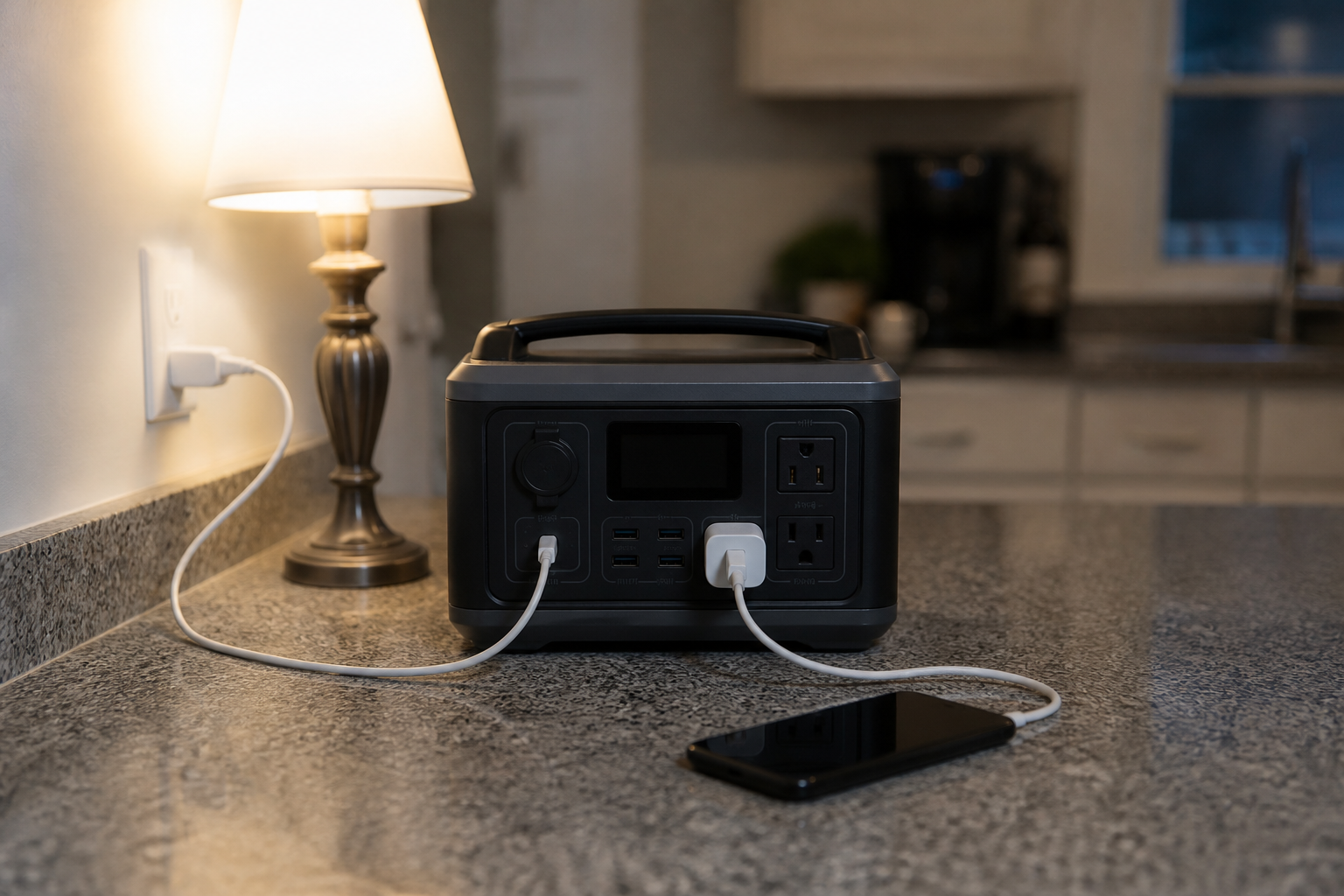
Portable power stations — which are self-contained LFP battery units with built-in AC inverters, USB ports, and DC outputs — are the simplest entry point for most households. Brands like EcoFlow, Jackery, and Bluetti have made this category approachable. They charge from a standard wall outlet, require no wiring knowledge, and can power standard appliances directly. Their main limitation is cost per watt-hour relative to a DIY battery bank, but for most non-technical households the convenience justifies the premium.
One technology to avoid for indoor home backup use: standard flooded lead-acid car batteries. They require active maintenance, off-gas significantly, and are not designed for the deep discharge cycles a backup application demands. They will fail faster and create more hazard than a proper deep-cycle alternative.
Charging, Safety, and the Mistakes That Shorten Battery Life
Charging a home battery backup from the grid is straightforward — but a few practices will dramatically extend the life of your system and keep your household safe.
For portable power stations, the built-in battery management system (BMS) handles most of the safety work automatically. Plug it into the wall, let it charge, and unplug it when full. Most manufacturers recommend not leaving them at 100% state of charge for extended periods if the unit will sit unused — storing at around 50-80% is generally better for long-term cell health, though specific guidance varies by manufacturer.
For DIY LFP battery banks, a proper LFP-compatible battery charger is non-negotiable. A charger designed for lead-acid will damage LFP cells over time by applying the wrong charge voltage profile. Match the charger chemistry setting to your battery chemistry, every time.
Temperature matters more than most people realize. Lithium batteries of all types should not be charged below 32 degrees Fahrenheit (0 degrees Celsius) — doing so causes lithium plating inside the cells that permanently reduces capacity. Many quality battery management systems will block charging in freezing conditions automatically, but not all do. Do not assume — check your product's specifications. Storing batteries in a cold garage in winter and then immediately trying to charge them is one of the most common ways people unknowingly damage their backup systems.
Keep batteries away from flammable materials, and position them where they can be quickly removed or isolated if something goes wrong. For lead-acid batteries indoors, cross-ventilation is required to prevent hydrogen accumulation. The National Fire Protection Association's electrical codes (NFPA 70, the National Electrical Code) and your local building codes govern how larger battery systems must be installed — for systems beyond a portable power station, consult those guidelines or a licensed electrician.
- Use a charger matched to your battery chemistry — LFP requires an LFP charger
- Do not charge lithium batteries below 32 F (0 C) — cell damage is permanent
- Store batteries at 50-80% charge if leaving them unused for weeks or months
- Keep lead-acid batteries in ventilated spaces — they off-gas hydrogen during charging
- Position your battery where it can be quickly accessed or isolated
- Check local codes (NFPA 70) before installing anything beyond a plug-in portable unit
Our Recommendation: Easy DIY Power Plan
The hard part of setting up a home battery backup without solar is rarely the hardware — it is the planning. Undersizing your system means you run out of power when it matters most. Oversizing means you spent money on capacity you will never use. Picking the wrong battery type, charger, or configuration can shorten the life of an expensive piece of equipment or, in the case of lead-acid indoors, create a real safety hazard.
The DIY and free-resource route for this kind of planning is genuinely time-consuming. Calculating loads, cross-referencing battery specifications, understanding depth-of-discharge limits, and mapping out a charging strategy that actually works across multiple scenarios requires pulling information from half a dozen sources — and most of those sources are written for engineers or off-grid enthusiasts who already know the vocabulary. That is the gap most households get stuck in: the technical resources exist, but they are not written for someone who just wants a clear, step-by-step plan they can follow on a weekend.
The Easy DIY Power Plan is built for exactly that situation. It is a simplified, non-technical guide to building a real home power backup strategy — written for people who want to reduce their grid dependence without hiring a contractor or becoming an electrical engineer. If you have done the load math in this article and you are ready to turn those numbers into an actual system, the Easy DIY Power Plan gives you the structured path to get there. Visit the link below to learn more and see if it fits what you are trying to build. For the next step, read How to Prepare Your Home for an Extended Power Outage Without a Generator.
Our recommendation
Easy DIY Power Plan
Check availability →This article contains an affiliate link. If you buy through it, we may earn a commission at no extra cost to you.
Frequently asked questions
Can I run a refrigerator on a battery backup without solar?
Yes, but it depends on the refrigerator's size and efficiency. A modern, energy-efficient full-size refrigerator runs around 100-200W and cycles on and off, consuming roughly 1-2 kWh per day. A 1,500 Wh battery could keep it running for most of a day. A chest freezer is significantly more efficient and is a better choice when running on battery power for extended periods.
How long does it take to charge a home battery backup from the wall?
It depends on the battery capacity and the charger output. A 1,000 Wh portable power station charging from a standard 120V outlet at roughly 400-600W input will take 2-3 hours from empty. Larger 2,000 Wh units may take 4-6 hours on a standard outlet, or less if they support faster charging via a 240V connection. Check the manufacturer's specs for your specific unit.
Is a home battery backup safe to use indoors?
Lithium iron phosphate (LFP) portable power stations are generally considered safe for indoor use and are designed for it. Standard flooded lead-acid batteries are not safe for indoor use without dedicated ventilation due to hydrogen off-gassing. Sealed AGM or gel lead-acid batteries have lower off-gassing risk but should still be kept in well-ventilated areas. Always follow the manufacturer's safety instructions.
How much does a home battery backup system cost without solar?
Entry-level portable power stations in the 500-700 Wh range typically start around $300-$500. Mid-range units at 1,500-2,000 Wh run roughly $800-$1,500. DIY LFP battery bank builds can sometimes achieve lower cost-per-watt-hour at larger capacities, but require more technical knowledge and additional components. Prices shift frequently — compare current listings from multiple brands before buying.
What is the difference between a UPS and a home battery backup?
A UPS (uninterruptible power supply) is designed to provide a few minutes of bridge power for electronics like computers during a sudden outage, protecting against data loss and hardware damage. A home battery backup is sized to power appliances and critical loads for hours or days. For whole-household preparedness, a UPS is a complement to a battery backup, not a replacement for it.
Related guides
Sources
- U.S. Energy Information Administration — Electric Power Annual: Electric Reliability
- FEMA — Build a Kit: Ready.gov
- U.S. Department of Energy — Batteries for Electricity Storage
General preparedness information, not medical or legal advice. Follow instructions from your local emergency authority during an active event.
Field notes by email
Get the next guide before you need it
One email when a new field guide drops — water, food, power, medicine. No spam, no daily noise, unsubscribe in one click.
Comments on this guide
Questions, corrections and field reports from your own setup are welcome.
No comments yet. Be the first to add a field report.