
Power
How to Prepare Your Home for an Extended Power Outage Without a Generator

By Ephraim Rusk · · 11 min read
This article contains an affiliate link. If you buy through it, we may earn a commission at no extra cost to you.
Quick answer
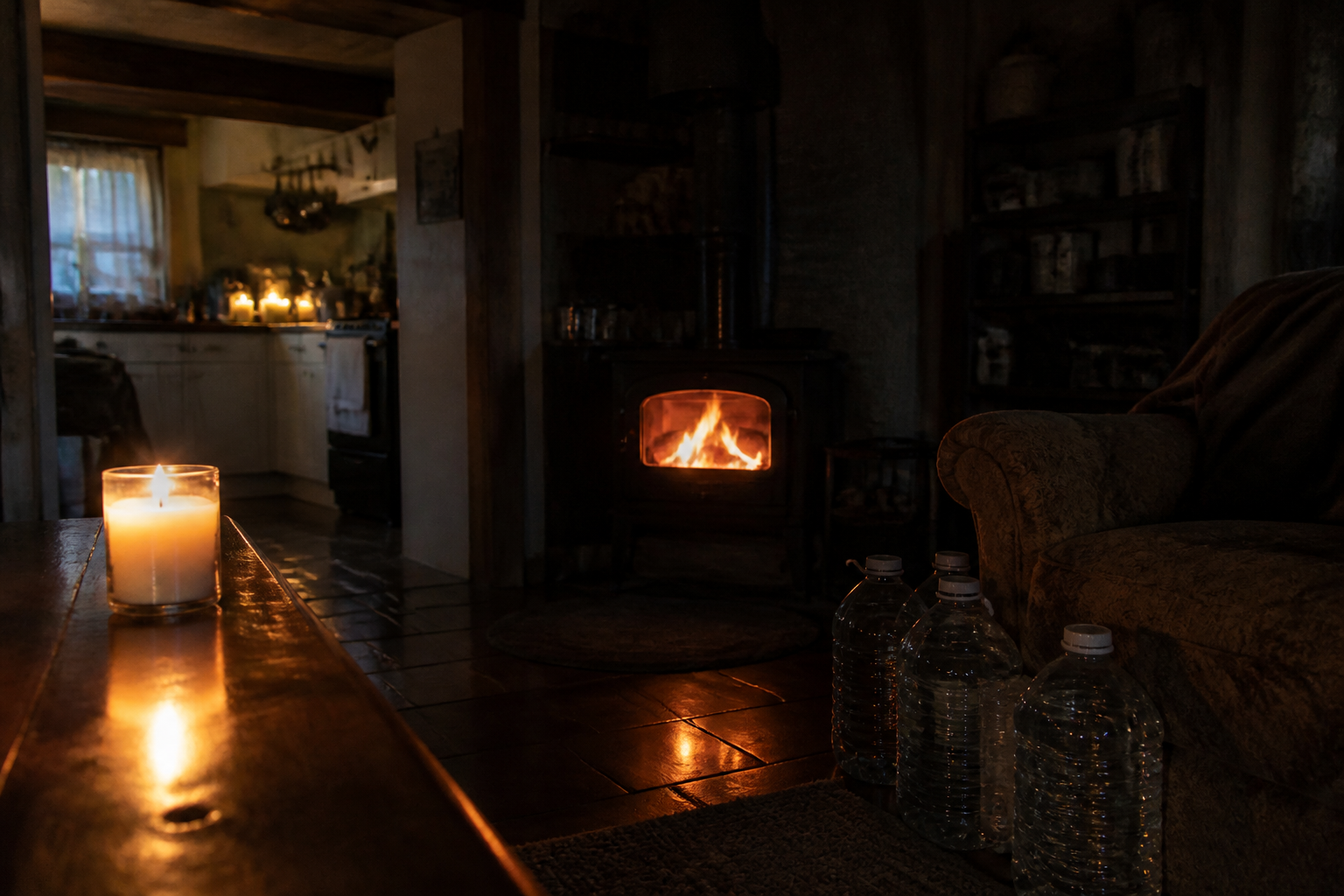
To prepare your home for an extended power outage without a generator, build systems around four needs in priority order: safe water, food that requires no refrigeration or cooking fuel, heat or cooling that needs no electricity, and lighting that does not depend on the grid. Low-tech, Amish-inspired methods cover all four at a fraction of what a generator costs.
Preparing your home for an extended power outage without a generator is not only possible — for most households it is the more reliable strategy. Generators are loud, expensive ($800 to $3,000 for a decent whole-home unit), and they consume fuel that runs out fast. In a week-long regional blackout, gas stations are typically offline within 24 to 48 hours, and the fuel you have on hand is gone shortly after. Worse, generators that rely on electronic ignition or control boards are vulnerable to electromagnetic pulse events in ways that a cast-iron woodstove or a hand-pump water filter simply are not.
The approach that actually holds up over multiple days — and one that off-grid homesteaders and Amish communities have refined for generations — is building layered, low-tech systems for each critical household need. FEMA recommends that every household be prepared to be self-sufficient for at least 72 hours, but real regional disasters routinely stretch past a week. The 72-hour kit is a floor, not a ceiling. This guide walks you through a practical, room-by-room strategy for keeping your household functional through an extended outage with no generator on the property at all.
Why Generators Fail When You Need Them Most
Generators are the default answer to blackout preparedness, but they carry failure modes that rarely get discussed in the sales pitch. Fuel dependency is the most obvious: a 5,000-watt generator burns roughly 0.5 to 0.75 gallons of gasoline per hour. A week-long outage at even modest runtime — say, 8 hours a day — requires 28 to 42 gallons. Most households store nowhere near that, and acquiring more after a regional disaster is not realistic.
Carbon monoxide poisoning is the second problem. The CDC reports that non-fire carbon monoxide deaths spike significantly after major power outages, with generator misuse being the leading cause. Generators must be run outdoors, at least 20 feet from any window or door — a constraint that becomes genuinely dangerous in winter when you are trying to route power into the house.
EMP vulnerability is the third and least discussed issue. A sufficiently large electromagnetic pulse event — whether from a high-altitude nuclear detonation or a severe geomagnetic storm — can disable the electronic control systems in modern generators, rendering them inoperable at the moment the grid goes down for an extended period. Carbureted engines from before roughly 1985 are more resistant, but those are not what most households own or can afford to stockpile.
None of this means a generator is always wrong. For a 24-hour outage, a small portable unit is a reasonable convenience. The problem is treating it as the backbone of a multi-day or multi-week readiness plan. The households that come through extended outages in the best shape are the ones that built low-tech redundancy into each critical system rather than betting everything on one machine and its fuel supply.
Water: The First Thing to Solve Before the Lights Go Out
Safe drinking water becomes a problem within hours of a grid failure if your household depends on a municipal system or an electric well pump. Municipal water systems rely on electrically powered pumps to maintain pressure; when backup generators at water treatment facilities fail or run out of fuel, pressure drops and the water itself may become unsafe to drink. The EPA advises that boil-water notices are common after major disasters precisely because of this pressure loss.
The FEMA baseline recommendation is one gallon per person per day for drinking and basic sanitation. For a family of four planning for seven days, that is 28 gallons minimum — and that number is conservative. Heat, physical exertion, and stress all increase water requirements. A more realistic planning number for comfort and cooking is two gallons per person per day.
Stored water in food-grade containers is the simplest first layer. Standard 5-gallon BPA-free containers are inexpensive, stack efficiently, and can be rotated on a six-to-twelve month schedule. Water stored in a clean, dark location away from direct sunlight and chemical fumes remains safe for an extended period when treated with 1/8 teaspoon of unscented household bleach per gallon at the time of storage.
The second layer is a gravity-fed or hand-pump water filter capable of treating water from outdoor sources — streams, rainwater collection, or a pool — down to a safe drinking standard. Gravity filters require no electricity and no moving parts; they work on the same principle used in off-grid homes worldwide. A third layer, if your property allows, is a rainwater catchment system routed from a clean metal or asphalt roof into food-grade barrels with a first-flush diverter. Even a modest 500-square-foot roof can collect 300 gallons from a single inch of rainfall.
Food Storage and Cooking Without Refrigeration or Grid Power
An extended outage without refrigeration means your perishables are gone within 24 to 48 hours, and your frozen food follows within 48 to 72 hours if the freezer door stays shut. The USDA Food Safety and Inspection Service guidance is clear: never taste food to determine if it is safe. When in doubt, throw it out.
The foundation of a no-generator food plan is a rotating pantry of shelf-stable foods your household already eats. This is not about buying pallets of freeze-dried emergency meals (though those have a place as a long-term buffer). It is about maintaining a 7-to-30 day supply of canned goods, dried beans, rice, oats, pasta, cooking oils, salt, sugar, honey, and shelf-stable fats like ghee or coconut oil. These items require no refrigeration, store well at room temperature, and provide real caloric density.
Cooking without grid power is where many households get stuck. The simplest and most versatile option for most climates is a propane camp stove with a supply of 1-pound canisters or a 20-pound tank with an adapter hose. A two-burner camp stove rated for outdoor use handles almost every cooking task a household needs. For longer-term or EMP-proof cooking, a wood-burning rocket stove using small-diameter fuel, or a simple outdoor fire pit with a grate, requires no purchased fuel and no electronic components whatsoever.
A solar oven is worth mentioning as a genuinely useful addition in sunny climates: a well-built reflector oven can reach temperatures sufficient for baking, pasteurizing water, and slow-cooking beans without any fuel at all. They have real limitations — cloud cover, winter sun angles, and cooking time — but as a supplemental layer alongside a propane stove, they reduce fuel consumption significantly.
Heat, Cooling, and Lighting: The Comfort Systems That Keep Households Safe
Hypothermia and hyperthermia are real risks during extended outages, and both kill — not just in extreme climates. A house that drops to 45 degrees Fahrenheit overnight is dangerous for young children and elderly adults within a matter of days. A house that climbs to 95 degrees without air conditioning is equally dangerous in summer for the same populations.
For heating, the most reliable no-electricity solution is a wood-burning stove or fireplace insert with a good chimney. A properly sized wood stove can heat a well-insulated 1,000-square-foot space adequately in all but the most extreme cold. If a wood stove is not installed, the next best option is a propane or kerosene radiant heater rated for indoor use with adequate ventilation — and a battery-powered CO detector running at all times. A kerosene heater rated at 23,000 BTU burns roughly 0.12 gallons per hour and can heat a room-sized space for 8 hours on about one gallon of fuel. Stockpiling 5 to 10 gallons of K-1 kerosene per week of anticipated outage is a practical planning number.
For cooling, the low-tech options are less powerful but not useless. Cross-ventilation through windows during cooler nighttime hours, followed by closing the house tight during the heat of the day, can drop interior temperatures 5 to 10 degrees compared to leaving windows open all day. Reflective window coverings, sleeping in the lowest interior floor of the house, and wet-towel evaporative cooling are all documented heat management strategies used in hot climates before air conditioning existed.
Lighting is the easiest system to solve without a generator. Quality LED headlamps on fresh or rechargeable batteries, oil lamps using lamp oil or olive oil with a simple wick, and a supply of quality beeswax or paraffin candles provide ample light for household tasks. Solar-charged LED lanterns that recharge during the day and provide 8 to 12 hours of light overnight are available for $15 to $40 and are among the best value items in any preparedness kit. The key detail most people miss: store twice as many batteries as you think you need, and rotate them on an annual schedule.
Our Recommendation: David's Shield
The real danger of an extended blackout is not any single failure — it is the cascade. Water runs out, then food preparation becomes difficult, then heat or cooling fails, and then the household is making decisions under compounding stress with no written plan to fall back on. Most households that struggle through extended outages do so not because they lacked resources, but because they had no integrated system connecting water, food, heat, medical, and shelter into a single workable approach.
The gap in the DIY approach is time and synthesis. You can research every system described in this article across dozens of sources, and most of that information is free. What takes real effort is pulling it into a coherent, prioritized plan that a household can actually execute under pressure — especially one that deliberately avoids electronic dependencies that an EMP or severe grid event could eliminate. Most prepper guides assume you have gadgets; relatively few are built around the assumption that the gadgets may not work.
David's Shield is a $67 digital guide built specifically around that assumption. Inspired by Amish off-grid principles, it covers blackout and EMP readiness through low-tech, no-gadget methods: water purification, food storage, basic medical care, shelter hardening, and home protection — the same priority stack this article covers, organized into a system rather than a checklist. It is not a gear catalog. It comes with a 60-day money-back guarantee, which means you can read it, apply it, and decide whether it delivered real value before you are committed to a dollar of it.
Our recommendation
David's Shield
Check availability →This article contains an affiliate link. If you buy through it, we may earn a commission at no extra cost to you.
Frequently asked questions
How long can a house stay warm without heat during a power outage?
A well-insulated modern house loses roughly 1 to 2 degrees Fahrenheit per hour in moderate cold with no heat source. In a house at 65 degrees with outdoor temps near freezing, you have 12 to 24 hours before interior temperatures become uncomfortable and potentially dangerous for vulnerable occupants. Older or poorly insulated homes lose heat significantly faster. This is why a backup non-electric heat source — wood stove, kerosene heater — is the highest-priority comfort investment for cold-climate households.
Is it safe to use a propane stove indoors during a power outage?
Camp-style propane stoves are designed for outdoor use and should not be operated inside an enclosed space without significant ventilation. Even low-output burners produce carbon monoxide. If you must use a propane stove indoors, open windows on two sides of the room to create cross-ventilation and run a battery-powered CO detector. Propane stoves rated for indoor use do exist — look for units specifically labeled as such, typically low-BTU catalytic models — but standard camp stoves are not in that category.
How much water should I store for a week-long power outage?
FEMA's minimum recommendation is one gallon per person per day. For a realistic week-long outage covering drinking, cooking, and basic hygiene, plan for two gallons per person per day. A family of four needs roughly 56 gallons for seven days at that rate. Store water in food-grade containers in a cool, dark location, and treat with 1/8 teaspoon of unscented liquid bleach per gallon if using tap water that has not been pre-treated.
Can an EMP really disable home generators?
Modern generators with electronic ignition systems, digital voltage regulators, or computerized control panels are potentially vulnerable to a high-altitude EMP event. The exact susceptibility depends on pulse intensity and the specific electronics involved — this is an area where definitive consumer-level data is limited. Older carbureted generators with no solid-state electronics are considered more resistant. For households concerned about EMP scenarios, the most reliable approach is building non-electric backup systems that have no electronic components to damage.
What is the best way to keep food cold during a long power outage without a generator?
Keeping a refrigerator closed maintains safe temperatures (below 40 degrees Fahrenheit) for about 4 hours; a full freezer holds safe temperatures for 48 hours. Beyond that, block ice in a quality hard-sided cooler can extend cold food safety several additional days — block ice melts significantly slower than cubed ice. For outages beyond 3 to 4 days, transition to your shelf-stable food supply and do not attempt to salvage perishables that have been above 40 degrees for more than 2 hours.
Related guides
Sources
- FEMA: Food and Water in an Emergency
- CDC: Carbon Monoxide Poisoning After Disasters
- USDA FSIS: Food Safety During Power Outages
- EPA: Emergency Disinfection of Drinking Water
General preparedness information, not medical or legal advice. Follow instructions from your local emergency authority during an active event.
Field notes by email
Get the next guide before you need it
One email when a new field guide drops — water, food, power, medicine. No spam, no daily noise, unsubscribe in one click.
Comments on this guide
Questions, corrections and field reports from your own setup are welcome.
No comments yet. Be the first to add a field report.