
Power
DIY Small Solar Power Setups for Beginners: What Works, What Doesn't, and One Low-Cost Concept to Explore

By Ephraim Rusk · · 10 min read
This article contains an affiliate link. If you buy through it, we may earn a commission at no extra cost to you.
Quick answer
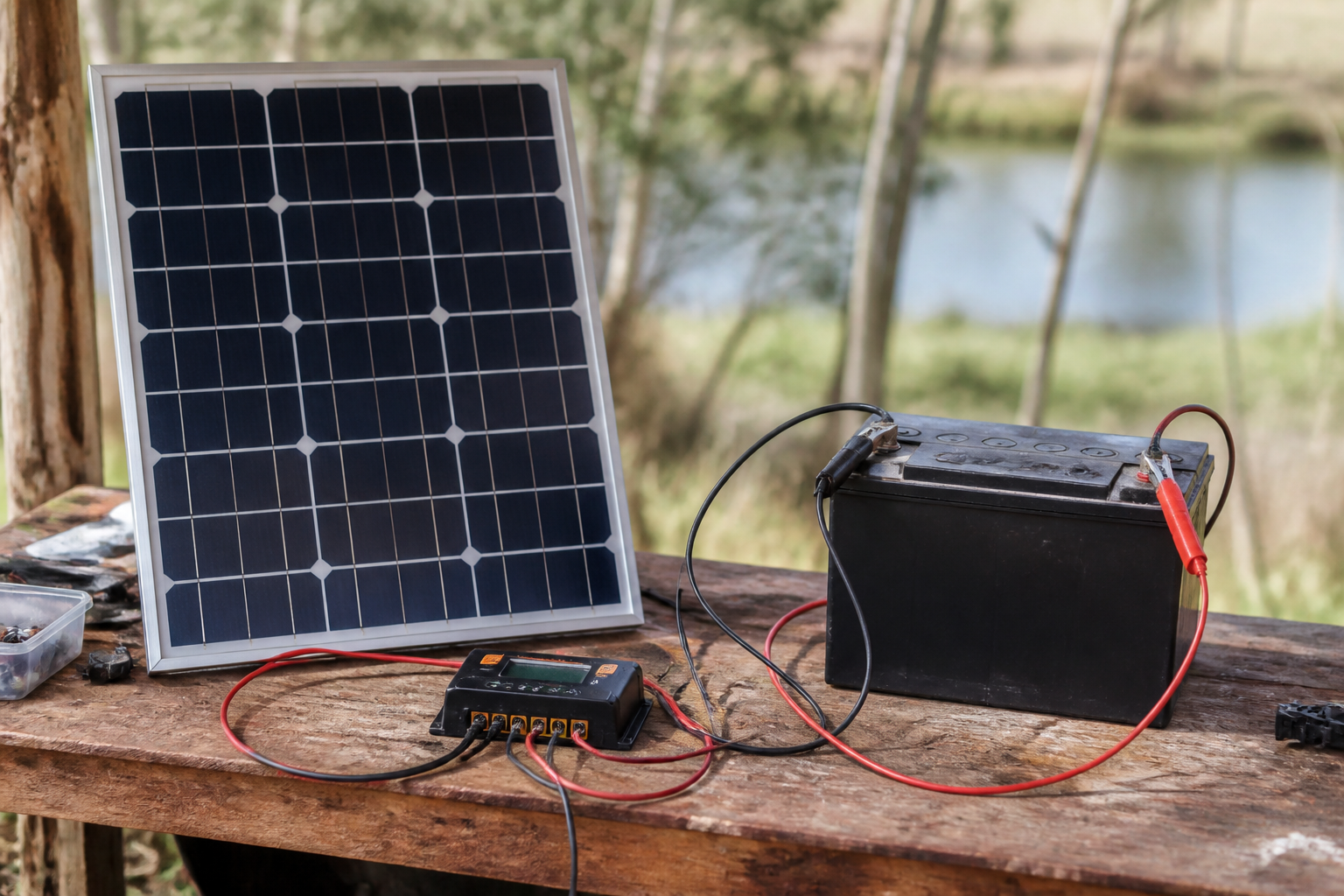
A beginner DIY small solar power setup typically starts with a single 100-200W panel, a charge controller, a battery, and an inverter — enough to run lights, a phone charger, or a small fan. Start small, match your load to your storage, and expand only once you understand your real daily watt-hour demand.
A DIY small solar power setup is the most common first step preppers and homesteaders take toward energy independence — and it is also where most beginners make expensive mistakes that set them back months. If you have searched 'how do I start with solar on a budget' or 'can I build a small solar system myself,' you are in the right place.
The good news is that a functional small-scale solar setup is genuinely achievable for a few hundred dollars, without hiring an installer or getting a permit for a roof-mount system. The bad news is that the beginner solar market is full of undersized kits sold as capable of more than they can realistically deliver, and a growing fringe of experimental concepts that blur the line between interesting DIY projects and outright fiction.
This article cuts through both problems. We will cover what a real beginner solar setup looks like, what it can and cannot do, common sizing mistakes, and — in the final section — one low-cost digital guide exploring an unconventional DIY solar concept that is transparent about its experimental nature.
What a Beginner DIY Solar Setup Actually Looks Like
A small DIY solar power setup has four core components: a solar panel (or panels), a charge controller, a battery bank, and an inverter if you need AC power. Every other detail — wire gauge, fuse sizing, mounting angle — flows from understanding how these four parts interact.
The solar panel converts sunlight into DC electricity. A single 100-watt panel in full sun for five peak hours produces roughly 500 watt-hours per day — enough to charge a phone about 40 times, run an LED lamp for 50 hours, or keep a small 12V fan going for about 8 hours. That is not a trivial amount of power for a dedicated backup or camping system, but it will not run a refrigerator.
The charge controller sits between the panel and the battery, preventing overcharge. For most beginner setups, a PWM (pulse-width modulation) controller works fine and costs $15-$40. MPPT controllers are more efficient but cost more — they make economic sense once you are running 300W or more of panels. Skipping the charge controller entirely is a common beginner mistake that kills batteries fast.
The battery stores what the panel produces so you can use power after dark or on cloudy days. A 100Ah 12V lead-acid battery stores roughly 50 usable watt-hours (you should not discharge lead-acid below 50%). A 100Ah lithium iron phosphate (LiFePO4) battery stores closer to 90 usable watt-hours and lasts far longer — but costs two to three times as much up front. Match your battery capacity to one to two days of your actual load, not to wishful thinking.
Finally, if you need to run standard AC devices, an inverter converts 12V DC to 120V AC. A 300-400W inverter covers most small loads. Size it to your largest single appliance, not to the total of everything you might ever run at once.
Sizing Your System: The Step Most Beginners Skip
Correctly sizing a DIY solar setup means calculating your real daily watt-hour demand before you buy a single panel. Skipping this step is the single most expensive beginner mistake — it leads to undersized systems that frustrate you or oversized systems that drain your budget.
Start by listing every device you want to power, its wattage, and the hours per day you will run it. Wattage is usually on the device label or in its manual. Multiply watts by hours to get watt-hours per device, then add them up. That sum is your daily load.
As a practical example: two LED bulbs at 10W each for 4 hours (80 Wh), a phone charger at 10W for 2 hours (20 Wh), and a small fan at 30W for 6 hours (180 Wh) adds up to 280 Wh per day. To cover that with solar in a region averaging 5 peak sun hours, you need at least 280 / 5 = 56 watts of panel — call it 100W to account for real-world losses from heat, wiring, and partial cloud cover. You would want at least a 60Ah battery to store one day's worth and maintain a safe depth of discharge.
The U.S. Department of Energy publishes average peak sun hours by region, which is the most important local variable in your calculation. A system that works well in New Mexico will be chronically underperforming in the Pacific Northwest without additional panel capacity.
Build in a 20-25% overhead on both panels and storage. Real conditions — a passing cloud, a slightly shaded panel, a battery that is two years old — all reduce effective output below nameplate ratings.
- List every device, its wattage, and daily run time
- Multiply watts x hours for each device to get watt-hours
- Add all watt-hours for your daily load total
- Divide daily load by your region's average peak sun hours to find minimum panel wattage
- Size your battery for 1-2 days of storage at a safe depth of discharge
- Add 20-25% overhead to both panel and battery figures before you buy
What Small Solar Setups Cannot Do (And Where Beginners Get Burned)
A small DIY solar setup cannot run a full household — and understanding that limit clearly upfront will save you money and frustration. A standard American home uses around 30 kilowatt-hours per day, according to the U.S. Energy Information Administration. A beginner 200W system produces roughly 1 kWh per day in good conditions. That is a 30-to-1 gap.
Electric resistance heating, electric water heaters, central air conditioning, and electric ovens are all off the table for a small setup. These are high-wattage, long-duration loads. Even a modest window AC unit running 8 hours a day will demand more than most beginner systems can provide.
Cloudy days are the other reality check. A heavily overcast sky can reduce panel output by 75-90% compared to direct sun. If your battery cannot carry you through two or three consecutive cloudy days — what solar installers call 'days of autonomy' — you will run out of power exactly when you need it most. This is especially relevant for emergency preparedness use cases.
Panel shading is a disproportionate problem. Even partial shade on one cell of a panel can cut the output of the entire string dramatically, depending on how the panel is wired internally. Site your panels where they will have full, unobstructed sun from at least 9 a.m. to 3 p.m.
Finally, the 'plug and play' solar kits sold online for $100-$150 are often not what they claim. A kit advertised as '200W' may include a panel rated at that wattage alongside a battery and inverter that cannot actually store or deliver enough power to make use of it. Always check every component spec individually, not just the headline kit wattage.
Beyond Flat Panels: Alternative and Experimental Solar Approaches
Most DIY solar guides stop at flat monocrystalline or polycrystalline panels — but there is a broader world of solar energy research exploring different geometries and collection strategies, some of which have trickled into the DIY community in various forms.
One concept that has attracted attention is three-dimensional solar collection — the idea that a spherical or multi-faceted solar collector can capture light from multiple angles throughout the day without a tracking system, potentially improving collection during early morning, late afternoon, and overcast conditions compared to a fixed flat panel. A 2011 study by Rawlinson, et al. published through the MIT Energy Initiative explored volumetric and three-dimensional PV configurations and noted potential advantages in diffuse-light environments, though the research also identified significant engineering challenges around cost and heat management at that stage.
It is worth being direct: three-dimensional and spherical solar concepts are not an established, commercially proven technology in the same sense that monocrystalline flat panels are. Academic interest in the geometry is real, but consumer-ready products based on it are not widely validated. Any DIY guide in this space should be approached as an experimental project, not a reliable power solution — a point that honest guides in this category state plainly.
That said, exploring experimental solar concepts as a supplementary or educational project has genuine value for a prepared household. Understanding how light collection geometry affects output, how to work with unconventional small-scale photovoltaic configurations, and how to assess a DIY energy project's real-world limitations are all practical skills. The key is going in with accurate expectations rather than marketing-driven ones.
Our Recommendation: Solar Innovator
If your small DIY solar setup cannot bridge the gap during cloudy stretches, grid outages, or high-demand periods, that gap is not a minor inconvenience — it is the exact scenario preparedness planning exists for. A system that works on sunny days in June but fails during a four-day November outage is not a reliable backup.
Most beginner workarounds — buying more panels, adding battery capacity, installing a tracking mount — quickly push costs past what a small-budget setup can absorb. DIY alternatives that rely on wind, water, or generator fuel each introduce their own site-specific requirements and ongoing costs. The real friction is finding a low-cost way to experiment with unconventional solar concepts without committing hundreds of dollars to hardware before you understand whether the approach makes sense for your situation.
Solar Innovator is a $39 digital guide that walks you through building a small 3D solar-sphere-style device as a DIY project. The publisher itself describes the technology as unverified and experimental — this is not a replacement for a conventional solar panel setup, and you should go in knowing that. What it offers is a low-cost, hands-on way to explore an unconventional solar collection concept, understand the practical realities of small-scale energy projects, and add one more DIY skill to your preparedness toolkit. If you are the kind of person who learns by building and wants to explore the edges of what small-scale solar experimentation looks like, it is worth the entry price — just treat it as an experimental project, not a proven power solution.
Our recommendation
Solar Innovator
Check availability →This article contains an affiliate link. If you buy through it, we may earn a commission at no extra cost to you.
Frequently asked questions
How much does a beginner DIY solar setup cost?
A functional beginner setup — one 100W panel, a PWM charge controller, a 100Ah lead-acid battery, and a small inverter — typically runs $200-$400 buying components separately. LiFePO4 batteries will push the cost higher but last longer. Pre-packaged 'starter kits' in this range exist but require careful spec-checking before you buy.
Can I run a refrigerator on a small solar setup?
A modern energy-efficient 12V DC refrigerator designed for off-grid use can run on a well-sized small solar system — typically 200-400W of panels and 200Ah or more of battery storage. A standard household AC refrigerator is much harder to run reliably on a small setup due to the compressor startup surge and continuous daily load.
Do I need a permit to build a small DIY solar setup?
Permit requirements vary by location. Portable or non-permanently-mounted small solar systems (a panel on the ground or a shed roof with no grid connection) generally do not require permits in most U.S. jurisdictions. Any system connected to the grid or permanently mounted to a home almost always does. Check your local building department before installing anything permanently attached to your home.
How many solar panels do I need to power a house?
The average U.S. home uses about 30 kWh per day. At 5 peak sun hours and accounting for real-world losses, covering that load typically requires 20-30 panels of 300-400W each — a full rooftop installation, not a DIY beginner setup. Small DIY setups are best understood as targeted backup or supplemental power for specific loads, not whole-home replacements.
What is a 3D or spherical solar collector and does it work better than flat panels?
A spherical or 3D solar collector is a concept in which photovoltaic cells are arranged on a curved or multi-faceted surface to capture light from multiple angles without a tracking system. Some academic research suggests potential advantages in diffuse-light or low-angle-sun conditions. However, this is not an established consumer technology — it remains an area of experimental interest, not a proven improvement over conventional flat panels in typical installations.
Related guides
Sources
- U.S. Energy Information Administration — Residential Energy Use
- U.S. Department of Energy — PVWatts Solar Resource Calculator
- NREL — Solar Panel Performance and Loss Factors
General preparedness information, not medical or legal advice. Follow instructions from your local emergency authority during an active event.
Field notes by email
Get the next guide before you need it
One email when a new field guide drops — water, food, power, medicine. No spam, no daily noise, unsubscribe in one click.
Comments on this guide
Questions, corrections and field reports from your own setup are welcome.
No comments yet. Be the first to add a field report.