
Food
How to Store Food Without Refrigeration on a Budget: Building a Real Pantry on $5 a Week

By Ephraim Rusk · · 10 min read
This article contains an affiliate link. If you buy through it, we may earn a commission at no extra cost to you.
Quick answer
You can store food without refrigeration on a tight budget by combining salt curing, fermentation, dehydration, and dry storage of staples like beans, rice, and grains. Adding $5 worth of preserved food per week builds a meaningful reserve over months without requiring specialized equipment.
Storing food without refrigeration on a budget is one of the most searched and least honestly answered topics in the preparedness space. Most guides either push expensive freeze-drying equipment or assume you have a root cellar and a homestead. Real households — apartments, rentals, suburban lots — need something that works with a grocery budget, not against it.
The core problem is straightforward: power outages, job losses, supply chain disruptions, and natural disasters all have the same effect on a family with no food reserve. FEMA recommends at minimum a two-week food supply for every household, and the CDC echoes that guidance after nearly every major emergency. Yet fewer than one in five American households keeps even that much on hand, largely because people assume serious food storage requires serious money.
It doesn't. Before refrigeration existed, working-class families routinely preserved hundreds of pounds of food a year using salt, vinegar, heat, fermentation, and cool-dark storage. Those methods are still valid, still cheap, and still teachable. This article covers what actually works, what it costs, and how to build a real pantry on $5 a week.
Why Budget Food Storage Without Refrigeration Is Harder Than It Looks
The biggest obstacle to no-refrigeration food storage on a budget is not money — it is knowledge. Most people know that canned goods and dried beans keep, but they stop there, which produces a pantry that is calorie-dense but nutritionally narrow and monotonous to cook from.
A second obstacle is the fear of spoilage. Without the refrigerator as a safety net, people worry that any mistake in preservation leads to wasted food or, worse, a foodborne illness. That fear is not irrational — improperly preserved low-acid foods can harbor botulinum toxin, which is genuinely dangerous. But the solution is learning correct technique, not avoiding preservation altogether. The USDA's Complete Guide to Home Canning, freely available online, gives tested, validated processing times for every common food. Following those tables is not difficult, but you have to actually use them.
A third obstacle is equipment creep. Prepper marketing frequently pushes freeze-dryers ($2,000–$5,000), vacuum sealers, and Mylar kits as prerequisites. In reality, salt curing, lacto-fermentation, dehydration, and dry-storage of grains require nothing more than mason jars, salt, vinegar, and airtight containers — total startup cost under $30 for most households.
Understanding these three obstacles — the knowledge gap, the safety misperception, and the equipment myth — is what makes a budget approach actually achievable rather than an exercise in cutting corners.
The Four Preservation Methods That Require No Electricity and Almost No Equipment
Four techniques cover the vast majority of what a household needs to preserve meat, vegetables, dairy alternatives, and starches without a refrigerator or freezer.
Salt curing and brining work by lowering the water activity of food to a level where most bacteria cannot reproduce. Dry-salting pork belly to make salt pork, or brining cucumbers into genuine pickles, requires only coarse non-iodized salt and a clean container. Salt is one of the cheapest commodities in any grocery store — a five-pound bag costs under $2 and preserves a substantial quantity of food.
Lacto-fermentation is arguably the most nutritionally rich preservation method available to a budget household. Vegetables fermented in a simple saltwater brine — sauerkraut, kimchi, fermented carrots — not only keep for months at cool room temperature but actually increase in certain B vitamins and beneficial bacteria during the process. Research published through the NIH and USDA has documented these nutritional changes, though the specific health implications of fermented food consumption remain an active area of study.
Solar and oven dehydration removes enough moisture from fruits, vegetables, and some meats to prevent microbial growth. A simple screen rack set in afternoon sun during dry weather can dehydrate apple slices, tomatoes, or mushrooms in six to eight hours. An oven set to its lowest setting (usually 170°F) works year-round. Dried food stored in airtight jars in a dark location keeps for one to four years depending on the food and storage conditions.
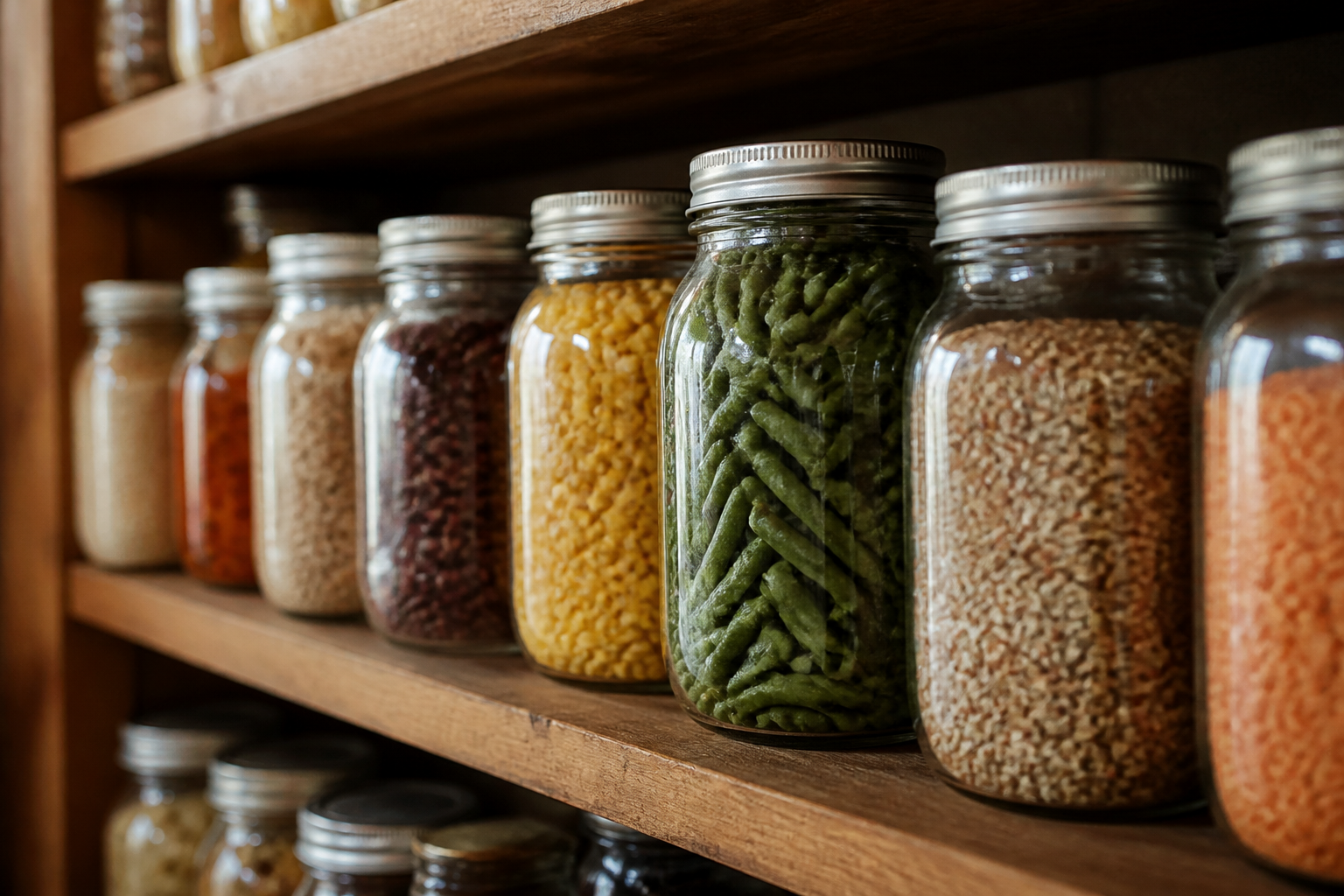
Dry storage of grains, legumes, and salt is the simplest method and the backbone of any no-refrigeration pantry. White rice, hard wheat berries, dried beans, lentils, and rolled oats stored in sealed containers away from heat, light, and moisture keep for two to thirty years depending on the food. Oxygen absorbers, available for a few dollars per pack, extend shelf life further and are one of the genuinely worthwhile low-cost additions to this approach.
- Salt curing and brining — requires only coarse salt and a container
- Lacto-fermentation — requires salt, water, and a jar with a loose lid
- Dehydration — requires a screen rack or low oven, no special equipment
- Dry storage of grains and legumes — requires airtight containers and a dark, cool location
Building a Real $5-a-Week Stockpile: A Practical Breakdown
Five dollars a week is not a large budget, but compounded over a year it is $260 — enough, if spent strategically, to assemble a meaningful food reserve. The key is prioritizing caloric density, nutritional variety, and foods that fit your existing preservation methods.
In the first month, the focus should be on dry staples: a 10-pound bag of white rice ($5–$8), a 4-pound bag of dried lentils ($3–$5), and a canister of oats ($3–$4). These provide calorie density, protein, and a long shelf life out of the box, with no preservation work required. Spread over four weeks, this is achievable at roughly $5 per week.
In months two and three, add salt (bulk, non-iodized), apple cider vinegar, and canning jars if you plan to ferment or pickle. A dozen wide-mouth pint jars costs around $10–$12 at most hardware stores. A five-pound bag of salt costs under $2. These purchases enable you to begin preserving garden surplus, sale produce, or discounted meat, multiplying the value of every dollar spent on fresh food.
By month six, a consistent $5-a-week buyer who is also preserving even modest quantities of seasonal produce can realistically have 60–100 pounds of combined dry goods and preserved foods on hand. That is meaningful food security for a single adult or a start for a small family — achieved without a single piece of specialized equipment.
Tracking what you have is as important as buying it. A simple paper inventory on the inside of a cabinet door, updated when you add or use something, prevents both duplication and forgotten spoilage. FEMA's emergency food guidelines suggest rotating stock regularly, using older items first and replacing them with fresh purchases — a habit that keeps your reserve current with no wasted food.
Common Mistakes That Waste Money and Food
The fastest way to lose a food stockpile is to store it incorrectly, and several mistakes come up repeatedly among people new to no-refrigeration preservation.
Storing in clear containers near light is the most common. UV exposure degrades fats, vitamins, and flavor in dried and preserved food. The fix is simple: use opaque containers or store glass jars in a box, a cabinet, or a dark corner. A pantry that looks impressive on an open shelf is actively degrading faster than it should.
Using iodized table salt for curing or fermentation is a frequent error. The iodine in standard table salt inhibits the beneficial bacteria responsible for lacto-fermentation and can produce off flavors in brines. Non-iodized pickling salt or kosher salt is the correct choice for any preservation application.
Ignoring heat is the other major storage killer. At 70°F (21°C), most dry goods have their rated shelf life. At 90°F (32°C), that shelf life can be cut by half or more. A garage in summer is not a food storage location in most of the United States. A cool interior closet, a basement, or a well-insulated storage space is the correct environment.
Finally, over-relying on any single food category produces a reserve that is nutritionally incomplete and genuinely unpleasant to eat under stress. Calories from white rice keep you alive; a diet of only white rice for two weeks produces real micronutrient deficiencies. Rotating in preserved vegetables, dried fruit, and fat sources (olive oil, coconut oil, nut butters) addresses this without significantly changing the budget.
- Storing in light — degrades nutrition and shortens shelf life
- Using iodized salt for fermentation — inhibits beneficial bacteria
- Storing in hot spaces — can halve shelf life of dry goods
- Single-food monotony — causes nutrient gaps and kills morale under stress
- No rotation system — leads to expired food and wasted money
Our Recommendation: The Lost Superfoods
The real barrier to a no-refrigeration food stockpile on a budget is not the $5 a week — it is not knowing enough preservation methods to put that money to effective use. A pantry built only on dried beans and rice is a start, but it leaves a family without the preserved fats, proteins, vegetables, and ready-to-eat options that make a food reserve genuinely livable rather than a last resort.
The gap in free online resources is coverage depth. You can find a sauerkraut recipe or a salt pork tutorial without much trouble, but assembling a complete, field-tested library of no-refrigeration preservation methods — the kind that covers 100-plus foods across multiple techniques — requires stitching together dozens of sources of varying reliability, most of which omit the specific ratios, timings, and troubleshooting details that make the difference between a successful batch and a spoiled one.
The Lost Superfoods is a $37 digital guide that compiles 126 forgotten preservation and no-refrigeration food preparation methods drawn from wartime and Depression-era practice — periods when preserving food without modern appliances was a practical necessity rather than a hobby. The guide claims families can store 295-plus pounds of food per year on $5 a week, which aligns with the math laid out in this article when a full range of preservation techniques is in play rather than just dry-good purchases. At $37 for a comprehensive reference, it is one of the more reasonably priced tools available for filling the knowledge gap that limits most budget food storage efforts. If the depth of methods described sounds like what your preparedness plan is currently missing, it is worth a look. For the next step, read High-Protein Vegan Meals from Stored Food: How to Hit Your Protein Needs When the Grid Goes Down.
Our recommendation
The Lost Superfoods
Check availability →This article contains an affiliate link. If you buy through it, we may earn a commission at no extra cost to you.
Frequently asked questions
How long can food last without refrigeration?
It depends on the food and the preservation method. Commercially sealed white rice and hard grains stored cool and dry can last 20–30 years. Home-dehydrated vegetables typically last 1–4 years in airtight jars away from light. Lacto-fermented vegetables kept in a cool location can last 6–12 months. Salt-cured meats vary widely by fat content and storage conditions. The USDA provides tested shelf-life data for home-preserved foods in its Complete Guide to Home Canning.
Is it safe to preserve food at home without refrigeration?
Yes, when correct techniques are followed. The main risk is botulism in improperly processed low-acid foods (meats, vegetables). Using tested recipes from USDA-validated sources, maintaining correct salt concentrations in ferments, and following proper canning procedures makes home preservation safe. Fermented foods with a pH below 4.6 and properly dehydrated foods with low water activity do not support botulinum growth.
What foods store best without refrigeration?
White rice, hard wheat berries, dried beans and lentils, rolled oats, salt, honey, coconut oil, and dried pasta store well at room temperature with no processing. Preserved foods with excellent shelf stability include properly canned goods, salt-cured meats, fermented vegetables, and dehydrated fruits and vegetables. Honey is particularly shelf-stable and has been recovered in edible condition from archaeological sites thousands of years old.
How do I start a food stockpile with very little money?
Start with calorie-dense, cheap staples: a bag of rice, a bag of dried lentils, and a container of oats in the first month — roughly $12–$18 total. In month two, buy salt and a jar of vinegar to enable basic preservation. Add one extra item or one pound of dried goods per week from there. Consistent small purchases over six to twelve months build a meaningful reserve without requiring a large upfront outlay.
Can you ferment food safely without special equipment?
Yes. Basic lacto-fermentation — the process behind sauerkraut, kimchi, and fermented pickles — requires only a clean mason jar, non-iodized salt, and the vegetable you are fermenting. No airlock is required for short ferments, though a loosely placed lid or a cloth cover prevents contamination while allowing CO2 to escape. The salt concentration (typically 2–3% by weight) and the anaerobic environment created by the brine are what make the process safe.
Related guides
Sources
- USDA Complete Guide to Home Canning
- FEMA Emergency Food and Water Supplies
- CDC Emergency Preparedness: Food Safety During a Power Outage
- NIH — Fermented Foods as a Dietary Source of Live Organisms
General preparedness information, not medical or legal advice. Follow instructions from your local emergency authority during an active event.
Field notes by email
Get the next guide before you need it
One email when a new field guide drops — water, food, power, medicine. No spam, no daily noise, unsubscribe in one click.
Comments on this guide
Questions, corrections and field reports from your own setup are welcome.
No comments yet. Be the first to add a field report.