
Food
High-Protein Vegan Meals from Stored Food: How to Hit Your Protein Needs When the Grid Goes Down

By Ephraim Rusk · · 10 min read
This article contains an affiliate link. If you buy through it, we may earn a commission at no extra cost to you.
Quick answer
You can meet protein needs on a fully plant-based emergency food supply by stockpiling complementary shelf-stable staples — primarily legumes, whole grains, and seeds — and combining them deliberately in each meal. Most plant-based preppers understock protein-dense foods and overstock calorie-dense starches; correcting that ratio is the single most effective fix.
High-protein vegan meals from stored food are entirely achievable — but only if you've planned for them specifically, not assumed they'll work out. Most plant-based preppers I've talked to have the calorie side of their food storage reasonably covered: rice, oats, pasta, canned vegetables. What they haven't run the numbers on is protein, and that gap shows up fast when physical labor and stress spike your daily requirements well above normal.
A sedentary adult needs roughly 0.8 grams of protein per kilogram of bodyweight per day under normal conditions. Put that same person through a week of hauling water, chopping wood, managing a garden, or dealing with the psychological load of an extended emergency, and that number climbs — some research on physically active individuals puts adequate intake at 1.2 to 1.6 g/kg/day. That's not a small difference. On a 150-pound (68 kg) body, you're talking about the gap between 54 grams and over 100 grams of protein daily.
This article is about closing that gap using nothing but shelf-stable, budget-accessible plant foods — the kind you can store long-term right now, cook without specialized equipment, and actually eat consistently without burning out on the same two meals.
Why Protein Is the Most Underplanned Nutrient in Plant-Based Food Storage
Most food storage guides focus on calories per dollar and shelf life — and by those metrics, white rice and refined pasta win almost every comparison. The problem is that both are protein-poor. White rice delivers roughly 2.7 grams of protein per 100 grams dry weight. Pasta is better at around 12 grams per 100 grams dry, but it's still primarily a carbohydrate source. If your emergency food supply is built around these two staples and little else, you can be eating adequate calories and still running a significant protein deficit within days.
Protein deficiency under stress doesn't look like starvation. It looks like muscle loss, slow wound healing, persistent fatigue, suppressed immune response, and difficulty maintaining body temperature — none of which you want in an already difficult situation. The USDA's Dietary Guidelines for Americans and the NIH both note that protein adequacy supports immune function, tissue repair, and sustained energy, all of which matter more during an emergency, not less.
The fix isn't complicated, but it is specific: you need to deliberately stock protein-dense plant foods in quantities that actually match your household's needs, and you need to know how to cook them into meals people will eat without complaint. That second part matters more than most prepper guides admit — food fatigue is real, and if your high-protein stores consist entirely of plain boiled lentils, your household will stop eating them within a week.
The Shelf-Stable Plant Proteins Worth Stocking (With Real Numbers)
The best shelf-stable vegan protein sources are dried legumes, whole grains with above-average protein content, seeds, and a few specific canned options. Here are the ones that earn their place in a serious food storage plan, with approximate protein content per 100 grams dry weight.
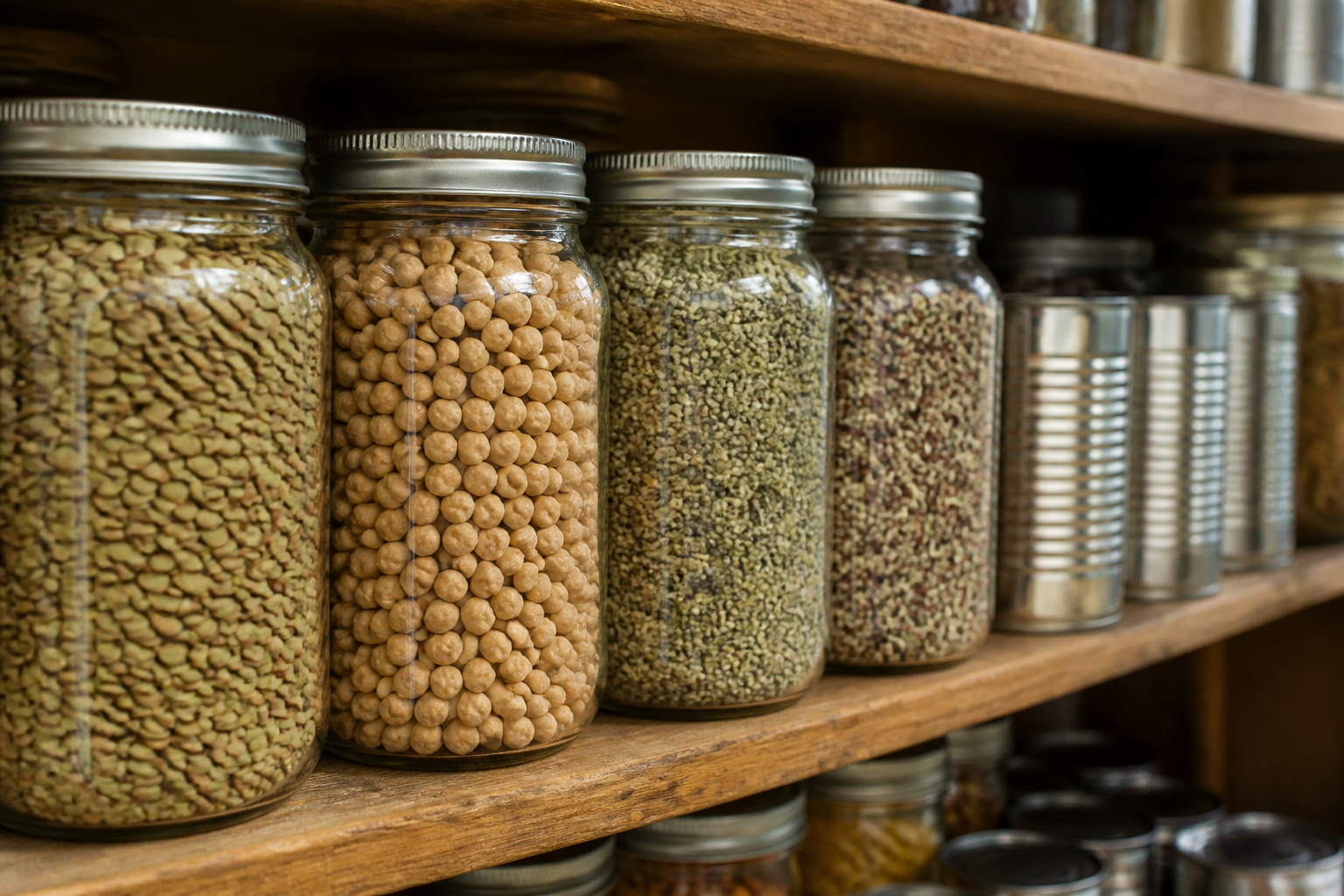
Dried lentils lead the list for practical value: about 25 grams of protein per 100 grams dry, no soaking required, 20-25 minute cook time, and a shelf life of 5 or more years when stored in airtight containers away from light and moisture. Split peas are similar in nutrition and cooking behavior. Dried black beans, kidney beans, chickpeas, and navy beans all run 20-25 grams per 100 grams dry and store equally well, though they require soaking and longer cook times — worth noting if fuel is limited.
Whole grains with meaningful protein content include quinoa (roughly 14 grams per 100 grams dry, and it's a complete protein containing all essential amino acids), oats (around 17 grams per 100 grams dry), and amaranth (about 14 grams). These pair well with legumes both nutritionally and in terms of flavor. Hemp seeds and sunflower seeds are calorie-dense, protein-rich (hemp seeds deliver around 31 grams per 100 grams), and store well in sealed, cool conditions for 1-2 years. Nutritional yeast — often overlooked — provides roughly 50 grams of protein per 100 grams, is shelf-stable, and adds significant flavor to otherwise plain meals.
Canned options worth including: canned chickpeas, canned lentils, and canned black beans are faster to prepare than their dried equivalents and useful when fuel is scarce. Canned sardines and mackerel are not vegan, but if your household is plant-based by choice rather than restriction, they're worth noting as a high-protein, long-shelf-life backup. For a fully plant-based approach, the dried and seed categories above carry the load.
- Dried lentils: ~25g protein per 100g dry, no soak needed, 5+ year shelf life
- Dried chickpeas: ~19g protein per 100g dry, 3-5 year shelf life
- Dried black beans: ~21g protein per 100g dry, 3-5 year shelf life
- Quinoa: ~14g protein per 100g dry, complete amino acid profile
- Oats (rolled or steel-cut): ~17g protein per 100g dry
- Hemp seeds: ~31g protein per 100g, 1-2 year shelf life sealed
- Nutritional yeast: ~50g protein per 100g, adds flavor, shelf-stable
- Sunflower seeds: ~21g protein per 100g dry
How to Build a Protein-Adequate Day from Stored Food
Hitting 80-100 grams of protein from plant sources in a single day using only shelf-stable food is straightforward once you know what you're working with — the challenge is building meals that don't feel like a nutrition exercise.
A practical framework: anchor each main meal around a legume, pair it with a whole grain, and add a seed or nutritional yeast for both protein and flavor. Breakfast might be oatmeal with a tablespoon of hemp seeds and a small handful of sunflower seeds — that gets you 15-20 grams before lunch. A midday meal of lentil soup with quinoa adds another 25-30 grams. An evening meal of black bean and rice bowl with nutritional yeast stirred in can close out the remaining 40+ grams.
The amino acid combination matters here: most legumes are low in methionine but high in lysine; most grains are the inverse. Eating them together — or even just within the same day — gives your body the full complement of essential amino acids it needs. This is the basis of traditional food pairings across dozens of cultures: rice and beans, lentils and flatbread, hummus and pita. These combinations aren't accidental; they're nutritional solutions that evolved over centuries.
Fuel and water are real constraints in a grid-down scenario. Lentils and split peas require less cooking time than whole dried beans — a meaningful advantage when you're managing a propane supply or a rocket stove. Pre-soaking dried beans overnight reduces their cooking time significantly and is worth building into your routine even during normal times so it becomes automatic under stress.
The Meal Variety Problem: Why 'Survivable' Isn't the Same as 'Sustainable'
You can stockpile all the right protein sources and still have your household refuse to eat the same pot of plain beans for the third consecutive day. Food fatigue is one of the most underestimated factors in emergency preparedness, and it's particularly acute when you're already under stress.
The research on disaster feeding supports this: FEMA and emergency nutrition literature consistently notes that familiar, culturally appropriate, and varied foods improve morale, encourage adequate intake, and reduce conflict in stressed households. This isn't a comfort-food luxury argument — it's a functional one. People who eat enough are more capable than people who are skipping meals because everything tastes the same.
The practical solution is building a recipe library before you need it. Not theoretical recipes — recipes you've actually tested with your stored ingredients, that your household will eat willingly, and that you can execute without a full kitchen. That library should include enough variation across flavor profiles, textures, and cooking methods that you can rotate through a two-week cycle without hitting the same meal twice. For a plant-based household trying to maintain protein adequacy, that means having at least a dozen high-protein vegan recipes that work with shelf-stable ingredients and can be prepared quickly without complex technique.
Our Recommendation: Fuel Your Body — 30 High Protein Vegan Recipes
The real problem this article outlines isn't stockpiling — it's knowing what to do with what you've stored when time, stress, and limited equipment are all working against you. Having dried lentils and hemp seeds on a shelf doesn't automatically translate into meals your household will eat consistently and in adequate quantities.
The gap in the DIY approach is recipe depth. Most people have two or three go-to preparations for each staple, and when those feel monotonous, intake drops. Building out a full rotation of high-protein plant-based meals from scratch takes real time — testing recipes, adjusting for shelf-stable ingredients, working out prep times. That's time most households don't spend before a disruption and definitely don't have the mental bandwidth for during one.
Fuel Your Body: 30 High Protein Vegan Recipes is a $10 digital ebook that fills that gap directly: 30 quick, high-protein vegan recipes designed for people who need to meet real protein targets without long prep times. The recipes are built around exactly the kind of ingredients covered in this article — legumes, grains, seeds — which makes the library directly applicable to a food-resilient pantry, not just a grocery-store routine. If you're building out your plant-based food storage and want a tested recipe foundation to cook from, it's a practical and low-risk addition at that price point, and it comes with a 60-day money-back guarantee if it doesn't fit your needs.
Our recommendation
Fuel Your Body: 30 High Protein Vegan Recipes
Check availability →This article contains an affiliate link. If you buy through it, we may earn a commission at no extra cost to you.
Frequently asked questions
How much protein do you actually need per day in an emergency situation?
Under physical stress, most adults need more protein than the standard 0.8g per kilogram of bodyweight recommendation. Research on physically active individuals suggests 1.2-1.6g per kilogram per day is more appropriate when you're doing sustained physical labor — hauling water, gardening, or managing shelter. For a 150-pound (68 kg) person, that means targeting 80-100+ grams of protein daily rather than the minimal 54 grams that covers sedentary needs.
Can you get complete protein from plant-based stored food?
Yes. Quinoa and amaranth are complete proteins on their own. For most other plant sources, eating legumes and whole grains together — within the same meal or the same day — provides the full range of essential amino acids your body needs. Traditional food pairings like rice and beans or lentils and flatbread accomplish this naturally.
What are the best high-protein plant foods for long-term storage?
Dried lentils, split peas, dried black beans, and chickpeas store 3-5+ years in sealed containers and deliver 19-25g protein per 100g dry. Hemp seeds (~31g/100g) and nutritional yeast (~50g/100g) are calorie-efficient protein boosters with good shelf lives when kept cool and sealed. Quinoa stores well and provides a complete amino acid profile.
How do you cook high-protein vegan meals with limited fuel?
Choose lentils and split peas over whole dried beans when fuel is limited — they cook in 20-25 minutes without soaking versus 60-90 minutes for beans. Pre-soaking dried beans overnight cuts their cooking time roughly in half. Pressure cookers, if you have one, reduce legume cooking times dramatically. Quinoa cooks in about 15 minutes, making it one of the more fuel-efficient whole-grain protein sources.
Does food fatigue really matter in a survival situation?
Yes, and emergency nutrition research backs this up. When stored food is monotonous, people — especially children — reduce their intake voluntarily, leading to real nutritional deficits on top of whatever stress they're already managing. Rotating through varied recipes using the same core ingredients significantly improves actual food consumption, morale, and physical performance over an extended disruption.
Related guides
Sources
- USDA Dietary Guidelines for Americans — Protein and Amino Acids
- NIH Office of Dietary Supplements — Protein
- USDA FoodData Central — Nutritional composition of legumes and seeds
- FEMA — Food and Water in an Emergency
General preparedness information, not medical or legal advice. Follow instructions from your local emergency authority during an active event.
Field notes by email
Get the next guide before you need it
One email when a new field guide drops — water, food, power, medicine. No spam, no daily noise, unsubscribe in one click.
Comments on this guide
Questions, corrections and field reports from your own setup are welcome.
No comments yet. Be the first to add a field report.