
Power
How to Reduce Your Electric Bill with DIY Home Energy: 5 Real Approaches (And What to Know Before You Start)

By Ephraim Rusk · · 10 min read
This article contains an affiliate link. If you buy through it, we may earn a commission at no extra cost to you.
Quick answer
You can meaningfully reduce your electric bill through DIY home energy measures — insulation upgrades, load-shifting, small-scale solar or wind, and alternative generation concepts — but savings vary widely by approach, upfront cost, and local utility rules. Start with conservation and efficiency before adding generation hardware.
How to reduce your electric bill with DIY home energy projects is one of the most-searched questions in the preparedness and homesteading space right now — and for good reason. The average U.S. residential electric bill has climbed steadily for years, and a household that depends entirely on the grid has no buffer when rates spike, supply disruptions hit, or a storm knocks out power for a week.
The problem is that the topic sits at the intersection of genuine opportunity and a lot of noise. Some advice is solid engineering. Some is marketing dressed up as science. And some is legally complicated depending on where you live. Before you spend money on hardware or a guide, it helps to understand the full landscape: what the proven approaches actually cost, what they realistically save, and where experimental or unverified concepts fit into the picture.
This article walks through five real categories of DIY home energy reduction, gives you honest numbers, and flags the limits of each. If you are a prepper household looking for both lower bills and greater grid independence, these are the approaches worth your time.
Start Here: Conservation and Efficiency Changes Cost Almost Nothing
The fastest return on investment for reducing your electric bill is not a new device — it is eliminating waste you are already paying for. The U.S. Department of Energy estimates that the average household can reduce energy use by 25 to 30 percent through efficiency improvements alone, many of which cost under $100 and require no permits.
Air sealing is the single highest-impact DIY task for most homes. Gaps around outlets, pipe penetrations, attic hatches, and window frames let conditioned air escape continuously. A tube of fire-rated caulk and a few rolls of weatherstripping can cost under $30 and return that investment in the first month in a leaky house.
Lighting is fully solved technology at this point. Replacing incandescent or older CFL bulbs with LED equivalents reduces lighting energy use by roughly 75 percent. A 10-pack of good LED bulbs runs about $15. Do it once and you are done for a decade.
Standby power — sometimes called 'phantom load' — accounts for roughly 5 to 10 percent of residential electricity use according to the Lawrence Berkeley National Laboratory. Plug strips with individual switches on entertainment centers, home offices, and kitchen counters let you cut that load completely when those circuits are not in active use. This is free money.
These steps do not require any new knowledge, permits, or controversial technology. They are the foundation. If you skip them and go straight to generation hardware, you will be generating power to replace waste you could have eliminated for $50.
- Air-seal around outlets, pipes, and attic penetrations with caulk and weatherstripping
- Replace all remaining incandescent and CFL bulbs with LEDs
- Install switched power strips to eliminate standby phantom loads
- Check and add attic insulation if it is below current code for your climate zone
- Set water heater to 120 degrees F — it runs less and uses less energy
Load-Shifting: Using Power When It Is Cheapest
Load-shifting means running high-draw appliances during hours when electricity is cheapest — and it can reduce your bill without generating a single watt of your own power. Many utilities now offer time-of-use (TOU) rate structures where off-peak electricity (typically late night to early morning) costs 30 to 50 percent less than peak-hour power.
Call your utility or log into your account portal and ask whether a TOU rate option exists. If it does, running your dishwasher, washing machine, dryer, and EV charger between 10 p.m. and 6 a.m. can produce real savings with no hardware investment beyond a $15 programmable outlet timer if your appliances lack delay-start features.
From a preparedness standpoint, understanding your utility's rate structure also tells you something important: when the grid is stressed, and when your household is most vulnerable to rate volatility. Households on TOU plans often develop a sharper awareness of their own consumption patterns — which is useful when you eventually do add storage or generation.
Load-shifting is not dramatic or exciting, but in states with pronounced TOU rate differences, a family of four can realistically save $30 to $80 per month without touching their home's systems at all. That is $360 to $960 per year that can fund hardware if you want to go further.
Small-Scale Solar: Real Savings, Real Costs, Real Rules
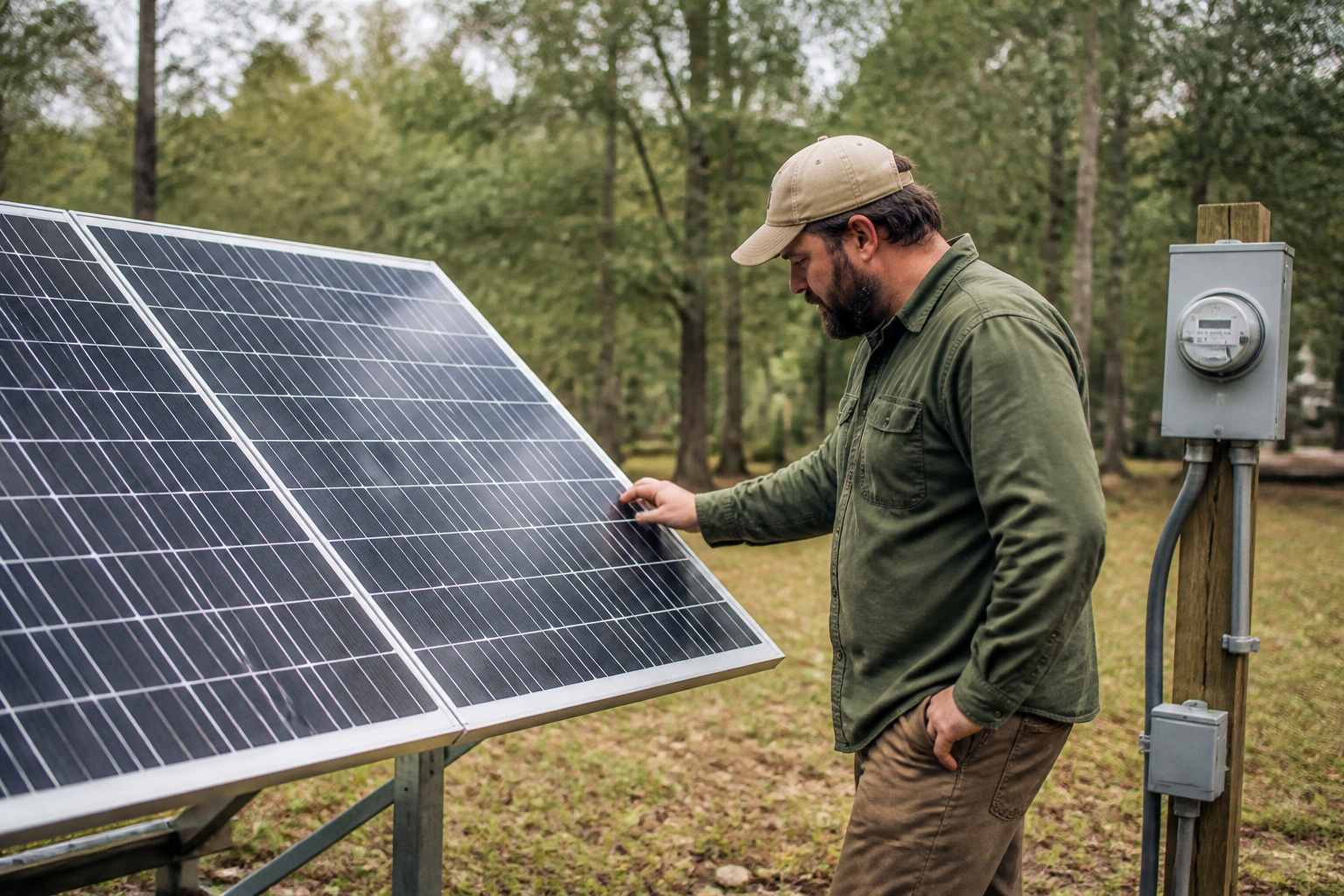
Rooftop or ground-mounted solar is the most proven DIY path to reducing your electric bill through generation — but it comes with real costs, permit requirements, and a longer payback timeline than most marketing suggests. Let's be direct about the numbers.
A grid-tied residential solar system averages $2.50 to $3.50 per watt installed in the U.S. as of 2025, before the federal Investment Tax Credit (ITC), which currently offers a 30 percent credit on the installed cost. A modest 5 kW system might cost $12,500 to $17,500 before the credit, dropping to roughly $8,750 to $12,250 after it. Payback periods typically run 7 to 12 years depending on your local electricity rate and sun hours.
DIY solar — purchasing panels, racking, and an inverter yourself and doing the installation — can reduce hardware and labor costs by 30 to 50 percent, but it requires electrical permits in virtually every U.S. jurisdiction, and utility interconnection approval for any grid-tied system. Skipping permits is not just a legal risk; it can void your homeowner's insurance and create a serious hazard.
Smaller, non-interconnected setups are much simpler. A portable 100 to 400 W solar kit with a charge controller and battery can power lights, phone charging, a small refrigerator, and a fan — legitimately off-permit in most places because it is not wired into the building's electrical system. Cost runs $300 to $800 for a capable setup. It will not cut your utility bill significantly, but it gives you real grid independence for essentials, which is a different and legitimate goal.
For a homesteader or prepper household, the honest priority question is: are you trying to lower your monthly bill, or are you trying to build resilience against outages? Solar does both, but the economics are different for each goal, and the system design differs too.
Alternative and Experimental Generation Concepts: What to Know Before You Invest
Beyond conventional solar and wind, there is a category of home energy concepts that get significant attention in the preparedness and off-grid community — magnetic generators, certain mechanical-generation arrangements, and other alternative approaches that their proponents claim can produce usable power at low cost. This is where honest evaluation matters most.
Some of these concepts have a genuine basis in physics principles that are well understood. Others make efficiency claims that conflict with established thermodynamics — specifically the principle that a system cannot output more energy than it takes in. When you see a device or guide claiming to produce 'free energy' with no external input, that specific claim contradicts verified physics, and no peer-reviewed engineering study supports it.
That does not mean every alternative generation guide is worthless. Some are genuinely useful as concept introductions, as thinking frameworks for understanding energy flow, or as starting points for experimentation. The honest standard is: does the guide itself acknowledge the limits of what it is presenting? Does it encourage you to verify local regulations before building anything? Does it distinguish between 'here is an interesting concept' and 'here is proven technology'?
If you are drawn to these ideas — and many thoughtful preppers are — approach them the way you would approach any unverified technique: read the material, understand what it is claiming and what it is not, check local ordinances before you build anything, and do not sink serious hardware money into an unproven design before you have tested it at small scale.
The key questions to ask about any alternative energy guide: Does it tell you the concept has not been independently assessed? Does it flag that local implementations may be restricted? Does it give you enough detail to evaluate the approach yourself rather than just promising results? Those are the marks of a guide written honestly versus one selling you a fantasy.
Our Recommendation: Energy Revolution System
If your electric bill stays high despite efficiency upgrades, and you are not yet ready to commit to a full solar installation, the core problem is a real one: there is a gap between free conservation tips and $10,000-plus hardware systems, and not many useful resources live in that gap for someone who wants to understand alternative generation concepts before spending serious money.
Most of what fills that gap online is either too shallow to act on or makes claims that do not hold up to scrutiny. DIY solar guides assume you are already committed to that path. 'Free energy' videos make claims that physics does not support. Finding a resource that presents alternative home-energy-generation concepts honestly — including their limitations and local regulatory questions — is genuinely difficult.
The Energy Revolution System is a $39 digital guide (regularly $149) presenting an alternative home-energy-generation concept for households looking to reduce their electric bill. Its own sales page states plainly that the system 'was not technically assessed' and that some implementations may be restricted locally — which, to me, is actually a mark in its favor. A guide that tells you upfront to check your local rules and does not overclaim is the kind of resource worth engaging with as a starting point for your own research and small-scale experimentation, not as a guaranteed engineering solution. It comes with a money-back guarantee, so if the material does not match what you need, you are not out $39. If you are in the research-and-concept phase of expanding your household's power independence, it is a low-risk way to explore an approach you have probably already been reading about. For the next step, read How to Protect Your Electronics from an EMP: What Actually Works and What Doesn't.
Our recommendation
Energy Revolution System
Check availability →This article contains an affiliate link. If you buy through it, we may earn a commission at no extra cost to you.
Frequently asked questions
What is the cheapest DIY way to reduce my electric bill right now?
Air sealing, LED lighting, and eliminating standby loads with switched power strips are the cheapest and fastest-return steps — often costing under $50 combined and paying back within one to two billing cycles. These should come before any investment in generation hardware.
Can I legally install a DIY solar system without a permit?
In the U.S., any solar system wired into your home's electrical panel requires permits and, for grid-tied systems, utility interconnection approval in virtually every jurisdiction. Small portable solar setups not wired into the building are generally permit-free. Check your local AHJ (authority having jurisdiction) before starting any wired installation.
Do magnetic generator or alternative energy DIY guides actually work?
Results vary widely and depend on exactly what is being claimed. Devices claiming to produce more energy than they consume conflict with established thermodynamics and have no peer-reviewed engineering support. Some guides present useful conceptual frameworks or experimental approaches without overclaiming — the honest ones say so plainly in their own materials.
How much can a typical household realistically save with DIY home energy improvements?
The U.S. Department of Energy estimates 25 to 30 percent savings from efficiency improvements alone. Adding small-scale solar or load-shifting on a time-of-use rate plan can push that further. Realistic combined savings for a committed household often land in the $600 to $1,500 per year range, depending on current baseline usage and local electricity rates.
What home energy projects require permits versus which ones do not?
Work that does not require permits in most jurisdictions: adding insulation, replacing bulbs, installing plug-in devices, and portable solar setups not wired into the home. Work that generally does require permits: any wiring into your electrical panel, grid-tied solar, wind turbine installations, and permanent generator hookups. Always confirm with your local building department before starting.
Related guides
Sources
- U.S. Department of Energy — Energy Saver: Saving Electricity at Home
- Lawrence Berkeley National Laboratory — Standby Power Summary Table
- U.S. Department of Energy — Homeowner's Guide to the Federal Tax Credit for Solar Photovoltaics
General preparedness information, not medical or legal advice. Follow instructions from your local emergency authority during an active event.
Field notes by email
Get the next guide before you need it
One email when a new field guide drops — water, food, power, medicine. No spam, no daily noise, unsubscribe in one click.
Comments on this guide
Questions, corrections and field reports from your own setup are welcome.
No comments yet. Be the first to add a field report.