
Medicine
Herbal Remedies for Cold and Flu Symptoms: What Actually Works (And What Doesn't)

By Ephraim Rusk · · 10 min read
This article contains an affiliate link. If you buy through it, we may earn a commission at no extra cost to you.
Quick answer
Several herbal remedies — including elderberry, echinacea, and ginger — have clinical evidence supporting modest reductions in cold and flu symptom duration or severity. None replace antiviral medication for serious illness, but used correctly they are a legitimate, low-cost first line for mild respiratory symptoms.
Herbal remedies for cold and flu symptoms are one of the most searched topics in home medicine — and for good reason. Whether you are snowed in, the pharmacy is closed after a storm, or you simply want a first-response option before reaching for an over-the-counter drug, knowing which plants and kitchen ingredients have genuine clinical backing matters.
This is not about replacing a doctor or dismissing conventional medicine. It is about having accurate information so you can make smart decisions when options are limited. Some herbal remedies are backed by credible research. Others are folklore with no meaningful evidence. A prepared household knows the difference.
Below, I break down what the evidence actually says about the most common herbal cold and flu remedies, how to use them correctly, where they fall short, and what to watch for so a mild illness does not become a serious one.
Why Cold and Flu Symptom Management Matters for Preparedness
Upper respiratory infections are the most common acute illness adults face — the CDC estimates that adults average two to three colds per year, and seasonal influenza affects millions each flu season. In a grid-up, normal scenario, most people manage these with rest, fluids, and over-the-counter symptom relief. In a preparedness scenario — a winter storm that closes roads for four days, a supply chain disruption, or an extended power outage — your access to those options narrows fast.
The realistic preparedness problem is not a catastrophic pandemic. It is a sick kid at 2 a.m. during a blizzard when the pharmacy is closed and your Tylenol ran out. It is a week-long campout where someone develops a chest cold. It is any situation where your normal first-response tools are unavailable and you need a credible alternative, not a desperate guess.
This is exactly the space where well-understood herbal and kitchen remedies earn their place — not as miracle cures, but as practical, accessible tools that can relieve symptoms and support recovery when nothing else is on hand. The key word is 'well-understood.' Using the right remedy for the right symptom, at the right dose, is the difference between genuine help and wasted effort.
Elderberry: The Most Researched Herbal Option for Flu Symptom Duration
Elderberry (Sambucus nigra) is the herbal remedy with the strongest body of clinical evidence for influenza-like illness. Multiple randomized controlled trials have examined its effect, and a 2016 meta-analysis published in Nutrients found that elderberry supplementation substantially reduced the duration and severity of colds in air travelers.
A commonly cited 2004 RCT published in the Journal of International Medical Research found that patients taking elderberry extract recovered from influenza on average four days faster than the placebo group. A 2019 study in Complementary Medicine Research found similar modest reductions in cold duration. It is worth being clear: the studies are small and the effect sizes vary, so elderberry is not a guaranteed shortcut — but the signal is consistent enough that many integrative medicine practitioners consider it a reasonable first-line option.
Elderberries must be cooked before consumption. Raw elderberries contain cyanogenic glycosides that can cause nausea and vomiting. Commercial syrups are pre-processed, and if you are making your own syrup from dried elderberries, simmering them for at least 15 minutes neutralizes this compound. Typical studied doses in adults range from 15 ml of syrup four times daily for five days to 300 mg capsule extracts twice daily — follow whatever standardized dosage the preparation you are using specifies.
Who should not use elderberry without medical guidance: people on immunosuppressant medications, those with autoimmune conditions, and pregnant or breastfeeding women. The theoretical concern is that elderberry may stimulate cytokine activity, which in certain conditions could be counterproductive — this remains an area of ongoing research rather than a settled conclusion.
Echinacea, Ginger, and Honey: What the Evidence Supports
Echinacea is probably the most widely sold herbal cold remedy in the United States, but its evidence base is messier than elderberry's. A 2015 Cochrane review covering 24 randomized trials concluded that some echinacea preparations may reduce the incidence and duration of the common cold, but results were inconsistent across products and preparations. The variation in plant species (E. purpurea vs. E. angustifolia), plant part used, and extraction method makes it difficult to generalize. If you use echinacea, a standardized extract of E. purpurea aerial parts is the preparation with the most supportive data.
Ginger (Zingiber officinale) has a well-established evidence base for nausea — including nausea associated with illness — and has anti-inflammatory properties documented in laboratory studies. For cold and flu specifically, ginger is most useful for symptom relief: sore throat soothing, nausea management, and the mild warming effect that eases congestion. A ginger-honey-lemon tea is one of the most practically useful preparations in home medicine, not because it is a cure, but because all three ingredients contribute something real. Honey, specifically, has documented antimicrobial properties and a 2021 BMJ Evidence-Based Medicine systematic review found that honey was more effective than usual care (including antihistamines and cough suppressants) for upper respiratory tract symptom relief in adults and children over one year of age.
Peppermint, specifically its active compound menthol, has evidence for relieving nasal congestion — the sensation of easier breathing — though it does not measurably reduce actual nasal airflow resistance. Peppermint steam inhalation or diluted topical application to the chest is a legitimate symptom-comfort tool. Garlic contains allicin, which has demonstrated antimicrobial activity in laboratory settings, but clinical evidence for garlic directly shortening cold duration in humans is limited and the studies are small. It belongs in your kitchen and your diet as a general health practice, not as a reliable acute treatment.
One herb worth avoiding as a cold remedy: colloidal silver. Despite decades of marketing, the EPA and FDA have found no evidence it is effective for any medical condition, and regular use carries a real risk of argyria (permanent skin discoloration) and potential kidney damage.
How to Recognize When a Cold or Flu Becomes a Medical Emergency
The most important skill in home symptom management is knowing when to stop managing at home. Herbal remedies are appropriate for mild, uncomplicated upper respiratory illness in otherwise healthy adults — they are not appropriate as a substitute for professional care when serious warning signs appear.
Seek medical attention immediately if any of the following are present: difficulty breathing or shortness of breath at rest, persistent chest pain or pressure, confusion or altered mental status, inability to stay awake or severe difficulty waking, bluish lips or face, fever above 103°F (39.4°C) that does not respond to fever-reducing measures, or symptoms that improve for a day and then return with worsening fever. These are CDC-recognized emergency warning signs for influenza that indicate a potentially serious complication such as pneumonia.
In children, additional warning signs include fast or labored breathing, ribs showing with each breath, severe or persistent vomiting, not drinking enough fluids, not urinating (or no wet diaper for 8 hours in infants), and extreme irritability. Children under 2 years, adults over 65, pregnant women, and people with underlying health conditions (heart disease, asthma, diabetes, immunosuppression) are at higher risk for complications and should have a lower threshold for seeking conventional medical care.
The practical rule for a preparedness context: herbal and home remedies cover the first 48-72 hours of mild illness in a healthy adult. If symptoms are not clearly improving by day three, or if any warning signs appear at any point, this has moved past the scope of home management.
Building a Simple Herbal Cold and Flu Kit for Your Home
A practical herbal cold and flu kit does not require a large investment or a background in herbalism. It requires a small number of well-chosen, shelf-stable items and the knowledge of how to use them correctly.
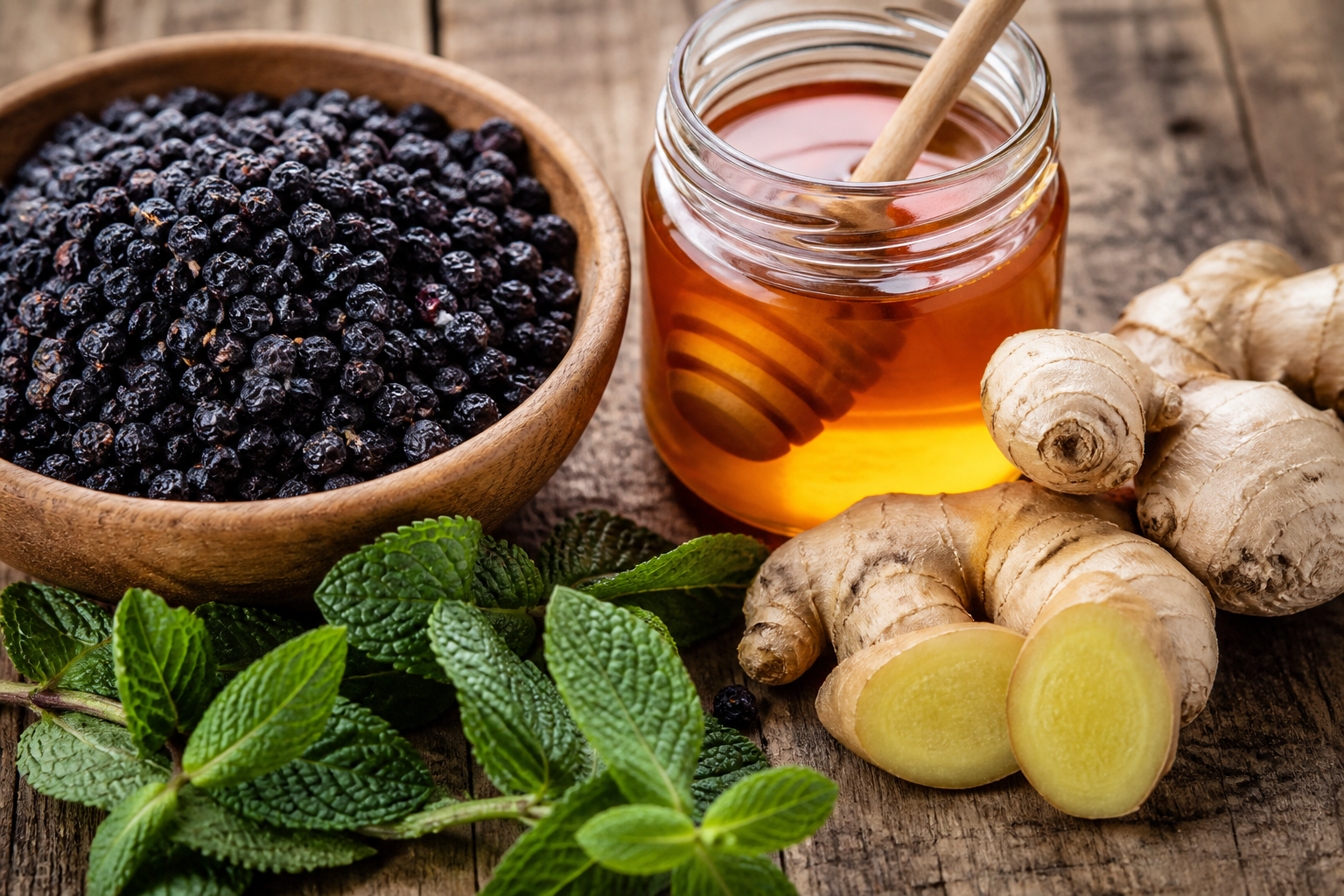
The core items worth keeping on hand are: dried elderberries or a standardized elderberry syrup (check expiration dates and rotate annually), raw local honey (indefinite shelf life if stored properly), dried ginger root or ginger powder, dried peppermint leaf for tea and steam inhalation, a standardized echinacea extract (capsule or tincture with clear species and part labeling), and a good digital thermometer. These items are inexpensive, take up minimal space, and cover the most evidence-supported bases for mild cold and flu symptom management.
A few practical preparation notes: elderberry syrup can be made in a batch and stored in the refrigerator for up to three months, or frozen in ice cube trays for longer storage. Dried herbs stored in airtight containers away from light and heat retain potency for one to three years. Honey does not expire if kept sealed and dry. A simple recipe file — written down, not just saved digitally — that covers basic preparations like elderberry syrup, ginger-honey tea, and echinacea dosing is worth keeping with the kit itself. When you are running a fever and feeling miserable, you do not want to improvise from memory.
What this kit does not replace: a supply of conventional fever reducers (acetaminophen or ibuprofen), oral rehydration salts, and a working plan for escalating to medical care if needed. Herbal remedies and conventional medicine are complements, not competitors. The goal is a layered system where each element covers the gaps the others leave.
- Dried elderberries or standardized elderberry syrup
- Raw honey (raw preserves more of the documented antimicrobial activity)
- Dried ginger root or ginger powder
- Dried peppermint leaf
- Standardized echinacea extract (capsule or tincture, labeled by species)
- Digital thermometer
- Written recipe and dosing reference — not relying on memory
Our Recommendation: Herbal Remedies for Everyday Ailments
A cold or flu that arrives when your pharmacy is closed, your roads are out, or your conventional medicine cabinet runs low is a real and common problem — not a hypothetical one. Having symptom-management options that you know how to use correctly can be the difference between a miserable but manageable week and a situation that spirals.
The gap in the DIY approach is not finding recipes — the internet has those. The gap is having a curated, organized reference you can actually use when you are sick, tired, and not in a position to sort through conflicting forum posts. Assembling that reference from scratch takes real time, and the quality varies enormously depending on the sources.
The Herbal Remedies for Everyday Ailments ebook is a $12 reference covering 100 herbal remedy recipes for common ailments using household and garden ingredients — the kind of practical, organized resource that closes the gap between knowing herbs might help and actually knowing what to make, how to make it, and what to use it for. It is positioned as a complement to conventional medicine for minor issues, which is exactly how any honest guide should frame it. It comes with a 60-day money-back guarantee, so there is no meaningful financial risk to trying it. If you are building out a home medicine reference library, this is a low-cost, practical addition worth having on the shelf before you need it. For the next step, read Natural Remedies for Upset Stomach Without Medication: What Actually Works.
Our recommendation
Herbal Remedies for Everyday Ailments
Check availability →This article contains an affiliate link. If you buy through it, we may earn a commission at no extra cost to you.
Frequently asked questions
Do herbal remedies actually shorten how long a cold lasts?
Some do, modestly. Elderberry has the most consistent clinical evidence for reducing flu symptom duration — multiple small randomized controlled trials show reductions of roughly two to four days. Echinacea shows inconsistent results depending on the preparation. Most herbal remedies are better understood as symptom-relief tools than true antivirals.
Is elderberry safe to take at the first sign of a cold?
For most healthy adults and children over one year, standardized elderberry preparations taken at the onset of symptoms are considered safe for short-term use of up to five days. People on immunosuppressant medications, those with autoimmune conditions, and pregnant women should consult a healthcare provider first. Never eat raw elderberries — they must be cooked.
What is the best homemade remedy for a sore throat?
A warm mixture of raw honey, fresh lemon juice, and ginger tea has the strongest practical evidence base. Honey specifically has documented symptom-relief benefits for upper respiratory tract infections, supported by a 2021 BMJ Evidence-Based Medicine systematic review. Gargling with warm salt water also remains a simple, evidence-supported option for throat comfort.
When should I stop using home remedies and see a doctor for flu symptoms?
Stop managing at home and seek care if you have difficulty breathing, persistent chest pain, confusion, a fever above 103°F that does not respond to treatment, symptoms that improve then sharply worsen, or bluish lips or face. Children, elderly adults, pregnant women, and people with chronic conditions should have a lower threshold for seeking professional care.
Can I use herbal cold remedies on children?
Some can be used carefully. Honey is safe and beneficial for children over one year of age but must never be given to infants under 12 months due to botulism risk. Elderberry syrup is used in children in some studies, but check age-appropriate dosing. Echinacea use in young children is generally not recommended without medical guidance. When in doubt, consult a pediatrician.
Related guides
Sources
- CDC: Flu Symptoms and Complications — Emergency Warning Signs
- NIH National Center for Complementary and Integrative Health: Echinacea
- NIH National Center for Complementary and Integrative Health: Elderberry
- CDC: Common Colds — How Many Do Adults Get Per Year
General preparedness information, not medical or legal advice. Follow instructions from your local emergency authority during an active event.
Field notes by email
Get the next guide before you need it
One email when a new field guide drops — water, food, power, medicine. No spam, no daily noise, unsubscribe in one click.
Comments on this guide
Questions, corrections and field reports from your own setup are welcome.
No comments yet. Be the first to add a field report.